According to Michael Barkun, many white supremacist groups of the radical right are deeply committed to the distinctive but little-recognized religious position known as Christian Identity. In Religion and the Racist Right (1994), Barkun provided the first sustained exploration of the ideological and organizational development of the Christian Identity movement. In a new chapter written for the revised edition, he traces the role of Christian Identity figures in the dramatic events of the first half of the 1990s, from the Oklahoma City bombing and the rise of the militia movement to the Freemen standoff in Montana. He also explores the government’s evolving response to these challenges to the legitimacy of the state. Michael Barkun is professor of political science in the Maxwell School of Citizenship and Public Affairs at Syracuse University. He is author of several books, including Crucible of the Millennium: The Burned-over District of New York in the 1840s.
eBook - ePub
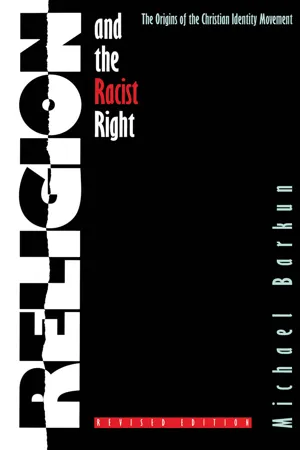
Religion and the Racist Right
The Origins of the Christian Identity Movement
- 352 pages
- English
- ePUB (mobile friendly)
- Available on iOS & Android
eBook - ePub
The Emergence of Christian Identity
1
The Origins of British-Israelism
In one sense, Christian Identity is barely half a century old. Its doctrinal basis was established after World War II by a network of independent preachers and writers. It passed rapidly from their hands into a variety of extreme right-wing political movements preoccupied with fears of racial mixing and Jewish conspiracy. Through such organizations as the Aryan Nations and Ku Klux Klan groups, Christian Identity had by the 1970s become, if not white supremacist orthodoxy, at least its most important religious tendency.
In order to understand how Christian Identity developed, the story must be pushed farther back, for Identity’s antecedents lay in England, not in America, and in the nineteenth century, not the twentieth. Identity is an outgrowth of what was itself a strange development in religious history, known variously as British-Israelism or Anglo-Israelism (the terms will be employed synonymously here). Although Christian Identity eventually made major changes in British-Israel doctrine, it remains sufficiently related to Anglo-Israelism so that the one cannot be understood without first knowing about the other. Hence, this chapter traces the beginnings of Anglo-Israelism, its key doctrinal concerns, and its growth into a social movement during the late nineteenth century. Succeeding chapters of part I will trace the passage of British-Israel ideas to America; the creation of an American movement by Howard Rand during the 1920s and 1930s; the gradual association of Anglo-Israelism in America with anti-Semitism during the Depression years; and the eventual separation of the American movement from its British roots, when, during the post-World War II years, an autonomous and increasingly strident Christian Identity began to develop in California. This narrative focuses upon three key figures: Howard Rand, whose indefatigable organizing created British-Israel outposts throughout the country during the Depression; his colleague, William J. Cameron, the Ford Motor Company executive who coordinated and largely wrote the notorious anti-Semitic tracts published under Henry Ford’s auspices; and Wesley Swift, the California preacher, evangelist, and associate of Gerald L. K. Smith, who, more than anyone else, was responsible for promulgating Identity in the form we know it today.
Part II examines the central ideas in Identity’s religious system—its mille-narian thrust, its sense of living in the “Last Days,” and, particularly, its bizarre theology of anti-Semitism. For more than anything else, Identity has been distinguished from other forms of conservative Protestantism and right-wing politics by its view of the Jews. In the view of Identity, the Jews are the literal biological offspring of Satan, the descendants of Satan’s sexual seduction of Eve in the Garden of Eden. This demonization of the Jews—almost without precedent in even the most overheated forms of anti-Semitism—did not emerge from a vacuum. It was instead the result of a synthesis of religious and occult ideas, some centuries old and all marginal. Part II is largely given over to identifying the elements of this synthesis and reconstructing the process by which they were combined.
Part III examines the political consequences and implications of Identity. Identity believers have had two different orientations toward the political system. Some have sought to remain within it, either through the electoral system (for example, the Identity circles around David Duke) or by minimizing their contacts with nonbelievers (the so-called survivalists). A smaller but more widely noted segment of Identity has rejected the possibility of working within the system, seeking instead to overthrow American political institutions (the agenda of such guerrilla groups as the Order) or advancing proposals for the territorial separation of a “white nation,” a goal associated with the leader of Aryan Nations, Richard Girnt Butler.
Before we can understand either Identity’s theology or its politics, we must first seek its origins, and these lie in the convoluted history of British-Israelism itself.
The Distant Origins of British-Israelism
Just as there is dispute about the origins of Christian Identity, so controversy surrounds the beginnings of its Anglo-Israel parent. British-Israelism, in the most general terms, refers to the belief that the British are lineal descendants of the “ten lost tribes” of Israel. This revisionist view of history did not become the basis for an organized movement until the second half of the nineteenth century. But long before that, there had been suggestions that the British and the biblical Israelites possessed some special affinity for one another. This linkage exerted particular force during the Puritan ascendancy in the mid-1600s, when anticipation of an imminent millennium was strong. Such Puritan sectarians as John Robins and Thomas Tany argued that Britain would play a central role in returning the Jews to Palestine, so that the rest of the millenarian scenario could be fulfilled. In like manner, Puritans in the American colonies saw themselves as a “New Israel” in the wilderness, confronting it for a providential purpose just as the original Israelites confronted the wilderness of Sinai after the Exodus. Two related but distinguishable tendencies were thus at work: either Britain as a nation was specially chosen by God to help realize the divine design in human history, or some spiritually purified portion of it was destined to take on this role.1
Nonetheless, this conviction of chosenness was based upon analogy, not upon the presumption of a direct biological link between England and the biblical tribes. Indeed, as far as seventeenth-century millenarians were concerned, the descendants of the Israelites were either their Jewish contemporaries or the fabled lost tribes, believed to be hidden somewhere in the fastness of Asia. As the seventeenth century progressed, the belief grew that the tribes would soon reemerge into the light of history, a development appropriate to the “Last Days.” Indeed, by 1665 Europe was swept by reports that this reappearance by the lost tribes had already begun, although its locale was variously reported to be Persia, the Arabian Desert, and the Sahara. These reports described a vast Jewish army moving westward, prepared to smite the Turk and, if need be, to enter Europe itself in order to wreak vengeance on anti-Semitic nations. Thus in November 1665, Robert Boulter of Aberdeen published a letter describing the army and one of its vessels: “There is Sixteen hundred thousand of them together in Arabia, and … there came into Europe Sixty Thousand more; as likewise … they have had Encounters with the Turks, and slain great numbers of them. … As for their Ship, … in the sails was this Inscription in fair Red Characters THESE ARE OF THE TEN TRIBES OF ISRAEL.” A similar letter, originating on the Continent, was published in London in February 1666. Millenarians were attracted to the reports because they believed that the Second Coming and the subsequent millennium could not occur until the Turks were defeated and the Jews regathered in Palestine, where they would accept Christ at the appropriate eschatological moment. As Gershom Scholem has demonstrated, this flurry of rumors in 1665–66 represented much-distorted reactions to the appearance in the Levant of the Jewish false messiah, Sabbatai Zevi. Neither Zevi nor his prophet, Nathan of Gaza, commanded an army, of course, let alone could bring the lost tribes from Tartary, but news of Zevfs messianic pretensions and their electrifying effect on Jewish communities quickly fused with existing legends of the hidden tribes.2
The English, absorbed in considerations of the Last Days, consequently found the fate of the Jews an absorbing topic. They also saw in it momentous implications for Christian hopes, and they often regarded England as the ideal instrument for realizing those hopes by assisting Jews in their longing for Palestine. They did not, however, regard themselves as part of Israel, except in the common Christian theological sense that the church was the “New Israel,” formed on the basis of a new covenant.
The first indisputably British-Israel figure about whom anything substantial is known appeared much later. He was Richard Brothers (1757–1824), a retired naval officer who began having millenarian visions in 1791. About 1793, he concluded that he had a divine mission to lead the Jews back to Palestine, an idea not unlike those that had circulated among the Puritans in the preceding century. Brothers, however, differed by adding two other ideas. First, he decided that he himself was a descendant of the House of David; and, second, that most Jews were hidden among existing European, and particularly British, peoples, unaware of their exalted biblical lineage. This idea of a “hidden Israel” that believed itself Gentile, ignorant of its true biological origins, marks the initial appearance of what was to become British-Israelism’s central motif. Brothers, however, was in no position to translate his beliefs into a social movement, in part because of his disinterest in organizational work, but more significantly because of his escalating personal eccentricity. His behavior become more and more bizarre with his increasing royal pretensions. In the end, Davidic scion or not, he was declared insane and institutionalized from 1795 until 1806. His followers maintained their faith for a time, but after Brothers’s release, they drifted away, in part disillusioned, in part stricken with acute social embarrassment. Consequently, although Brothers has some claim to being the first British-Israelite, and is so identified in some accounts, the movement certainly did not begin with him, for by the time of his death, he was a lonely figure.3
John Wilson, the First British-Israelite
The British-Israel movement, as opposed to the British-Israel idea, begins more than a generation after Brothers with the writings of John Wilson (?—1871 ). The self-educated son of a radical Irish weaver, Wilson lectured tirelessly in Ireland and England, advancing his claim to have discovered the hidden origins of the nations of northern Europe. His central work, Lectures on Our Israelitish Origin, appeared in 1840 and ran through five editions, the last published posthumously in 1876. This work, together with Wilson’s lectures and the periodicals he edited, brought the British-Israel message to a large middle-class audience. The Lectures depended less on the interpretation of biblical prophecy than on Wilson’s attempt to demonstrate empirically that the lost tribes had in fact migrated from the Near East to Europe. Like many writers after him, one of his favorite techniques was to look for words in different languages that sounded the same, assuming, usually erroneously, that if the sounds were similar, then the languages and their speakers had to be connected. Since similar sounds often crop up in otherwise unrelated languages, they allowed Wilson to claim, and to believe, that he had proved that “many of our most common [English] words and names of familiar objects are almost pure Hebrew.” He was equally confident that similarities in social institutions were the result of an Israelite legacy directly imported by the migrating tribes themselves, whom he deemed responsible for everything good and British, from limited monarchy to trial by jury. Every strand of evidence seemed to lead Wilson to his conclusion that the search “for the Lost Sheep of the House of Israel” must necessarily end “in the NORTH-WEST—in our own part of the world.”4
If the British were Israelites, then what of the Jews? Wilson never went so far as to deny the Jews a place in “All-Israel,” but he saw nothing to suggest that they held a religious status equal to their newly discovered northern European brethren. In the first place, Wilson and all his successors drew a sharp distinction between the southern kingdom of Judah, from which Jews were deemed to have sprung, and the northern kingdom of Israel, the ancestors of the British and other European peoples. Hence, Jews bore only those divine promises God had given to the few tribes that dwelt in Judah, while the bulk of the prophecies were inherited by descendants of the tribes that dwelt in Israel—preeminently the tribe of Ephraim, which populated the British Isles. In addition, Wilson was skeptical of Jewish claims to undiluted descent from biblical ancestors. Patterns of intermarriage, he maintained, had intermixed Judah’s descendants with other, spiritually inferior peoples: “ISRAEL, who were taken out of the land, cannot be more lost among the heathen than were the people called ‘Jews’ who remained in it,” for the Jews, having mingled with “the worst of the Gentiles,” had inherited the Gentiles’ curse, which could be lifted only with the acceptance of Jesus. Thus Wilson’s attitude toward the Jews was at once fraternal and patronizing. They were erring brothers who needed to be shown the true path to salvation by the spiritually more advanced Israel/Britain, now made aware of its true Identity.5
Wilson was not, however, concerned only with the British. He found manifestations of Israel in a range of mostly northern European peoples, “not only among the Germans and their Anglo-Saxon offspring, but also in Italy, and especially in France and Switzerland,” as well as in Scandinavia. Britain retained a place of spiritual preeminence, since the British were descendants of the tribe of Ephraim, one of Joseph’s sons. Jacob’s birthright blessing, which originally had gone to Reuben, was taken from him and transferred to Ephraim and his brother, Manasseh, but Jacob “set Ephraim before Manasseh” (1 Chron. 5:1; Gen. 48:19, 20). Although other peoples might descend from sons of Jacob, it was the descendants of these “adoptive sons,” his grandsons, who would lead the way; and since Britain was deemed to flow from the loins of Ephraim, its position was assured. Nonetheless, in Wilson’s view, the British needed to recognize their kinship with Germanic peoples across the Channel, a contentious point, for later Anglo-Israel writers were far less willing to share Britain’s divine vocation. Wilson’s flirtation with “Teutonism” in fact reflected a broader British fascination with Germanic prehistory.6
The linkage Wilson made between the British and other Teutonic peoples was reinforced by a number of tendencies in English political thought and intellectual life. There was, in the first place, the prevalent belief that a natural democracy had been practiced by the unspoiled Anglo-Saxon peoples, which presumably developed organically out of their tribal life in Germany and England. This, in turn, was contrasted with the “Norman yoke,” the authoritarian and inegalitarian practices that the Norman invaders imposed upon these natural democrats they conquered in 1066. To link England with Germanic peoples was to return to pre-Norman roots and, by implication, to rein-vigorate the indigenous democratic inheritance. At a scholarly level, English intellectuals were drawn to the efforts of German philologists who sought to trace the English and German languages to a common Indo-European origin, part of the search for the Aryans from whom both languages were presumed to have sprung. Germanic peoples were therefore deemed to be linked by shared democratic propensities, language, and, ultimately, common descent. By the period 1815-40, which is to say during the time when John Wilson was formulating his version of British-Israelism, these ideas began to take on a more explicitly racial tone. In the hands of Thomas Carlyle and others, links among Anglo-Saxon peoples were increasingly associated with claims to racial superiority. The imperial expansion of England and the settlement of the American West suggested that the Anglo-Saxons had a special destiny to prevail over lesser breeds. Wilson’s assertion that the Anglo-Saxons and other Germanic peoples were the very offspring of Israel whom God addressed in Scripture fit in a seemingly natural way with these ambient notions about political institutions, linguistics, and race.7
Edward Hine and the Beginnings of a Social Movement
Wilson’s book was widely noted, and he worked assiduously to promulgate his ideas from the lecture platform, yet at the time of his death—1871—the task of turning his i...
Table of contents
- Cover Page
- Religion and the Racist Right
- Copyright Page
- Contents
- Preface to the Revised Edition
- Preface
- Part One The Emergence of Christian Identity
- Part Two Christian Identity Doctrine
- Part Three Christian Identity and the Political system
- Notes
- Index
Trusted by 375,005 students
Access to over 1.5 million titles for a fair monthly price.
Study more efficiently using our study tools.
Frequently asked questions
Yes, you can cancel anytime from the Subscription tab in your account settings on the Perlego website. Your subscription will stay active until the end of your current billing period. Learn how to cancel your subscription
No, books cannot be downloaded as external files, such as PDFs, for use outside of Perlego. However, you can download books within the Perlego app for offline reading on mobile or tablet. Learn how to download books offline
Perlego offers two plans: Essential and Complete
- Essential is ideal for learners and professionals who enjoy exploring a wide range of subjects. Access the Essential Library with 800,000+ trusted titles and best-sellers across business, personal growth, and the humanities. Includes unlimited reading time and Standard Read Aloud voice.
- Complete: Perfect for advanced learners and researchers needing full, unrestricted access. Unlock 1.5M+ books across hundreds of subjects, including academic and specialized titles. The Complete Plan also includes advanced features like Premium Read Aloud and Research Assistant.
We are an online textbook subscription service, where you can get access to an entire online library for less than the price of a single book per month. With over 1.5 million books across 990+ topics, we’ve got you covered! Learn about our mission
Look out for the read-aloud symbol on your next book to see if you can listen to it. The read-aloud tool reads text aloud for you, highlighting the text as it is being read. You can pause it, speed it up and slow it down. Learn more about Read Aloud
Yes! You can use the Perlego app on both iOS and Android devices to read anytime, anywhere — even offline. Perfect for commutes or when you’re on the go.
Please note we cannot support devices running on iOS 13 and Android 7 or earlier. Learn more about using the app
Please note we cannot support devices running on iOS 13 and Android 7 or earlier. Learn more about using the app
Yes, you can access Religion and the Racist Right by Michael Barkun in PDF and/or ePUB format, as well as other popular books in Social Sciences & Religion, Politics & State. We have over 1.5 million books available in our catalogue for you to explore.