American eating changed dramatically in the early twentieth century. As food production became more industrialized, nutritionists, home economists, and so-called racial scientists were all pointing Americans toward a newly scientific approach to diet. Food faddists were rewriting the most basic rules surrounding eating, while reformers were working to reshape the diets of immigrants and the poor. And by the time of World War I, the country’s first international aid program was bringing moral advice about food conservation into kitchens around the country. In Modern Food, Moral Food, Helen Zoe Veit argues that the twentieth-century food revolution was fueled by a powerful conviction that Americans had a moral obligation to use self-discipline and reason, rather than taste and tradition, in choosing what to eat.
Veit weaves together cultural history and the history of science to bring readers into the strange and complex world of the American Progressive Era. The era’s emphasis on science and self-control left a profound mark on American eating, one that remains today in everything from the ubiquity of science-based dietary advice to the tenacious idealization of thinness.
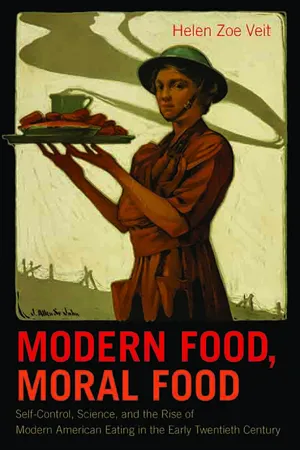
eBook - ePub
Modern Food, Moral Food
Self-Control, Science, and the Rise of Modern American Eating in the Early Twentieth Century
- 320 pages
- English
- ePUB (mobile friendly)
- Available on iOS & Android
eBook - ePub
Modern Food, Moral Food
Self-Control, Science, and the Rise of Modern American Eating in the Early Twentieth Century
About this book
Information
1
NATIONAL WILLPOWER
American Asceticism and Self-Government
If men have not self-control, they are not capable of that great thing which we call democratic government.
In January 1918, 300 of the richest women in New York City asked the government to tell them what to eat. The United States had entered the Great War nine months earlier, and food was one of the most immediate ways that American civilians experienced it. European food shortages were front-page news, and in the minds of many, the outcome of the war and the fate of the country depended on Americans’ success in feeding their allies and their soldiers. The government had already launched an elaborate voluntary food conservation program orchestrated by a nationwide network of volunteers, but these wealthy New York women did not want their participation to be voluntary. They wanted orders. And so the Food Administration printed special ration cards just for them, setting strict weekly limits on the red meat, butter, wheat flour, and sugar they and their families could eat, although permitting unlimited amounts of milk, vegetables, nonwheat cereals, fish, and poultry.1 After seeing their ration cards, some of the women called the program a “stiff one,” but they added that the government could not ask too much of them if their sacrifices would help win the war.2
On one level, it was playacting. These “rations” were utterly unenforced, and compliance with them remained as voluntary as food conservation had always been. If some of those wealthy families chose to feast on pork loin and cake every night, no one was the wiser, and maybe some of them did. But on another level, the sense of obligation conferred by the idea of “rations” was clearly critical to these women. Voluntary food conservation gave them a freedom of choice they did not want; they did not want the burden of having to choose to go without pork and cake and all the other foods they liked, night after night. They simply wanted to be “told definitely what to eat,” to be able to act morally without a moral dilemma.3 And it soon became obvious that they were not the only ones who longed for stricter rules and less autonomy when it came to saving food. Within a week, a group of wealthy white women in New Orleans announced that they were adopting the same rationing plan.4 By the end of another week, society women in Washington, D.C.—including the wives of senators, congressmen, and cabinet members—pledged to submit to rations, too.5 By springtime, requests for rations were pouring into the Food Administration from across the country, especially from wealthy homes, and newspapers printed the ration plan so that anyone could follow it.6
When the United States entered World War I in April 1917, food supplies seemed vitally important to victory. As crop yields fell in Europe and regular distribution lines failed, each side sought to induce capitulation through military and civilian hunger, turning the war into a contest of endurance on and off the battlefield. By 1917, food scarcity had become a central factor in the military strategy of both sides. One of the first steps that President Woodrow Wilson took after American entry into the war was to create the United States Food Administration, a powerful, temporary wartime agency that combined extensive volunteer networks with unprecedented federal power in order to export as much food as possible to western European allies and neutrals. To head the Food Administration, Wilson named Herbert Hoover, a mining engineer turned public servant who had led relief efforts to feed Belgian and French civilians since the beginning of the European war.
Pressed for shipping space, the Food Administration’s goal was to send nutrients to Europe in their most concentrated form. By the nutrition standards of the day, this meant prioritizing the export of beef, pork, white flour, butter, and sugar, all of which were packed with desirable calories and kept well during the transatlantic voyage. As a result, the U.S. government actively discouraged its citizens from eating those same foods, dietary staples for many Americans. Officially, the Food Administration did not encourage Americans to eat less, just to eat differently: to eat substitutes like chicken and fish and cornmeal rather than commodities needed for export. The administration’s official line, which appeared on placards, membership cards, posters, and in instructional guidelines for volunteer canvassers, was that Americans “should eat plenty, wisely and without waste.”7
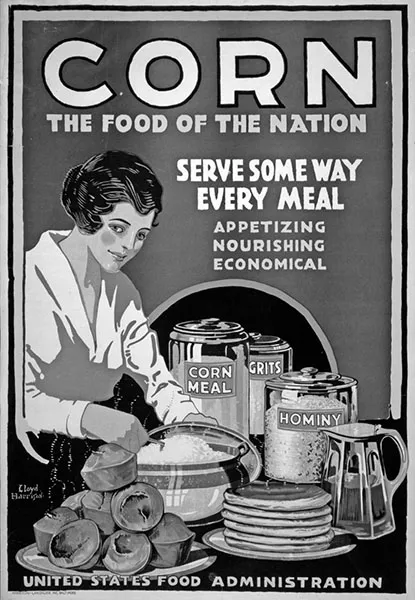
Lloyd Harrison, “Corn: The Food of the Nation,” 1918. This Food Administration propaganda poster advertised some of the many uses of corn, one of the most prominent of the substitute foods administrators promoted. Harrison-Landauer Inc., Baltimore, Prints and Photographs Division, Library of Congress, Washington, D.C.
But despite the official position that there was no need for Americans to reduce their overall consumption, individuals within and without the administration clearly saw the food conservation campaign as an opportunity to champion the moral value of austerity, and they drew parallels between righteous physical self-control and individuals’ capacity for political self-control. Large numbers of Americans participated in the voluntary food conservation campaign to some extent, and the most enthusiastic participants often did so because they welcomed the chance to exercise ascetic self-control and to demonstrate their mastery over their own bodies. Throughout the war, administrators and other Americans adopted a rich vocabulary of sacrifice in which austerity and self-discipline figured both as the virtues fuelling voluntary food conservation and as casts of mind sympathetic to the possibility of righteous mandatory rationing, should it become necessary. Amid Progressive Era disputes over the nature of government and the meaning of democracy, some Americans during World War I came to make striking associations between self-control, a distrust of the pleasures of food, and views of the war as a morally and politically purifying experience.
THE MOST RADICAL BILL EVER ENACTED BY CONGRESS
The Food Administration’s motto, “Food Will Win the War,” was more than empty rhetoric. German troops had occupied Belgium and parts of northeastern France since the start of the European war in 1914, severing regular distribution networks and stifling production in what had been France’s richest agricultural region. Millions of European farmers left their fields for the trenches, while drought and cold weather further depleted crop yields across Europe. The populations of Germany and Britain had come to rely heavily on imported food in previous decades, and both nations took aim at this shared weakness. Both the Allied naval blockade of Germany and the German U-boat campaign aimed to deprive civilians in other countries of food.8 Western Europeans were not starving, but in some places wartime food shipments were the only bulwark against hunger.9
Americans had been hearing about food’s importance to the war since 1914, when a young American engineer named Herbert Hoover became head of the Commission for Relief in Belgium.10 The commission was a philanthropic, ostensibly neutral organization that fed millions of Belgian and French civilians during the war, using contributions from individuals and aid from allied and neutral governments. The German occupation had stifled French agricultural production and severed regular food distribution networks, and it had cut off Belgium from the imports it relied upon for upwards of 80 percent of its cereals.11 Under Hoover’s leadership, the commission was a voluntary and famously efficient organization that had enormous success in provisioning people who otherwise would have faced bleak shortages. By 1917, the commission was feeding nine million people a day, including most of the population of Belgium and occupied northern France.12 A midwestern orphan and a self-made man, Hoover had forsaken his lucrative engineering work to head wartime food relief efforts, and he made an appealing subject of news stories about the heady potential of a “simon-pure American” abroad.13 Hoover’s coordination of food aid on an international scale was unprecedented, and it earned him a global reputation as the face of U.S. benevolence.14
By the time the United States entered the war in 1917, Hoover was the obvious choice to lead a formal American aid program, despite his total absence of nutritional expertise. Even as he awaited congressional approval throughout the first four months of the war, Hoover launched the still unofficial Food Administration and rolled out an extensive food conservation campaign to change the ways Americans ate. In order to export surplus food to Europe, American food administrators needed it in hand in the first place, ready for shipment in their warehouses by the New York ports. But surplus food was hard to come by. In the immediate prewar years, production levels of major American crops had only just exceeded domestic consumption. Securing surplus food required not only getting farmers to produce more beef, pork, wheat, sugar, and butter, but also, somehow, getting American consumers to eat less of them. For food conservation to work, a critical mass of people had to change their eating habits, at least temporarily. Administrators asked Americans to eat one meatless—meaning no red meat—and one wheatless meal each day, and to observe a completely meatless day on Tuesday, a porkless day on Saturday, and a wheatless day on Monday. Wartime pamphlets, posters, and cookbooks instructed Americans how to cook and eat what were to many people unfamiliar wartime substitutes like oatmeal, peanut butter, skim milk, cottage cheese, and pasta.15
As they worked to convince Americans to change their eating habits, administrators had to confront the very live issue of soaring food prices.16 Between William McKinley’s inauguration in 1897 and Woodrow Wilson’s reelection in 1916, the cost of living in the United States had risen by almost a third.17 Wages had risen, too, but not in pace with inflation. In early 1917, food prices that already seemed astronomical soared further still, with the price of some commodities nearly doubling, a catastrophic development for poor families who already spent more than 40 percent of their incomes on food.18 In February and March, food riots erupted in major American cities, including New York, Boston, Baltimore, Philadelphia, Saint Louis, and Chicago.19 Disgusted at food prices, one woman lambasted supposed American abundance while so many were suffering from chronic hunger: “But poor is the people/ Whose women must cry, / ‘We work, but we starve—/ Give us food or we die!’”20 A few weeks later, when Russian food riots sparked the revolution that toppled the tsar, they seemed like an ominous—or hopeful—herald of American events. During the spring and summer of 1917, thousands of Americans from across the country wrote to the still unofficial Food Administration to complain about prices. Sallie Bardette, a mother of thirteen in West Virginia, spoke for many when she asked “why the food bill cant be pased in a way by witch we may Have a Bite to eat in speaking distance of wages.”21
The “food bill” to which Bardette referred was the Lever Food and Fuel Control Bill, and it was on the minds of lots of people during the summer of 1917. The Food Administration’s official status—and the funding and power that would go with it—awaited the bill’s passage, but it stalled in the Senate for five weeks that summer.22 Legislators intended the bill to define and expand the government’s capabilities to dampen food prices while increasing wartime food exports, and it faced fierce opposition from people who objected to its broad expansion of federal power. Especially as it concerned alcohol, food requisitioning, price fixing, and rationing, the Lever Bill generated genuine anxiety, and people called it “despotic,” “antagonistic” to democracy, and “the most radical [bill] ever enacted by congress.”23
The Lever Act was radical, in fact. When it finally passed Congress in August 1917, it granted audacious power to the federal government, appropriating more than $150 million for the Food Administration and granting administrators unprecedented ability to intervene in the market. One of the most controversial parts of the act was its authorization of the government to requisition any food or fuel deemed necessary from civilians.24 In the winter of 1918, the Food Administration routinely received letters from Americans loyally providing an inventory of their pantries, because they had heard a rumor that the Food Administration wanted a “census” of all food in individual homes in advance of requisitioning personal supplies.25 And when volunteer canvassers went door to door to gather signatures during Food Administration membership drives, they regularly encountered people scared that if t...
Table of contents
- Cover Page
- MODERN FOOD, MORAL FOOD
- Copyright Page
- CONTENTS
- ILLUSTRATIONS
- ACKNOWLEDGMENTS
- INTRODUCTION: VICTORY OVER OURSELVES
- 1 NATIONAL WILLPOWER
- 2 EATING CATS AND DOGS TO FEED THE WORLD
- 3 FOOD WILL WIN THE WORLD
- 4 A SCHOOL FOR WIVES
- 5 A CORN-FED NATION
- 6 AMERICANIZING THE AMERICAN DIET
- 7 THE TRIUMPH OF THE WILL
- EPILOGUE
- NOTES
- BIBLIOGRAPHY
- INDEX
Trusted by 375,005 students
Access to over 1.5 million titles for a fair monthly price.
Study more efficiently using our study tools.
Frequently asked questions
Yes, you can cancel anytime from the Subscription tab in your account settings on the Perlego website. Your subscription will stay active until the end of your current billing period. Learn how to cancel your subscription
No, books cannot be downloaded as external files, such as PDFs, for use outside of Perlego. However, you can download books within the Perlego app for offline reading on mobile or tablet. Learn how to download books offline
Perlego offers two plans: Essential and Complete
- Essential is ideal for learners and professionals who enjoy exploring a wide range of subjects. Access the Essential Library with 800,000+ trusted titles and best-sellers across business, personal growth, and the humanities. Includes unlimited reading time and Standard Read Aloud voice.
- Complete: Perfect for advanced learners and researchers needing full, unrestricted access. Unlock 1.5M+ books across hundreds of subjects, including academic and specialized titles. The Complete Plan also includes advanced features like Premium Read Aloud and Research Assistant.
We are an online textbook subscription service, where you can get access to an entire online library for less than the price of a single book per month. With over 1.5 million books across 990+ topics, we’ve got you covered! Learn about our mission
Look out for the read-aloud symbol on your next book to see if you can listen to it. The read-aloud tool reads text aloud for you, highlighting the text as it is being read. You can pause it, speed it up and slow it down. Learn more about Read Aloud
Yes! You can use the Perlego app on both iOS and Android devices to read anytime, anywhere — even offline. Perfect for commutes or when you’re on the go.
Please note we cannot support devices running on iOS 13 and Android 7 or earlier. Learn more about using the app
Please note we cannot support devices running on iOS 13 and Android 7 or earlier. Learn more about using the app
Yes, you can access Modern Food, Moral Food by Helen Zoe Veit in PDF and/or ePUB format, as well as other popular books in History & North American History. We have over 1.5 million books available in our catalogue for you to explore.