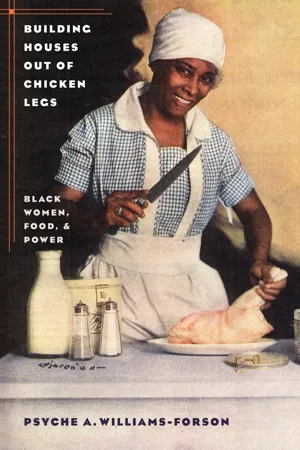
Chicken — both the bird and the food — has played multiple roles in the lives of African American women from the slavery era to the present. It has provided food and a source of income for their families, shaped a distinctive culture, and helped women define and exert themselves in racist and hostile environments. Psyche A. Williams-Forson examines the complexity of black women’s legacies using food as a form of cultural work. While acknowledging the negative interpretations of black culture associated with chicken imagery, Williams-Forson focuses her analysis on the ways black women have forged their own self-definitions and relationships to the “gospel bird.”
Exploring material ranging from personal interviews to the comedy of Chris Rock, from commercial advertisements to the art of Kara Walker, and from cookbooks to literature, Williams-Forson considers how black women arrive at degrees of self-definition and self-reliance using certain foods. She demonstrates how they defy conventional representations of blackness and exercise influence through food preparation and distribution. Understanding these complex relationships clarifies how present associations of blacks and chicken are rooted in a past that is fraught with both racism and agency. The traditions and practices of feminism, Williams-Forson argues, are inherent in the foods women prepare and serve.
eBook - ePub
Building Houses out of Chicken Legs
Black Women, Food, and Power
- 336 pages
- English
- ePUB (mobile friendly)
- Available on iOS & Android
eBook - ePub
About this book
Information
Part I: Encounters with the Bird
Chapter 1: We Called Ourselves Waiter Carriers
Bacon to spare will allow me a preference with the country people or rather Negroes who are the general chicken merchants.
—John Mercer
We called ourselves “Waiter Carriers.”
—Bella Winston
When Augustus Baldwin Longstreet wrote Georgia Scenes in 1835, he included among his characters a rambunctious and offensive native gentleman from Georgia by the name of Ned Brace. Ned was the kind who would wreak havoc wherever he went. Lyman Hall, one of Longstreet’s two narrators, accompanies Ned on a three-day venture to Savannah.1 After a day of playing pranks on everyone from the lodging house hostess to a member of a fancy funeral procession, Ned takes his behavior to the market to “buy something of everybody and some of everything.” Being the sort of character who “wanted his articles in such portions and numbers as no one would sell, or upon conditions to which no one would submit,” he approaches “an old Negro woman” and explains that his wife is sick and she wants chicken pie. Ned, however, has just enough money to buy half a chicken based upon the seller’s asking price. As a result, Ned wants the vending woman to cut the live chicken in half. In her outrage and disbelief, she explains to Ned that this is impossible. She has no place to properly dress the chicken, and she does not want to get feathers all over the other chickens that she has to sell. If this was to happen, she is sure that it would result in her being punished by other white men:
“Do, my good mauma, sell it to me,” said he; “My wife is very sick, and is longing for chicken pie, and this is all the money I have” (holding out twelve and a half cents in silver), “and it’s just what a half chicken comes to at your own price.”
“Ki, massa! how gwine cut live chicken in two?”
“I don’t want you to cut it in two alive; kill it, clean it, and then divide it.”
“Name o’ God! what sort o’ chance got to clean chicken in de market-house! Whay de water for scall um and wash um?”
“Don’t scald it at all; just pick it, so.”
“Ech-ech! Fedder fly all ober de buckera-man meat, he come bang me fo’ true. No, massa, I mighty sorry for your wife, but I no cutty chicken open.” 2
Upon the refusal of the woman to sell him the chicken, Ned appears to leave her, ending the scene. The reader is left with no knowledge of whether or not the old woman complied, but one can assume by her closing remarks that she did not. Although I will return to this scene later in this discussion, it is important now for its illustration of at least one level of interaction exchanged between whites and blacks in the New World marketplace. It reveals the boundaries that each established and transversed in his or her desire to consume and obtain goods. Moreover, it lends itself to an examination of how black women left their mark both in kitchens and on the market landscape. It further suggests some of the social, cultural, and economic tensions that were bound to arise in a society marked by patriarchal control and white dominance. The basic goals of this chapter are to discuss two things: some of the various interactions that African and African American people may have had with chicken upon their arrival in the New World and how those relationships have been circumscribed by a discourse of race and capitalism.
Like intricate weavings on a tapestry, so are the stories and the heritages that help to compose the beginnings of African life in America. The accounts that surround the forced migrations of Africans to Brazil, the West Indies, and America have been the source of debate for decades. What remains consistent is that the Atlantic slave trade left an amalgamation of cultures and transformations that permeate every aspect of American life, including its foodways. The historical contexts within which relationships developed between black women and chickens reveal practices that were circumscribed by gender, race, class, and power. Certain boundaries guided the exchange of goods that took place in and around the marketplace. Black people were no freer than their circumstances allowed at that time. But it was the level of market autonomy and relative independence that reveal some of the ways in which black people saw themselves in relationship to certain goods. Far from simply being victims of their circumstances, black women and men were sometimes in positions where they could be enterprising.3 Chicken may be considered one food with which competency for trade was exercised and meanings were expressed. Chicken may have figured very minutely within the scope of early wide-scale commercial capitalism, but an examination of its role within the marketplace provides a small glimpse of how power, race, and capitalism converged in the American landscape.
When exploring a phenomenon such as the one this study suggests, it is necessary to make some generalizations at the risk of oversimplification and overestimation. Recognizing this pitfall, this chapter will limit its geographic focus mainly to areas of the Maryland and Virginia Chesapeake and the Carolina Lowcountry, even though the marketing activities of slaves and free blacks have been recorded as far north as New England.4 But, before furthering the discussion on African American relationships to chicken, it seems a brief history of poultry and fowl in American society is necessary.
The history of chicken (Gallus domesticus), the common name for what we know today as domestic fowl, is long and complicated primarily due to cultural diffusion as much as anything else. But there seems to be perennial agreement that chickens arrived in the New World from Asia and are descended from the red jungle fowl.5 The agricultural surplus found in the New World allowed eastern seaboard settlers to be relatively self-sufficient. The areas surrounding the Chesapeake Bay were especially lush with wildlife, fish, plants, nuts, fruits, and other food provisions. Chickens were a part of this surplus and the general exchange of foods, tools, and methods of production between European colonists and Native Americans. Because these birds roamed freely, Native Americans often traded chickens and wild turkeys with the colonists in an effort to obtain more favorable goods like guns and cooking utensils.6
Writing in 1634, Captain Thomas Young wrote of a journey to Jamestown, Virginia, wherein he noticed that America was endowed with “very great plenty” of birds, fowl, and other foods: “In so much so that in ordinary planters’ houses of the better sort, we found tables furnished with pork, kids, chickens, turkeys, young geese, caponetts and such other fowls as the seas of the year afforded.”7 As Young rightfully observed, goose, duck, and chicken appeared often on the tables of the “better sort.” Writing in 1709, William Byrd kept a detailed journal where he secretly recorded the minutiae of his daily life. While many dined on “hash’d or fricasseed” cold remains of turkeys and geese, or “boil’d and roasted” fowl, Byrd broke his fast with boiled milk. Nonetheless, by dinner, boiled beef, blue wing, pigeon, partridge, geese, duck, pork, and boiled or roasted mutton graced his table.8 And in the latter part of the eighteenth century, German settler Johann Martin Bolzius observed that birds were so plentiful that he could only describe them by their color. He noted that food could not be stored because of worms but added that “chickens are easily kept from which they have eggs regularly, and fresh meat in case of emergency. They usually slaughter in autumn and winter, salt the meat, smoke it, lay it away for preservation.”9
Wealthy landowners may have dined often on all kinds of fowl, but it was slave men and women who had the primary responsibility of caring for the birds. Landon Carter’s diary has several entries wherein the slave Sukey gives him an account of that “which she has been entrusted with.”10 Sukey’s “charges” included:
Old geeses | 33 | |
Goslings | 78 | two geese still to hatch |
Old ducks | 8 | |
Young ducks | 20 | seven hens sitting on duck eggs |
Old fowls | 32 | |
Chickens | 200 | one hen still sitting on her eggs |
Old turkey | 12 | |
Young ditto | 7 | seven turkey hens sitting |
Even though the mistress of the house would have had the overall responsibility for supervising the work on the farm, slaves like Sukey would have cared for the livestock.
Although Sukey may have been taught how to care for these animals, this task probably would have been familiar to her ancestors. Almost all West African societies held agriculture as the chief form of subsistence. And usually everyone engaged in the agricultural process. Part of this engagement might have included interaction with the guinea fowl (Numida meleagris).11 The skills held by Africans were not lost on slave traders. For this reason, slaves were taken from certain regions according to their specific knowledge, their dispositions, and their benefits to New World markets. European slave traders like the British took Africans from different coastal regions, including the Bight of Benin, Senegambia, Sierra Leone, West Central Africa, the Gold Coast, and the Bight of Biafra. They were taken to Brazil and the Caribbean to build the sugar industry, to the Carolinas for rice cultivation, and to the Chesapeake colonies for harvesting tobacco, among other crops, cotton being the eventual mainstay of United States economic export.12
By the middle of the seventeenth century, trade in Africans had fully taken hold, linking Europe, Brazil, the Caribbean, and North America. The purpose here is not to revisit this discussion but to benefit from it by building on the general consensus that although slaves arrived in America with no material possessions, some were equipped with the sensibilities of marketing and trading foodstuffs and other consumer goods.13 Using what they or their ancestors knew and that which was acquired in the New World, some slaves were able to better their material lives. Though meager by any comparison, some slaves were able to acquire possessions that would make their lives markedly more improved. This was by no means widespread, and it varied over time and space.14 The sheer weight of material accumulation by planters necessitated the passing on of goods that were no longer desired. Often times, these possessions fell into the hands of favored slaves. Other slaves acquired goods through barter, trade, recycling, and theft. Archaeological work on slaves’ sites throughout the Americas reveals that chicken was one of many food items with which some Africans came into contact and used to gain access to other goods.15
Historians point to the economic, social, and cultural importance of African Americans in the profitable capacity of selling foods such as poultry, fowl, and chicken; as hawkers and traders, enslaved and freed blacks entered the early commercial economy.16 Being able to participate meant a number of things for slaves: it provided the ability to supplement the food and clothing allotted to them by plantation owners, an opportunity to acquire a wider variety of goods, and the ability to exercise a modicum of autonomy and relative economic success on or near the plantation environment. This in no way suggests the beneficence of enslavement; rather, it points to the relative material and economic transactions that could surround plantation life. It also reflects the self-interest of some slave owners who wanted to save money and did so by allowing their slaves to feed themselves.17
According to travelers’ accounts, it was not an unfamiliar sight to see slave women vending and hawking food items while walking the streets of major towns. Apparently, this scene was so familiar that in 1779 John Mercer was prompted to comment on it to his business agent, Battaile Muse: “I know already that chickens or other fresh meat cant be had but in exchange & bacon to spare will allow me a preference with the country people or rather Negroes who are the general chicken merchants.”18 Mercer realized that in order to trade with blacks for chicken and other goods, he would need to reserve some of his own supply of bacon.
Plantation as well as non-plantation households had to be provisioned from day to day and week to week. To be sure, many of the wealthier plantations like Carter Burwell’s Carter’s Grove and Thomas Jefferson’s Monticello were able to distribute their week’s rations from among the many food items grown and tended to by the slaves on the property. However, even some of these plantation owners had to go beyond their own property to stock their household. Also in Virginia, Landon Carter not only “humored” his slaves by purchasing their goods but also saw his own profitability in their ability to trade. Of Nat, a slave, Carter says:
Nat brought me 6 chickens this day; his others not quite big enough. I have been asked why I don’t sell my salted Pork. I think I now see a good way of selling it, and perhaps at a great Price than others have got for theirs. My poor slaves raise fowls, and eggs in order to exchange with their master now and then; and, though I don’t value the worth of what they bring, yet I enjoy the humanity of refreshing such poor creatures in what they (though perhaps mistakenly) call a blessing. Indeed, I hope this is a good way of selling what I may have to spare out of my own sumptuous fare; and not to inure the small profits which I am content with.19
Not all slaves sold chicken, of course; some sold baked goods while other times they marketed foods grown in their gardens or obtained—legally or illegally—from their owners. And while some like Carter’s slave Nat had an opportunity to participate in supplemental trade activities, the majority were employed in the production of staple crops like sugar, rice, tobacco, and cotton.
Entry into the slave economy was strictly guarded and regulated on a number of levels. First, slaves who participated did so only with permission from their owners and were limited to a certain traveling distance. Second, even when allowed to trade, they were governed by the constraints of production rhythms and patterns and therefore not relieved of their everyday duties and assignments. And last, they were bound by numerous legal restrictions that dictated the parameters of trade.
Within the diversity and pervasiveness of the slave’s participation in the business (mostly informal) of buying and selling, the social, economic, and cultural landscape of black and white, enslaved and master, and rich, poor, and poorer often overlapped and collided. For example, in 1642, the General Assembly of Virginia made it unlawful to “secretly and covertly trade and truck with other mens’ servants and apprentices which tended to the great injury of masters of familys, their servants being thereby induced and invited to purloin and imbeasill the goods of their said masters.” In neighboring Maryland and other locales, established merchants agitated against itinerant hucksters, intermediaries, and peddlers who would set up their goods and forestall prior to the opening of the markets.20 Even though many of these laws were ignored because of self-interest, some planters believed it was necessary to press the issue. In 1665, Philip Calvert brought a case to the Provincial Court of Maryland against Thomas and Elizabeth Wynne, who were accused of repeatedly bartering and trading with “ffrank Indian & dyvers others of the slaves of Philip Calvert Esq … for Ten poultry or Henns.”21
To stem the tide of competition by hucksters, peddlers, and other competitors, regulations were established that required traders to be licensed. In 1737, South Carolina passed an act “for licencing Hawkers, pedlars and Petty Chapmen, and to prevent their trading with Indented Servants, Overseers, Negroes, and Othe...
Table of contents
- Cover Page
- Building Houses out of Chicken Legs Black Women, Food, and Power
- Copyright Page
- Dedication
- Contents
- Illustrations
- Acknowledgments
- Introduction
- Part I: Encounters with the Bird
- PART II: African American Women and Gender Malpractice
- Epilogue: From Train Depots to Country Buffets
- Notes
- Bibliography
- Index
Trusted by 375,005 students
Access to over 1.5 million titles for a fair monthly price.
Study more efficiently using our study tools.
Frequently asked questions
Yes, you can cancel anytime from the Subscription tab in your account settings on the Perlego website. Your subscription will stay active until the end of your current billing period. Learn how to cancel your subscription
No, books cannot be downloaded as external files, such as PDFs, for use outside of Perlego. However, you can download books within the Perlego app for offline reading on mobile or tablet. Learn how to download books offline
Perlego offers two plans: Essential and Complete
- Essential is ideal for learners and professionals who enjoy exploring a wide range of subjects. Access the Essential Library with 800,000+ trusted titles and best-sellers across business, personal growth, and the humanities. Includes unlimited reading time and Standard Read Aloud voice.
- Complete: Perfect for advanced learners and researchers needing full, unrestricted access. Unlock 1.5M+ books across hundreds of subjects, including academic and specialized titles. The Complete Plan also includes advanced features like Premium Read Aloud and Research Assistant.
We are an online textbook subscription service, where you can get access to an entire online library for less than the price of a single book per month. With over 1.5 million books across 990+ topics, we’ve got you covered! Learn about our mission
Look out for the read-aloud symbol on your next book to see if you can listen to it. The read-aloud tool reads text aloud for you, highlighting the text as it is being read. You can pause it, speed it up and slow it down. Learn more about Read Aloud
Yes! You can use the Perlego app on both iOS and Android devices to read anytime, anywhere — even offline. Perfect for commutes or when you’re on the go.
Please note we cannot support devices running on iOS 13 and Android 7 or earlier. Learn more about using the app
Please note we cannot support devices running on iOS 13 and Android 7 or earlier. Learn more about using the app
Yes, you can access Building Houses out of Chicken Legs by Psyche A. Williams-Forson in PDF and/or ePUB format, as well as other popular books in Social Sciences & African American Studies. We have over 1.5 million books available in our catalogue for you to explore.