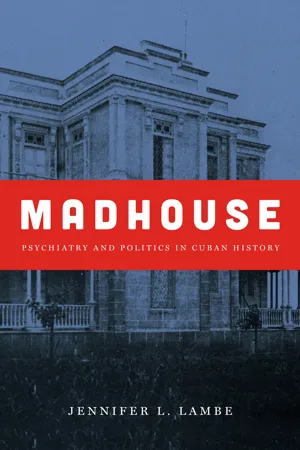
On the outskirts of Havana lies Mazorra, an asylum known to — and at times feared by — ordinary Cubans for over a century. Since its founding in 1857, the island’s first psychiatric hospital has been an object of persistent political attention. Drawing on hospital documents and government records, as well as the popular press, photographs, and oral histories, Jennifer L. Lambe charts the connections between the inner workings of this notorious institution and the highest echelons of Cuban politics. Across the sweep of modern Cuban history, she finds, Mazorra has served as both laboratory and microcosm of the Cuban state: the asylum is an icon of its ignominious colonial and neocolonial past and a crucible of its republican and revolutionary futures.
From its birth, Cuban psychiatry was politically inflected, drawing partisan contention while sparking debates over race, religion, gender, and sexuality. Psychiatric notions were even invested with revolutionary significance after 1959, as the new government undertook ambitious schemes for social reeducation. But Mazorra was not the exclusive province of government officials and professionalizing psychiatrists. U.S. occupiers, Soviet visitors, and, above all, ordinary Cubans infused the institution, both literal and metaphorical, with their own fears, dreams, and alternative meanings. Together, their voices comprise the madhouse that, as Lambe argues, haunts the revolutionary trajectory of Cuban history.
- 344 pages
- English
- ePUB (mobile friendly)
- Available on iOS & Android
eBook - ePub
About this book
Information
CHAPTER ONE
A Moral Revolution at Mazorra, 1899–1902
We cannot say that place was an Asylum or even a place of cure[;] it is nothing more than a prison in the Spanish style, with all of the horrors and all of the attacks against nature, morality, hygiene and life.
—Domingo Méndez Capote, Informe del Secretario de Estado y Gobernación Domingo Méndez Capote y del Vicesecretario Manuel Despaigne, dirigido al General Brooke (1899)
The last gasp of Spanish colonialism at Mazorra produced mass hunger and then a death wave. From 1897 to 1898, well over half of its patients fell victim to the ravages of the ongoing war. In December 1896, hospital records counted the number of patients at 1,052. By 1897, 337 had lost their lives. The following year, another 458 deaths left only 393 patients alive by the start of 1899.1 Hunger, malnutrition, and gastrointestinal illness decimated the population, left to its own devices by a regime that had relinquished the duty of caring for the island’s most vulnerable inhabitants. Longtime employees of the hospital bemoaned the sight of the survivors, who wandered its increasingly deserted wards with only rags and scraps to cover them during the cool January nights.2
Their fate had not passed unnoticed. Both the Cuban and the U.S. press excoriated the Spanish for the shameful state of affairs at Mazorra, already a target of critical voices ranging from Cuban patriot José Martí to the New York Times. All drew attention to the senseless nature of the devastation, while diverging in their speculations about its cause.3 But an insider account by Dr. Gustavo López laid the blame squarely at the feet of hospital superintendent and Spanish political favorite Juan Kohly. López proclaimed Kohly to be a “chief without medical expertise, who never lived at the Asylum, who couldn’t know or attend to certain things.”4 In fact, in the few months of his tenure, Kohly had presided over the worst human catastrophe the hospital had ever seen. When Dr. Tomás Recio, a twenty-year hospital employee, dared to blow the whistle on conditions—specifically Kohly’s attempt to feed the patients rotten, worm-infested bread—his reward was summary dismissal.5
If the superintendent triumphed in that battle, however, he lost the bureaucratic war. A new administrative board replaced him in November 1898 with the very Dr. Recio he had tried to force out. But by then it was too late to save the patients who had suffered under Kohly’s incompetence. Instead, the relief vessel Comal, sent from Tampa under the direction of Clara Barton, provided an emergency food supply to the hospital.6 In the aftermath of death and despair, revolution had finally made its way to Mazorra’s doors.
The madman in Cuba is already celebrating! Charity is beaming!
—Gustavo López, Los locos en Cuba (1899)
On January 1, 1899, the U.S. military occupation of Cuba ended Spanish colonialism on the island. Only a month later, the occupation government ordered a changing of the guard at Mazorra, endowing it with a new administration of patriotic consequence. The political significance of the act was clear: future renovation at Mazorra represented a vital nationalist project, a rejection of the horrors of the recent past. To both Cuban and American constituencies, Mazorra had come to exemplify the worst face of the Spanish regime. As Domingo Méndez Capote, the new secretary of state, argued in a widely cited 1899 report, the hospital was little more than a prison in the Spanish style. The memory of its anonymous victims would persist for years to come, stoking the revolutionary ardor that the war’s brutality had unleashed.
The U.S. occupation governments of General John R. Brooke and General Leonard Wood and their Cuban counterparts set out to convert that “prison” into a true mental asylum. On the U.S. side, the rebuilding of Mazorra and other charitable institutions bolstered a Progressive imperialist vision, an ideology that was both paternalistic and earnest in its insistence on renovation. Meanwhile, Cuban participants and press depicted the reconstruction as a patriotic duty and a repudiation of the legacies of Spanish colonialism. These visions were distinct, but they were not incompatible. During the first U.S. occupation, they largely coexisted, sometimes fruitfully, as Cuban and U.S. leaders claimed successes at Mazorra as their own—and each other’s. This did not preclude disagreements between the two sides, but a common belief in the urgency of reconstruction often trumped their differences. As a result, charitable work under U.S. stewardship quickly became a weighty site of political theater and genuine reform.
Occupation had paved the way for the entrance of U.S. Progressives, and authorities allowed them to turn Cuba into a testing ground where they had significant say and agency. For these Progressives and their administrative counterparts, the ethical value of charitable work justified the total reconstruction of public institutions, along with the attendant fiscal responsibilities (subsidized by the Cuban treasury). In rebuilding Mazorra, both sides invested public beneficence with ideological significance, setting the stage for a century of contestation over the site they would turn into a national icon. The hospital’s political import, forged at the nexus of colonial abjection, patriotic euphoria, and imperialist conceit, would become an enduring legacy of independence.
The patriotic weight of reconstruction was apparent in the U.S. government’s earliest decisions about the asylum. In contrast with many Cuban hospitals and charitable facilities under U.S. occupation, the rebuilding of Mazorra began with the selection of Cuban leadership, namely, Dr. Lucas Álvarez Cerice, the hospital’s new superintendent. He was seconded in his efforts by Dr. J. Vega Lamar and Dr. Antonio Esperón, both participants in the independence war. Recio, who had soldiered through some of the worst times during his twenty years of employment at Mazorra, did not take his summary dismissal well. But his protest to the American authorities was largely drowned out by the celebration of Álvarez Cerice.7
Álvarez Cerice was a distinguished veteran of the Liberation Army, in which he had served as a lieutenant colonel under future president José Miguel Gómez, as assistant to celebrated leader General Máximo Gómez, and as chief of sanitation in the Second Division of the Third Corps. He had finally reached the rank of colonel in 1898.8 Upon his promotion to doctor at army headquarters in 1898, Álvarez Cerice’s work in Gómez’s brigade was memorialized by Fermín Valdés Dominguez, a comrade in arms. Álvarez Cerice, he said, was the doctor who had “lavished … the greatest solace on his comrades,” inspiring “affection … and confidence and love … as a doctor and as a man and brother of all.”9 His record had also earned him the position of delegate to the Constituent Assembly of La Yaya in 1897. Álvarez Cerice was, in short, a roundly beloved war hero and an accomplished physician.
Álvarez Cerice’s arrival to Mazorra was framed by widespread press coverage of the ignominious conditions of Spanish hospitals and jails—and the fact that the former were often indistinguishable from the latter. A typical U.S. report on the “Horrors in a Hospital” denounced “frightful conditions … where there is an assortment of patients, including criminals and insane persons, neglected, with little food and all the conditions pointing to great wretchedness.”10 The war had indeed produced carnage of catastrophic proportions among both combatants and civilians. Yet Cubans and Americans found particular meaning in unveiling desperation among those populations who were not able care for themselves: orphans, widows, and the mentally ill. Charitable work exalted care for these groups as the barometer of compassionate governance.
Prisons and municipal jails were a special target of discovery and introspection, for there, along with prisoners, reporters and officials unfailingly found the mentally ill. The conditions of the prisons were reprehensible, “filled to overflowing with poor, miserable creatures, living in filth.”11 Many of the inmates had “never been tried or convicted for any offense” and were subsequently released; one had been “awaiting trial 11 years when found.”12 The Baltimore Sun reported that, on the eve of a visit from a Spanish inspector, the female prisoners would pass around the single garment they possessed for the entire ward.
The lot of the insane in prisons, however, was particularly abject. From the vantage point of 1915, Dr. Diego Tamayo still found himself unsettled by the kinds of tragedies they had unearthed. These included a “poor madman” in the jail of Holguín who had been declared “ungovernable” and confined in stocks. Tamayo and his colleagues had ordered the man to be released from his chains, and he had responded, dazed, by crawling “to the extreme edge of his cell” and “curling up among the rags that covered him.” The callous treatment afforded to him had left a psychological mark, and his stocks were subsequently sent to Emilio Bacardí’s museum in Santiago as a “memento of a civilization that was disappearing, pushed aside by another where human mercy was germinating.” Equally affecting had been the sight of a “wretched madwoman” in the prison of Pinar del Río, so “abandoned” that her fingernails had grown to an “incredible size” and her hair had taken on the look of Medusa’s. There, “covered from the waist to the knees by a filthy rag,” she “danced to the rhythm of her own strident screams.”13
These are primal visions, shadows that reflected not only on the horrors of Spanish colonialism but also on the indifference displayed by many Cubans toward their marginalized compatriots. The rejection of Spanish colonialism in turn demanded nothing less than a political and spiritual exorcism. In an exercise that would be repeated many times throughout the twentieth century, political change demanded that Cubans reckon with the repression, neglect, and violence that had accumulated around the colony’s edges. Flush with recent efforts to organize public charity in their own country, North American interlopers would provide the organizational stimulus and budgetary oversight to reimagine these institutions. But it would be up to the Cubans to confront the psychic legacies embedded at Mazorra. Following his first visit to the asylum, Dr. Eduardo Plá, a representative of the inaugural Board of Patrons established under the occupation government, declared it to be the site of a “crime against humanity.”14 This and other denunciations would strongly shape U.S. and Cuban interventions at the hospital in the months to come.
Of course, there were contradictions inherent to a patriotic reconstruction initiated under the auspices of occupation. Cuban administrators constantly walked the line between celebration of the national import of their mission at the hospital and strategic flattery for the Americans who held the purse strings. Theirs was a paradoxical nationalism, which encompassed pride in Cuban agency, a pragmatic stance of collaboration with foreign occupiers, and muted admiration for U.S. models and precedents. Progress at the institution depended on fostering good relations with occupation officials, and luckily American officials were widely convinced of the importance of this mission. They framed their work at Mazorra as a natural outgrowth and validation of their role as stewards of political transition.
Undoubtedly, for many of the Cubans involved, there was no contradiction here. Those who had chafed at Spanish control, both within the hospital and more broadly, welcomed the “modern” and “scientific” oversight of the American forces. Gustavo López, for one, had sustained battles not only with the colonial administrators of the asylum but also with the Spanish medical establishment in the 1890s. Spanish officials, he asserted, had been possessed by bureaucratic mania and total disregard for the scientific, to the detriment of patient care: “all official attention … seemed closed in a circuit that, like a suggestive anti-scientific screen, allowed them to be aware only of peseta quantities, of differences in the price of a shoe or beef or of the more or less celebrated ability of an employee for the numbers game (‘cuenta’).”15 So it was that, despite a move in the early 1890s to restore medical experts to hospital leadership, government favorites had spent the better part of the decade in power at Mazorra. As a result, physicians had long been forced to pursue scientific advancement outside its walls.
López thus welcomed the “spontaneously” promised help of U.S. forces. For him, their efficient intervention at the hospital represented something truly hopeful: a new age of scientific progress. Invoking the heritage of Philippe Pinel, famed (if apocryphal) liberator of the insane in the French Revolution,16 López postulated that the transformation of Mazorra into a true hospital would elevate its “alienados” (madmen) to the “dignity of enfermos” (patients). They would, in turn, claim the status of patient and thus “help the alienist in the work of returning their reason to them, consenting to adequate treatment plans.”17 For López, the dawn of science at Mazorra would thus extend to a new relationship of reciprocal understanding between physician and patient. He discerned a direct correlation between the new political order and the medical regimen to be instituted at Mazorra, leaving behind confinement in carceral facilities and embracing “treatment in freedom” for the hospital’s patients.18
Other Cubans, however, were more circumspect in their embrace of U.S. supervision and sought to remind occupation officials of the moral obligations attendant upon their presence. In this respect, they would not have to exert themselves much. General Leonard Wood undertook rebuilding at Mazorra in a spirit of sincerity and would be memorialized thereafter for his dedication. Seriousness of purpose, however, did not guarantee unanimity of vision. Overall, U.S. forces would not fade in their commitment to the asylum. Nevertheless, the top-down nature of the reconstruction, its dependence on imperial (read: Cuban, disbursed by American) la...
Table of contents
- Cover
- Series Announcement Page
- Title Page
- Copyright
- Dedication
- Contents
- List of Illustrations
- Acknowledgments
- Introduction
- Chapter One: A Moral Revolution at Mazorra, 1899–1902
- Chapter Two: Fragments of a Journey to Mazorra: From a “State of Ruin” to a Second Occupation, 1902–1909
- Chapter Three: The Great Divergence: Psychiatry, Race, and the Age of the Inferno, 1909–1933
- Chapter Four: The Plague of Politiquería: Corruption and the Experts, 1934–1958
- Chapter Five: Banishing the Inferno: From Mazorra to Hospital Psiquiátrico de La Habana
- Chapter Six: The World the Revolution Made: Political Process and Mental Transformation
- Chapter Seven: The Repeating Madhouse, from Havana to Miami
- Epilogue
- Notes
- Bibliography
- Index
- Series Page
Trusted by 375,005 students
Access to over 1.5 million titles for a fair monthly price.
Study more efficiently using our study tools.
Frequently asked questions
Yes, you can cancel anytime from the Subscription tab in your account settings on the Perlego website. Your subscription will stay active until the end of your current billing period. Learn how to cancel your subscription
No, books cannot be downloaded as external files, such as PDFs, for use outside of Perlego. However, you can download books within the Perlego app for offline reading on mobile or tablet. Learn how to download books offline
Perlego offers two plans: Essential and Complete
- Essential is ideal for learners and professionals who enjoy exploring a wide range of subjects. Access the Essential Library with 800,000+ trusted titles and best-sellers across business, personal growth, and the humanities. Includes unlimited reading time and Standard Read Aloud voice.
- Complete: Perfect for advanced learners and researchers needing full, unrestricted access. Unlock 1.5M+ books across hundreds of subjects, including academic and specialized titles. The Complete Plan also includes advanced features like Premium Read Aloud and Research Assistant.
We are an online textbook subscription service, where you can get access to an entire online library for less than the price of a single book per month. With over 1.5 million books across 990+ topics, we’ve got you covered! Learn about our mission
Look out for the read-aloud symbol on your next book to see if you can listen to it. The read-aloud tool reads text aloud for you, highlighting the text as it is being read. You can pause it, speed it up and slow it down. Learn more about Read Aloud
Yes! You can use the Perlego app on both iOS and Android devices to read anytime, anywhere — even offline. Perfect for commutes or when you’re on the go.
Please note we cannot support devices running on iOS 13 and Android 7 or earlier. Learn more about using the app
Please note we cannot support devices running on iOS 13 and Android 7 or earlier. Learn more about using the app
Yes, you can access Madhouse by Jennifer L. Lambe in PDF and/or ePUB format, as well as other popular books in History & Latin American & Caribbean History. We have over 1.5 million books available in our catalogue for you to explore.