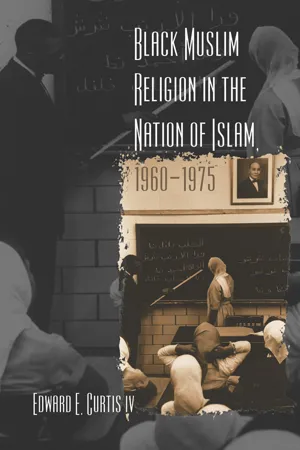
Elijah Muhammad’s Nation of Islam came to America’s attention in the 1960s and 1970s as a radical separatist African American social and political group. But the movement was also a religious one. Edward E. Curtis IV offers the first comprehensive examination of the rituals, ethics, theologies, and religious narratives of the Nation of Islam, showing how the movement combined elements of Afro-Eurasian Islamic traditions with African American traditions to create a new form of Islamic faith.
Considering everything from bean pies to religious cartoons, clothing styles to prayer rituals, Curtis explains how the practice of Islam in the movement included the disciplining and purifying of the black body, the reorientation of African American historical consciousness toward the Muslim world, an engagement with both mainstream Islamic texts and the prophecies of Elijah Muhammad, and the development of a holistic approach to political, religious, and social liberation. Curtis’s analysis pushes beyond essentialist ideas about what it means to be Muslim and offers a view of the importance of local processes in identity formation and the appropriation of Islamic traditions.
- 256 pages
- English
- ePUB (mobile friendly)
- Available on iOS & Android
eBook - ePub
Black Muslim Religion in the Nation of Islam, 1960-1975
About this book
Information
Topic
Theology & ReligionSubtopic
Islamic TheologyChapter One: What Islam Has Done For Me
Finding Religion in the Nation of Islam
I believe in Allah, God of the Muslims, creator of all the
worlds, and in Elijah Muhammad, his last Apostle, who
was conceived by a black man, born of a black woman,
suffered under the white man, was economically crucified,
mentally dead and racially buried. He is still in hell
(America) but has risen from the dead the so-called
Negroes, and is raising his people from their graves of
ignorance, to inherit heaven on this earth. … Thence
Allah shall judge the living (devils) and the dead (so-
called Negroes). I believe in no “Holy Ghost” tales; no
murderous Spanish Inquisition Catholic Church; no communion
of saints, angels, spirits or spooks; no forgiveness
of your [white] people’s sins against mine; no dry
bones and decayed flesh resurrecting; and no life after
physical death.
worlds, and in Elijah Muhammad, his last Apostle, who
was conceived by a black man, born of a black woman,
suffered under the white man, was economically crucified,
mentally dead and racially buried. He is still in hell
(America) but has risen from the dead the so-called
Negroes, and is raising his people from their graves of
ignorance, to inherit heaven on this earth. … Thence
Allah shall judge the living (devils) and the dead (so-
called Negroes). I believe in no “Holy Ghost” tales; no
murderous Spanish Inquisition Catholic Church; no communion
of saints, angels, spirits or spooks; no forgiveness
of your [white] people’s sins against mine; no dry
bones and decayed flesh resurrecting; and no life after
physical death.
—Sylane X, Muhammad Speaks, April 1962
Given the ways in which powerful interpreters of culture framed the NOI during the 1960s and 1970s, it is no wonder that many Americans came to regard the movement primarily as a political and social movement rather than a religious one. NOI leaders also contributed to this image of the group; their sometimes heavy-handed use of the word “religion” was partly a political strategy used to claim social legitimacy and legal protections. NOI leaders frequently cited the American tradition of religious liberty as a powerful symbol in their fight to protect NOI males from the military draft, to repel the interference of local police forces and the FBI, and to defend Elijah Muhammad’s status as a religious leader.
At the same time, if one takes seriously the words of NOI members, it is clear that many of Elijah Muhammad’s followers understood themselves to be practitioners of a genuine religion. In fact, members of the NOI used the word “religion” over and over again to describe their belief in Islam.1 Their eloquent and enthusiastic writings show that, while these narratives may have sometimes performed political functions, they were also expressions of religious feelings, ideas, and experiences.
Hundreds of Muslim followers contributed letters to the editor of Muhammad Speaks and especially testimonials about the impact of Islam on their lives. The testimonials appeared in a running feature of Muhammad Speaks called “What Islam Has Done For Me.” Many of these stories were classic American religious conversion narratives whose form will be familiar to many readers, and they evidence how the styles of religious practice and patterns of conversion in the NOI echo those of other American religious groups. These testimonials often described how a convert faced a crisis or lingering problem before they found Elijah Muhammad and the NOI. Converting to Islam provided a way out and a solution to their problems. Some of these narratives, like those of born-again African American Christians, discussed conversion as a sudden and powerful moment in which the believer experienced God’s presence.2 Others framed their conversions in less numinous terms, instead explaining their conversions as a gradual transition to Islam that nevertheless yielded equally important results. In this chapter, I offer a reading of those narratives, foregrounding the words of the believers themselves. In so doing, I highlight first-person narratives of Islamization, stories that explain what it meant to members of the NOI to become Muslims. For these persons, Islam was certainly a religion, but it was also a path to self-improvement and a source of physical and psychological safety or protection. For some, it was a complete way of life.
Islam as a Religious Alternative
Many believers in the NOI embraced Islam as a religious alternative to Christianity.3 As shown by the epigraph at the beginning of this chapter, Sylane X from New York City even crafted a creed of Muslim belief—one that was not part of regular NOI literature—that transformed a well-known Christian formula into a statement of theological and doctrinal protest. His creed is a rejection of Christian religion, which was associated in the minds of many believers in the NOI with black suffering and white racism. It also denied the existence of any “spooky” God or afterlife. Over and over again in the pages of Muhammad Speaks, believers contrasted what they saw as the superstitious and spooky religion of Christianity with the rational and practical religion of Islam. For instance, Dr. Leo X McCallum, the semi-official dentist of the NOI, praised the scientific and rational elements of Islam. “There is nothing more scientifically, biologically, physiologically or mathematically correct than Islam,” he claimed. Unlike Christianity, he argued, Islam is compatible with logic. The “basic dogmas of Christianity,” including the teachings about the divine nature of Jesus and his resurrection, are not believable to the rational man, especially those black professionals with higher education in the scientific fields, Dr. McCallum said. (He made no comment about the mythological teachings of the NOI.) Thus, Islam can better serve as the scientific man’s religion, he asserted.4 Likewise, Marie Atterbury of Macon, Georgia, emphasized the extent to which Islam appealed to her thirst for rational answers to life’s persistent questions. A former Methodist, Atterbury wrote, “Islam teaches more than Christianity. One learns more basic facts of life, because the ministers are trained to give more detailed explanations. … The Honorable Elijah Muhammad inspires me with his sincerity. I am also impressed by his logical answers to the problems that plague the black man.”5
For some believers, Elijah Muhammad and the NOI also offered interpretations of the Bible that were simply more convincing than the readings offered by the Christian church. John X Lawler, for example, said that when he converted years before, Elijah Muhammad helped him understand the confusing aspects of the Bible. “Only when I discovered Islam,” he wrote in 1963, “were the most puzzling aspects of the scripture made clear. And not only I, but others have found that the Messenger of Allah’s teachings to be the key that unlocked not only the mystery of the Bible, but of life itself.” According to Lawler, Elijah Muhammad taught him both the “reality of the Supreme Being [read W. D. Fard]” and his “duties to my fellow man.”6 Sister Beatrice X of Washington, D.C., also praised Elijah Muhammad’s teaching about the Bible, arguing that her former Baptist minister, a thirty-three-degree Mason, had used only part of the teachings of Islam to illuminate the difficult sections of the Bible. Elijah Muhammad, on the other hand, “pointed out some things in the Bible with which I had to agree.”7 Another, Sister Georgia X Thompson of Monroe, Louisiana, simply said, “This religion gave me a better and clearer understanding of the Bible.”8 Though some believers never explained why they were convinced by Elijah Muhammad’s Biblical exegeses, others said that it was Muhammad’s “unlocking” of certain Biblical passages, especially in the book of Revelation, that convinced them. These interpretations of the Bible were used to support the Messenger’s theories on the origins of the black man, on the role of the white devil in God’s divine plan, and on the coming apocalypse.9
In fact, many believers thought that Elijah Muhammad had access to esoteric science, a kind of gnosis that paved the way for a perfect understanding of the universe. Theodore F. X Peyton of Detroit said that before he became a Muslim, “I professed to be everything except a Christian. I went from an atheist to a skeptic to an agnostic. … I never could understand Christianity, nor could I bring myself to pretend I did.” For him, the fundamentalist Christian teaching claiming that human beings were only 6,000 years old was unscientific: “I could not understand how the Christian preachers could stand up and claim that the earth and man were only 6,000 years old when untold numbers of fossils dating 750,000 and 800,000 and more years old of man’s bones are found nearly every day. I could not see how they (the preachers) could ignore these facts.”10 Islam, as interpreted by Elijah Muhammad, offered an alternative view—that the earth and human beings were millions of years old, as outlined in the introduction to this book.
Of course, one might argue that Elijah Muhammad’s pseudoscientific myth of the black man’s origins were just as scientifically implausible as any Christian myth. But for this believer, Elijah Muhammad’s myth made sense. As Warner X Berry, another believer who saw Islam as a scientific faith, put it, Allah “knows the natural laws that govern the universe. He knows the chemical and mathematical secrets of life.”11 And Elijah Muhammad made that knowledge available to believers. George X Tucker said, “In history and science Elijah stands by himself as unbeatable. He has taught us the history of the earth and its inhabitants and of the moon which is a part of this planet earth, separated by an explosion by a black scientist 66 trillion years ago.”12 These “facts,” which had clear numerological significance in their use of the evil number “six,” were featured in the NOI’s catechisms, called the Actual Facts and Student Enrollment.13
In addition to being more rational and scientific than Christianity, Islam was also cast as a religion of resistance and action. Former Christian minister Marvin Omar of Maywood, Illinois, who identified himself as a graduate of Howard Law School, contrasted the this-worldly nature of Elijah Muhammad’s Islam with the other-worldly and deceptive character of the white man’s Christianity. Christianity, he said, was a white man’s religion meant to turn black people into docile and powerless beings:
Thank God for sending the Honorable Elijah Muhammad to open my eyes. It seems incredible that I once believed the white man’s Christian dogma. Through black preachers, the white man told me that Jesus was white; that God is white; that angels are white women with wings; that black men, after they die, would fly around with Jesus in ‘heaven’; that Jesus flew away and someday after I die I would be like him and fly away to some never-land in the sky; that after I die everything would be all right; that I should be good on earth and turn the other cheek so that after I die and shed this body some blue-eyed stringy-haired white God was going to give all little black boys bodies like his; that I would lay up in the sky where all God’s children have shoes and eat and drink milk and honey forever.14
After his conversion to Islam, Omar said, he rejected such “pie-in-the-sky stories,” and decided to work in this life for “justice, freedom and equality.” Similarly, for Brother Hiram X, a former Black Student Union volunteer who converted during his student years at one of the California State University branches, Islam was a religion that spoke to his need for a faith that addressed the practical problems of black life. “Before hearing the teachings of the Honorable Elijah Muhammad, I could have been classified as an agnostic,” he wrote. “I did not rule out the existence of God; I believed rather the Christians’ concept of god did not relate to my conditions and was powerless to change it.” The Messenger, according to Hiram X, taught people how to live and how to meet the everyday needs of life, including food, clothing, and shelter.15
For many believers, Islam was not held responsible for white racism and black internalized oppression, much of which was associated with slavery and the legalized system of segregation in the South called Jim Crow. Charlene M. Whitcomb, a sixty-eight-year-old believer from Oakland, California, said that “Islam is a religion of life, while Christianity is a religion of death. … Now I see why Christianity is called the ‘opium of the masses.’ It’s used to keep men enslaved.”16 Or as another former minister, Elder L. Hinis, of Elizabeth, New Jersey, said, Christianity was slave religion, and “we have slaved long … enough.”17 Some also called Christianity a hypocritical religion, criticizing church members for failing to practice the values of integrity that they preached.18 Islam met the spiritual needs of those who still thirsted for religion but wanted nothing to do with Christians. “My fear,” said John 11X of Miami, Florida,
was that after seeing the hypocrisy of Christianity, religion was dead inside me. Yet, when I thought of the complexity of the human body, the existence and precise movements of the planets, and the wonders of nature, I knew that deep down inside I was religious and believed in God, whose proper name is Allah. … Islam taught me to reach the identity I unconsciously sought; an identity free of the slavemasters’ name, of the slavemasters’ language, of the slavemasters’ flag, of the slavemasters’ culture, of the image that the slavemaster and their children presented and present of me to the world.19
Sister Ann 3X echoed this criticism of Christianity, proclaiming that Christian “religion is based on a lot of unrealistic ideas given to the slave by his slavemaster to keep him a slave. Christianity satisfied neither the Blackman’s material nor spiritual needs.”20
Many former southerners also tied the religion of Christianity to their lives in the South, and constructed Islam as a religion that brought them new hope in the North. For example, Sister Beatrice X of Washington, D.C., remembered that “my people were farmers and devoted church-goers” in South Carolina. “There was plenty of religion in the family. My uncles were preachers. Looking back, I think of what a shame it was to see them glorifying the white man and preaching his religion with so much fervor.”21 From the late nineteenth century to 1960, millions of African Americans left the South in what historians have called the Great Migration, a movement of persons that had a profound impact on the cultural, social, political, and economic life of the United States as a whole.22 In northern cities like Detroit, Chicago, Cleveland, Philadelphia, and New York, among others, African Americans sometimes joined established churches. In many other cases, however, they began to experiment with new religious traditions and communities. As Albert Raboteau summarizes,
Besides increasing the size and number of urban black churches, migration also increased the variety of black religious choices. Accustomed to deciding between Baptist, Methodist, and perhaps Holiness-Pentecostal churches back home, migrants to the cities encountered black Jews, black Muslims, black Catholics, black Spiritualists (people who believed that the living could communicate with the dead), and black disciples of charismatic religious figures like Daddy Grace, the founder of a church called the Universal House of Prayer for All People, who believed that their leaders could exercise divine power to heal their problems in this world as well as the next.23
In choosing to become Muslims, African American members of the NOI often self-consciously divorced themselves from their southern roots and proudly claimed allegiance to a new religious community where they could find what they described as more dignity and happiness. For example, Jerry Wilson of Chicago, Illinois, was born in 1940 in Clarksdale, Mississippi. When he was a boy, his family moved to Memphis, Tennessee, and he was “happy, happy to leave Mississippi.” Wilson remembered with regret that his father had taught ...
Table of contents
- Cover Page
- Black Muslim Religion in the Nation of Islam, 1960–1975
- Copyright Page
- Dedication
- Contents
- Illustrations
- Acknowledgments
- Introduction
- Chapter One: What Islam Has Done For Me
- Chapter Two: Making a Muslim Messenger
- Chapter Three: Black Muslim History Narratives
- Chapter Four: The Ethics of the Black Muslim Body
- Chapter Five: Rituals of Control and Liberation
- Conclusion
- Notes
- Index
Trusted by 375,005 students
Access to over 1.5 million titles for a fair monthly price.
Study more efficiently using our study tools.
Frequently asked questions
Yes, you can cancel anytime from the Subscription tab in your account settings on the Perlego website. Your subscription will stay active until the end of your current billing period. Learn how to cancel your subscription
No, books cannot be downloaded as external files, such as PDFs, for use outside of Perlego. However, you can download books within the Perlego app for offline reading on mobile or tablet. Learn how to download books offline
Perlego offers two plans: Essential and Complete
- Essential is ideal for learners and professionals who enjoy exploring a wide range of subjects. Access the Essential Library with 800,000+ trusted titles and best-sellers across business, personal growth, and the humanities. Includes unlimited reading time and Standard Read Aloud voice.
- Complete: Perfect for advanced learners and researchers needing full, unrestricted access. Unlock 1.5M+ books across hundreds of subjects, including academic and specialized titles. The Complete Plan also includes advanced features like Premium Read Aloud and Research Assistant.
We are an online textbook subscription service, where you can get access to an entire online library for less than the price of a single book per month. With over 1.5 million books across 990+ topics, we’ve got you covered! Learn about our mission
Look out for the read-aloud symbol on your next book to see if you can listen to it. The read-aloud tool reads text aloud for you, highlighting the text as it is being read. You can pause it, speed it up and slow it down. Learn more about Read Aloud
Yes! You can use the Perlego app on both iOS and Android devices to read anytime, anywhere — even offline. Perfect for commutes or when you’re on the go.
Please note we cannot support devices running on iOS 13 and Android 7 or earlier. Learn more about using the app
Please note we cannot support devices running on iOS 13 and Android 7 or earlier. Learn more about using the app
Yes, you can access Black Muslim Religion in the Nation of Islam, 1960-1975 by Edward E. Curtis IV in PDF and/or ePUB format, as well as other popular books in Theology & Religion & Islamic Theology. We have over 1.5 million books available in our catalogue for you to explore.