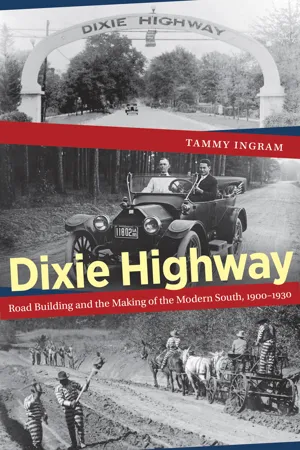
At the turn of the twentieth century, good highways eluded most Americans and nearly all southerners. In their place, a jumble of dirt roads covered the region like a bed of briars. Introduced in 1915, the Dixie Highway changed all that by merging hundreds of short roads into dual interstate routes that looped from Michigan to Miami and back. In connecting the North and the South, the Dixie Highway helped end regional isolation and served as a model for future interstates. In this book, Tammy Ingram offers the first comprehensive study of the nation’s earliest attempt to build a highway network, revealing how the modern U.S. transportation system evolved out of the hard–fought political, economic, and cultural contests that surrounded the Dixie’s creation.
The most visible success of the Progressive Era Good Roads Movement, the Dixie Highway also became its biggest casualty. It sparked a national dialogue about the power of federal and state agencies, the role of local government, and the influence of ordinary citizens. In the South, it caused a backlash against highway bureaucracy that stymied road building for decades. Yet Ingram shows that after the Dixie Highway, the region was never the same.
- 272 pages
- English
- ePUB (mobile friendly)
- Available on iOS & Android
eBook - ePub
About this book
Information
Topic
GeschichteSubtopic
Nordamerikanische GeschichteChapter 1
Building a Good Roads Movement, 1900–1913
At the turn of the twentieth century, a host of humorous songs, poems, and anecdotes poked fun at the nation’s abysmal roads. A poem called “Bad Roads Did It” played with the common theme of farmers getting stuck in the mud:
A farmer old, so we’ve been told,
With a team of horses strong
Drove down the road with a heavy load,
While singing his merry song.
But his mirth in song was not so long
For his horse gave a leap
As he ran amuck in the mud he stuck,
Clear up to his axles deep.
Bad roads did it!1
With a team of horses strong
Drove down the road with a heavy load,
While singing his merry song.
But his mirth in song was not so long
For his horse gave a leap
As he ran amuck in the mud he stuck,
Clear up to his axles deep.
Bad roads did it!1
Another example relayed the tale of two farmers who could only communicate with one another across the muddy, impassable road that separated their two farms. While talking one day, they noticed a hat lying atop a mud puddle in the middle of the road. It was a very fine-looking hat, so one of the men made up his mind to retrieve it using a fishing rod. He cast his line into the mud and managed to hook the hat. As he began to reel it in, however, a man’s head suddenly emerged from the mud beneath the hat. “Why you poor fellow,” the fisherman exclaimed, “you are in an awful fix!” “Well, I don’t mind it very much,” the man calmly replied, “but it is pretty hard on the horse.”2
Comical stories like these mocked bad roads, but they constituted part of a very serious national dialogue about the limits of transportation options. In the early twentieth century, roads governed everyday life. They determined where people could and could not travel, as well as whether or not other people, goods, services, and even ideas could reach them. Roads dominated conversations around the ballot box and the dinner table, but good roads eluded most Americans and virtually all southerners. In their place was a jumble of muddy sand-clay routes covering the region like a bed of briars, sometimes radiating from a railroad depot but often simply from each other, full of dead ends and treacherous mud puddles like the one that snared the apocryphal traveler and his horse.3
The bureaucracies that managed roads were equally underdeveloped. Farmers and other citizens who depended on these routes had no one to turn to for help besides the local officials who were already failing to maintain them. Local government control over road building divided scarce resources and limited opportunities for travel and trade. There were few links between towns, and even fewer between states and regions, because no central agency coordinated roadwork across local or state boundaries. Only seven state highway departments existed in 1900—none in the South—and no federal agency was empowered to fund road improvements.4 No one saw much need for long-distance roads, anyway. Horses and wagons were not long-distance modes of transportation for the average traveler, so aside from a handful of old stagecoach routes and Native American trading paths, roads linked farms to the nearest towns and to little else.5 Roads were entirely local in scope and in management, and they circumscribed people’s lives accordingly.
Railroads crisscrossed the South by 1900, but they were no substitute for a good system of roads. While railroad lines reached deep into rural communities, most had monopolies over local trade and travel. These monopolies resulted in high freight rates and limited passenger schedules that severely limited ordinary people’s ability to get around.6 Railroads did not ease the isolation or the financial pressures of farmers who needed to travel where railroad lines did not go. When bad weather or general neglect made roads leading to and from the depots impassable, railroads were of little use. With the average farm ten miles from a depot, rural families at the turn of the century were at the mercy of a woefully deficient system of local dirt roads.7
The invention of automobiles around the turn of the century challenged the limitations of local roads. While initially they aggravated tensions between wealthy urban motorists and the farmers whose roads they carved up on weekend drives, cars became more common in rural areas of the South after 1910.8 The range and flexibility of automobiles required bigger, better roads, which neither urban motorists nor rural farmers alone could afford to build and whose construction would have to depend on the coordination of dozens of county and city governments. People had to rethink not only the way roads looked but also how they were built and maintained. Over the next few years, cars eroded geographic, socioeconomic, and political divides. Farmers and motorists alike came to view roads not as farm-to-market routes or automobile thoroughfares but as parts of a modern state and federally built highway system that served a range of different interests.
By recognizing their common interests, rural farmers, city drivers, and automobile industrialists forged an uneasy alliance in the Good Roads Movement in the 1910s and 1920s. Such wide-ranging support was not altogether unusual for a Progressive reform campaign. For example, Prohibition supporters included women seeking political leverage for a future suffrage amendment, religious leaders concerned about lax morals, and “wet-dry” politicians who drank openly but jumped on the dry bandwagon when it was politically expedient. Those who backed electoral reforms included advocates of everything from secret ballots to African American disfranchisement.9 Still, the alliance between urban northerners and rural southerners, and between industrialists and farmers, was exceptional. Divided by political and economic priorities, not to mention sectional divisions reinforced by anemic lines of communication and transportation, this motley mix of people came together to challenge the status quo in road building.
The automobile served as the catalyst for farmers’ and auto industrialists’ joint efforts to redefine both good roads and good government. It was out of this coalition that the Dixie Highway was born. By 1915, these road advocates envisioned long-distance automobile highways like the Dixie Highway as the backbones of new, modern highway systems that connected isolated farms with distant metropolises. The campaign pushed the limits of automotive technology, challenged the hegemony of the powerful railroads, and forced both automakers and their fastest-growing group of consumers to compromise on some of their most sacred beliefs about the federal government’s proper size and reach. In the new century, big roads, big business, and big government remade the Good Roads Movement and the South alike.
The Origins of Good Roads
In the early 1900s, local governments had neither the resources nor the expertise to manage roadwork. Building just one mile of paved road cost an average of $5,000 in 1909, and fancier paving materials were twice that much. A mile of “improved” dirt road—meaning graded and surfaced with a sand-clay mixture that was supposed to hold up better than topsoil but rarely did—was a fraction of that cost at $723 per mile, but even small counties had hundreds of miles of rough roads linking farms to towns and could scarcely afford to improve them all. Northern, urban states had the nation’s best roads, but even there, the figures were grim. In New York, barely 16 percent of the state’s roads had been improved by 1909, and New Jersey, a much smaller state, had improved less than a quarter of its roads (and most of those were concentrated in cities). Massachusetts and tiny Rhode Island boasted nearly 50 percent improved roads. Roads in the rapidly urbanizing Midwest were good, too. Ohio had improved over 27 percent of its roads by 1909, down from over 30 percent a few years before, most likely because of population increases and greater wear and tear. Nearly 40 percent of Indiana’s roads were improved. The percentage in Illinois was much lower, but urban counties averaged between 50 and 80 percent. Moving South, where states were larger and tax revenues smaller, the numbers dropped considerably. Kentucky had improved only 18 percent of its roads by 1909, and Tennessee had improved scarcely 11.5 percent. Georgia, the largest state in the South, had improved just over 7 percent of its roads. Only the larger but more sparsely populated states of the West fared worse.10
Rural southern counties struggled to keep up with the costs of maintaining the roads they already had. Due to higher tax values and larger local road bonds, the average expenditure for roads per resident in the Northeast in 1910 was $1.53. In the South, it was $0.86. Denser populations along northern roads further increased the funds available to improve each mile of road. In the South, where population densities were half that of New England and 80 percent that of the Midwest, counties had to find alternative ways to finance roadwork.11 Before local and state laws were passed to put convicts to work on public roads, many southern counties relied upon statute labor laws, which compelled able-bodied male citizens to donate their time—and their tools—to work on local roads a certain number of days each year. Enforcing these unpopular laws proved impossible in many counties, while in others, men often paid a minimal tax in order to get out of working.12 In Chattooga County, Georgia, county road supervisors reported that as many as half the eligible men in some of the county’s ten districts paid from one to two dollars in order to get out of working the roads. The money presumably went back to the county road fund, though Chattooga officials did not spend it to hire additional labor. Even when men did “work out” the tax instead of paying it, they accomplished little: in Chattooga County districts, the average work crew consisted of approximately ten men working a specific stretch of road with shovels and a paid “overseer.”13 Since most crews in Georgia were required to work only about five days out of the year, it is no wonder why rural roads saw little improvement under the statute labor system.14
Farmers wanted better roads but felt overburdened by the higher taxes needed to pay for them.15 But the “mud tax,” as farmers called it, burdened farmers as well by multiplying the cost of transporting crops to market. A heavy wagon carrying a load of goods could easily overturn on a bumpy dirt road, spill its contents, and even severely injure the farmer driving it, or it could become mired in the deep ruts left by previous wagon wheels, which turned into mud holes every time it rained. Around 1910, good-roads disciples estimated losses from such accidents to be as high as $500–600 million per year, costs borne primarily by farmers but also by urban consumers of farm products.16 Yet neither farmers nor urbanites were convinced they could offset the mud tax by paying higher property taxes.
The commitment to local political control compounded problems. Throughout the South, white Democratic hegemony depended upon an array of mechanisms designed to guard local control and limit state and especially federal interference in local affairs. Consequently, while many northeastern and midwestern states had developed at least minimal forms of state highway aid as early as 1911, southern states had not. They relied on property taxes, forced labor, and occasional local bond issues to finance all roadwork. And while local road expenditures in many southern states exceeded the sums issued by northern and midwestern state highway commissions, they were scattered among so many different local road projects that they had little benefit.17 Counties and municipalities controlled only their own domains and rarely cooperated with neighboring communities on road projects. This complicated efforts to build uniform, high-quality roads that spanned multiple counties, much less entire regions. Instead, local roads often ended abruptly at farmhouses, county lines, or, more often, railroad depots, leaving farmers dependent upon avaricious railroads to get their crops to distant markets. These “spokes-on-a-wheel” systems fractured rural landscapes into a series of adjacent yet isolated communities.18
In Georgia, a unique electoral process known as the county unit system further protected rural control even as the state became more urban and industrial. Instituted in 1898, the county unit system mitigated the popular vote in primary elections by dividing counties into three types according to population and then apportioning unit votes for each type of county. The state’s eight urban counties each received six unit votes; thirty counties with middling-sized towns each received four unit votes; and the state’s 121 rural counties each received two unit votes. The candidate who received a plurality of votes in a county received that county’s unit allotment. Rural votes weighed more under this system; three rural counties with a combined population far less than that of a single urban county received the same number of unit votes.19 Residents of large cities like Atlanta, where urban issues demanded attention, resented the tyranny of their rural neighbors, but to no avail. The state’s conservative leaders depended on the county unit system for their political survival and defended it vigorously. As future Georgia governor Hugh M. Dorsey proclaimed in 1914, the county unit system “is at the base of our government . . . [and] it means everything politically and governmentally to the smaller counties in Georgia. . . . [It] runs through the whole structure of our governmental scheme.”20 Thus the specter of rural political domination hung over the state throughout the years when good-roads advocates nationwide struggled to unite town and country and region and nation.
At the federal level, the idea of investing in roads was not unheard of and in fact had deep historical roots. A century earlier, Federalists and Democratic-Republicans had clashed over the limits of federal power to fund internal improvements. But as the nation expanded westward in the first half of the nineteenth century...
Table of contents
- Cover Page
- Dixie Highway
- Copyright Page
- Dedication
- Contents
- Figures and Maps
- Acknowledgments
- Introduction
- Chapter 1 Building a Good Roads Movement, 1900–1913
- Chapter 2 The Road to Dixie, 1914–1916
- Chapter 3 Roads at War, 1917–1919
- Chapter 4 Modern Highways and Chain Gang Labor, 1919–1924
- Chapter 5 Paved with Politics
- Conclusion
- Notes
- Bibliography
- Index
Trusted by 375,005 students
Access to over 1.5 million titles for a fair monthly price.
Study more efficiently using our study tools.
Frequently asked questions
Yes, you can cancel anytime from the Subscription tab in your account settings on the Perlego website. Your subscription will stay active until the end of your current billing period. Learn how to cancel your subscription
No, books cannot be downloaded as external files, such as PDFs, for use outside of Perlego. However, you can download books within the Perlego app for offline reading on mobile or tablet. Learn how to download books offline
Perlego offers two plans: Essential and Complete
- Essential is ideal for learners and professionals who enjoy exploring a wide range of subjects. Access the Essential Library with 800,000+ trusted titles and best-sellers across business, personal growth, and the humanities. Includes unlimited reading time and Standard Read Aloud voice.
- Complete: Perfect for advanced learners and researchers needing full, unrestricted access. Unlock 1.5M+ books across hundreds of subjects, including academic and specialized titles. The Complete Plan also includes advanced features like Premium Read Aloud and Research Assistant.
We are an online textbook subscription service, where you can get access to an entire online library for less than the price of a single book per month. With over 1.5 million books across 990+ topics, we’ve got you covered! Learn about our mission
Look out for the read-aloud symbol on your next book to see if you can listen to it. The read-aloud tool reads text aloud for you, highlighting the text as it is being read. You can pause it, speed it up and slow it down. Learn more about Read Aloud
Yes! You can use the Perlego app on both iOS and Android devices to read anytime, anywhere — even offline. Perfect for commutes or when you’re on the go.
Please note we cannot support devices running on iOS 13 and Android 7 or earlier. Learn more about using the app
Please note we cannot support devices running on iOS 13 and Android 7 or earlier. Learn more about using the app
Yes, you can access Dixie Highway by Tammy Ingram in PDF and/or ePUB format, as well as other popular books in Geschichte & Nordamerikanische Geschichte. We have over 1.5 million books available in our catalogue for you to explore.