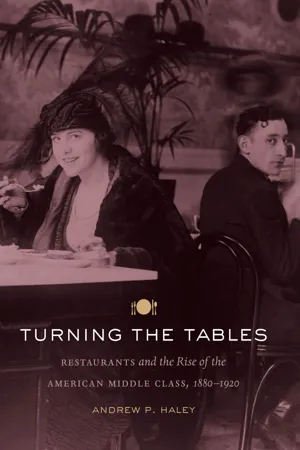
In the nineteenth century, restaurants served French food to upper-class Americans with aristocratic pretensions, but by the turn of the century, even the best restaurants cooked ethnic and American foods for middle-class urbanites. In Turning the Tables, Andrew P. Haley examines how the transformation of public dining that established the middle class as the arbiter of American culture was forged through battles over French-language menus, scientific eating, cosmopolitan cuisines, unescorted women, un-American tips, and servantless restaurants.
eBook - ePub
Turning the Tables
Restaurants and the Rise of the American Middle Class, 1880-1920
- 376 pages
- English
- ePUB (mobile friendly)
- Available on iOS & Android
eBook - ePub
About this book
Information
1 TERRAPIN À LA MARYLAND
The Era of the Aristocratic Restaurant
In 1842, Charles Dickens visited the United States and left unimpressed. He was received warmly; as Dickens admitted, “There never was a King or Emperor upon the Earth, so cheered, and followed by crowds, and entertained in Public at splendid balls and dinners.” The admiration, however, was not mutual.1 While Dickens’s feelings toward America ultimately soured over copyright law, in his autobiographical account of the trip, American Notes, and his subsequent novel, Martin Chuzzlewit, the great democracy’s eating habits were singled out for ridicule:
The poultry, which may perhaps be considered to have formed the staple of the entertainment—for there was a turkey at the top, a pair of ducks at the bottom, and two fowls in the middle—disappeared as rapidly as if every bird had had the use of its wings, and had flown in desperation down a human throat. . . . Great heaps of indigestible matter melted away as ice before the sun. It was a solemn and awful thing to see. Dyspeptic individuals bolted their food in wedges; feeding, not themselves, but broods of night-mares, who were continually standing at livery with them. Spare men, with lank and rigid cheeks, came out unsatisfied from the destruction of the heavy dishes, and glared with watchful eyes upon the pastry.2
Dickens, whose aspirations to respectability included a love of French cuisine, found the culinary life of America barbarous.
The American public was not amused by lurid descriptions of its dining habits, and a heated, transcontinental exchange of barbs ensued. Encapsulating the views of the harshest of Dickens’s American critics, editor and poet Park Benjamin Sr. wrote in The New World, “Mr. Dickens, whatever may be his merits as a writer, is, as will readily be admitted by those who have been most in his society, a low-bred vulgar man.”3 But the public outcry only made Dickens more recalcitrant. “I have nothing to defend, or to explain away,” the aggrieved author added in a new preface to American Notes published in 1850. “The truth is the truth; and neither childish absurdities, nor unscrupulous contradictions, can make it otherwise.”4
Twenty-five years later, Dickens returned to the United States. The trip, intended to secure Dickens’s financial future, was carefully managed to protect the aging author’s frail health. Dickens attended only one public dinner, spent most of his time in Boston and New York, and reserved ample time to rest privately in his hotels. His hosts made every effort, grudgingly or not, to demonstrate that the United States of 1867–68 was a very different place from the young country that Dickens had encountered in 1842. Gone were the pesky reminders of democratic unruliness, from the gargantuan, disordered meals to the slinging of tobacco juice, and in their place was a new, distinctly European refinement. In New York, Dickens was housed at the Parisian Westminster Hotel, where he had exclusive use of the back stairs and a French waiter, the former to protect his privacy and the latter to flatter his appetites. And when Dickens eventually consented to a public dinner, it was not surprising that it took place at Delmonico’s, the nation’s most European restaurant, where French cuisine—and only French cuisine—was served.5 Perhaps the gambit worked. At the dinner at Delmonico’s, Dickens offered a surprising (and, admittedly, financially opportune) retraction of his previous libels. “I have been received with unsurpassable politeness, delicacy, sweet temper, hospitality, consideration, and with unsurpassable respect for the privacy daily enforced upon me by the nature of my avocation here and the state of my health,” Dickens proclaimed to an enthusiastic crowd of reporters and dignitaries. Given these “gigantic changes,” Dickens resolved that “so long as I live, and so long as my descendants have any legal right in my books,” those books would include an appendix testifying to his revised opinion of America.6
It would be folly to ascribe Dickens’s change of heart to any one cause. He hoped to repair a costly rift with the book-buying American public, and undoubtedly his revised sentiments were a byproduct of his restricted itinerary. Still, Charles Dickens, like most people of means in Europe, equated a country’s civilization with its culinary fare, and perhaps nothing better symbolized the new America that Dickens admired than the ready availability of French cuisine. His American hosts understood this. Instead of the massive hotel dinners featuring as many as seventy dishes with which he was feted during his first visit, immigrant chefs renowned for their mastery of French cuisine prepared his farewell dinner at Delmonico’s. And, as a correspondent for the Boston Transcript noted, it was when Dickens spoke of “gigantic changes” in the “graces and amenities” of American life that “every man rose to his feet and acknowledged by loud hurrahs the compliment so beautifully expressed.”7
In the decades that followed Dickens’s second trip to the United States, members of America’s elite became more refined in their tastes and more imitative in their aspirations. Unprecedented economic opportunities following the Civil War created a wealthy class of capitalists who, seeking to distinguish themselves in a democratic nation that had traditionally spurned class distinction, turned to Europe to find markers of their social standing. Along with imported marble, Old Master paintings, and haute couture, they imported French culinary culture (and the chefs and waiters required to prepare and serve it). By the end of the century, French cuisine dominated the menus of the best restaurants and, supported by the economic and cultural elite, gained hegemonic status. French cuisine was the best, and Americans, if they had any taste at all, wanted to eat French food.8
The American Aristocracy
By the second half of the nineteenth century, an American aristocracy of wealth dominated the cultural contours of consumption. The growth of large cities, the mass arrival of cheap immigrant labor, and the concentration of large-scale business enterprises in the hands of a few made unprecedented luxury possible; the dour egalitarian ideals that had suppressed extravagant displays of wealth in the days of the early Republic were a distant memory. The Gilded Age was a period of conspicuous consumption, the heyday of aristocratic culture.
Only 1 or 2 percent of the population, buoyed by America’s four thousand millionaires, was rich, but these capitalists, merchants, manufacturers, and landowners controlled 27 percent of the nation’s wealth by 1870.9 Although the distribution of wealth is difficult to measure between 1880 (when census takers stopped asking about real estate and personal property) and the introduction of the income tax in 1913, it was widely believed at the time that the economic equality that characterized Toqueville’s America was quickly fading as the eastern capitalist establishment consolidated its control of the nation’s riches. Recent economic studies lend credence to these beliefs.10
Money made the capitalist, but wealth alone did not make the American aristocrat. Historian Michael E. McGerr argues that the wealthy were a homogenous group with a shared history and shared values. They were primarily of English descent, Protestant, from middle-and upper-income families, and generally college graduates. “Above all,” McGerr observed, “the upper ten shared a fundamental understanding about the nature of the individual. Glorifying the power of the individual will, the wealthy held to an uncompromising belief in the necessity of individual freedom.”11 Yet these were intangible characteristics and hardly exclusive to the wealthiest Americans. To distinguish themselves publicly, members of the upper class engaged in unprecedented conspicuous consumption. In the years that followed the Civil War, American elites invested their surplus wealth in mansions, fancy balls, extravagant dinners, elaborate carriages, charities, and collections of paintings.12 Not every newly minted businessman sought the social sanction that prodigal spending might bring, but a significant number—calling themselves “Society”—did, and once “Society” had taken root, it inspired competition and even more extravagant acts of splendor. Consumption, particularly the conspicuous consumption that economist Thorstein Veblen described in 1899, was an honorific investment in social reputation, an effort to secure membership in elite society through the purchase of the right address, the right clothes, and the right table at a restaurant.13
Lavish consumption had a practical purpose. Elaborate spending, and the standards of taste and imposed exclusivity that accompanied it, created bonds among the men and women of old wealth and pedigree (in their vernacular, the “nobs”) and the industrial magnates whose fortunes were less than a generation old (the “swells”).14 In their private dining rooms, these wealthy Americans enacted the intricate parlor games that settled their internecine claims to status and secured their place in local blue books. Arbitrary but acknowledged distinctions, the stuff of Edith Wharton novels, determined who belonged and who did not. But it was in public venues—opera houses, restaurants, theaters—that subtle distinctions in food, clothing, and manners were transformed into public declarations of class membership. Extravagant spending, conspicuous leisure, and sanctioned manners established the legitimacy (and the hegemonic sway) of wealthy Americans’ claim to aristocracy.15
An early historian of society life noted that New York elites (and, for that matter, Pittsburgh, Chicago, and San Francisco elites) were “frantically eager to adopt any earmarks of social distinction.”16 But the rapid growth of the ranks of America’s millionaires in the late nineteenth century posed a challenge for any aristocrat seeking to demonstrate success through conspicuous consumption. A relatively young nation without a history of aristocracy, America had failed to develop homegrown accoutrements of wealth, the socially certified markers of aristocracy.17 American fashions, paintings, architecture, and cuisine, the traditional indicators of honorific value and economic success, were, at best, in their infancy. For those Americans who chose to be conspicuous in their spending, it was necessary to look to Europe, where an authentic, hereditary nobility set the standard for what constituted enviable wealth. By the late nineteenth century, wealthy Americans were purchasing dresses in France, paintings in England and Italy, and titles in Spain, and were also eagerly embracing European manners and cuisine.18 As French novelist Paul Bourget wrote after visiting the United States in 1893, “[American millionaires] do not admit they are different from the Old World, or if they admit it, it is to insist that if they chose they could equal the Old World, or, at least, enjoy it.”19
Aristocratic Dining
By the mid-nineteenth century, adventurous visitors to America’s cities could find rough taverns serving beefsteaks, pie, and beer as well as exotic Italian restaurants featuring spaghetti, olive oil, and—shockingly!—garlic. Yet this diversity belied America’s culinary orthodoxy. Like their counterparts throughout Europe, wealthy Americans demanded French cuisine prepared by French chefs and served by professional waiters who knew how to flatter their patrons.
FRENCH RESTAURANTS
French cuisine had not always been the hallmark of excellence in the United States, although it had always signaled pretension. Historian Dixon Wecter noted that in the 1780s, Philadelphia society was “startled” by Mrs. William Bingham’s Francophile “innovations” at dinner parties, and contemporary chroniclers noted “a prejudice against dishes with French names.”20 As late as the 1820s and 1830s, Americans looked to England more than France for guidance regarding correct culinary fashions (ignoring, apparently, the growing importance of French cuisine in London), and French restaurants were familiar only to the most fastidious residents of a few American cities, including New York and Philadelphia.21 But in the years just prior to and immediately following the American Civil War, as the Industrial Revolution churned out steel, jute, and millionaires, French cuisine transformed the upper-class menu.22 In 1857, August Belmont, the wealthiest of New York’s parvenus, caused a sensation when he hired a French chef for his private home, and a few years later, Pierre Blot—a transplanted Frenchman and author of What to Eat and How to Cook It—opened a cooking academy in New York dedicated to spreading the gospel of French cuisine among the city’s fashionable families.23 Trips to Europe on the “Grand Tour” further stimulated the elites’ interest in French fashions and cuisine, and soon New York’s millionaires were offering exorbitant salaries to lure French chefs (many of whom were actually Swiss or Austrian) to the United States. As New York’s late-nineteenth-century cultural arbiter Ward McAllister wrote in Society as I Have Known It, “The French chef then literally, for the first time, made his appearance, and artistic dinners replaced the old-fashioned, solid repasts of the earlier period.”24
Delmonico’s restaurant in New York set the national standard.25 Founded by Swiss immigrants in the 1820s, Delmonico’s brought French restaurant cuisine to the United States. Sam Ward, banker and bon vivant, recalled the first Delmonico’s restaurant, located on William Street in the business district, as a “primitive little café” with excellent food and “prompt and deferential attendance, unlike the democratic nonchalance of [its rivals].”26 Yet if the atmosphere was “primitive,” the menu was not. An 1838 menu—printed in both French and English—was ten pages long (excluding the wine menu) and featured such dishes as Pâté de volaille aux truffes (described as Chicken Pie with Truffles) and Salmi de becasse (Woodcock Salmi).27
“Del’s,” as the restaurant was affectionately called, grew in pretension as New York emerged as the nation’s capital of capitalists. By midcentury, Delmonico’s cuisine was celebrated throughout the United States and in Europe. In an 1848 New York Daily Tribune article extolling the virtues of Delmonico’s (at a time when French food was still a novelty), reporter George F...
Table of contents
- Cover Page
- TURNING THE TABLES
- Copyright Page
- CONTENTS
- ILLUSTRATIONS
- ACKNOWLEDGMENTS
- NOTE ON LANGUAGE
- INTRODUCTION THE TANG AND FEEL OF THE AMERICAN EXPERIENCE
- 1 TERRAPIN À LA MARYLAND
- 2 PLAYING AT MAKE BELIEVE
- 3 CATERING TO THE GREAT MIDDLE STRIPE
- 4 THE RESTAURATION
- 5 THE SIMPLIFIED MENU
- 6 SATISFYING THEIR HUNGER
- 7 THE TIPPING EVIL
- 8 ENDING LINGUISTIC DISGUISES
- CONCLUSION INDIFFERENT GULLETS
- NOTES
- BIBLIOGRAPHY
- INDEX
Trusted by 375,005 students
Access to over 1.5 million titles for a fair monthly price.
Study more efficiently using our study tools.
Frequently asked questions
Yes, you can cancel anytime from the Subscription tab in your account settings on the Perlego website. Your subscription will stay active until the end of your current billing period. Learn how to cancel your subscription
No, books cannot be downloaded as external files, such as PDFs, for use outside of Perlego. However, you can download books within the Perlego app for offline reading on mobile or tablet. Learn how to download books offline
Perlego offers two plans: Essential and Complete
- Essential is ideal for learners and professionals who enjoy exploring a wide range of subjects. Access the Essential Library with 800,000+ trusted titles and best-sellers across business, personal growth, and the humanities. Includes unlimited reading time and Standard Read Aloud voice.
- Complete: Perfect for advanced learners and researchers needing full, unrestricted access. Unlock 1.5M+ books across hundreds of subjects, including academic and specialized titles. The Complete Plan also includes advanced features like Premium Read Aloud and Research Assistant.
We are an online textbook subscription service, where you can get access to an entire online library for less than the price of a single book per month. With over 1.5 million books across 990+ topics, we’ve got you covered! Learn about our mission
Look out for the read-aloud symbol on your next book to see if you can listen to it. The read-aloud tool reads text aloud for you, highlighting the text as it is being read. You can pause it, speed it up and slow it down. Learn more about Read Aloud
Yes! You can use the Perlego app on both iOS and Android devices to read anytime, anywhere — even offline. Perfect for commutes or when you’re on the go.
Please note we cannot support devices running on iOS 13 and Android 7 or earlier. Learn more about using the app
Please note we cannot support devices running on iOS 13 and Android 7 or earlier. Learn more about using the app
Yes, you can access Turning the Tables by Andrew P. Haley in PDF and/or ePUB format, as well as other popular books in History & 20th Century History. We have over 1.5 million books available in our catalogue for you to explore.