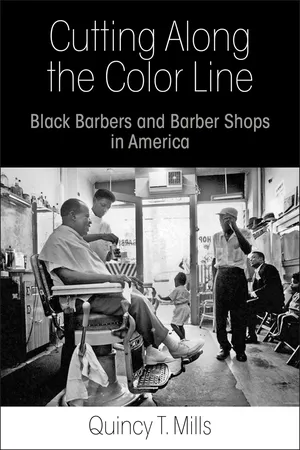
Today, black-owned barber shops play a central role in African American public life. The intimacy of commercial grooming encourages both confidentiality and camaraderie, which make the barber shop an important gathering place for African American men to talk freely. But for many years preceding and even after the Civil War, black barbers endured a measure of social stigma for perpetuating inequality: though the profession offered economic mobility to black entrepreneurs, black barbers were obliged by custom to serve an exclusively white clientele. Quincy T. Mills traces the lineage from these nineteenth-century barbers to the bustling enterprises of today, demonstrating that the livelihood offered by the service economy was crucial to the development of a black commercial sphere and the barber shop as a democratic social space.
Cutting Along the Color Line chronicles the cultural history of black barber shops as businesses and civic institutions. Through several generations of barbers, Mills examines the transition from slavery to freedom in the nineteenth century, the early twentieth-century expansion of black consumerism, and the challenges of professionalization, licensing laws, and competition from white barbers. He finds that the profession played a significant though complicated role in twentieth-century racial politics: while the services of shaving and grooming were instrumental in the creation of socially acceptable black masculinity, barbering permitted the financial independence to maintain public spaces that fostered civil rights politics. This sweeping, engaging history of an iconic cultural establishment shows that black entrepreneurship was intimately linked to the struggle for equality.
- 336 pages
- English
- ePUB (mobile friendly)
- Available on iOS & Android
eBook - ePub
About this book
Information
Table of contents
- Cover Page
- Title Page
- Copyright Page
- Dedication Page
- Contents
- Preface
- Introduction
- Part I. Barbering in Slavery and Freedom
- Part II. Black Barbers, Patrons, and Public Spaces
- Epilogue
- Notes
- Index
- Acknowledgments
Trusted by 375,005 students
Access to over 1.5 million titles for a fair monthly price.
Study more efficiently using our study tools.
Frequently asked questions
Yes, you can cancel anytime from the Subscription tab in your account settings on the Perlego website. Your subscription will stay active until the end of your current billing period. Learn how to cancel your subscription
No, books cannot be downloaded as external files, such as PDFs, for use outside of Perlego. However, you can download books within the Perlego app for offline reading on mobile or tablet. Learn how to download books offline
Perlego offers two plans: Essential and Complete
- Essential is ideal for learners and professionals who enjoy exploring a wide range of subjects. Access the Essential Library with 800,000+ trusted titles and best-sellers across business, personal growth, and the humanities. Includes unlimited reading time and Standard Read Aloud voice.
- Complete: Perfect for advanced learners and researchers needing full, unrestricted access. Unlock 1.5M+ books across hundreds of subjects, including academic and specialized titles. The Complete Plan also includes advanced features like Premium Read Aloud and Research Assistant.
We are an online textbook subscription service, where you can get access to an entire online library for less than the price of a single book per month. With over 1.5 million books across 990+ topics, we’ve got you covered! Learn about our mission
Look out for the read-aloud symbol on your next book to see if you can listen to it. The read-aloud tool reads text aloud for you, highlighting the text as it is being read. You can pause it, speed it up and slow it down. Learn more about Read Aloud
Yes! You can use the Perlego app on both iOS and Android devices to read anytime, anywhere — even offline. Perfect for commutes or when you’re on the go.
Please note we cannot support devices running on iOS 13 and Android 7 or earlier. Learn more about using the app
Please note we cannot support devices running on iOS 13 and Android 7 or earlier. Learn more about using the app
Yes, you can access Cutting Along the Color Line by Quincy T. Mills in PDF and/or ePUB format, as well as other popular books in History & North American History. We have over 1.5 million books available in our catalogue for you to explore.