- 383 pages
- English
- ePUB (mobile friendly)
- Available on iOS & Android
eBook - ePub
About this book
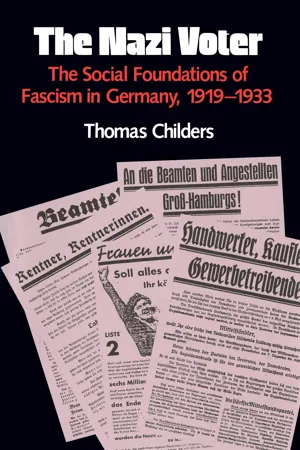
The first study based on a large national sample of both urban and rural districts examines the Nazi constituency — how it was formed, from which social groups, under what conditions, and with what promises. Using advanced statistical techniques to analyze each national election of the Weimar era, Childres offers a new and challenging interpretation of who voted for Hitler's NSDAP and why. He also provides a systematic examination of Nazi campaign strategy.
Information
Notes
Introduction
1. Karl Dietrich Bracher, Die Deutsche Diktatur, pp. 166–67.
2. This theme is widely developed in the literature. Among the more prominent examples are: Theodor Geiger, “Panik im Mittelstand,” pp 637ff.; Harold D. Lasswell, “The Psychology of Hitlerism,” p. 374; Franz Neumann, Behemoth. The Structure and Practice of National Socialism 1933–1944, p. 411; Hans Rudolf Roeske, Faschismus: Soziale Herkunft und Soziale Funktion p. 54; Svend Ranulf, Moral Indignation and Middle Class Psychology, pp. 8–9. Marxist examinations of fascism have traditionally shown little inclination to investigate the popular bases of the NSDAP, preferring instead structural analyses of interest conflict in the capitalist system. Yet, while rejecting the conceptual framework of the major bourgeois interpretations, Marxist analysts, too, have isolated the social locus of Nazi support in the lower middle class. See, for example, Manfred Clemenz, Gesellschaftliche Ursprünge des Faschismus, p. 96; and David Abraham, The Collapse of the Weimar Republic, p. 324.
3. William Kornhauser, The Politics of Mass Society, p. 180.
4. Hannah Arendt, The Origins of Totalitarianism, p. 323.
5. Seymour Martin Lipset, “Fascism—Left, Right, and Center.” See also Alexander Weber, “Soziale Merkmale der NSDAP-Wähler. Eine Zusammenfassung bisheriger empirischen Untersuchungen und eine Analyse in den Gemeinden der Länder Baden und Hessen” and Sammuel A. Pratt, “The Social Bases of Nazism and Communism in Urban Germany. A Correlation Study of the July 31, 1932, Reichstag Election in Germany.”
6. Proceeding chronologically, see David A. Hackett, “The Nazi Party in the Reichstag Election of 1930”; Loren K. Waldman, “Models of Mass Movements—The Case of the Nazis”; Dee Richard Wernette, “Political Violence and German Elections: 1930 and July 1932”; James P. Madden, “The Social Composition of the Nazi Party, 1919–1930”; Thomas Childers, “The Social Bases of Electoral Politics in Urban Germany, 1919–1933”; Childers, “The Social Bases of the National Socialist Vote”; Childers, “National Socialism and the New Middle Class”; and finally, Richard F. Hamilton, Who Voted for Hitler? An excellent critical summary of much of this literature is found in Jürgen W. Falter, “Wer verhalf der NSDAP zum Sieg?”
7. Hackett, for example, deals only with the 1930 election, Wernette with the 1930 and 1932 campaigns. Hamilton’s more recent work analyzes only the July elections of 1932, with cursory descriptions of previous elections. The older literature is equally limited chronologically. See, for example, Pratt, “The Social Bases”; and James K. Pollock, “An Areal Study of the German Electorate, 1930–1933.”
8. See Thomas Childers, “Inflation, Stabilization, and Political Realignment in Germany, 1924–1928.” See also the works of Larry Eugene Jones, “‘The Dying Middle’: Weimar Germany and the Fragmentation of Bourgeois Politics”; “Inflation, Revaluation, and the Crisis of Middle-Class Politics: A Study of the Dissolution of the German Party System, 1923–1928”; and “The Dissolution of the Bourgeois Party System in the Weimar Republic.”
9. See, for example, Werner Kaltefleiter, Wirtschaft und Politik in Deutschland pp. 32–34; and Heinrich Bennecke, Wirtschaftliche Depression und politischer Radikalismus, 1918–1938, pp. 42–55.
10. Hamilton’s work, for example, is based on a sample of only thirteen of the country’s largest cities. And Hackett confines his analysis to Berlin and Bavaria. Hamilton, Who Voted for Hitler? pp. 64–219, and Hackett, “The Nazi Party in the Reichstag Election of 1930,” pp. 403–31. Pratt’s sample is national in scope but limited to cities with over 20,000 inhabitants, thus ignoring the small towns and rural areas where over half the German population lived. Pratt, “The Social Bases,” pp. 60–80. The still very useful study of Charles P. Loomis and J. Allan Beegle, “The Spread of German Nazism in Rural Areas,” is, on the other hand, limited to the rural areas of Schleswig-Holstein, Hannover, and Bavaria.
11. Among the most noteworthy are William S. Allen, The Nazi Seizure of Power; Rudolf Heberle’s classic, Landesbevölkerung und Nationalsozialismus; Jeremy Noakes, The Nazi Party in Lower Saxony, 1921–1933; Herb Kühr, Parteien und Wahlen in Stadt- und Landkreis Essen in der Zeit der Weimarer Republik; Günther Plum, Gesellschaftsstruktur und politisches Bewusstsein in einer katholischen Region, 1928–1933; and Wilfried Böhnke, Die NSDAP im Ruhrgebiet, 1920–1933.
12. See Nils Diederich, Empirische Wahlforschung, p. 25.
13. Statistik des Deutschen Reichs, 408:112–15.
14. For a useful summary of the occupational categories of the census, see ibid., 102:98–100, 123–91.
15. Although a number of cities reported their returns by borough, census figures for those boroughs were not recorded. Only in the Reich’s two largest cities, Berlin and Hamburg, are both sets of figures available. As a result, Hamilton, who attempts to analyze the Nazi vote by neighborhood in several other cities, is compelled to make highly impressionistic assumptions about the social composition of those areas under examination. Hamilton, Who Voted for Hitler? pp. 129–219.
16. The literature on “ecological fallacy” is truly mammoth. Among the more useful are: W. S. Robinson, “Ecological Correlations and the Behavior of Individuals”; Leo A. Goodman, “Some Alternatives to Ecological Correlation”; W. P. Shively, “‘Ecological’ Inference: The Use of Aggregate Data to Study Individuals”; Mattei Dogan and Stein Rokkan, eds., Quantitative ‘Ecological’ Analysis in the Social Sciences; Allan J. Lichtman, “Correlation, Regression, and the Ecological Fallacy: A Critique” and J. Morgan Kousser, “Ecological Regression and the Analysis of Past Politics.”
17. See, for example, Theodor Geiger, Die soziale Schichtung des deutschen Volkes, pp. 72–138.
18. See, for example, the treatment of social background found in the 1927 survey of its membership by the liberal white-collar union, the GdA, and in the official measurement of social background used in the university statistics reported regularly in the Vierteljahreshefte zur Statistik des Deutschen Reichs. In both instances, the standard measurement was occupation of father. See Die wirtschaftliche und soziale Lage der Angestellten.
19. Robert Michels, Umschichtungen in den herrschenden Klassen nach dem Kriege, pp. 104–5; on the role of occupation, see Talcott Parsons, “Democracy and Social Structure in Pre-Nazi G...
Table of contents
- Cover Page
- The Nazi Voter
- Copyright Page
- Dedication
- Contents
- Abbreviations
- Acknowledgments
- Introduction
- I The Sociology of German Electoral Politics, 1871–1924
- II Inflation and Stabilization: The Elections of 1924
- III Disintegration and Crisis: The Elections of 1928 and 1930
- IV Polarization and Collapse: The Elections of 1932
- Conclusion
- Appendix I
- Appendix II
- Appendix III
- Notes
- Bibliography
- Index
Trusted by 375,005 students
Access to over 1.5 million titles for a fair monthly price.
Study more efficiently using our study tools.
Frequently asked questions
Yes, you can cancel anytime from the Subscription tab in your account settings on the Perlego website. Your subscription will stay active until the end of your current billing period. Learn how to cancel your subscription
No, books cannot be downloaded as external files, such as PDFs, for use outside of Perlego. However, you can download books within the Perlego app for offline reading on mobile or tablet. Learn how to download books offline
Perlego offers two plans: Essential and Complete
- Essential is ideal for learners and professionals who enjoy exploring a wide range of subjects. Access the Essential Library with 800,000+ trusted titles and best-sellers across business, personal growth, and the humanities. Includes unlimited reading time and Standard Read Aloud voice.
- Complete: Perfect for advanced learners and researchers needing full, unrestricted access. Unlock 1.5M+ books across hundreds of subjects, including academic and specialized titles. The Complete Plan also includes advanced features like Premium Read Aloud and Research Assistant.
We are an online textbook subscription service, where you can get access to an entire online library for less than the price of a single book per month. With over 1.5 million books across 990+ topics, we’ve got you covered! Learn about our mission
Look out for the read-aloud symbol on your next book to see if you can listen to it. The read-aloud tool reads text aloud for you, highlighting the text as it is being read. You can pause it, speed it up and slow it down. Learn more about Read Aloud
Yes! You can use the Perlego app on both iOS and Android devices to read anytime, anywhere — even offline. Perfect for commutes or when you’re on the go.
Please note we cannot support devices running on iOS 13 and Android 7 or earlier. Learn more about using the app
Please note we cannot support devices running on iOS 13 and Android 7 or earlier. Learn more about using the app
Yes, you can access The Nazi Voter by Thomas Childers in PDF and/or ePUB format, as well as other popular books in History & German History. We have over 1.5 million books available in our catalogue for you to explore.