eBook - ePub
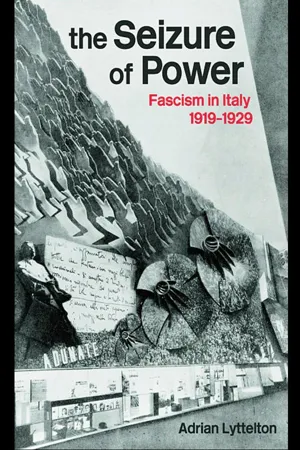
The Seizure of Power
Fascism in Italy, 1919-1929
- 576 pages
- English
- ePUB (mobile friendly)
- Available on iOS & Android
eBook - ePub
About this book
This volume is a study of Fascism in its country of origin, Italy. It describes the impact of a new type of political movement on Italian government and society. The Fascist seizure of power did not begin or end with Mussolini's famous March on Rome in 1922; it was achieved rather by gradual subversion of the liberal order, which involved not only the destruction of all political opposition but also the creation of new institutions designed to control economic and cultural life. A classic work of wide-ranging scholarship, this book is here republished with a new preface by the author and will be essential reading for all students of Fascism and international history.
Information
1
INTRODUCTION
This is a study not of the origins of Fascism but of ‘the seizure of power’, a description which demands a further word of explanation. In Italy, in spite of the drama of the March on Rome, the subversion of the liberal order by Fascism was a piecemeal process, starting in 1921 and not concluded until 1928–9. So this is a study not just of the mechanics of a coup d’état, but of the impact of a new type of political movement on Italian government and society. It is intended not only to show the reasons for the success of Fascism in conquering political power, but also how that power, even at its greatest, was limited. Fascism had aspirations to be ‘totalitarian’; Mussolini virtually invented the term. But, leaving on one side the question of how far the totalitarian nightmare can ever be fully realized, it is clear that Mussolini’s grip on Italian society was not as firm, his influence so pervasive, as that of a Hitler or a Stalin. Fascism left huge areas of Italian life practically untouched. Nonetheless it would, in my opinion, be mistaken to believe that Fascism did not mark a sharp break in Italy’s development. Many men and even institutions from the liberal regime survived, but they had to fit into a new framework. In a modernizing society, a far-reaching change in the methods by which political power was exercised could not fail to have repercussions on economic and social and intellectual life.
I hope that this book will also be read as a modest contribution towards the general study of Fascism. Although my purpose is to relate the peculiar historical circumstances which made possible and conditioned the success of Italian Fascism, the reader should be warned that the movement cannot be viewed in correct perspective if the European dimension of Fascism is not kept in mind. Fascism was, after all, more characteristic of an age than of any one nation or people. National character and national history may certainly provide explanations for the differences between the Fascists, the Nazis and the Iron Guard; but it would be rash to say that they had no features in common. The Fascists themselves, heirs to romantic nationalism, were fond of asserting the absolute individuality of race or nation, and therefore of their own movements, but one should not take these assertions as gospel, any more than the student of ‘international Communism’ should overlook the influence of national traditions.
Fascism and Italian History
The Italian historian Gaetano Salvemini was among the first to fight against the conception of Fascism as a peculiar product of the Italian national character. It must be admitted that this view has always been popular in England. While our amour propre is certainly flattered by foreign imitation of our models of government, we have generally viewed defections from democracy with an odd complacency. They confirmed, after all, the peculiar virtues of our own institutions and character. Even a distinguished historian like G.M. Trevelyan did not altogether help to correct the popular view of Italian politics as a kind of synthesis of the national addictions to bel canto and the stiletto. Trevelyan saw ‘the historical causes of the present state of affairs in Italy’ as residing in the unbroken millennial continuity of the politics of the piazza: ‘Italy never had a Hampden’, and without our ‘obscure hereditary instinct’ for parliamentary government, it was natural that the Italian constitutional experiment should have failed. Similar explanations, although they may often contain incidental aperçus, will not really do: the victory of National Socialism and the sporadic successes enjoyed by movements of the radical right even in the advanced democracies should have made it clear that Fascism was not just a part of Italian folklore.1
But it would be unfair to Trevelyan not to recognize that the tendency to see Fascism as the inevitable outcome of a long process of national decline was widespread also among Italian writers. The great publicist of Southern Italy, Giustino Fortunato, described Fascism as a revelation of the ancient vices and defects of Italy,2 and this line of interpretation has since usually been known as the ‘revelation thesis’. This pessimistic view of Italian history has been chiefly concerned to explain the failure of the mass of the Italian people to resist Fascism, rather than their active participation. Moralists saw the success of Fascism as dependent upon the attitudes of passive resignation, conformity and subservience to power prevalent among the majority; they traced these attitudes above all to two causes, poverty and Catholicism. For Piero Gobetti, the brilliant young theorist of the ‘liberal revolution’, it was the failure to develop an idea of individual moral responsibility, due to the lack of a Reformation, which made the Italians unfitted for self-government.3 Other writers, like G.A.Borgese, put the accent on the unrealistic yearning after Roman glories. Borgese described ‘the Italian disease’ as a combination of cultural megalomania with a political and military inferiority complex. ‘Too stubbornly, for too long have the Italians entertained the queerest and most distorted ideas about themselves and others. They have thought themselves a nation of geniuses in a universe of dunces, and a mass of cowards in a world of the brave.’4
There is a danger in this type of interpretation, revealing though it may sometimes be. If one sees Fascism as the inevitable result of Italy’s backwardness, or of the Italian volksgeist, one is in fact conceding the case made by the regime’s apologists, who argued that democracy was a foreign import which had proved unrealistic and unsuitable in Italy.5 Modern Italian history is not an unbroken record of failure or stagnation; on the contrary, social change and the aspiration towards a more effective democracy were, paradoxically, necessary preconditions for the emergence of Fascism. The problem is, in fact, as Salvemini stated, why ‘the Italians felt the need to get rid of their free institutions exactly at the moment in which they should have been proud of the results achieved through them. One would rather have expected a step forward towards more advanced forms of democracy. How was it that at such a moment the Italians opened their doors to dictatorship?’6
One part of the explanation must be in the general European upheaval of the First World War. The interpretation of Fascism as the result of the First World War was carried furthest by Benedetto Croce when he described it as a ‘parenthesis’ in the history of Italy. Fascism-as-parenthesis and Fascism-as-revelation have been the two opposite poles of historical discourse about Fascism.7 The former substitutes Zeitgeist for Volksgeist as the covering explanation. There is some advantage in this: it has helped to distinguish Fascism from other types of dictatorship as a novel phenomenon. Croce’s own examination of the intellectual humus out of which Fascism grew showed that many of the ingredients of the Fascist mentality were not peculiar to Italy. No great nation altogether escaped the irrationalist trahison des clercs or the infatuations of imperialism. However the interpretation of Fascism as a ‘parenthesis’, or even, as Croce put it elsewhere, as a ‘moral malady’8 to which all Europe was subject, still leaves unexplained why it was in Italy that the movement first took root and won power.
The entry of Italy into the war was a meditated decision, and there is no doubt that in the minds of the statesmen responsible for intervention internal political motives were present. The governing class (or a part of it) was not just surprised by an external catastrophe but chose to go to meet it. Even the peculiar international position of Italy, a partner in 1914 of an alliance with her hereditary enemy, cannot simply be taken as a fact of nature.
Above all, the moral and even economic effects of the war cannot be divorced from the way in which Italy entered the contest in May 1915. In a real sense, Fascism itself was born in 1914–15; and the split between interventionists and neutralists produced a violent laceration of the political fabric, a bitterness of feeling, more characteristic of a civil than of a ‘national’ war. The divisions in the country and their consequences cannot be understood except in the light of the relationship, or lack of it, between the State and the mass of the Italian people.
This leads one back inevitably to the Risorgimento. Real historical controversy about the connection of Fascism with the Italian past, conducted at a level above that of the denunciation and the brilliant but unsupported intuition, has not gone further. Like all great political movements, the Risorgimento aroused more aspirations than it could fulfil. The Post-Risorgimento pessimism about Italy’s development which became so marked after 1880 has been well described by an American historian, J.A.Thayer.9 It is tempting to conclude that this cultural pessimism, resulting from anomie, was the real evil which give birth to Fascism. However though this is persuasive as an account of the origins of the Fascist mentality, it obviously leaves some of the most important questions unanswered. The cultural discontents of a handful of intellectuals and publicists (which were not unique to Italy) would not by themselves have overturned Italian democracy, and the permanent structural weaknesses which made the Italian polity vulnerable to Fascism cannot be ignored. The Post-Risorgimento critics were concerned with real as well as imagined deficiencies.
It may be unjust to speak of the Risorgimento as a ‘failed revolution’,10 since in one way or another it was bound to fall short of the extravagant and conflicting ambitions which were inseparably bound up with romantic nationalism. However it is still necessary to ask: what were the ‘failures’ and what were their consequences?
The earliest and most familiar form of the ‘failed revolution’ thesis goes back to the frustrations of the left, and in particular to the dramatic renunciation made by Garibaldi in favour of Victor Emmanuel 11, and its aftermath. National unity was not achieved by a great popular movement, ending in a republic, but was instead imposed from above by ‘royal conquest’.11 This democratic complaint was sometimes combined with the more nationalistic regret that Italian unity had owed so much to diplomacy and foreign help.
Secondly, the Risorgimento failed to satisfy hopes of religious and moral reform. These were not simply a peculiar aberration of Mazzini, with his ‘religion of humanity’; they were shared, although in a more sober and less pronounced form, by several of the statesmen of the Right. Underlying their concern was an objective problem of the utmost importance: the hostility of the Catholic Church to the new Italian state, and the hold which it had on popular feeling.
Thirdly, the Risorgimento was not a social revolution. There was no general redistribution of landed property, except between nobility and bourgeoisie. There was consequently also no mobilization of the masses (especially the peasants) in the service of the nation, and they did not identify their interests with the new State. Later writers emphasized the incompleteness of the Risorgimento even as a ‘bourgeois revolution’. The backwardness of Italian industrial and commercial development and the persistence of archaic semi-feudal relationships in the South were the proofs of the failure or immaturity of the Italian bourgeoisie.12 The lack of a well-developed modern class of entrepreneurs allowed the cultural and political predominance of a backward-looking, economically parasitic, humanistic tradition to remain unchallenged.13
The result of all these separate failures, it could be held, was one great deficiency: the continued lack of a widely diffused ‘civic culture’. Wavering between a superstitious conformity to religious authority and an anarchic individualism which expressed itself in violence and a disrespect for law, the average Italian had an inadequate conception both of his rights as citizen and his duties as subject. In so far as he had genuine political concerns, these tended to be local and factional in character. As I have already suggested, this is a one-sided and exaggerated picture: it would not hold good without qualification for 1870, let alone 1914. For a more balanced summary, one can turn to the historian Luigi Salvatorelli: ‘Whoever had drawn up a balance of Italian political development on the eve of the European War would have found that it marked a culminating point. Italy was in the process of creating a national, liberal and social democracy. There was, however, a general factor of weakness present in the still limited diffusion of political education, and in the consequent narrowness of the base of the ruling class.’14 A very brief look at the conditions of unification from this point of view will serve to set subsequent developments in perspective.
The liberals of the Risorgimento made it possible to govern a united Italy by means of parliamentary institutions. In a sense, this achievement owed a good deal not only to the skill of Cavour and his devotion to the liberal ideal, but to the relative weakness of the Piedmontese monarchy. The terms of the 1848 Statute, which conceded constitutional government to Piedmont, allowed the King freedom to choose and dismiss his ministers, while conceding control of finance to Parliament. This particular division of powers invited conflict and was unlikely to be a permanent solution. A similar situation existed in Prussia, and there, in the constitutional crisis of the early 1860s, it was parliamentary control of finance that was effectively sacrificed to the independence of the monarchy. In Italy the reverse was true: the 1852 Cavour ministry was virtually imposed by Parliament, and it succeeded in reorganizing the bureaucracy so that it answered to the ministers rather than the Crown.15 Two years later, the crisis provoked by the Government’s proposal to dissolve the monasteries seemed to give the King an excellent opportunity to recover the initiative. But he failed: and this turn of events was critical. It determined the liberal direction which Italian political development was to take, in contrast to that of Germany, even though the latter was by far the more socially homogeneous and developed society. The Piedmontese monarchy of the nineteenth century could not match the military glories of Prussia, or even Austria, and this was probably the decisive reason why various attempts to re-establish the Crown’s independence met with failure.16 However, this weakness also made the monarchy less effective as a symbol of national unity after 1860: and this could only have been compensated for by really strong popular feeling. But this was lacking; Mazzini’s ideal of democratic nationhood was not realized. Mazzini and many other democrats had not seen the Risorgimento as an isolated national movement, but as ‘the Italian prelude to a vast European movement of freedom and justice’.17 European, rather than just Italian, developments put an end to this dream: the failure of the 1848 revolutions, the dictatorship of Louis Napoleon and the Bismarckian solution to the unification of Germany made a narrowing of outlook inevitable. The sense of ‘mission’ remained, divorced from its original European context, and for the disciples of Mazzini there was a strong temptation to view it in exclusively nationalist terms.
In Italy itself, the decisive failure of the democrats was in 1848 rather than 1860. During the intervening period the Piedmontese and monarchist solution had steadily gained in prestige. But the democratic movement retained enough strength to make the moderates, who controlled the process of unification, uneasy: Garibaldi’s expedition, if it made unity possible, was also a threat. The moderates’ fears led to a hardening of their attitude to the problems of the organization of the new state. An ‘unconditional unitarianism’ took the place of an earlier willingness to consider regional claims and differences.18 This was indeed only part of a wider tendency to stress the ideals of order and authority at the expense of liberty: the balance of Italian liberalism shifted to the right. It is true that this involution was the subject of vigorous and open criticism, which was not denied political expression and contributed to the eventual victory of the left in 1876. However the important fact is that the early years of the new state created a pattern of institutions and practices which were hard to change, and which often acted as a brake on further development. Analogies have been drawn between the unification of Italy and that of Germany: in both cases the union was formally carried out by dynastic rather than democratic methods. But the differences are more important than the similarities. The victory of Prussia meant the triumph of the authoritarian east over the more democratic south and west of Germany; Italy, on the other hand, was unified by the most progressive state in the peninsula. Piedmont had had a constitution since 1848, and it was one of the most prosperous regions in Italy, with easily the highest literacy rates. The progress of Piedmontese society gave a firm basis to the development of liberal political institutions and political thought which was elsewhere lacking.19 In particular, the political thought of Southern liberalism put stronger emphasis on the action of the State as a power above society and less on civil liberties.20
The effects of the encounter with the Southern political tradition were paralleled by the effects of the discovery of the real South, in its misery and ignorance. Cavour and the moderates ha...
Table of contents
- Cover Page
- Title Page
- Copyright Page
- Preface
- Back to the Future?: Coming to Terms With Italy’s Fascist Past
- Series Editor’s Preface
- 1. Introduction
- 2. The Crisis of the Liberal State
- 3. The Rise of the Fascist Movement
- 4. The March On Rome
- 5. Mussolini and His Allies
- 6. Normalization
- 7. The Party and the State (I)
- 8. The Party and the State (II)
- 9. Employers and Unions
- 10. The Matteotti Crisis
- 11. The Defeat of the Party
- 12. The Origins of the Corporate State
- 13. The Fascist Economy
- 14. Ideology and Culture
- 15. Propaganda and Education
- 16. The Regime
- 17. Afterword
- Abbreviations
- Notes
- Bibliography
Trusted by 375,005 students
Access to over 1.5 million titles for a fair monthly price.
Study more efficiently using our study tools.
Frequently asked questions
Yes, you can cancel anytime from the Subscription tab in your account settings on the Perlego website. Your subscription will stay active until the end of your current billing period. Learn how to cancel your subscription
No, books cannot be downloaded as external files, such as PDFs, for use outside of Perlego. However, you can download books within the Perlego app for offline reading on mobile or tablet. Learn how to download books offline
Perlego offers two plans: Essential and Complete
- Essential is ideal for learners and professionals who enjoy exploring a wide range of subjects. Access the Essential Library with 800,000+ trusted titles and best-sellers across business, personal growth, and the humanities. Includes unlimited reading time and Standard Read Aloud voice.
- Complete: Perfect for advanced learners and researchers needing full, unrestricted access. Unlock 1.5M+ books across hundreds of subjects, including academic and specialized titles. The Complete Plan also includes advanced features like Premium Read Aloud and Research Assistant.
We are an online textbook subscription service, where you can get access to an entire online library for less than the price of a single book per month. With over 1.5 million books across 990+ topics, we’ve got you covered! Learn about our mission
Look out for the read-aloud symbol on your next book to see if you can listen to it. The read-aloud tool reads text aloud for you, highlighting the text as it is being read. You can pause it, speed it up and slow it down. Learn more about Read Aloud
Yes! You can use the Perlego app on both iOS and Android devices to read anytime, anywhere — even offline. Perfect for commutes or when you’re on the go.
Please note we cannot support devices running on iOS 13 and Android 7 or earlier. Learn more about using the app
Please note we cannot support devices running on iOS 13 and Android 7 or earlier. Learn more about using the app
Yes, you can access The Seizure of Power by Professor Adrian Lyttelton,Adrian Lyttelton in PDF and/or ePUB format, as well as other popular books in Storia & Storia italiana. We have over 1.5 million books available in our catalogue for you to explore.