Appalachia on Our Mind is not a history of Appalachia. It is rather a history of the American idea of Appalachia. The author argues that the emergence of this idea has little to do with the realities of mountain life but was the result of a need to reconcile the “otherness” of Appalachia, as decribed by local-color writers, tourists, and home missionaries, with assumptions about the nature of America and American civilization.
Between 1870 and 1900, it became clear that the existence of the “strange land and peculiar people” of the southern mountains challenged dominant notions about the basic homogeneity of the American people and the progress of the United States toward achiving a uniform national civilization. Some people attempted to explain Appalachian otherness as normal and natural — no exception to the rule of progress. Others attempted the practical integration of Appalachia into America through philanthropic work. In the twentieth century, however, still other people began questioning their assumptions about the characteristics of American civilization itself, ultimately defining Appalachia as a region in a nation of regions and the mountaineers as a people in a nation of peoples.
In his skillful examination of the “invention” of the idea of Appalachia and its impact on American thought and action during the early twentieth century, Mr. Shapiro analyzes the following: the “discovery” of Appalachia as a field for fiction by the local-color writers and as a field for benevolent work by the home missionaries of the northern Protestant churches; the emergence of the “problem” of Appalachia and attempts to solve it through explanation and social action; the articulation of a regionalist definition of Appalachia and the establishment of instituions that reinforced that definition; the impact of that regionalistic definition of Appalachia on the conduct of systematic benevolence, expecially in the context of the debate over child-labor restriction and the transformation of philanthropy into community work; and the attempt to discover the bases for an indigenous mountain culture in handicrafts, folksong, and folkdance.
eBook - ePub
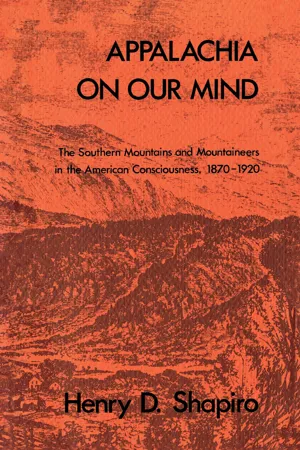
Appalachia on Our Mind
The Southern Mountains and Mountaineers in the American Consciousness, 1870-1920
- 397 pages
- English
- ePUB (mobile friendly)
- Available on iOS & Android
eBook - ePub
Appalachia on Our Mind
The Southern Mountains and Mountaineers in the American Consciousness, 1870-1920
About this book
Information
1. The Local-Color Movement and the “Discovery” of Appalachia
In the autumn of 1869, Will Wallace Harney had occasion to journey in the Cumberland Mountains. Who he was and where he was going is of little interest now, and his trip would be forgotten had he not written of his experiences for Lippincott’s Magazine. Published in 1873 as “A Strange Land and Peculiar People,” Harney’s account contains anecdotes of the hardships of travel and little stories of Civil War days in the mountains, but hardly a word to justify so striking a title. Yet throughout, one senses Harney’s sense of great adventure in a land of “geological and botanical curiosities” where unfamiliar customs prevailed among an unfamiliar population.
The natives of this region are characterized by marked peculiarities of the anatomical frame. The elongation of the bones, the contour of the facial angle, the relative proportion or disproportion of the extremities, the loose muscular attachment of the ligatures, and the harsh features were exemplified in the notable instance of the late President Lincoln. A like individuality appears in their idiom … [which] is peculiar to the mountains, as well on the Wabash and Allegheney, I am told, as in Tennessee.1
Harney had been trained as a physician,2 and may well have been familiar with the sketches of travel published in American medical journals during the first half of the nineteenth century as contributions to an understanding of the climate, geology, and human ecology of the nation, and as raw data from which conclusions concerning the etiology of endemic and epidemic diseases might be drawn.3 His piece on the southern mountains shows the marks of this tradition, in the distinction drawn between his ostensibly objective observations as a man of science and the more sentimental responses of his female traveling companion toward the picturesque aspects of mountain life, for example; but it is with the newer forms characteristic of the local-color movement in American literature that the sketch must be identified. Its emphasis, like the literary efforts of other physicians of Harney’s generation who found science increasingly a monopoly of professionals at a time when literature was opening its doors to amateurs, was on the peculiarities of life in a little-known corner of the nation. Its object was to entertain rather than to inform, by describing a region which seemed interesting because it was so different from the familiar world in which the author and his readers lived. It was composed of splashes of local color, offering a glimpse of a life which was literally exotic.
Harney’s sense of the “otherness” of Appalachia must not be seen as a naturally appropriate response to some objective reality, however. It involved the selection of certain aspects of reality for consideration instead of others, and an attempt to order the aspects of reality thus perceived. Most important, his sketch took as its subject not the conditions of the region, by which its otherness was defined, but the fact of otherness. In this “A Strange Land and Peculiar People” is an entirely characteristic, if somewhat early example of local-color writing. But this is as it should be, for the rise of the local-color movement cannot be divorced from the economic, social, and cultural conditions which made literary careers like Harney’s possible, and the “discovery” of Appalachia, which rested on a perception of the otherness of mountain life, cannot be divorced from the local-color movement. By an act which was itself conditioned by the demands of his literary medium, Harney made the southern mountains and mountaineers available as subjects for literary treatment. It is an accident of fate that he is remembered (if at all) as a minor figure in the literary exploitation of Florida, where more skillful writers worked, rather than in connection with the literary gold mine of Appalachia which, having discovered, he promptly abandoned for a more congenial setting.
In a real sense it was Harney and the editors of Lippincott’s who “discovered” Appalachia, for they were the first to assert that “otherness” which made of the mountainous portions of eight southern states a discrete region, in but not of America, and which, after 1890, would seem to place Appalachia and America in radical opposition. The emergence of a tension between Appalachia and America, however, was the result of a twenty-year long process which began with the exploitation of Harney’s sense of “otherness” by writers who would use it to justify extensive descriptions of “figures suggestive of the Homeric age” leading lives “as unfamiliar to us as the dweller in a wheeled house on the Scythian steppes,”4 and to provide readymade the aesthetic distance which makes such description possible.
The cumulative effect of the publication of the numerous descriptive sketches and short stories of local color which took Appalachia as a subject was the establishment of a conventional view of the mountain region as an area untouched by the progressive and unifying forces that seemed to be at work elsewhere in the United States. In Appalachia, it was said, a style of life and a mode of social organization once common to all areas of the country seemed to persist unchanged after a hundred or more years. Harney’s perception of the “otherness” of the mountain region thus became transformed by its reiteration into a conception of Appalachia as a discrete region. From here it was but a short step soon taken to the perception that the characteristics which set the mountain section of the South apart as a strange land inhabited by a peculiar people made Appalachia the opposite of America.
By 1890 the sense of wonder which characterized the local colorists’ sketches of Appalachia as terra incognita had begun to disappear. In its place, especially in the “uplift” literature which dates from the last decade of the century, was a new note of distress at the discrepancy between what contemporaries had begun to call the “promise” of American life, on the one hand, and an apparent reality of degradation and degeneracy in the mountain region, on the other; and, more generally, a new note of concern at the anomaly of Appalachian existence within an otherwise homogeneous and unified America. It is from this time that one may speak of the emergence of a tension between Appalachia and America, and recognize as efforts at resolution of this tension those attempts at explanation which begin to intrude upon the narrative and descriptive sketches published after that date.
The “discovery” of Appalachia with which we are immediately concerned, however, took place in the new middle-class magazines that flourished in the years following the Civil War, in the context of an emerging literature of local color. Although this discovery occurred simultaneously with the first systematic development of the natural resources of the region, it was the strangeness of the strange land rather than the economic opportunities which it offered that made Appalachia seem interesting and hence a suitable field for literary exploitation. This is not to say that the growth of industry did not direct the attention of Americans toward this little-known land, just as the development of resort areas, especially around Asheville, North Carolina, brought outsiders—including home missionaries on vacation and the writers E. A. Pollard, Charles Dudley Warner, Frances Hodgson Burnett, Constance Fenimore Woolson, and Rebecca Harding Davis—into the area; but simply that what Americans saw in the mountains was not the usual but the unusual, not progress but its opposite: a strange land and peculiar people.
The history of American literature between 1870 and 1890 is very much the history of the new magazines—Lippincott’s, Scribner’s, The Century, Appleton’s, The Living Age, The American Review of Reviews, and the prototype of these genteel magazines designed for a mass, middle-class audience, Harper’s New Monthly Magazine. Established in 1850 by the already prominent publishing firm of J. Harper and Brothers to service a developing market for occasional literature, Harper’s was for the family, designed to entertain, illustrated, not so much serious as sincere. It was with some pride, indeed, that J. Henry Harper acknowledged that the magazine had never been directed at “a limited class of highly cultivated readers,” but rather was “addressed to all readers of average intelligence.” Its purpose was “their entertainment and illumination, meeting in a general way the varied claims of their human intellect and sensibility, and in this accommodation following the lines of their aspiration.”5 The brothers Harper, in other words, wished to sell magazines, and perceived—correctly—that they could do so by telling their middle-class audience what it wished to hear: that it was the center of the universe and the true bearer of American culture.
Their successes with this new venture yielded the establishment in 1857 of The Atlantic Monthly, the halfway covenant of New England Brahminism, and by the proliferation of magazines on the Harpers’ model in the years following the Civil War. Although each of these differed slightly from the others and from their common prototype, no single magazine catered to a single, self-conscious clientele, and all faced the problem of competing for the same, essentially fickle, readership. The solution to this problem seems to have been implicit in the Harpers’ formula which utilized the vogue of the interesting and the mode of pictorial representation. In the context of post-Civil War cultural nationalism, these combined to form the local-color movement.6
Much of the confusion which has attended the use of the phrase “local color” to describe the work of a generation of writers whose dialect tales and sketches describing little-known or forgotten aspects of American life dominated literary production in the United States during the 1870s and 1880s seems to be a direct result of the paucity of aesthetic merit which this work possessed. The local-color “movement” has, as a consequence, more often been regarded as a bridge (or hiatus) between the romanticism of the 1830s and 1840s and the realism of the 1890s than as a literary phenomenon worthy of study for its own sake.7 In the absence of serious modern attempts to understand the nature and function of the local-color movement, moreover, we have inevitably carried on the arguments of earlier generations of critics and historians, whose vision of their more recent literary past was a function of their own present. What we think we know about the theory and practice of local-color writing in America, for example, we have taken from those critics of the 1890s and early twentieth century, especially William Dean Howells and the young Hamlin Garland, who saw Frank Norris, Theodore Dreiser, Edward Kirkland and Edgar W. Howe as rightful heirs to the mantle of genteel acceptability once worn by Bret Harte, G. W. Cable, Mary Murfree, and Thomas Nelson Page. What we think we know about the meaning of the local-color movement in American literary history, on the other hand, we have taken from Fred Lewis Pattee and that first generation of critics interested in the role of literature in the development of American culture, who, beginning about 1910, found in the work of the local colorists a vision of nationalism and patriotism which seemed to provide a needed corrective to the fragmented vision of their own time, a protopluralism that acknowledged the diversity of American life while asserting its essential unity.8
If we refuse to ride the ideological hobby horses of the Garlands or the Pattees, or to choose between their competing attempts to create usable pasts, then the local-color movement may be viewed as a thing in itself and in terms of its own time. As a thing in itself, its nature is not difficult to perceive nor is its occurrence unimportant. It was, first of all, not a movement in the conventional sense of that word, for it lacked the coherence which might have been provided by the social interaction of its participants and it lacked the direction which might have been provided by an articulated set of goals or principles. In this it differed significantly from the self-conscious literary movement of the earlier nineteenth century which bore the same name. Its very existence as a literary phenomenon was acknowledged only long after the fact, moreover; contemporary critics failed to distinguish between local color and other kinds of writing, so intent were they on preaching a set of principles which would encourage the production of a mature and coherent American literature. Their emphasis was on structure rather than content.9
This is not to say that the local-color “movement” did not possess characteristics which set it off from other literary modes. It was descriptive rather than analytical. It was short rather than long. It was enormously popular. It aided in the sale of the literary magazines in which it appeared, bolstered the fortunes of those publishing houses which brought out volumes of collected stories and sketches, and established the literary reputations of innumerable young and middle-aged writers. It was popular also in the sense that it was consciously not directed at a limited readership of sophisticates and/or aesthetes. These very characteristics point to the central fact about local-color literature—it emerged as a response to the existence of a substantial market for descriptive pieces which the readers of the new middle-class monthlies would find interesting.
Long after local-color writing had gone out of vogue, Hamlin Garland noted that “authors write for publication,” and that “the conditions which govern the distribution and sale of books and magazines have more to do with determining the form and spirit of a nation’s literature than most historians are willing to admit,” and acknowledged, perhaps ruefully, that “authorship as an art may be free of such limitations, but in so far as it approaches a trade it must conform.”10 Few historians have been willing to accept so empirical an understanding of the process of literary creation, and few modern authors are free of that sense of the late nineteenth century as a golden age in literature which prohibits them from generalizing from their own experience in the present to understand the local colorists as practitioners of a craft. Yet the writers, editors, and publishers of the 1870s and 1880s knew quite well what local-color writing was about, and one at least remembered very clearly the practical circumstances of publishing in those days. “The fact that English fiction in serial form was ... of such eminence as to command the preference of readers, and therefore a larger space in the pages of the Magazine, caused special stress to be laid upon the short stories of American writers.”11 And while we may doubt the ascription of intentional support for American letters suggested by this remark, its tone is surely correct. This the published and unpublished correspondence of contemporary authors bears out. The editors had space to fill, and they chose to fill it with material which their readers would find “interesting.” But what was interesting? Or, more precisely, what were the characteristics of local-color writing which made it interesting, and to whom?
As literature, the work of the American local colorists is most closely tied to the travel sketches and descriptions of scenery written by the naturalists and physicians of the first quarter of the nineteenth century, who sought to make knowledge of the climate, geology, resources, and natural history of America available to the scientific community.12 To them and to their readers, the newness of the new world, and the possibilities inherent in systematic observation and careful description for the achievement of scientific understanding, made all areas of the nation interesting. The literary form of the travel sketch which emerged out of this tradition during the second quarter of the century differed from it in tone, purpose, and focus, however. It was explicitly bellestristic. It was personal rather than objective. And it was intended to entertain, to give pleasure through its artful reportage of the experiences of a particular person. Not the object of observation, nor the naked act of observation, but “sensibility,” that nexus between observer and observed, was what made such material interesting. “I sought,” one writer said, “to give a clear and vivid daguerrotype of the districts I traversed and the incidents which came under my observation,” and he begged the indulgence of a “sympathetic circle” of readers for such inartful qualities as his sketches possessed.13 The use of visual metaphors in discussions of the genre by its practitioners was both conventional and crucial, moreover, for whether they offered “daguerrotypes,” or “pictures,” or “sketches,” or—neologism of neologisms—“hurrygraphs,” their manner was that of the artist, and it was manner rather than matter that was to be judged. The favorable judgment of such a “sympathetic circle” as might be found among the readers of a journal with local or regional circulation in an age of personal literature was one thing. The favorable judgment of the entire magazine-reading public, which became the travel sketch’s audience after the mid-century, however, was something more difficult to obtain, and the travel sketch was forced to change its focus accordingly.
The reading public of the 1870s and 1880s had been raised on the vivid descriptions of places and events characteristic of...
Table of contents
- Cover Page
- Appalachia on Our Mind
- Copyright Page
- Dedication
- Contents
- Preface
- 1. The Local-Color Movement and the “Discovery” of Appalachia
- 2. Protestant Home Missions and the Institutionalization of Appalachian Otherness
- 3. Solving the “Problem” of Appalachian Otherness: The Role of History and Environment
- 4. Solving the “Problem” of Appalachian Otherness: The Role of Ethnicity and Culture
- 5. Naming as Explaining: William Goodell Frost and the Invention of Appalachia
- 6. Region as Community and the Transformation of Mountain Benevolence
- 7. Economic Modernization and the Americanization of Appalachia
- 8. The Southern Highland Division and the Institutionalization of Appalachian Regionalism
- 9. Creating Community and Culture in Appalachia: Folk Schools and the Crafts Revival
- 10. The Folksong Revival and the Integration of the Mountaineers into Modern American Civilization: The Triumph of Pluralism
- Notes
- Bibliography
- Index
Trusted by 375,005 students
Access to over 1.5 million titles for a fair monthly price.
Study more efficiently using our study tools.
Frequently asked questions
Yes, you can cancel anytime from the Subscription tab in your account settings on the Perlego website. Your subscription will stay active until the end of your current billing period. Learn how to cancel your subscription
No, books cannot be downloaded as external files, such as PDFs, for use outside of Perlego. However, you can download books within the Perlego app for offline reading on mobile or tablet. Learn how to download books offline
Perlego offers two plans: Essential and Complete
- Essential is ideal for learners and professionals who enjoy exploring a wide range of subjects. Access the Essential Library with 800,000+ trusted titles and best-sellers across business, personal growth, and the humanities. Includes unlimited reading time and Standard Read Aloud voice.
- Complete: Perfect for advanced learners and researchers needing full, unrestricted access. Unlock 1.5M+ books across hundreds of subjects, including academic and specialized titles. The Complete Plan also includes advanced features like Premium Read Aloud and Research Assistant.
We are an online textbook subscription service, where you can get access to an entire online library for less than the price of a single book per month. With over 1.5 million books across 990+ topics, we’ve got you covered! Learn about our mission
Look out for the read-aloud symbol on your next book to see if you can listen to it. The read-aloud tool reads text aloud for you, highlighting the text as it is being read. You can pause it, speed it up and slow it down. Learn more about Read Aloud
Yes! You can use the Perlego app on both iOS and Android devices to read anytime, anywhere — even offline. Perfect for commutes or when you’re on the go.
Please note we cannot support devices running on iOS 13 and Android 7 or earlier. Learn more about using the app
Please note we cannot support devices running on iOS 13 and Android 7 or earlier. Learn more about using the app
Yes, you can access Appalachia on Our Mind by Henry D. Shapiro in PDF and/or ePUB format, as well as other popular books in History & North American History. We have over 1.5 million books available in our catalogue for you to explore.