eBook - ePub
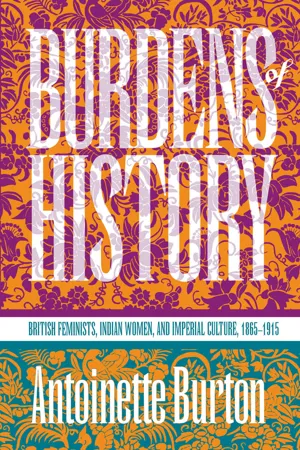
Burdens of History
British Feminists, Indian Women, and Imperial Culture, 1865-1915
- 318 pages
- English
- ePUB (mobile friendly)
- Available on iOS & Android
eBook - ePub
Burdens of History
British Feminists, Indian Women, and Imperial Culture, 1865-1915
About this book
In this study of British middle-class feminism in the late nineteenth and early twentieth centuries, Antoinette Burton explores an important but neglected historical dimension of the relationship between feminism and imperialism. Demonstrating how feminists in the United Kingdom appropriated imperialistic ideology and rhetoric to justify their own right to equality, she reveals a variety of feminisms grounded in notions of moral and racial superiority. According to Burton, Victorian and Edwardian feminists such as Josephine Butler, Millicent Garrett Fawcett, and Mary Carpenter believed that the native women of colonial India constituted a special 'white woman's burden.' Although there were a number of prominent Indian women in Britain as well as in India working toward some of the same goals of equality, British feminists relied on images of an enslaved and primitive 'Oriental womanhood' in need of liberation at the hands of their emancipated British 'sisters.' Burton argues that this unquestioning acceptance of Britain's imperial status and of Anglo-Saxon racial superiority created a set of imperial feminist ideologies, the legacy of which must be recognized and understood by contemporary feminists.
Information
1
The Politics of Recovery
HISTORICIZING IMPERIAL FEMINISM, 1865–1915
Organized feminism in Britain emerged in the context of Victorian and Edwardian imperialism. Historically speaking, arguments for British women’s emancipation were produced, made public, and contested during a period in which Britain experienced the confidence born of apparent geopolitical supremacy as well as the anxieties brought on by challenges to imperial permanence and stability. Although historians of women and feminist historians have been concerned with what Adrienne Rich calls “the politics of location” in the work of reconceptualizing traditional history, Western feminism’s historically imperial location has not been the subject of comprehensive historical inquiry, except insofar as the origins of “international sisterhood” are concerned.1 This is true, despite the imperial discourses that leading British feminists utilized, the world-civilizing significance they attached to their role in national political culture, and the frequent invocation of non-Western and especially of Indian women as subjects in need of salvation by their British feminist “sisters.” Relocating British feminist ideologies in their imperial context and problematizing Western feminists’ historical relationships to imperial culture at home are, therefore, the chief concerns of this book.
As historical phenomena, feminism and imperialism might at first glance be considered an unlikely match. In the course of working on this project, I discovered that, to other people, these two terms suggested Virginia Woolf—presumably because of her rejection of the terms of Englishness, her fierce attacks on Kipling’s imperialism, and her claims to be a citizen of the world.2 The combination “women and India” was also typically taken to signify lady missionaries or colonial memsahibs. Such ready equivalencies reflect both gender stereotyping in the narratives of imperial history and the lack of attention paid to the domestic culture of imperialism in which nineteenth-century middle-class British feminism came into its own. Although some of Woolf’s “quarrel[s] with patriarchy and imperialism”3 are echoed here, what is primarily at issue is not British feminists’ opposition to empire, but their collaboration in its ideological work. And while the role of women as cultural and religious missionaries is certainly addressed, my emphasis is on the secular work of emancipation, frequently undertaken in the name of Indian women, which was the main concern of British feminists during this period. That the languages of imperialism—articulating as they did the parameters of cultural superiority, political trusteeship, and sheer Englishness—should have been among the most readily available to women involved in various aspects of the British women’s movement from the Victorian period onward is not particularly surprising. Evidence of empire was to be found everywhere in Western culture from the nineteenth century onward. There were few who disagreed with its values, even if they questioned the efficiency of its agents or the effectiveness of its agencies.4 The vocabulary of Victorian social reform and philanthropy at home was, moreover, steeped in racial metaphors and civilizing tropes, to which the emerging discourses of social Darwinism and institutional anthropology added their share.5 The geopolitical context for all of this was an expanding empire and an expansive, if at times slightly anxious, confidence in Britain’s cultural superiority. These are, indeed, among the hallmarks of Victorian culture, historically speaking—though admittedly they have not traditionally been seen as constituents of domestic political or social reform culture.6 A quick chronological sketch therefore provides the immediate historical context for what Valerie Amos and Pratibha Parmar have called “imperial feminism.”7
The beginnings of the organized British women’s movement at mid-century coincided with the apogee of British imperial preeminence.8 In meeting to discuss the “disabilities of the female sex” and, by the mid-1860s, to generate suffrage petitions to the House of Commons, the ladies of Langham Place and the founding members of the London Women’s Suffrage Society were laying claim to the same benefits of citizenship that Lord Palmerston enshrined in his famous “civis Romanus sum” paean to British imperial hegemony.9 Although she never called herself a feminist, after the Crimean War Florence Nightingale nonetheless became a symbol in the public mind of what one female’s emancipation could do for Britain’s imperial interests, and feminists claimed her as one of their own until World War I and beyond.10 As Greater Britain became a formal empire, British women’s movements achieved many of their goals: university education for women, municipal suffrage, marriage-law reform, and the abolition of the Contagious Diseases Acts. The “scramble” for Africa and the ongoing struggle for women’s rights occurred virtually at the same time. Significantly, British feminists noted the coincidence and exploited it in order to advance arguments for what many believed to be the most fundamental right of all: women’s suffrage. This was partly in response to the invective against women’s suffrage that prominent imperial statesmen like Lords Cromer and Curzon hurled at women activists, but it was not simply a reflex action. Feminists and particularly suffrage advocates had their own traditions of imperial rhetoric long before the formation of the Anti-Suffrage League in 1908—traditions that they routinely invoked to ally women’s political emancipation with the health and well-being of the British Empire.
The Boer War debacle and the eugenic concerns that followed in its wake undoubtedly shaped the terms of the imperial feminist Cause. The war itself disturbed feminists, albeit for different reasons. While Josephine Butler raged against the injustices done to “the native races” in South Africa, Millicent Garrett Fawcett defended the British government’s war camps; meanwhile, woman as savior of the nation, the race, and the empire was a common theme in female emancipation arguments before and especially after 1900.11 With the emergence of international feminist institutions like the International Woman Suffrage Alliance and the International Council of Women in the pre-World War I period, British women figured in British feminist rhetoric as the saviors of the entire world of women as well. As Sarah Amos put it, “We are struggling not just for English women alone, but for all the women, degraded, miserable, unheard of, for whose life and happiness England has daily to answer to God.”12 The persistence of rhetoric about “global sisterhood,” together with what Deborah Gorham calls the “sacral” character attributed to international feminism in the late twentieth century,13 has obscured the historically imperial context out of which “international” female solidarity was initially imagined and has continued to be unproblematically reproduced by some. As Chandra Mohanty has written, such notions of universal sisterhood are “predicated on the erasure of the history and the effects of contemporary imperialism.” Behind the project of historicizing imperial feminism lies the problem of how and why the modern British women’s movement produced a universal female “we” that continues to haunt and, ironically, to fragment feminists worldwide.14
By 1915 the war between Germany and England threatened to undermine what appeared to be feminist unity and British imperial predominance; both were to survive the peace, though not without short- and longterm damages. Victorian feminism thus came of age in a self-consciously imperial culture, during an extended historical moment when the British Empire was believed to be at its height and, subsequently, feared to be on the wane.15 Its development was not just “consolidated during a period of popular imperialism,” though anxieties about empire shaped the terms of feminist debate inexorably.16 Imperial culture at home provided the ground for feminism’s organizational resurgence after the decline of antislavery reform, while imperial anxiety furnished one of the bases for middle-class British feminism’s appeals to the state in the aftermath of the Boer War. The fact of empire shaped the lives and identities of those who participated in the women’s movement, making it a constituent part of modern British feminist identities.
Given the longevity of many in the first generation of women suffragists, there were some who, like Fawcett and Eleanor Rathbone, witnessed the onset of British imperial decline over the course of their own lifetimes.17 Those born into the second and third generations had to have been aware of the tenuousness of British imperial supremacy after 1918, despite the fact that Britain emerged a victor from the European war. The role of Indian soldiers in defending the imperial nation during the Great War and the claims that colonial nationalists believed it lent to their own quest for self-government—not to mention the riots in Britain and at Amristar in 1919—signified to many that the old imperial policies and attitudes were increasingly outmoded.18 Like feminism, imperialism after World War I was not what it had been in the nineteenth century, even while, as Brian Harrison and others have begun to argue, the break between 1918 and what came before is not perhaps as definitive as it once seemed.19 In spite of these vicissitudes, and of course because of them, empire, from its mid-Victorian glories through its prewar crises of confidence, must be counted among the influences shaping the feminist discourses and self-images of these first generations of emancipationists. And because they enlisted empire and its values so passionately and so articulately in their arguments for female emancipation, British feminists must also be counted among the shapers of imperial rhetoric and imperial ideologies in this period.
Feminists working for reform in the political, social, and cultural arenas of late Victorian Britain demonstrated their allegiances to the imperial nation-state and revealed their imperial mentalities in a variety of ways. Although this tendency has not been critically examined by historians of British feminism, arguments for female emancipation were articulated in patriotic, and at times remarkably nationalistic, terms. Whether the cause was votes for women, the opening up of university education, or the repeal of the Contagious Diseases Acts, feminists of all persuasions viewed Britain’s national political traditions and its traditional political culture as an irresistible justification for their claims upon the state.
Conversely, their exclusions and oppression were considered violations of their great heritage. “What is it, after all,” Emmeline Pethick-Lawrence asked in 1908, “that British women asked of a British Government [?]” Her response followed: “Nothing more than that constitutional rights should be given to women who were British born subjects of the Crown. ... It was neither a strange nor a new demand, and meant only the restitution of those ancient rights which had been stolen from them in 1832.”20 Victorian feminists traced their political disenfranchisement all the way back to Magna Carta, with Chrystal Macmillan calling for an equivalent Woman’s Charter to redress the balance in the twentieth century.21 While a few historians have disclaimed the nationalist rhetoric of Victorian and Edwardian suffrage women, others tend to view it simply as a product of war patriotism confined largely to the pronouncements of Christabel and Emmeline Pankhurst.22 In fact, British feminists worked consistently to identify themselves with the national interest and their cause with the future prosperity of the nation-state. Practically the entire corpus of female emancipation argument depended on these kinds of associations; they were not, in other words, either erratic or uncommon. As this book works to illustrate, British feminists produced them across a variety of genres throughout the nineteenth century and down to the symbolic end of the Victorian period, the Great War.
A word is necessary here on the terms “English” and “British” and the significance of their relationships. They were often used interchangeably in the period under consideration and some modern British historians have tended to reproduce this elision.23 While the women’s movement was a British phenomenon, encompassing activists from England, Ireland, Scotland, and Wales, it often, as we shall see, privileged “Englishness” as its core value and attributed the so-called best qualities of the Anglo-Saxon race to it. As Graham Dawson has noted, this maneuver marked “the hegemony of England within the United Kingdom”—a hegemony that some English feminists accepted unquestioningly and that at times brought them into conflict with some of their Irish and Scotch sisters.24 Feminist pride in Englishness was not necessarily crude or vulgar, and it was not perhaps exactly equivalent to the expressions of jingoism commonly found in music hall productions and other forms of popular culture in the late Victorian period. Of Englishness and its characteristics, for example, Ray Strachey told Fawcett rather genteelly in the 1930s: “I’ve always thought it was one of the solidly good things in the world.”25 Her gentility notwithstanding, Strachey and those feminist women who, like her, grew up with a keen appreciation for British imperial greatness, did pronounce their loyalty to things English and did commit the women’s movement in Britain to what they believed to be the best characteristics of the “national culture.” Compelling Britain to live up to its own unique cultural—and, of course, to its nationally specific moral—attributes was one of the forces behind feminist ideology before the First World War. In an interesting combination of rhetorical skill and political canniness, British feminists argued that female emancipation was necessary not simply because it was just, but because it was nothing less than the embodiment of Britain’s national self-interest and the fulfillment of its historical destiny.
Aligning the women’s movement, and especially the suffrage campaign, with the fate of the nation meant, in the context of late-nineteenth-century Britain, identifyi...
Table of contents
- Cover Page
- Burdens of History
- Copyright Page
- Dedication
- Contents
- Acknowledgments
- Epigraph
- 1 The Politics of Recovery
- 2 Woman in the nation
- 3 Female Emancipation and the Other Woman
- 4 Reading Indian Women
- 5 The White Woman’s Burden
- 6 A Girdle round the Earth
- 7 Representation, Empire, and Feminist History
- Notes
- Bibliography
- Index
Trusted by 375,005 students
Access to over 1.5 million titles for a fair monthly price.
Study more efficiently using our study tools.
Frequently asked questions
Yes, you can cancel anytime from the Subscription tab in your account settings on the Perlego website. Your subscription will stay active until the end of your current billing period. Learn how to cancel your subscription
No, books cannot be downloaded as external files, such as PDFs, for use outside of Perlego. However, you can download books within the Perlego app for offline reading on mobile or tablet. Learn how to download books offline
Perlego offers two plans: Essential and Complete
- Essential is ideal for learners and professionals who enjoy exploring a wide range of subjects. Access the Essential Library with 800,000+ trusted titles and best-sellers across business, personal growth, and the humanities. Includes unlimited reading time and Standard Read Aloud voice.
- Complete: Perfect for advanced learners and researchers needing full, unrestricted access. Unlock 1.5M+ books across hundreds of subjects, including academic and specialized titles. The Complete Plan also includes advanced features like Premium Read Aloud and Research Assistant.
We are an online textbook subscription service, where you can get access to an entire online library for less than the price of a single book per month. With over 1.5 million books across 990+ topics, we’ve got you covered! Learn about our mission
Look out for the read-aloud symbol on your next book to see if you can listen to it. The read-aloud tool reads text aloud for you, highlighting the text as it is being read. You can pause it, speed it up and slow it down. Learn more about Read Aloud
Yes! You can use the Perlego app on both iOS and Android devices to read anytime, anywhere — even offline. Perfect for commutes or when you’re on the go.
Please note we cannot support devices running on iOS 13 and Android 7 or earlier. Learn more about using the app
Please note we cannot support devices running on iOS 13 and Android 7 or earlier. Learn more about using the app
Yes, you can access Burdens of History by Antoinette Burton in PDF and/or ePUB format, as well as other popular books in History & British History. We have over 1.5 million books available in our catalogue for you to explore.