Weaving national narratives from stories of the daily lives and familiar places of local residents, Françoise Hamlin chronicles the slow struggle for black freedom through the history of Clarksdale, Mississippi. Hamlin paints a full picture of the town over fifty years, recognizing the accomplishments of its diverse African American community and strong NAACP branch, and examining the extreme brutality of entrenched power there. The Clarksdale story defies triumphant narratives of dramatic change, and presents instead a layered, contentious, untidy, and often disappointingly unresolved civil rights movement.
Following the black freedom struggle in Clarksdale from World War II through the first decade of the twenty-first century allows Hamlin to tell multiple, interwoven stories about the town’s people, their choices, and the extent of political change. She shows how members of civil rights organizations — especially local leaders Vera Pigee and Aaron Henry — worked to challenge Jim Crow through fights against inequality, police brutality, segregation, and, later, economic injustice. With Clarksdale still at a crossroads today, Hamlin explores how to evaluate success when poverty and inequality persist.
eBook - ePub
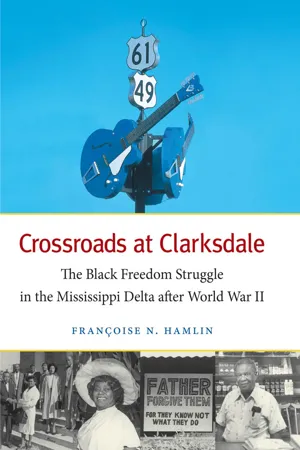
Crossroads at Clarksdale
The Black Freedom Struggle in the Mississippi Delta after World War II
- 392 pages
- English
- ePUB (mobile friendly)
- Available on iOS & Android
eBook - ePub
Crossroads at Clarksdale
The Black Freedom Struggle in the Mississippi Delta after World War II
About this book
Information
Chapter One
Washington Was Far Away
DEFINING A DIFFERENT POSTWAR DELTA
As protest began to stir among local Negroes in the early fifties, it became more acceptable to express dissatisfaction with the status quo. This change was significant, because so many Negroes had been willing to accept conditions rather than question them and gamble with reprisals.—Aaron Henry, Fire Ever Burning
The only thing I knew about the NAACP was that it is something that is supposed to make these Mississippi white folks act like human beings and I want to be a part of that monster.—Vera Pigee, Struggle of Struggles
In Mississippi, the violence of white supremacy stained the land as in few other places in America. The brutal murder of fourteen-year-old Emmett Till in Money, Mississippi, in August 1955 embodied, then transcended, that violence. The crime stunned even those who had grown accustomed to everyday white terror, but it also galvanized a generation in Mississippi and beyond.
One of those responding to the violence was Aaron Henry, president of the Clarksdale/Coahoma County branch of the National Association for the Advancement of Colored People (NAACP). “The Coahoma County Branch found itself at the Rail Head of activities relating to the murder of Emmett Till in 1955,” Henry recalled.1 Members of the NAACP leadership, most of whom were not normally found in the fields, donned overalls to comb the area looking for witnesses who either saw the murderers with Till or witnessed the theft of the cotton gin that pinned him down in his watery resting place. Henry remembered, “We all knew we moved under a cloud, and we moved cautiously.”2 He told an interviewer in 1969 that “in trying to find out who the witnesses were, who saw what [happened], day after day, [we went] into the cotton fields and chopping cotton with the hands, and picking cotton with the hands, wandering through the crowds just to find out what we could about Emmett.”3 The organization also provided safe passage north for these witnesses after the trial.
As northern journalists descended on the Delta, reporting to a rapt national audience on the alien, backward conditions in postwar Mississippi, one of that state’s native daughters came back home. Vera Mae Pigee had recently returned to Clarksdale from Chicago, where she had studied cosmetology. As an active member of the Coahoma County NAACP, she journeyed to Sumner, the site of the trial and about thirty miles from Clarksdale, to observe and offer support to fearful locals: “I was in touch with the people when the trial was over, they wouldn’t stay in a little town like Sumner, they would come to Clarksdale and go other places to stay, and some wouldn’t tell anyone where they were. They were just that afraid,” Pigee remembered. “They were black people and maybe it wasn’t like they were so afraid of one white person, but of a crowd, coming with their white sheets on to kill somebody, like these people had killed Emmett Till.”4
Henry and Pigee are emblematic of postwar grassroots black freedom movements. Virtually unknown on the national stage, they are two of many who devoted the greater part of their adult lives to the struggle for racial justice in Mississippi. Yet Henry and Pigee, by organizing and sustaining the local movement in Clarksdale, were not simply local representatives of a national mass movement. They were, in complex ways, architects of the movement’s foundation, the kind of people without whom a mass uprising against Jim Crow would have been impossible.
Aaron Henry, the most celebrated civil rights leader in Clarksdale, was born in the Coahoma County town of Dublin in 1922. His father took shoe carpentry courses at the Tuskegee Institute in Alabama, enabling him to work his trade in the county. His mother, Mattie, was a member of the Women’s Society of Christian Service, one of the few biracial organizations in Mississippi.5 The family had the means to pay tuition for a decent high school education, and with no black public schools available, boarding at Coahoma County Agricultural High School was the only option. While there, Henry became involved in the NAACP. He credited one civics teacher in particular, Miss Thelma K. Shelby, newly graduated from Dillard University (where she had joined the NAACP), as a major influence on his maturing political sensibilities. She spent extra time with her seniors, assigning Richard Wright’s Black Boy and Native Son, along with Uncle Tom’s Cabin, speaking French to them, and sharing her indignation over the state of racial affairs. Henry recalled that Shelby talked the “total incoming senior class into taking out a junior membership in the NAACP.”6
Serving in the U.S. Army during World War II, he sought out the NAACP as he struggled between the discrimination in the military and the patriotism black soldiers felt and exhibited through their service and sacrifice. Henry grew impatient with the segregated facilities and the blatant racism. On his ship, the army had segregated movie showings: the whites had one night and African Americans had the next. As a result, black servicemen boycotted the movies. Henry recalled a particularly ornery chaplain in Honolulu, Hawaii. While preaching, he described the weather as “raining pitch forks and nigger babies.” The black congregants walked out and never returned, preferring to attend services in town. A year later, Henry tried to talk to his fellow servicemen about Marcus Garvey (the Jamaican-born black nationalist and Pan-Africanist who founded the Universal Negro Improvement Association in 1914), but “hardly anyone else in the whole company knew who I was talking about.” They seemed only versed in the contributions of Booker T. Washington and George Washington Carver, he noted. “They hadn’t heard of Benjamin Bannicar [Benjamin Banneker, 1731–1806, African American mathematician and astronomer] . . . and Harriet Tubman and Nat Turner and many of these great Americans who were black and who helped to shape the destiny of this country.”7 They obviously had never had exposure to someone like Thelma Shelby in the classroom. He returned to Mississippi open-eyed and politically prepared to tackle Jim Crow.
Henry used his veteran’s benefit provided through the GI Bill, one of the few postwar pieces of legislation or federal funding that trickled down into the hands of African Americans. Designed to reward veterans for their service, the GI Bill provided tuition and subsistence pay, and it educated a new generation of southern black men, elevating them out of the narrow occupational niche available to blacks in the region.8 Henry enrolled at the Xavier University pharmacy school in New Orleans, determined to be his own boss. He served as student body president for two years, and at a 1948 meeting of the U.S. National Student Association (founded by veterans in 1947), he met and established a relationship with Allard Lowenstein, who would erupt on the political scene and in Mississippi with force in the sixties.9 Henry graduated and became an independently employed pharmacist in Clarksdale, a man whose middle-class status had been forged with government assistance and who, in the coming years, would challenge Mississippi to make the kind of opportunity he enjoyed open to all. He was, as writer and activist Constance Curry put it, a “conservative militant,” able to work his way up the social and political ladder while fighting it all the way in order to improve and expand its range.10
Vera Mae Pigee was born Vera Berry, the daughter of sharecroppers from Tutwiler, in Tallahatchie County. Wilder Berry, the father of Vera and brother W. C., succumbed to alcoholism and a wanderlust that led him to abandon his family. Their mother, Lucy Wright Berry, spent her time working the farm, raising livestock, growing vegetables, and exercising her impressive voice in the church choir, while instilling in her two children a fear of God and a solid work ethic. Young Vera absorbed both her mother’s religious faith and her strength, especially in the way she stood up for herself in a hostile segregated South.11 At a time when black people tended to “take things off of white folks,” her mother had once delivered “a backhand whooping” to a white boy who continuously and contemptuously bumped her with his bike. The blow “knocked him plumb off his bike!”12 Those opportunities to assert one’s humanity (and not have it painfully stripped away) were rare. Lucy Berry, like many black Mississippians unable outwardly to resist Jim Crow most of the time, found alternative ways, particularly through spirituality, to voice discontent and ease everyday pressure.13 By example, this mother’s resourcefulness and endurance influenced her daughter, who grew up fast as she helped to run the household. Unable to go further than the ninth grade at the Rolenwald School in Tallahatchie County, she married Paul Pigee when she was fifteen and he was eighteen. “I’d set my cap for Paul Pigee the very first day I laid eyes on him,” and their love survived the families’ objections. Their daughter, Mary Jane, arrived a year later, but their second daughter died less than three weeks after birth the following year.14 Pigee recalled traveling to Memphis from Clarksdale on the bus with baby Mary Jane in the mid-1940s: “I had to stand on a bus, where I had paid up fare. . . . It’s approximately 100 miles and there were seats available on the bus, and because I was a black woman, I had to stand there and hold my baby.”15 Wearied by the journey and insulted by the injustice, she never forgot that day.
The Pigees wanted to improve their life chances and not be dependent on the land (and on landowners), as their parents had been. They moved briefly to Chicago so that Vera could study cosmetology and have a sustaining trade. Preferring to live closer to family, they returned to Clarksdale. Honing her skills at a beauty salon, her meticulousness and leadership acumen impressed the shop owner, Lillie Pharr, who, upon moving to California because of declining health, promptly promoted her to manage the business. Pigee rose to the occasion and learned how to run a business, then located at 407 Ashton Avenue. Pigee remembered how Pharr “took me aside and said that if anything happened to her, she wanted me to have the shop.” When she passed, Pharr’s husband honored his wife’s wish and sold the business to Pigee, and in this way she became an independent business owner.16
Each in his or her own way, Henry and Pigee helped birth the modern black freedom movement in Coahoma County. As time moved on, it becomes clear how they were contrasting figures whose life trajectories bespeak the mass movement’s dependence on distinct, yet malleable, modes of organizing. Both leadership styles, and the distinct gendered spheres in which they operated, were crucial to the movements’ lifeblood—in Coahoma County and throughout the South. This chapter focuses more on Henry, since Pigee was away in Chicago for much of the county’s early organizing, returning in 1955 and joining him on center stage.
In the meantime, four years before the Till murder, in 1951, another act of racial violence had spurred the founding of the Clarksdale/Coahoma County branch of the NAACP. The rape of Leola Tates and Erline Mills, two young African American women from Clarksdale, like the later lynching of Till, had galvanized the local community and had transformed ad hoc, disparate resistance to Jim Crow into the early stirrings of a movement. The perpetrator of the assaults walked away free, a gift to a white man that was all too common in southern justice. That crime changed the fate of Coahoma County forever and amplified a rich history of local organizing and activism that already existed. Despite living under the calloused thumb of Jim Crow, African Americans in the immediate postwar years found ways to voice their concerns (from voting to education) and minister to one another’s needs and complaints.
Early Postwar Organizing
The national NAACP had always had an embattled relationship with the state of Mississippi. So much so that in May 1948, Gloster Current, national director of branches for the NAACP, wrote to Executive Secretary Walter White cautioning that “the state is devoid of a spokesman, white or Negro, who can speak out against [Governor Fielding L.] Wright.”17 Wright, who that year would be the vice presidential candidate of the Dixiecrat revolt, had appeared on statewide radio “advising” black people in his state to go elsewhere if they contemplated eventual social equality.18 The following year, in March 1949, John Bell Williams, congressman from the Magnolia State and devout Dixiecrat, published an article in Speakers Magazine about the threat of “Civil Rights,” expounding on the internal Communist attack driven by “selfishly organized minority groups.” He tapped into a growing national hysteria generated by the escalating Cold War—a hysteria that would be used against civil rights organizations.19 “Through the conscienceless racketeers who head these parasitic groups,” Williams wrote, “they are asserting their political strength as never before—attempting to bring about a forced amalgamation of the white and black races.”20
The virulent racism of Wright and Williams, and the ever-present threat of white violence it inspired, intimidated many black people into a public silence. Yet Current misjudged the extent of local African American agitation. Lamenting the absence of one clear spokesman in Mississippi, he had overlooked the leaders then working long hours within black communities, discreetly and safely out of general view. Local black civil rights groups worked to improve their members’ life choices in the everyday, given the opportunities (which were lacking) available. Thus organizations rose and fell in visibility and activity, and memberships shifted, depending on the ebb and flow of success, activism, and leadership. Flexible loyalties and alliances to organizations helped local people adapt to their current crises and pool resources quickly and as needed. It helped them to survive. Within four years of Current’s comment, local leaders would become more vocal and visible in public, and many would gain national recognition.21
During the war years, the most dominant black activist organization of the era, the NAACP, had remained predominantly middle class in membership and legalistic in strategy. Conventional political lobbying in Washington, D.C., in the end, produced few gains; and the courts eventually provided the NAACP with its most durable successes.22 It chose its cases carefully, selecting plaintiffs who ...
Table of contents
- Cover Page
- Crossroads at Clarksdale
- Copyright Page
- Dedication
- Contents
- Figures, Maps, and Tables
- Preface
- Introduction
- Chapter One Washington Was Far Away
- Chapter Two M is for Mississippi and Murder . . . and Mother
- Chapter Three I Think Freedom and Talk Freedom
- Chapter Four Fires of Frustration
- Chapter Five Children Should Not Be Subjected To What Is Going On There
- Chapter Six It Was a Peaceful Revolution
- Epilogue
- Notes
- Bibliography
- Acknowledgments
- Index
Trusted by 375,005 students
Access to over 1.5 million titles for a fair monthly price.
Study more efficiently using our study tools.
Frequently asked questions
Yes, you can cancel anytime from the Subscription tab in your account settings on the Perlego website. Your subscription will stay active until the end of your current billing period. Learn how to cancel your subscription
No, books cannot be downloaded as external files, such as PDFs, for use outside of Perlego. However, you can download books within the Perlego app for offline reading on mobile or tablet. Learn how to download books offline
Perlego offers two plans: Essential and Complete
- Essential is ideal for learners and professionals who enjoy exploring a wide range of subjects. Access the Essential Library with 800,000+ trusted titles and best-sellers across business, personal growth, and the humanities. Includes unlimited reading time and Standard Read Aloud voice.
- Complete: Perfect for advanced learners and researchers needing full, unrestricted access. Unlock 1.5M+ books across hundreds of subjects, including academic and specialized titles. The Complete Plan also includes advanced features like Premium Read Aloud and Research Assistant.
We are an online textbook subscription service, where you can get access to an entire online library for less than the price of a single book per month. With over 1.5 million books across 990+ topics, we’ve got you covered! Learn about our mission
Look out for the read-aloud symbol on your next book to see if you can listen to it. The read-aloud tool reads text aloud for you, highlighting the text as it is being read. You can pause it, speed it up and slow it down. Learn more about Read Aloud
Yes! You can use the Perlego app on both iOS and Android devices to read anytime, anywhere — even offline. Perfect for commutes or when you’re on the go.
Please note we cannot support devices running on iOS 13 and Android 7 or earlier. Learn more about using the app
Please note we cannot support devices running on iOS 13 and Android 7 or earlier. Learn more about using the app
Yes, you can access Crossroads at Clarksdale by Françoise N. Hamlin in PDF and/or ePUB format, as well as other popular books in Social Sciences & North American History. We have over 1.5 million books available in our catalogue for you to explore.