The South’s system of Jim Crow racial oppression is usually understood in terms of legal segregation that mandated the separation of white and black Americans. Yet, as Stephen A. Berrey shows, it was also a high-stakes drama that played out in the routines of everyday life, where blacks and whites regularly interacted on sidewalks and buses and in businesses and homes. Every day, individuals made, unmade, and remade Jim Crow in how they played their racial roles — how they moved, talked, even gestured. The highly visible but often subtle nature of these interactions constituted the Jim Crow routine.
In this study of Mississippi race relations in the final decades of the Jim Crow era, Berrey argues that daily interactions between blacks and whites are central to understanding segregation and the racial system that followed it. Berrey shows how civil rights activism, African Americans' refusal to follow the Jim Crow script, and national perceptions of southern race relations led Mississippi segregationists to change tactics. No longer able to rely on the earlier routines, whites turned instead to less visible but equally insidious practices of violence, surveillance, and policing, rooted in a racially coded language of law and order. Reflecting broader national transformations, these practices laid the groundwork for a new era marked by black criminalization, mass incarceration, and a growing police presence in everyday life.
eBook - ePub
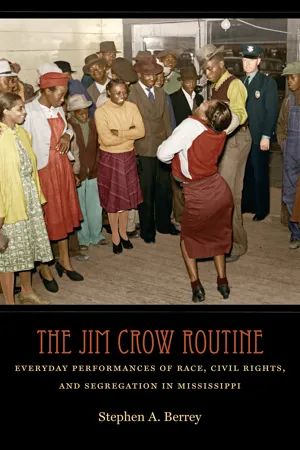
The Jim Crow Routine
Everyday Performances of Race, Civil Rights, and Segregation in Mississippi
- 352 pages
- English
- ePUB (mobile friendly)
- Available on iOS & Android
eBook - ePub
The Jim Crow Routine
Everyday Performances of Race, Civil Rights, and Segregation in Mississippi
About this book
Information
1: Intimate Spaces
Performance and the Making of Jim Crow
H. A. Scott Sr. was born in the mid-1920s in the Mississippi Delta town of Yazoo City. His father worked in a sawmill six days a week; his mother was employed at a steam factory for dry cleaning. Scott has vivid memories of growing up in the Jim Crow South. Like many other Mississippians on both sides of the racial line, he remembers black and white children playing together. He remembers too that white people addressed him as “boy,” and that this moniker stayed with him even after he reached adulthood. Some of Scott’s most intriguing memories, however, relate to physical space. He recalls that some places had a double-sided door, two entrances side by side, “one for white and one for black.” The doors then opened into a larger area divided only by a row of stools separating the space for whites and the space for blacks. As Scott explains, “You could see each other but there was a space between you.”1
Scott may be thinking about one place in particular or perhaps a composite of many places. Regardless, his description captures a compelling visual image of the geography of segregation. On the one hand, the stools hint at the significance of lines, important enough that in the absence of a full wall, something tangible was deemed necessary to divide these two spaces. On the other hand, one might wonder about a line of stools’ qualifications for being a barrier. One can imagine that these stools could have been easily moved or knocked over, and that individuals on either side could have accidentally or intentionally nudged these stools, adding space to one side as space was subtracted from the other. But even if no one moved the stools, even if those stools had been bolted down, they still could not have fully separated black people from white people. Lines of vision and presumably voices would have effortlessly crossed the space between. Thus, if the stools split the larger area, they nonetheless preserved a black presence and a white presence within that area; the stools allowed for a separated togetherness. Ultimately, then, Scott’s description spotlights two intertwined components of segregation. Explicitly, he directs our attention to the physicality of this racial system and has us wondering, like Richard Wright in the elevator with his hat and his packages, about the props and the other material things of this segregation stage. Implicitly, he also pushes us to think about these black people and white people looking across the stools and seeing each other.
The space that Scott looked out upon was part of a racial geography that had been forged a generation earlier. In the 1880s and 1890s, new laws firmed up racial lines and in the process made segregation more official and more permanent. Tied to customs of racial separation that extended back into the period of enslavement and to the black codes of the postemancipation period, the earliest legislation targeted physical spaces. In 1881, Tennessee passed the first state segregation law pertaining to travel, a measure applied to railcars and which was in part a response to discrimination and the mistreatment of first-class black passengers. The law required railroad companies to provide “separate cars, or portions of cars cut off by partition wall” for black passengers with first-class tickets.2 Seven years later, Mississippi passed legislation requiring separate accommodations in sleeping cars and railroad rooms. White legislators believed that this measure was simply reflecting what was already being practiced.3 Nonetheless, in the last two decades of the nineteenth century and extending into the new century, states and municipalities across the region enacted scores of laws and ordinances that mandated racialized public spaces with racial boundaries on trains, in waiting rooms, on streetcars, in places of leisure such as movie theaters and ballparks, in restaurants, and in countless other places. Legal measures served as a blueprint that altered the physical landscape of the region. White Southerners erected walls and other types of partitions, they put up curtains and constructed dual entrances, and an entire industry sprang up to mass-produce racial signage for “whites only” and “colored” spaces.4
It was no coincidence that white Southerners pushed through legal measures targeting physical spaces during this period. Following generations of enslavement, African Americans occupied new spaces, and they also occupied familiar spaces in new ways. During the Reconstruction years, African Americans populated polling booths and the legislative halls of state government. Some of them rode on trains as first-class passengers alongside white males and females. And some walked the sidewalks ignoring the custom from the period of enslavement to step aside for approaching whites.5 As Leon Litwack observes, by the 1870s, many white Southerners worried especially about the presence of a “New Negro” who had never been enslaved and who was perceived as more aggressive.6 They compared this less-deferential individual to what they remembered as a faithful slave who, in contrast to this New Negro, had always—at least in their memories—looked and acted the part of a social and racial inferior.7 In the nineteenth century, many whites increasingly found themselves in public spaces where African Americans insisted on playing the part of social equals.
Other factors also fueled white Southerners’ concerns about race and space. Across the South, the growth of towns, the expansion of railroads, and a more mobile population meant that blacks and whites were ever more frequently meeting in public spaces as strangers.8 And even if the African American stranger did not take on the role of the assertive New Negro, interracial interactions in shared space blurred the lines of difference and potentially undermined a racial hierarchy that positioned “white” as superior to and above “black.” In the past, notes historian Grace Hale, slavery informed social interactions between blacks and whites and preserved the hierarchy. As long as slavery existed and was limited to one group, it marked everyone in that group as inferior. The abolition of slavery removed the defining racial distinction between black and white, and for many whites this circumstance was most unsettling where people interacted as strangers, such as on trains and in cities. Accordingly, laws served to mark space not only in response to a New Negro but also as a means to solidify racial difference. As Hale contends, segregation created and labeled spaces as inferior or superior, and by extension it then marked the people occupying these spaces.9 Furthermore, the first segregated spaces tended to be those that allowed for especially intimate forms of physical contact, such as places for eating or sleeping, including restaurants, hotels, and homes.10 Thus, as segregation affirmed racial hierarchies, it also created distinctions where boundaries were most fluid.
Segregation, then, can be understood as an answer to a racial question, an answer that involved the use of space to reestablish difference and hierarchy and to thwart black assertiveness. Certainly, the passage of new laws and the physical manipulation of the landscape, as well as an unprecedented wave of violence in the 1880s and 1890s, transformed these spaces and made racial lines more rigid. At the same time, Scott’s recollection of two entrances and a row of stools highlights two other critical components in the making of racial space. First, even within a segregated system, African Americans and whites regularly interacted in public spaces such as in bars and on buses and in the private spaces of the home. Black Southerners and white Southerners, observes historian George Frederickson, “were too much involved with each other” to ever be sharply divided by racial boundaries.11 Thus, an investigation of segregated space is necessarily an investigation of interracial space. Second, Scott’s memory of black people and white people looking out across each other suggests that the meanings and boundaries of these spaces depended not only on the stools and the doors but also on the people themselves, and on how these people moved, interacted, gestured, and looked at each other. It is an indication, too, that segregated space had to be made daily.
Cultural geographer Doreen Massey contends that any given space is the product of interactions among people and is “formed through a myriad of practices of quotidian negotiation and contestation.” Massey also makes a case for understanding spaces as unstable, in which the regular negotiations among individuals mean that spaces are “always in the process of being made.”12 Applying this notion to segregation in the U.S. South, it suggests that even as the blueprints of laws and customs and the physical materials of signs and barriers combined to form a Jim Crow stage, the meanings of that space still depended on how people daily navigated this stage. These performative components of Jim Crow indicate too, as historian Thomas C. Holt argues, that race had to be made and remade in the “ ‘ordinary’ events of everyday life . . . perpetrated by ‘ordinary’ people.”13 Meanings of Jim Crow—of what it meant to be white and what it meant to be black—were made by what blacks and whites did and did not do as they looked at each other across a row of stools. The central point in these observations about making space and about making Jim Crow is that we can understand both blacks and whites as actors on this stage. While it is generally well known that African Americans regularly “wore the mask,” pretending at deference in the interest of survival, they were not the only ones playing a part. Indeed, as Ralph Ellison noted in the 1950s, donning a mask was something white Americans had been doing at least since masquerading as Indians at the Boston Tea Party.14
In 1930s and 1940s Mississippi, blacks and whites performed on a Jim Crow stage that had been largely constructed decades earlier from the laws and practices of the 1880s and 1890s. This stage, however, featured daily showings. In their interactions with each other and with “props,” blacks and whites remade Jim Crow with each daily performance. Focusing on Jim Crow as a series of enactments reveals one of the central features of this racial system. Many white Southerners imagined a world not of separation or isolation but rather of a particular form of racial intimacy and harmony. In that world, which was reflected in laws, customs, barriers, and expectations, they imagined whites as superior masters, as paternalists with privileges who cared for and protected black people. Meanwhile, they imagined blacks as inferior, as lazy, and as prone to mischief or crime, but also as loyal servants who loved white people and preferred segregation. These white Southerners thus tried to make real a world of white paternalists and black servants that would depend on both blacks and whites playing their respective parts.
Although we might think of a singular Jim Crow stage—one where whites and blacks were always expected to enact a particular role—the physicality of racial spaces varied widely. Across the South, the laws and customs of the late nineteenth and early twentieth centuries created and allowed for spaces formed from a range of physical materials that ultimately sustained different levels of interaction between the races. In Mississippi in the 1930s, 1940s, and 1950s, black actors and white actors entered these spaces with scripts—with expectations—for how to move, to wait, and to interact. Often these actors followed the script but sometimes they did not, and these unexpected performances by blacks and by whites served to disrupt and redefine the racial meanings of these Jim Crow spaces.
CONSTRUCTION: THE JIM CROW STAGE
In the early 1940s, noted sociologist Charles S. Johnson, an African American originally from Virginia, conducted research on segregation throughout the nation for Gunnar Myrdal’s monumental exploration of race relations in the United States, An American Dilemma. Johnson’s findings, published in 1943 as Patterns of Negro Segregation, included an incident about three white men who took a fishing trip with a black guide. After fishing all morning within the confines of a small boat, at lunchtime the white men placed a stick between themselves and the black guide in an effort to maintain segregated eating practices.15 Johnson included the story as an example of how strictly Southerners adhered to segregation rules. Yet, similar to H. A. Scott’s row of stools, it also represents another example of the importance of pretense in establishing a physical separation that preserved interracial togetherness. Indeed, Johnson noted that with the stick in place conversation between the black guide and the white men “took place without strain.”16 Scott’s stools and Johnson’s boat were necessarily about the geography and the materiality of Jim Crow, about how black Southerners and white Southerners interacted with physical space and objects and with each other.
The racial geography of the 1930s and 1940s had been largely formed in the late nineteenth century during a period of swift changes. Customs, laws, and evolving practices served as blueprints, and bricks, lumber, and paint served as the raw materials for the physical construction of barriers.17 It was a particularly volatile and violent moment in which white Southerners and black Southerners were working out racial meanings.18 The legacy of these early Jim Crow years—the legislation and ordinances, as well as the physical construction of signs, walls, and buildings—bequeathed a legacy to the later Jim Crow period experienced by Scott and by Johnson’s fishermen. That is, they navigated a landscape that from their perspective had long ago been established. In numerous ways, however, the later Jim Crow period was quite distinct from the earlier one.19 For instance, by the 1930s, the frequency of lynchings had declined dramatically since the 1890s and early 1900s.20 In addition, the later generation of black Southerners and white Southerners were born into a world in which at least the broad features of Jim Crow, one that included extensive racial rules and racially marked spaces, would have seemed more or less settled or even permanent.21 Accordingly, in examining the racial geography of the 1930s and 1940s, it is necessary to consider the legal and physical parameters that grew out of the early Jim Crow period and the particular ways in which a later generation of black Southerners and white Southerners imposed their own meanings on the landscape, which hosted widely varying levels of separation between the races.
At one end of the spectrum were the spaces of near-complete racial separation, where blacks and whites encountered each other only sporadically. Schools, churches, and the homes of African Americans, for example, tended to be racially exclusive. Some of this separation developed in the aftermath of emancipation, as African Americans, whose daily lives had been closely monitored by white masters, were eager to create their own clubs, churches, institutions, and private spaces free from white control.22 In addition, some of the earliest laws, beginning in 1866 in Tennessee, required white students and black students to attend separate schools.23 Still, even as segregation became more formalized in the Jim Crow era and the racial lines around these spaces more rigid, separation was often incomplete. In Mississippi, for example, white superintendents regularly monitored the activity in “colored” schools in their districts. In addition, schools for white children might employ black janitors. In the case of restaurants, many black employees worked in restaurants that were off-limits to them as customers. The extent of interaction within these spaces depended on the location. Interactions were more frequent in...
Table of contents
- Cover Page
- The Jim Crow Routine
- Copyright Page
- Dedication
- Contents
- Illustrations
- Acknowledgments
- Map
- Introduction
- 1: Intimate Spaces
- 2: Benevolence, Violence, and Militancy
- 3: Jim Crow Audiences
- 4: Breaching the Peace
- 5: Intimacy, Black Criminality, and Whiteness
- Epilogue
- Notes
- Bibliography
- Index
Trusted by 375,005 students
Access to over 1.5 million titles for a fair monthly price.
Study more efficiently using our study tools.
Frequently asked questions
Yes, you can cancel anytime from the Subscription tab in your account settings on the Perlego website. Your subscription will stay active until the end of your current billing period. Learn how to cancel your subscription
No, books cannot be downloaded as external files, such as PDFs, for use outside of Perlego. However, you can download books within the Perlego app for offline reading on mobile or tablet. Learn how to download books offline
Perlego offers two plans: Essential and Complete
- Essential is ideal for learners and professionals who enjoy exploring a wide range of subjects. Access the Essential Library with 800,000+ trusted titles and best-sellers across business, personal growth, and the humanities. Includes unlimited reading time and Standard Read Aloud voice.
- Complete: Perfect for advanced learners and researchers needing full, unrestricted access. Unlock 1.5M+ books across hundreds of subjects, including academic and specialized titles. The Complete Plan also includes advanced features like Premium Read Aloud and Research Assistant.
We are an online textbook subscription service, where you can get access to an entire online library for less than the price of a single book per month. With over 1.5 million books across 990+ topics, we’ve got you covered! Learn about our mission
Look out for the read-aloud symbol on your next book to see if you can listen to it. The read-aloud tool reads text aloud for you, highlighting the text as it is being read. You can pause it, speed it up and slow it down. Learn more about Read Aloud
Yes! You can use the Perlego app on both iOS and Android devices to read anytime, anywhere — even offline. Perfect for commutes or when you’re on the go.
Please note we cannot support devices running on iOS 13 and Android 7 or earlier. Learn more about using the app
Please note we cannot support devices running on iOS 13 and Android 7 or earlier. Learn more about using the app
Yes, you can access The Jim Crow Routine by Stephen A. Berrey in PDF and/or ePUB format, as well as other popular books in Social Sciences & North American History. We have over 1.5 million books available in our catalogue for you to explore.