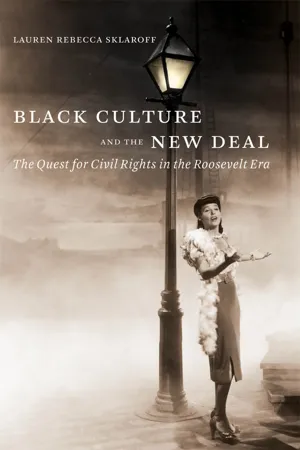
In the 1930s, the Roosevelt administration — unwilling to antagonize a powerful southern congressional bloc — refused to endorse legislation that openly sought to improve political, economic, and social conditions for African Americans. Instead, as historian Lauren Rebecca Sklaroff shows, the administration recognized and celebrated African Americans by offering federal support to notable black intellectuals, celebrities, and artists.
Sklaroff illustrates how programs within the Federal Arts Projects and several war agencies gave voice to such notable African Americans as Lena Horne, Joe Louis, Duke Ellington, and Richard Wright, as well as lesser-known figures. She argues that these New Deal programs represent a key moment in the history of American race relations, as the cultural arena provided black men and women with unique employment opportunities and new outlets for political expression. Equally important, she contends that these cultural programs were not merely an attempt to appease a black constituency but were also part of the New Deal’s larger goal of promoting a multiracial nation. Yet, while federal projects ushered in creativity and unprecedented possibilities, they were also subject to censorship, bigotry, and political machinations.
With numerous illustrations, Black Culture and the New Deal offers a fresh perspective on the New Deal’s racial progressivism and provides a new framework for understanding black culture and politics in the Roosevelt era.
eBook - ePub
Black Culture and the New Deal
The Quest for Civil Rights in the Roosevelt Era
- 328 pages
- English
- ePUB (mobile friendly)
- Available on iOS & Android
eBook - ePub
Black Culture and the New Deal
The Quest for Civil Rights in the Roosevelt Era
About this book
Information
chapter one
AMBIVALENT INCLUSION
During the first week of June 1939, Washington, D.C., avidly followed news of the visit of King George VI and Queen Elizabeth. “A crowd as enthusiastic and large as ever greeted an American President on inauguration day turned out today to watch and take part in the pomp,” the New York Times reported, chronicling all aspects of the historical occasion, down to the king’s and queen’s attire.1 On June 8, President Roosevelt received the royals at a state dinner; before approximately three hundred guests, he joined the king in a pledge to “walk together along the path of friendship in a world of peace.”2 Along with proclamations of international cooperation, the evening also included performances that featured what the White House considered “authentic” representations of American music. Showcasing elements of this “vital and undeniably American” folk culture, the evening’s entertainment included cowboy ballads, Appalachian folk songs, and rural-based dancing “handed down through generations.”3
The central focus, however, was on African Americans. In evaluating the origins of American music, the program notes for the evening stated, “above all, the negro has made the most distinctive contribution.” At the musicale’s opening, the American hosts and their British guests heard the voices of the North Carolina Spiritual Singers, a “community activity group” directed by the WPA’s Federal Music Project. As the program explained, the Spiritual Singers included a “cross section of Negro life in the State, composed of workers from the tobacco plants, clerks, doctors, school teachers … and housewives.” The program also noted that several of the performed folk songs were of “Negro origin” or derived from black minstrel songs. Last, African American contralto Marian Anderson delivered three compositions, including “Ave Maria” and “My Soul’s Been Anchored in the Lord”; only two other solo performers, Kate Smith and Lawrence Tibett, were part of the state dinner production. At this important event, for arguably the most respected of foreign dignitaries, the White House chose to highlight African American culture, not in a demeaning fashion, but as an affirmation of African American citizenship and inclusiveness.4
This focus on black performance was integral to the Roosevelt administration’s development of federal cultural programs and its larger racial policy by the end of the 1930s. However, understanding why African Americans were so centrally staged in an event such as the royal reception in 1939 requires an explanation of how racial issues became increasingly important to the administration’s political agenda. We must also consider why New Dealers advocated for the establishment of a federally sponsored arts program, one that would come to play a central role in the government’s recognition of African Americans. Upon Roosevelt’s election in 1932, neither culture nor race weighed heavily on the political agenda; in a matter of years, the administration’s outlook would change.
Race and Politics in the New Deal Era
For decades, African Americans had shown an unwavering commitment to the Republican Party. Although Democrats had made some inroads among African Americans in the 1928 and 1932 elections, African Americans remained faithful to the party of Lincoln during Franklin Roosevelt’s first term in office. Even after previous Republican administrations had ignored African Americans and sanctioned discriminatory policies, African Americans’ loyalty to the GOP remained steadfast, largely out of an allegiance to the Great Emancipator. As historian Nancy Weiss contends, “The Lincoln legacy was one of the toughest obstacles to overcome in converting blacks to the Democratic Party.”5 With this in mind, Republican Party officials treated the black membership within the GOP as a given and made few efforts before 1936 to reach out to African American voters. This confidence in black Republicanism, however, was not unshakable, particularly when African Americans had good reason to abandon the party. Disproportionately affected by the Depression, black men and women did not see any indication that President Herbert Hoover would initiate legislation to better their economic or social condition. Hoover’s Supreme Court nomination of John Parker, deemed “anti-black” by the NAACP, with a record of discriminatory legislation he supported while serving as the secretary of commerce, left many black voters to question the mission of the GOP.6
Yet, frustrations with Hoover did not immediately result in black men and women shifting their political allegiance. In 1932, Democrats offered scant evidence that their party would offer a better alternative for African Americans. Before his presidency, Roosevelt had never been a proponent of black civil rights. As New Deal historian Harvard Sitkoff contends, Roosevelt’s political career had been a “model of deference to the white South on racial issues” and during his first term, the president demonstrated few actions that would contradict this description. Highly dependent on southern states for political backing and a self-described “adopted son of Georgia,” due to his purchase of a home in Warm Springs, Roosevelt was unwilling to make mention of any racial issues that might alienate his supporters. He did not make a significant attempt to court the black vote during his 1932 election campaign, and unsurprisingly, African Americans backed the Republican candidate, Herbert Hoover, in 1932, by a two-to-one majority. With the landslide election of Roosevelt and the Texan vice president, John Nance Garner, the federal government’s disinterest in racial matters confirmed the southern belief that these policies should remain the states’ province. Roosevelt’s first cabinet bore the conviction that any threats to white supremacy could be politically disastrous.7
Even if Roosevelt eschewed explicit overtures to African Americans, many testified that in its early days, the New Deal had dramatically improved their lives. As the black political scientist Earl Brown asserted, “countless Negroes were snatched from a living death by New Deal relief.”8 As African Americans suffered extreme poverty during the Depression, New Deal programs were a clear manifestation of the government’s concern, particularly in light of Herbert Hoover’s skeletal policies. In January 1933, John Gaddis, an African American mechanic, told Franklin Roosevelt that he believed the president was receptive to offering the “few acts of encouragement” African Americans badly needed.9 According to Gaddis, who considered himself one of the “many forgotten men,” the election of Roosevelt ushered in positive changes for impoverished African Americans, especially as previous presidencies had not rewarded these Republican ballots. The creation of agencies such as the National Recovery Administration, the Agricultural Adjustment Administration, and the Civilian Conservation Corps raised African Americans’ expectations of the federal government; as a result of these developments, Howard University dean Kelly Miller urged black men and women to “trust President Roosevelt” in the early days of the New Deal.10
In this context, maintaining loyalty to the Republican Party’s legacy was less imperative than supporting an administration that had begun to demonstrate a commitment to improving economic conditions. As the New York Times proclaimed, there existed a “deep sense of gratitude among the Negroes for the benefits of the New Deal and the fact that the old traditions handed down to them in rather violent steps from the Civil War and reconstruction days are giving way.” Besides appreciating the economic benefits of New Deal programs, African Americans also supported Roosevelt for the “recognition” they received from the federal government.11 Expressing his faith in the Roosevelt administration, one Pittsburgh Courier writer stated, “Perhaps more than any other couple ever occupying the White House, President and Mrs. Roosevelt have demonstrated their friendliness and interest in the problems of colored Americans…. The couple … is setting an example in tolerance, sympathetic understanding and lack of color bias which all white America should follow.”12
In addition, black men and women were also encouraged by a few progressive administrators. In the early years of the New Deal, some liberal-minded officials boldly confronted racial issues, most notably Interior Secretary Harold Ickes, former president of the Chicago chapter of the NAACP. Ickes viewed the New Deal as a potential vehicle in the battle against racial discrimination. In a letter to the NAACP assistant secretary, Roy Wilkins, in 1933, he confirmed his faith in interracialism: “I have long been interested in the advancement of the Negro, and I do not see how any fairminded individual, either white or colored, can expect to advance the interests of the Negro if mutuality of contact is not established through the efforts of both races.”13 In addition, a white Georgian named Clark Foreman, who served under Ickes as “special advisor on the economic status of Negroes,” sought to combat racial discrimination in government agencies such as the National Recovery Administration (NRA) and advocated on behalf of southern black farmers and workers. Two black intellectuals, Robert Weaver and William Hastie, who served in the Interior Department, exerted important influence within the small coterie of white liberals; it was Weaver and Hastie who successfully lobbied for the desegregation of the department’s restrooms and cafeteria. Thus, while Roosevelt himself did not pronounce a commitment to racial reform during his first term, there were some within his administration who believed that African Americans could not go unrecognized.14
Although New Deal programs were a far cry from the kind of policies that African American leaders fought for, they nonetheless represented concrete efforts to bring the nation out of poverty. One black political scientist, Earl Brown, placed full confidence in a black Democratic electorate: “They [African Americans] will vote for Franklin D. Roosevelt in November because they are sick of the Abe Lincoln–Civil War claptrap and because they are still being fed by Roosevelt relief.”15 Well aware of this perception among African Americans, by 1936, Republicans made efforts to retain their previously unwavering constituency by harkening back to Lincoln’s achievements and emphasizing the overwhelming influence of racist southern Democrats. These kinds of appeals, however, had come too late; although Republicans attacked the New Deal, they could not offer concrete evidence that they would provide a better alternative. By 1934, the number of registered black voters increased in urban areas, particularly following the continuous northern and midwestern black migration during the Depression. Cities with existing strong black communities, such as Washington, D.C., Chicago, and New York City, all witnessed sizable population increases in the 1930s; states such as Michigan, Missouri, and Pennsylvania witnessed growth in the black population by one-third. Thus, for many Democrats, the black vote became important in securing the party’s victory in 1936; prospective candidates often could not avoid the topic of civil rights in their campaigns. As the New York Times described, one campaign to court the black vote in September 1936 emphasized an aggressive drive in the “pivotal Northern states, where the disposition of some 2,000,000 Negro votes may spell the difference between victory and defeat for Mr. Roosevelt.”16 For the first time, in 1936, black delegates attended the Democratic National Convention, an overture that Republicans were not willing to make.17
The newfound promise of the Democratic Party did not prevent black political organizations and individual men and women from immediately decrying discriminatory practices in New Deal agencies. As these agencies were largely decentralized during Roosevelt’s first administration, the distribution of relief remained in the hands of local officials. Therefore, African Americans, who still largely resided in the South, faced widespread discrimination in the Civilian Conservation Corps (CCC), the Tennessee Valley Authority (TVA), and other federal agencies, which reinforced the southern political and racial hierarchy. Julian Harris of the New York Times described the damaging effects of the National Recovery Act for African American workers, frequently displaced or forced to accept wage differentials that southern manufacturers had instituted under the NRA codes.18 In the NAACP’s annual report in 1933, Executive Secretary Walter White charged that southern manufacturers “thinly disguised” wage differentials as geographical when they were in fact “placed into effect on a strictly racial basis.”19 Echoing these sentiments, another New York Times writer declared, “the Blue Eagle [symbol of the NRA] may be a predatory bird instead of a feathered messenger of happiness.”20 African Americans also condemned Federal Emergency Relief Administration (FERA) director Harry Hopkins for rescinding the thirty-cent-per-hour minimum wage for work relief projects in Georgia. Claiming that the government “has abandoned the high idealism which marked the inception of the New Deal,” one Opportunity editorial expressed intense disappointment with the Roosevelt administration’s hypocrisy. As the government had originally provided African Americans with an unprecedented chance to attain a standard of living “infinitely better that they had ever dreamed of before,” wage reductions within FERA, particularly in southern states, confirmed that the president was not holding true to his word.21 “We question the wisdom of the administration in setting the seal of its approval on the wages of wretchedness,” another Opportunity editorial proclaimed.22
Black individuals and organizations such as the NAACP also opposed the appointment of Clark Foreman, a white man, to the newly created position of “special advisor on the economic status of Negroes.” As this was the first position within the New Deal that explicitly treated racial issues, for African Americans the administration’s choice of a director symbolized the future course and tenor of federal race policy. As Alphonzo Harris, an employee in the Office of the Treasury and a pronounced “Roosevelt man,” wrote to presidential secretary Louis Howe, “the colored man knows his plight better and more fully than anybody else and, if given the backing and the authority of the great United States Government he could work out his economic conditions to the satisfaction of the entire country.”23 Although Robert Weaver, an African American, held the position of Foreman’s assistant and Harold Ickes assured African Americans that Foreman was “devoting his life” to the cause of racial justice, the idea of a white “expert” on racial issues did not sit well with many black Americans.24 This debate over whether a white man could serve as a “Negro affairs” expert in the Department of the Interior would reemerge in the government’s cultural bureaucracies as well. In short, the controversy over the appointment of Clark Foreman foreshadowed one of the major issues confronting officials in the development of federal racial policy for years to come.
The Roosevelt administration was cognizant of black criticism, as the president’s colleagues and advisers alerted his staff to specific articles in the black press. Referring to a column (condemning the NRA) written by Kelly Miller in the New York Amsterdam News, prominent New York Democrat James Hoey wrote to presidential secretary Louis Howe, “you can see from this article that the negroes are looking to the President to do or say something in their behalf. I trust that this matter have earnest and prompt consideration.”25 One New York Age article tried to explain the scarcity of political appointments for African ...
Table of contents
- Cover Page
- BLACK CULTURE AND THE NEW DEAL
- Copyright Page
- Dedication
- CONTENTS
- ILLUSTRATIONS
- ACKNOWLEDGMENTS
- INTRODUCTION
- chapter one AMBIVALENT INCLUSION
- chapter two HOOKED ON CLASSICS
- chapter three THE EDITOR’S DILEMMA
- chapter four CONSTRUCTING G.I. JOE LOUIS
- chapter five VARIETY FOR THE SERVICEMEN
- chapter six PROJECTING UNITY
- EPILOGUE
- NOTES
- BIBLIOGRAPHY
- INDEX
Trusted by 375,005 students
Access to over 1.5 million titles for a fair monthly price.
Study more efficiently using our study tools.
Frequently asked questions
Yes, you can cancel anytime from the Subscription tab in your account settings on the Perlego website. Your subscription will stay active until the end of your current billing period. Learn how to cancel your subscription
No, books cannot be downloaded as external files, such as PDFs, for use outside of Perlego. However, you can download books within the Perlego app for offline reading on mobile or tablet. Learn how to download books offline
Perlego offers two plans: Essential and Complete
- Essential is ideal for learners and professionals who enjoy exploring a wide range of subjects. Access the Essential Library with 800,000+ trusted titles and best-sellers across business, personal growth, and the humanities. Includes unlimited reading time and Standard Read Aloud voice.
- Complete: Perfect for advanced learners and researchers needing full, unrestricted access. Unlock 1.5M+ books across hundreds of subjects, including academic and specialized titles. The Complete Plan also includes advanced features like Premium Read Aloud and Research Assistant.
We are an online textbook subscription service, where you can get access to an entire online library for less than the price of a single book per month. With over 1.5 million books across 990+ topics, we’ve got you covered! Learn about our mission
Look out for the read-aloud symbol on your next book to see if you can listen to it. The read-aloud tool reads text aloud for you, highlighting the text as it is being read. You can pause it, speed it up and slow it down. Learn more about Read Aloud
Yes! You can use the Perlego app on both iOS and Android devices to read anytime, anywhere — even offline. Perfect for commutes or when you’re on the go.
Please note we cannot support devices running on iOS 13 and Android 7 or earlier. Learn more about using the app
Please note we cannot support devices running on iOS 13 and Android 7 or earlier. Learn more about using the app
Yes, you can access Black Culture and the New Deal by Lauren Rebecca Sklaroff in PDF and/or ePUB format, as well as other popular books in Social Sciences & North American History. We have over 1.5 million books available in our catalogue for you to explore.