In 1880, ancient-growth forest still covered two-thirds of West Virginia, but by the 1920s lumbermen had denuded the entire region. Ronald Lewis explores the transformation in these mountain counties precipitated by deforestation. As the only state that lies entirely within the Appalachian region, West
Virginia provides an ideal site for studying the broader social impact of deforestation in Appalachia, the South, and the eastern United States.
Most of West Virginia was still dominated by a backcountry economy when the industrial transition began. In short order, however, railroads linked remote mountain settlements directly to
national markets, hauling away forest products and returning with manufactured goods and modern ideas. Workers from the countryside and abroad swelled new mill towns, and merchants ventured into
the mountains to fulfill the needs of the growing population. To protect their massive investments, capitalists increasingly extended control over the state’s legal and political systems.
Eventually, though, even ardent supporters of industrialization had reason to contemplate the consequences of unregulated exploitation. Once the timber was gone, the mills closed and the railroads pulled up their tracks, leaving behind an environmental disaster and a new class of marginalized rural poor to confront the worst depression in American history.
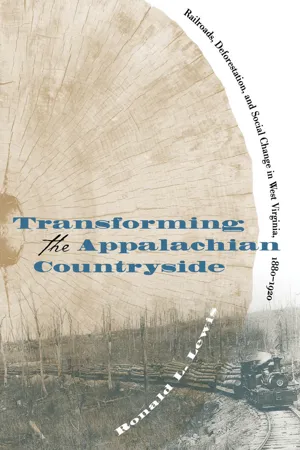
eBook - ePub
Transforming the Appalachian Countryside
Railroads, Deforestation, and Social Change in West Virginia, 1880-1920
- 368 pages
- English
- ePUB (mobile friendly)
- Available on iOS & Android
eBook - ePub
Transforming the Appalachian Countryside
Railroads, Deforestation, and Social Change in West Virginia, 1880-1920
About this book
Information
Table of contents
- Cover Page
- Transforming the Appalachian Countryside
- Copyright Page
- Dedication
- CONTENTS
- ILLUSTRATIONS
- TABLES
- MAPS AND FIGURES
- ACKNOWLEDGMENTS
- INTRODUCTION
- CHAPTER ONE THE VIRGIN FOREST AND THE BACKCOUNTY ECONOMY
- CHAPTER TWO THE TOUCH OF CAPITAL: RAILROADS, TIMBER, AND ECONOMIC DEVELOPMENT OF THE BACKCOUNTIES
- CHAPTER THREE LAND, CAPITAL, AND TIMBER OPERATIONS AT THE PERIPHERY
- CHAPTER FOUR MAKING CAPITAL SECURE: LAW AND THE INDUSTRIAL TRANSFORMATION OF WEST VIRGINIA
- CHAPTER FIVE WORKERS IN THE WOODS
- CHAPTER SIX ETHNICITY, EXPLOITATION, AND SOCIAL CONFLICT
- CHAPTER SEVEN CONNECTING THE PERIPHERY: COMMERCIALIZATION OF THE COUNTRYSIDE
- CHAPTER EIGHT “NEW MEN” VERSUS “OLD MEN”: POLITICAL ECONOMY AND THE COUNTY SEAT WARS
- CHAPTER NINE THE MARKET REVOLUTION AND THE DECLINE OF AGRICULTURE
- CHAPTER TEN IF TREES COULD CUSS: ENVIRONMENTAL DESTRUCTION AND THE BEGINNINGS OF RESTORATION
- NOTES
- BIBLIOGRAPHY
- INDEX
Trusted by 375,005 students
Access to over 1.5 million titles for a fair monthly price.
Study more efficiently using our study tools.
Frequently asked questions
Yes, you can cancel anytime from the Subscription tab in your account settings on the Perlego website. Your subscription will stay active until the end of your current billing period. Learn how to cancel your subscription
No, books cannot be downloaded as external files, such as PDFs, for use outside of Perlego. However, you can download books within the Perlego app for offline reading on mobile or tablet. Learn how to download books offline
Perlego offers two plans: Essential and Complete
- Essential is ideal for learners and professionals who enjoy exploring a wide range of subjects. Access the Essential Library with 800,000+ trusted titles and best-sellers across business, personal growth, and the humanities. Includes unlimited reading time and Standard Read Aloud voice.
- Complete: Perfect for advanced learners and researchers needing full, unrestricted access. Unlock 1.5M+ books across hundreds of subjects, including academic and specialized titles. The Complete Plan also includes advanced features like Premium Read Aloud and Research Assistant.
We are an online textbook subscription service, where you can get access to an entire online library for less than the price of a single book per month. With over 1.5 million books across 990+ topics, we’ve got you covered! Learn about our mission
Look out for the read-aloud symbol on your next book to see if you can listen to it. The read-aloud tool reads text aloud for you, highlighting the text as it is being read. You can pause it, speed it up and slow it down. Learn more about Read Aloud
Yes! You can use the Perlego app on both iOS and Android devices to read anytime, anywhere — even offline. Perfect for commutes or when you’re on the go.
Please note we cannot support devices running on iOS 13 and Android 7 or earlier. Learn more about using the app
Please note we cannot support devices running on iOS 13 and Android 7 or earlier. Learn more about using the app
Yes, you can access Transforming the Appalachian Countryside by Ronald L. Lewis in PDF and/or ePUB format, as well as other popular books in History & North American History. We have over 1.5 million books available in our catalogue for you to explore.