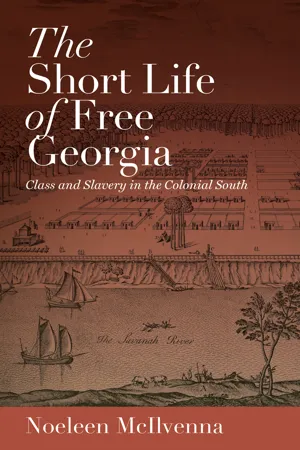
For twenty years in the eighteenth century, Georgia — the last British colony in what became the United States — enjoyed a brief period of free labor, where workers were not enslaved and were paid. The Trustees for the Establishment of the Colony of Georgia created a “Georgia experiment” of philanthropic enterprise and moral reform for poor white workers, though rebellious settlers were more interested in shaking off the British social system of deference to the upper class. Only a few elites in the colony actually desired the slave system, but those men, backed by expansionist South Carolina planters, used the laborers' demands for high wages as examples of societal unrest. Through a campaign of disinformation in London, they argued for slavery, eventually convincing the Trustees to abandon their experiment.
In The Short Life of Free Georgia, Noeleen McIlvenna chronicles the years between 1732 and 1752 and challenges the conventional view that Georgia’s colonial purpose was based on unworkable assumptions and utopian ideals. Rather, Georgia largely succeeded in its goals — until self-interested parties convinced England that Georgia had failed, leading to the colony’s transformation into a replica of slaveholding South Carolina.
- 158 pages
- English
- ePUB (mobile friendly)
- Available on iOS & Android
eBook - ePub
About this book
Information
Table of contents
- Cover Page
- Short Life of Free Georgia: Class and Slavery in the Colonial South
- Copyright Page
- Dedication
- Contents
- Figure and Maps
- Acknowledgments
- Introduction
- Chapter 1: Pre-Georgia, 1720s
- Chapter 2: Workers, 1733–1736
- Chapter 3: Discontent, 1736–1739
- Chapter 4: Whitefield and War, 1739–1742
- Chapter 5: Credit and Blame, 1742–1749
- Chapter 6: Defeat, 1750s
- Conclusion
- Notes
- Bibliography
- Index
Trusted by 375,005 students
Access to over 1.5 million titles for a fair monthly price.
Study more efficiently using our study tools.
Frequently asked questions
Yes, you can cancel anytime from the Subscription tab in your account settings on the Perlego website. Your subscription will stay active until the end of your current billing period. Learn how to cancel your subscription
No, books cannot be downloaded as external files, such as PDFs, for use outside of Perlego. However, you can download books within the Perlego app for offline reading on mobile or tablet. Learn how to download books offline
Perlego offers two plans: Essential and Complete
- Essential is ideal for learners and professionals who enjoy exploring a wide range of subjects. Access the Essential Library with 800,000+ trusted titles and best-sellers across business, personal growth, and the humanities. Includes unlimited reading time and Standard Read Aloud voice.
- Complete: Perfect for advanced learners and researchers needing full, unrestricted access. Unlock 1.5M+ books across hundreds of subjects, including academic and specialized titles. The Complete Plan also includes advanced features like Premium Read Aloud and Research Assistant.
We are an online textbook subscription service, where you can get access to an entire online library for less than the price of a single book per month. With over 1.5 million books across 990+ topics, we’ve got you covered! Learn about our mission
Look out for the read-aloud symbol on your next book to see if you can listen to it. The read-aloud tool reads text aloud for you, highlighting the text as it is being read. You can pause it, speed it up and slow it down. Learn more about Read Aloud
Yes! You can use the Perlego app on both iOS and Android devices to read anytime, anywhere — even offline. Perfect for commutes or when you’re on the go.
Please note we cannot support devices running on iOS 13 and Android 7 or earlier. Learn more about using the app
Please note we cannot support devices running on iOS 13 and Android 7 or earlier. Learn more about using the app
Yes, you can access The Short Life of Free Georgia by Noeleen McIlvenna in PDF and/or ePUB format, as well as other popular books in History & Early American History. We have over 1.5 million books available in our catalogue for you to explore.