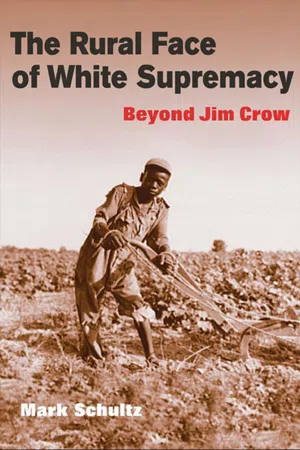
Now in paperback, The Rural Face of White Supremacy presents a detailed study of the daily experiences of ordinary people in rural Hancock County, Georgia. Drawing on his own interviews with over two hundred black and white residents, Mark Schultz argues that the residents acted on the basis of personal rather than institutional relationships. As a result, Hancock County residents experienced more intimate face-to-face interactions, which made possible more black agency than their urban counterparts were allowed. While they were still firmly entrenched within an exploitive white supremacist culture, this relative freedom did create a space for a range of interracial relationships that included mixed housing, midwifery, church services, meals, and even common-law marriages.
- English
- ePUB (mobile friendly)
- Available on iOS & Android
eBook - ePub
About this book
Information
Publisher
University of Illinois PressYear
2010Print ISBN
9780252074363
9780252029608
eBook ISBN
9780252092367
Topic
SozialwissenschaftenSubtopic
Nordamerikanische Geschichte1
“Friendship Was Better than Money”
One day in 1936 thirteen-year-old Carlton Morse was at school with his brothers and sisters. His family—black—worked on shares for a white Hancock planter. Midway through the schoolday a brother who had stayed home sick arrived with a note for Carleton to give his teacher. Before he delivered it, curiosity nudged him to open the note. It said simply that the Morse children needed to be excused from class. At home he learned why: the landlord had told his father that “the children didn’t have time to go to school. The bushes needed cutting. Take them out.” That day he had believed that his education had come to an end. Sixty years later he still became angry recalling the incident.1
Fourteen years earlier and a few miles north of the Bennett family, a white farmer, Dick Sykes, rode a horse to the farm of Katie Hunt, a black woman in her early thirties. Hunt and her husband, Wilkins, were relatively independent, renting land from a nearby white planter. Wilkins had gone to work in New York for the summer and was sending money to help his family through the first boll weevil year, while Katie and her children were taking care of their cotton acreage and substantial garden. Hunt was sitting on her porch when Sykes approached. The white man made small talk for a while and then hinted that the planter from whom she rented would like her to take her children out of summer school and set them to work poisoning the boll weevils. She answered: “He can’t tell me to tell my children what to do, ’cause he isn’t the daddy of nary a one of them. Every one of them is mine and Wilkins Hunt’s—their daddy.” The planter, she continued, “hain’t got but one child that I know of—is Sarah—and that’s the onliest person he can tell to go on out there and go—is his own daughter.” Sykes laughed and said that he was going on to the next farm. “I just told them plain out,” remembered Katie Hunt; “I didn’t never bite my tongue.” She laughs every time she relates the story.2
These stories illustrate that far from being “solid,” the South provided for diverse experiences and widely differing self-direction among rural African Americans. The highly personal nature of the postbellum southern economy created many different economic platforms on which black and white southerners worked out their relationships. This rural southern diversity persisted until the region’s distinctive agricultural system was subsumed into the national economy by forces unleashed in World War II. Yet our historical literature has not fully come to reflect this diversity. Where, for example, are the Katie Hunts in our histories of the rural South? Where, indeed, are any rural African Americans who achieved more than marginal economic or personal independence? Until recently much of the historical literature describing race relations in the postbellum rural South has taken for granted that the structure of the agricultural economy homogenized the region’s African Americans into general poverty, dependence, and relative defenselessness. A number of writers have commented that their position was little removed from slavery.3 This is ironic, for dozens of recent studies have commented on the diversity of experiences collected under the title of “the” slave experience.4
Beyond question, the experience of “freedom” offered much less than the freedmen had hoped for, beset as they were by white violence and largely denied the franchise, education, and land. Their freedom was further circumscribed by the limitations of the pre–World War II cotton culture—a culture that stifled urban growth, inhibited the development of a diversified economy, and held down southern wages generally.
The experience of African American southerners in the century after the Civil War has to be understood in the economic context of the region as a whole. While the rest of the country moved increasingly toward either industrialization or agricultural mechanization, southerners held fast to traditional farming technologies and labor-intensive farming strategies. As the rest of the country became accustomed to the cash-driven consumer economy and adapted to the bureaucratic, impersonal, modern culture it produced, many rural southerners remained in a distinctive semisubsistence cultural backwater: cash poor, local, personal, and in many regards, premodern. In the twentieth century as in the antebellum period, the cotton culture of Georgia’s piedmont meshed “rationally” with the national economy while preserving a distinctive, “less rationalized” set of relationships within the South. In the decades after the Civil War, however, King Cotton became a petty, decrepit baron as worldwide cotton production rose and the price of cotton sank. A series of forces—some intentional and personal, others diffuse and impersonal—trapped African American farmers within this decaying industry and somewhat isolated world. Sometimes for better but more often for worse, they remained thralls to a diminished, increasingly miserly lord, until forces set into motion by the world wars opened a means of escape and integrated the South, economically, socially, and culturally, into the main currents of the nation.5
From the end of Reconstruction until World War II, Hancock’s planters and merchants exerted local control over the internal structure of this impoverished, insular culture. Although they lacked either the funds or the inclination to mechanize, the planters did control a large labor force, which they consciously kept unskilled through their manipulation of the education system. Whenever dependent agricultural laborers challenged their control, either politically or economically, they closed ranks to destroy the threat through legal means or violence. Yet, while they united to defend their system against organized attack, they separated to administer it. Throughout this period powerful white southerners enhanced their own personal power by upholding a decentralized authority structure and a culture of personalism. Individual planters therefore held direct and personal control over a majority of Hancock’s black laborers and answered to no one for their manner of administration. This system gave the planters a sense of confidence in their control—a confidence that fostered their tolerance of a rural culture marked by interracial intimacy and by autonomy and even resistance on the part of individual African Americans.
In rural Hancock the African American experience of earning a living was far from homogeneous. Although most black farmers were never able to buy land, a surprising number successfully navigated all impediments to become farm owners. Many others, such as the Hunts, used the tenant system in ways that gave them a level of security that they themselves described as meaningful. Others carved independent, nonagricultural niches for themselves in the rural economy. Simultaneously, many families found nothing but an inescapable cycle of poverty, with many losing control over important aspects of their lives. Yet the story of black farmers in the South must include the many who continued to make meaningful choices about their own lives. W. E. B. Du Bois, commenting on the situation from Atlanta in 1908, wrote: “Few among modern groups show a greater internal differentiation of social conditions than the Negro American, and the failure to realize this is the cause of much confusion. . . . The forward movement of a social group is not the compact march of an army, where the distance covered is practically the same for all, but is rather the straggling of a crowd, where some of whom hasten, some linger, some turn back, some reach far-off goals before others even start, and yet the crowd moves on.” Du Bois’s assessment applied even among the farms of Georgia’s piedmont.6
It is tempting to search for black economic progress to which Du Bois referred only in terms of success in the traditional capitalist economy. Until World War II, however, southern farmers sometimes engaged the market in ways that offered greater personal autonomy instead of the hope of higher cash income. Local economies in at least some parts of the rural South were somewhat removed from the homogenizing logic of the market economy.7 These rural economies could vary a great deal within themselves. Some Hancock farms were fully “rationalized” and driven by dependence on northern credit and the impersonal laws of supply and demand.8 Other Hancock farms, through neighborhood exchanges of food and labor and the persistence of semisubsistence strategies, maintained alternative ways to engage the market and hence somewhat expanded autonomy. These non-market-oriented approaches broke down, along with the entire cotton culture, when the national economy made deep inroads into the southern economy during World War II and created high-wage jobs in the region. The economic modernization of the 1940s and 1950s transformed the material basis of race relations in rural Hancock, modernizing and systematizing it. Until then, poverty, rural isolation, and the embedded traditions of personalism and paternalism kept Hancock County—and places like it—in an eddy apart from the “main” currents of U.S. society.
The Context of Southern Poverty
After emancipation freedmen attempted to fashion for themselves a meaningful autonomy. They envisioned themselves as yeomen farmers, as participants in government, as heirs to the social respect due citizens, as people free to worship in a manner of their own choosing, and—through their children—as literate people. Taken together, their goals spoke primarily of their desires to make meaningful choices and to enjoy autonomy from external coercion, a desire surely forged by their experience of slavery.9 Arguably, chief among their claims on freedom was the desire for land—for “forty acres and a mule,” as the popular saying proclaimed. Instead of finding autonomy, however, most freedmen became landless, dependent farmers, working as wage laborers, sharecroppers, share tenants, or cash renters. These forms of land tenure were not systematically administered across the South, and tenants and landlords often renegotiated terms at the start of each growing season, but the planters held most of the cards in these negotiations: ownership of the land, the threat of violence, and the right to write and interpret the law.10
For three generations following emancipation, white planters and black farmers struggled over the direction of labor and the division of steadily shrinking cotton profits. The ex-slaves had the misfortune of emerging into the free market just as the country entered three decades of economic turbulence. Although the value of all goods declined during this period, the prices of agricultural products fell even more precipitously. Cotton farmers in the South doubled their production between 1870 and 1890, thereby glutting the market. During these years the price of cotton fell from eighteen cents per pound to only seven. With expanded wartime demand and a restriction on worldwide trade, the price soared for a short, delirious period around World War I. Then it plummeted again, eventually hitting bottom at five cents per pound. Southern cotton growers also came to face competition from cotton plantations in Egypt and India and, early in the twentieth century, from huge, mechanized, state-subsidized cotton plantations in California and the Southwest. The South—unmechanized, beset by the boll weevil, and broken into small, overworked farms—ultimately could not compete and lost cotton supremacy to California by the end of the 1950s. Despite the plant’s decreasing value, southern farmers continued to plant cotton as their primary market crop in the first half of the twentieth century. This decision left few profits to divide between landowners and laborers in places such as Hancock.11
The profits of southern cotton farmers were further reduced by regionwide rural overpopulation. Until World War II, too many people attempted to wring their livelihoods from an industry that simply could not decently support them all. The abundance of labor in the South suppressed competition among employers and lowered the wages of dependent farmers. As the rural population grew, these farmers worked on smaller and smaller plots of land. They plowed with mules, thinned the crop with hoes, and picked the cotton by hand, employing essentially the same methods and equipment used by farmers centuries earlier.12 Meanwhile, California’s agribusinesses, using subsidies from the U.S. Department of Agriculture, built complex irrigation systems and invested in enormous tractors that could do the work of a dozen manual workers. The unmechanized, labor-intensive cotton culture survived as long as it did in the South only because the extremely meager wages paid to dependent farmers kept labor costs low. In essence, the high profits of the modern agribusinesses were subsidized by the federal government, while the marginal earnings of landowners in the Georgia piedmont were subsidized by their own impoverished tenants.13
According to the economist Gavin Wright, the South became an isolated regional labor market, an insular low-wage economy within a national high-wage one.14 But why did cotton farmers choose to remain within this impoverished economy? One group of historians has argued that poor farmers—especially poor black farmers—literally had no choice. They were trapped on southern farms by white planters who recognized them as a valuable and exploitable resource. In many parts of the South, planters and merchants consciously offered credit at high interest to ensnare dependent farmers in cycles of debt. According to this interpretive model, planters used debt to extend their control: farmers who could not repay their furnish at the end of a bad year were legally barred from leaving the plantation until they had cleared their debt. Once ensnared, they were trapped for life. The planter or merchant to whom the farmer owed money often insisted that cotton—the only reliable cash crop—be planted instead of food crops. This drew the farmer out of a semisubsistence economy and more fully into the market, which in turn necessitated a larger furnish and more debt.
Literal peonage did exist across the South. In many places sharecroppers who owed a landlord at the end of the year were compelled to remain with that landlord until they paid off their debts. None of the people I interviewed mentioned this kind of peonage in Hancock, but another kind of coerced labor did exist. Those who were jailed and allowed planters to pay their fines were bound over by the courts to work off their debts in the cotton fields. If they attempted to escape or committed some other infraction, the courts extended their terms of servitude. This system obviously created opportunities for gross exploitation. Sometimes men convicted of petty crimes had their terms of service extended for years. In some counties local law-enforcement officers cooperated with planters by trumping up false charges against black men to secure their labor.
These abuses led to legislation designed to protect workers’ freedom of movement. Congress made peonage illegal in 1867, and the U.S. Supreme Court upheld the law in 1905. Furthermore, the Georgia state legislature outlawed convict leasing in 1908. Nevertheless, the state winked at loopholes that allowed planters to continue these practices for decades. Some judges and county leaders simply defied the law, a reality that highlights legal history’s need for a social history context.15 As one Hancock planter, J. E. Johnson, said, “If you needed a hand, you went to the chain gang to get a worker. When a man was on the chain gang for a year, he was cleaned out. You knew he was in good health, well fed, has worked, and is harde...
Table of contents
- Cover
- Title
- Copyright
- Contents
- List of Figures
- Preface
- Acknowledgments
- Introduction: A Place in Time
- 1. “Friendship Was Better Than Money”
- 2. The Other Rural Workers: Landowning and Working for Cash
- 3. Beyond Segregation: The Outlines of Interracial Social Relations in Rural Hancock
- 4. The Solid South and the Permissive South
- 5. Race, Violence, and Power in a Personal Culture
- 6. Paternalism and Patronage: Public Power in a Personal Culture
- Epilogue: The Rise of “Public Work”
- Appendix A: Methods
- Appendix B: Interviews
- Notes
- General Index
- Interviewee Index
- Photographs
Trusted by 375,005 students
Access to over 1.5 million titles for a fair monthly price.
Study more efficiently using our study tools.
Frequently asked questions
Yes, you can cancel anytime from the Subscription tab in your account settings on the Perlego website. Your subscription will stay active until the end of your current billing period. Learn how to cancel your subscription
No, books cannot be downloaded as external files, such as PDFs, for use outside of Perlego. However, you can download books within the Perlego app for offline reading on mobile or tablet. Learn how to download books offline
Perlego offers two plans: Essential and Complete
- Essential is ideal for learners and professionals who enjoy exploring a wide range of subjects. Access the Essential Library with 800,000+ trusted titles and best-sellers across business, personal growth, and the humanities. Includes unlimited reading time and Standard Read Aloud voice.
- Complete: Perfect for advanced learners and researchers needing full, unrestricted access. Unlock 1.5M+ books across hundreds of subjects, including academic and specialized titles. The Complete Plan also includes advanced features like Premium Read Aloud and Research Assistant.
We are an online textbook subscription service, where you can get access to an entire online library for less than the price of a single book per month. With over 1.5 million books across 990+ topics, we’ve got you covered! Learn about our mission
Look out for the read-aloud symbol on your next book to see if you can listen to it. The read-aloud tool reads text aloud for you, highlighting the text as it is being read. You can pause it, speed it up and slow it down. Learn more about Read Aloud
Yes! You can use the Perlego app on both iOS and Android devices to read anytime, anywhere — even offline. Perfect for commutes or when you’re on the go.
Please note we cannot support devices running on iOS 13 and Android 7 or earlier. Learn more about using the app
Please note we cannot support devices running on iOS 13 and Android 7 or earlier. Learn more about using the app
Yes, you can access The Rural Face of White Supremacy by Mark Roman Schultz in PDF and/or ePUB format, as well as other popular books in Sozialwissenschaften & Nordamerikanische Geschichte. We have over 1.5 million books available in our catalogue for you to explore.