In the late 1950s, against the unfolding backdrop of the Cold War, American and European leaders began working to reshape Western Europe. They sought to adapt the region to a changing world in which European empires were rapidly disintegrating, Soviet influence was spreading, and the United States could no longer shoulder the entire political and economic burden of the West yet hesitated to share it with Europe. Focusing on the four largest Atlantic powers — Britain, France, Germany, and the United States — Jeffrey Giauque explores these early stages of European integration.
Giauque uses evidence from newly opened international archives to show how a mix of cooperation and collaboration shaped efforts to unify postwar Europe. He examines the “grand designs” each country developed to advance its own interests, specific plans for collaboration or accord, and the reactions of the other Atlantic powers to these proposals. Competing national interests not only derailed many otherwise sound plans for European unity, Giauque says, but also influenced such nascent European institutions as the Common Market, the antecedent of today’s European Union. Indeed, beyond examining the origins of the European community, this comparative study provides insight into national attitudes and aspirations that continue to shape European and American policies today.
eBook - ePub
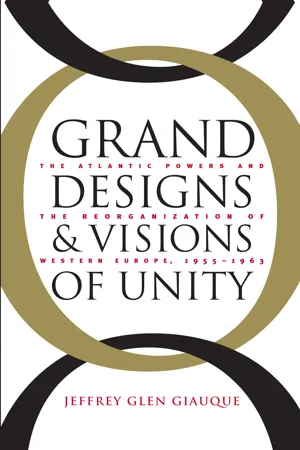
Grand Designs and Visions of Unity
The Atlantic Powers and the Reorganization of Western Europe, 1955-1963
- 344 pages
- English
- ePUB (mobile friendly)
- Available on iOS & Android
eBook - ePub
Grand Designs and Visions of Unity
The Atlantic Powers and the Reorganization of Western Europe, 1955-1963
About this book
Information
Chapter One: The Origins and Development of the Common Market, 1955–1960
European nations must learn the biblical precept that to save their lives they must lose them.—Dwight D. Eisenhower, comments to German finance minister Franz Etzel, 6 February 1957
Europe in the Plans of Germany, the United States, Britain, and France
After the defeat of the European Defense Community (EDC) in August 1954 at the hands of the French National Assembly and its subsequent replacement with the Western European Union (WEU) in late 1954, the process of Western European organization reached a turning point. The initial period of cooperation between 1947 and 1950 had been shaped by fears of the USSR, the need to coordinate recovery from the war, and British efforts to thwart supranational integration. A second phase between 1950 and 1954 was dominated by French promotion of greater supranationalism to control Germany. The institutions created during the period of British predominance, largely cooperative in nature and typified by the Organization for European Economic Cooperation (OEEC), and those created at French initiative, such as the supranational European Coal and Steel Community (ECSC), would remain in force. Nevertheless, the failure of the EDC signaled the end of the era of French leadership, leaving the field open for new initiatives.
During the next five years, between 1955 and 1960, such initiatives came from a variety of directions, from Western European leaders, nongovernmental pressure groups, and also from the United States. These new ideas ultimately laid the groundwork for the formation of the European Economic Community, more frequently known as the Common Market. Historians and political scientists have often studied this period, but none has focused on the rivalries within the Atlantic alliance as the key factor shaping Western Europe and its institutions.1 Between the mid-1950s and the early 1960s the major Atlantic countries waged a fairly traditional power struggle, complete with shifting allegiances and limited only by the Cold War necessity of maintaining the Atlantic alliance itself, by novel means. By promoting their own plans and resisting or supporting those of others, each of the four major Atlantic powers contributed to the birth and development of the Common Market.
Although Jean Monnet and the leaders of the Benelux countries are credited with the original ideas for the Common Market and the relaunching of Europe in 1955, German chancellor Konrad Adenauer and his foreign ministry quickly adopted them.2 Bonn’s leaders hoped to use a common market to advance German interests on many fronts, including opening markets and establishing economic links to the West to replace the political and military ties lost in the failure of the EDC. The Germans expected the Common Market to overcome the residue of past conflicts in Europe, foster Franco-German reconciliation, and thwart any temptation of future German leaders for a new “Rapallo” with the USSR. They also sought greater ties with the West to promote Germany’s economic development, political stability, and democracy, as well as its external security. If the Soviet Union aimed at dividing the West, a common economic area would thwart Moscow’s designs. Finally, German leaders favored further progress in integration to assure the maintenance of existing institutions such as the Coal and Steel Community.3
Postwar German leaders blamed European disunity for the devastation and division of their country and the continent’s decline. Adenauer viewed the two world wars as European “civil” wars that had decimated the continent’s human and material resources, sacrificed its overseas possessions and influence, and allowed it to be dominated by outside powers: “Germany and France are neighbors who waged war against each other again and again over the centuries. This was a European madness that must end once and for all.”4 Integration provided a chance to halt this conflict and restore Europe’s position in the world. A strong and unified Europe could deal with both the United States and USSR from a position of strength and promote both German and European interests. It could force the United States to acknowledge European concerns and enable Germany to negotiate reunification with the Soviets someday on a basis acceptable to the West, all while reassuring its neighbors of its stability and commitment to European cooperation.5
Many German political leaders also felt that in an interdependent world dominated by two superpowers, the European nation-state had become obsolete. Looking back to their own history, the Germans rediscovered the Zollverein (“Tariff Union”) of the early nineteenth century. In the words of Adenauer, it too “had initially been limited to economics but had led to political unity,” as the economic ties it created among dozens of small states had ultimately provided the building blocks for political unification. Although they knew that the European case was more complicated, Adenauer and his followers suggested that gradual economic unification via a European common market could similarly lead to a political entity able to serve the interests of Europe as well as its national components.6
Foreign Minister Heinrich von Brentano (1955–61), who shared most of the chancellor’s basic views, was convinced that Europe must not halt after the EDC’s failure. Although von Brentano saw European integration primarily as a link between France and Germany, he and Adenauer both hoped that Western European unity would be as wide as possible. After all, the greater its membership, the greater the group’s political and economic weight. Von Brentano also shared the chancellor’s conviction that, “over the long term, economic cooperation between various countries cannot be realized without the development of political coordination as well.”7 As realists who understood the impediments to political and economic integration, Adenauer and von Brentano hoped to limit it to the scale of the possible (that of the six members of the ECSC, known simply as “the Six”) at the outset, while leaving the door open for future members. Recognizing that an arrangement with France was the key to European unity, they were prepared to make extensive political and economic concessions to French interests in order to advance their fundamental goal of continental unity.
While there was general agreement within the German government on the broad design delineated above, there was sharp disagreement over how to achieve it. Minister of Economics Ludwig Erhard, the father of the “wirtschaftswunder,” led the resistance to Adenauer and von Brentano’s short-term strategy. He feared that a narrow and autarkic common market limited to the Six would damage German political and economic interests by dividing Western Europe into two blocs and threatening to cut off vital German markets in Britain and the other excluded countries. He felt that Adenauer was much too conciliatory toward France and complained, “The French are always making new demands. When you concede them half of what they demand, they act like they are making a great sacrifice.”8 He favored a looser free trade arrangement embracing all of Western Europe. Until Adenauer’s retirement in 1963, Erhard helped shape and modify German foreign policy, but never managed to replace the chancellor’s conceptions with his own.
In contrast to their German counterparts, American leaders during the latter years of the Eisenhower administration generally agreed on how best to advance their country’s interests in Europe. Although Eisenhower and his secretary of state, John Foster Dulles, had no particular blueprint, the consolidation of Western Europe was essential to America’s diplomatic, political, and economic interests.9 Eisenhower tended to frame his views on European integration in the most dramatic terms. He referred to European unity as the “salvation” of the western world, as a guarantee of the security, prosperity, and strength of Europe and the West as a whole, and as the surest way to assure world peace. “This project would be to the benefit of the United States, of the Atlantic community, and of all the world.” On the other hand, Eisenhower described the consequences of the failure of integration in the darkest possible terms: “If they [the Europeans] did not join together, deterioration and ultimate disaster were inevitable.”10 Like Adenauer, Eisenhower found an analogy for European integration in his own country’s history. He often evoked America’s evolution from a loose confederation of states to a strong federation as an example for Europe, notwithstanding the vast differences between the European and American cases, and stated that he hoped to “live long enough to see the creation of a United States of Europe.”11 Eisenhower understood that Western Europe had the economic and human resources to become a global superpower alongside the United States and the Soviet Union. With this third great concentration of power lined up alongside the United States, the global balance would shift decisively in favor of the West. A unified Western Europe could act as a powerful magnet on the Soviet satellites in Eastern Europe and slowly dissolve the communist bloc by peaceful means.12
Eisenhower was shrewd enough to realize that as Western Europe recovered its economic strength and political stability, it would become restless under American leadership and desire more independence within the Atlantic alliance and greater influence in the world. The United States could not withdraw from Western Europe and leave a vacuum for the USSR to exploit, but a unified Europe could both fill the void and meet the European desire for greater autonomy. Eisenhower, who was not afraid to use the term “Third Force,” believed that a unified Europe would inevitably act with a high degree of independence from the United States and welcomed this prospect. A European “third great power bloc” would remain a close American ally, if for no other reason than the weight of common interests, and it would be able to bear a much larger degree of the political and military burden of the Cold War.13 Eisenhower, who was always concerned with America’s vast global responsibilities, sought means to reduce its burden and make it more sustainable over the long term by making Europe more responsible for its own defense.14 He thus focused American support on the ambitious integration efforts of the Six rather than on wider and looser cooperative arrangements. He hoped for a strong supranational Europe that would include all the countries of Western Europe; but like the Germans he understood that it must start from a smaller base. He wished for the British to join Europe, but refused to hold up the whole process to wait for them.15
John Foster Dulles shared many of Eisenhower’s views on Europe, particularly its need for self-reliance to create and focus a Third Force. Unlike Eisenhower, Dulles was led more by fear of Europe’s future, of the prospects of neutralism and of an eventual deal with the USSR that might harm U.S. interests. From his own historical perspective and experience with the 1919 Paris peace conference and the failed Treaty of Versailles, Dulles recognized the dangers of American neglect and of European weakness and national rivalries and therefore dedicated himself to supporting European unity. Much more frightening than the possibility that a unified Europe might not always agree with the United States were the risks that a divided Western Europe might return to its old habits of internal conflict or prove unable to match the economic strength of the more centralized Eastern bloc. Dulles also made a virtue of necessity in another area. He welcomed the “realization by the Western European nations that they could not invariably count on the United States standing with them in the face of every difficulty they encountered in every part of the world. This realization is leading these nations to the belief that they must have real and intrinsic strength of their own and that such strength can only derive from genuine European unity. European integration might prove to be a welcome byproduct of the current friction with our allies.”16
Eisenhower and Dulles had learned hard lessons from the EDC episode. They now understood that all initiative for integration must come from the Europeans themselves and reflect real European ambitions rather than simply desperate and reluctant European responses to American pressures. For this reason, both men understood that the United States could advance European unity more by supporting European initiatives than by sponsoring any particular proposals themselves. They also realized that American indifference or hostility could slow or arrest the integration process and that the United States could not simply remain on the sidelines. Eisenhower and Dulles thus frequently assured European leaders that they supported integration in principle and would favor any particular proposal that advanced it.17
The British perspective toward Europe differed markedly from the German and American views and was based primarily on maintaining the three circles. Without the Commonwealth, Britain would become just another European country, unable to act as a global partner of the United States. But a Europe unified without the United Kingdom would become America’s main ally regardless of Britain’s links with its former colonies. If Britain could maintain its juggling act and retain its privileged relations with all three areas, it might be able to act as a bridge between Europe, the United States, and the wider world and play a leading role in the Cold War.18 British leaders based their policy in Europe on promoting sufficient unity and cooperation to foster security and economic development (and British influence on the continent), without leading to supranational unity that would confront Britain with the choice of joining and abandoning its global interests or of standing aside, losing its influence on the continent, and becoming little mo...
Table of contents
- Cover Page
- Title Page
- Copyright Page
- Dedication
- Contents
- Acknowledgments
- Abbreviations
- Introduction
- Chapter One: The Origins and Development of the Common Market, 1955–1960
- Chapter Two: The European and American Rejection of Britain’s Alternatives to the Common Market, 1956–1960
- Chapter Three: Adenauer, De Gaulle, and the Formation of the Franco - German Entente, 1958–1960
- Chapter Four: The Atlantic Community and the Role of the United States in Western Europe, 1959–1963
- Chapter Five: De Gaulle and the Rise and Fall of the Fouchet Plan, 1958–1963
- Chapter Six: Britain’s Application to the Common Market, 1961–1963
- Chapter Seven
- Conclusion
- Appendix: Chronology
- Notes
- Bibliography
- Index
Trusted by 375,005 students
Access to over 1.5 million titles for a fair monthly price.
Study more efficiently using our study tools.
Frequently asked questions
Yes, you can cancel anytime from the Subscription tab in your account settings on the Perlego website. Your subscription will stay active until the end of your current billing period. Learn how to cancel your subscription
No, books cannot be downloaded as external files, such as PDFs, for use outside of Perlego. However, you can download books within the Perlego app for offline reading on mobile or tablet. Learn how to download books offline
Perlego offers two plans: Essential and Complete
- Essential is ideal for learners and professionals who enjoy exploring a wide range of subjects. Access the Essential Library with 800,000+ trusted titles and best-sellers across business, personal growth, and the humanities. Includes unlimited reading time and Standard Read Aloud voice.
- Complete: Perfect for advanced learners and researchers needing full, unrestricted access. Unlock 1.5M+ books across hundreds of subjects, including academic and specialized titles. The Complete Plan also includes advanced features like Premium Read Aloud and Research Assistant.
We are an online textbook subscription service, where you can get access to an entire online library for less than the price of a single book per month. With over 1.5 million books across 990+ topics, we’ve got you covered! Learn about our mission
Look out for the read-aloud symbol on your next book to see if you can listen to it. The read-aloud tool reads text aloud for you, highlighting the text as it is being read. You can pause it, speed it up and slow it down. Learn more about Read Aloud
Yes! You can use the Perlego app on both iOS and Android devices to read anytime, anywhere — even offline. Perfect for commutes or when you’re on the go.
Please note we cannot support devices running on iOS 13 and Android 7 or earlier. Learn more about using the app
Please note we cannot support devices running on iOS 13 and Android 7 or earlier. Learn more about using the app
Yes, you can access Grand Designs and Visions of Unity by Jeffrey Glen Giauque in PDF and/or ePUB format, as well as other popular books in History & European History. We have over 1.5 million books available in our catalogue for you to explore.