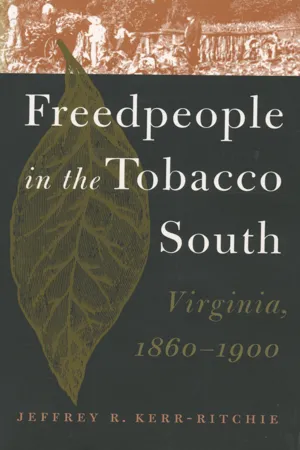
Throughout the colonial and antebellum periods, Virginia’s tobacco producers exploited slave labor to ensure the profitability of their agricultural enterprises. In the wake of the Civil War, however, the abolition of slavery, combined with changed market conditions, sparked a breakdown of traditional tobacco culture. Focusing on the transformation of social relations between former slaves and former masters, Jeffrey Kerr-Ritchie traces the trajectory of this breakdown from the advent of emancipation to the stirrings of African American migration at the turn of the twentieth century.
Drawing upon a rich array of sources, Kerr-Ritchie situates the struggles of newly freed people within the shifting parameters of an older slave world, examines the prolonged agricultural depression and structural transformation the tobacco economy underwent between the 1870s and 1890s, and surveys the effects of these various changes on former masters as well as former slaves. While the number of older freedpeople who owned small parcels of land increased phenomenally during this period, he notes, so too did the number of freedom’s younger generation who deserted the region’s farms and plantations for Virginia’s towns and cities. Both these processes contributed to the gradual transformation of the tobacco region in particular and the state in general.
- 368 pages
- English
- ePUB (mobile friendly)
- Available on iOS & Android
eBook - ePub
About this book
Information
Topic
SozialwissenschaftenSubtopic
ArbeitsmarktforschungChapter One: Slavery, Tobacco, and Old Dominion
You can make a nigger work, he said, but you cannot make him think.
—Slaveowner W to Frederick Law Olmsted
Used to wuk in family groups, we did....In dat way one could help de other when dey got behind.
—Ex-slave Frank Bell
Of course, when the master was away, they didn’t make much. —Ex-mistress Sarah Payne
Unfree labor and tobacco production were spawned by European colonialization and transatlantic mercantilism in the New World, along with popular luxury consumption in the Old World.1 The 250 years spanning the early seventeenth to the mid-nineteenth centuries saw the making of Virginia, its westward expansion, its cash crop production, and its social organization of slavery. By the eve of the Civil War the Old Dominion had established a long and venerable past. This history drew upon old English roots. These sprang up variously: Virginia led the ideological and military challenge to the British monarchy, provided disproportionate leadership in both the executive and the legislative branches of the new government, and nourished Jeffersonian republicanism as crucial to the political culture of the young nation. This proud state was also a society in which African slaves worked under the supervision of Anglo-American masters. This Old Dominion became increasingly exposed to a series of both internal and external pressures. The exigencies of war provided a quick shock to this traditional and relatively stable polity. The post-war decades were all about an Old Dominion struggling to come to terms with emancipation.
Cash crop production reigned supreme in the Old Dominion on the eve of the Civil War. During the 1859 agricultural season, slaves produced nearly 122 million pounds of tobacco leaf. This crop fetched an estimated $7 million in market sales and amounted to record high production levels. This poundage represented 28 percent of the total tobacco production in the United States, making the region the most valuable tobacco real estate in the nation (and probably globally). Cereal grains, especially wheat, were also an important component of Virginia’s export economy. During the same season, slaves helped produce nearly 11 million bushels of wheat worth over $15 million. Former slaves in Virginia recalled their arduous labors. Archie Booker never forgot “dem days dey raise co’n, wheat an’ terbaccy,” when they would “wuk fum sun to sun.” Eighty-six-year-old Henrietta Perry remembered her harsh work regimen and tobacco’s role in it. She recalled distastefully, “Use to get sick of seein’ de weed. Use to wuk fum sun to sun in dat old terbaccy field. Wuk till my back felt lak it ready to pop in two. Marse ain’ raise no thin’ but terbaccy, ceptin’ a little wheat an’ corn for eatin’, an’ us black people had to look arter dat ‘baccy lak it was gold.”2
There was some local consumption of these crops, but most were raised for export purposes. Tobacco was marketed to local urban areas such as Richmond, Petersburg, Danville, Lynchburg, and Clarksville. Once there, it was processed by factory workers into snuff for sniffing, plug for chewing, and shredded leaf for pipe smoking. The Old Dominion’s tobacco industry was estimated to be worth over $12 million in 1859. Its outlet was primarily domestic exportation for consumption southward in the cotton states. Planters and farmers consumed these tobacco products, as did slaves and free blacks. Cereal produce was also marketed to urban areas where it was milled into flour and grain and shipped to the cotton states as well as to northern states and Brazil. It should be added that profits from this slave agricultural production were also shipped northward; financial control of marketing and manufacturing radiated from New York City’s financial district.3
Despite the prime position of Virginia tobacco as an established staple crop that was part of a broader antebellum economy, specters of leaf competition loomed from bordering states. Kentucky’s rural producers had harvested a small tobacco crop in 1839. Twenty years later slave and free labor produced over 108 million pounds, or around one-quarter of the nation’s total poundage. The specter was also raised southward. North Carolina produced nearly 33 million pounds (7 percent of the national total) in 1859.4 Especially noteworthy was the emergence of a lighter and more pliable leaf called bright tobacco, which eventually became the favorite of tobacco manufacturers.5 Farther west the wheat fields were expanding. In 1849 farmers in the relatively new state of Illinois (1818) had produced nearly 10 million bushels of wheat compared to 11 million bushels from Virginia; a decade later these farmers produced nearly 24 million bushels compared to 13 million bushels. Indiana, Wisconsin, and Ohio all reported greater wheat production than the Old Dominion.6 These specters that haunted the Old Dominion’s cash crop economy were to sweep all before them in the postwar decades of emancipation and agricultural depression.

MAP 1.1. Virginia’s principal geographic regions (adapted from Dabney, Virginia, 417, by permission of the University Press of Virginia)
There was a temporary halt to tobacco’s dominion when Virginia’s rural producers switched crops to meet the exigencies of a Confederacy at war. On March 3, 1862, the Confederate congress assembled in Richmond passed a joint resolution “recommending the planters of the Confederate States to refrain from the cultivation of cotton and tobacco and devote their energies to raising provisions.”7 Many planters appear to have heeded this advice. On June 13,1862, J. B. Lundy, a slaveholder from Brunswick County in southside Virginia, wrote to the Confederate secretary of war requesting the return of impressed slaves from fortifying Richmond since “it is as necessary to till the land as to fight the battles.” Lundy went on to inform the secretary, “We planted full Crops of Corn for all our hands our determination being to raise grain and meat. We have planted all our best lands in Corn, (no tobacco is planted with us).”8 This substitution of subsistence for staple crops was widespread throughout internal Virginia during the war. According to Laurent Marcellin Joseph de Give, a Belgian consul reporting to his foreign minister on conditions in the Confederacy during the fall of 1862, tobacco production had all but ceased. “Tobacco raising in Virginia during 1862,” de Give wrote, “was affected by the same circumstances: like cotton, the crop hardly existed. It is estimated at not over a fifteenth of an average crop. Indeed during the autumn when I went through the region formerly planted to tobacco, I looked in vain for those immense fields of green which one used to see everywhere: the long, yellow corn stalks had crowded out the broad green tobacco leaves.”9

MAP 1.2. Tobacco production in Virginia, 1859 (USBC, 1860, Agriculture, 155-63)
This regional shift from intensive to extensive agricultural production was undoubtedly the result of the exigencies of war; it was also probably inevitable given the special labor requirements of leaf production. It is likely that this reduction in the labor-intensive agricultural routine of slaves in the Virginia tobacco belt marked an embryonic stage in the gradual erosion of older forms of social control. This transformation would have to await the military reality of Appomattox. Not until the 1870s did the full impact of western tobacco and cereal competition begin to undermine seriously an older dominion. And only during the century’s final two decades did the cigarette industry revolutionize an older tobacco world and its social relations.10
If cash crop production was one side of the Old Dominion, its other was unfree labor. African chattel slavery spread into the Virginia piedmont during the early eighteenth century. By 1750 the region’s 40,000 slaves represented one-third of Virginia’s total slave population. By the end of the eighteenth century the region had virtually trebled its slave populace. The piedmont held half of the state’s total slaves, compared with the one-third held in the tidewater. Tobacco’s lucrative profits drew slaveholders and forced slaves westward. In Pittsylvania County in southwestern Virginia, the slave population increased from 271 in 1767 to 4,200 by 1800, primarily through westward expansion. Just over a generation later, rural producers in this county were responsible for nearly 6.5 million pounds of tobacco; its population at this time had reached 24,400, of whom 11,558 (47 percent) were slaves.11
Creoles soon began to dominate the region’s slave population. This became evident in their use of acculturation to facilitate resistance against slavery. The usage of English language skills, the relative stability of family life through reproduction, slave naming in opposition to master’s naming, the rise of evangelical Christianity, and an increase in plantation units replacing smaller farms all encouraged the growth of slave communities in Virginia’s eighteenth-century interior regions. This piedmont life developed quite quickly in contrast to the slower maturation of tidewater society. By the late antebellum period, however, there was a remarkable degree of convergence as the piedmont had become an established extension of the Old Dominion.12
By the final antebellum decade the Virginia piedmont constituted the heart of the state’s slave economy. According to the region’s most recent historian, “Economic and political changes in the tidewater steadily molded the plantation upcountry into a specialized hinterland that served as an occasional labor reserve for commercial and industrial interests, in addition to tunneling raw materials to seaboard factories and ports.” The modern forces of factories, mines, railroads, and urban areas, it is further argued, pulled slaves out of the undeveloped tobacco region into the developing mixed economy of the eastern seaboard. These slaves and free blacks apparently gained some familiarity with the market economy, especially the “rudiments” of wage labor, which they took back with them into the hinterland. These antebellum experiences purportedly prepared these African Virginians for emancipation in contrast to their slower cotton-belt cousins who were less exposed to urban, commercial, and industrial relations.13
The social organization of slavery was sovereign in the Old Dominion. In 1860, Virginia led the fifteen southern slave states with 52,128 slaveholding households and 490,865 slaves. These masters and slaves were overwhelmingly concentrated in eastern Virginia, constituting 80 percent of all masters and 87 percent of all slaves in the state. Most of the sixty-nine counties east of the Shenandoah Valley had either majority or high minority populations subjected to the social discipline of slavery. Furthermore, of the 5,810 slaveholders with more than twenty slaves, 5,410 lived in eastern Virginia. The tobacco belt that embraced the central and southern piedmont was the most concentrated region of planters, slaveholders, and slaves. This entrenchment of unfree labor stood in marked contrast to the free labor farming practiced in trans-Allegheny Virginia, which had few large farms and almost no slaves. The political consequences of this regional division became manifest with the advent of the Civil War when slave Virginia sided with the secessionist slave South and free western Virginia stayed with the Union.14
Slave relations also characterized urban Virginia. The most recent student of urban slavery estimates that around 12,843 slaves, mostly males, worked in the tobacco factories of Richmond, Lynchburg, and Petersburg. Over half of these slave semiproletarians were hired out by their owners for the factory season encompassing the spring and fall months/Indeed, these tobacco slaves are seen as only part of a broader hiring process that encompassed free blacks as well as skilled white laborers. These semifree and free laborers were part of a versatile economy. During slack parts of the agricultural seasons, they worked in factories, furnaces, coal mines, railroads, and canals and engaged in domestic work in urban households.15 It is difficult to determine the exact number of these hired laborers, their origins, and the precise nature of their work. But two points seem fairly clear. These slaves were more likely to emanate from the tidewater region because of its mixed economy rather than the piedmont with its year-round labor-intensive tobacco calendar. Furthermore, the number of these slave hirees was always very small whether we think of them either as a manifestation of the slave system’s versatility or as a contradiction of the social organization of slavery.16
The Old Dominion knew aggressive geographical expansionism from the British Isles to the southern Atlantic Seaboard and beyond. Unfree labor was central to this expansionist process. Slavery linked the various southern regions together as well as production on the land and manufacturing in the city. Southwestern expansion and the search for cotton and sugar profits redirected the unfree labor surplus of the Upper South to the newer colonized region...
Table of contents
- Cover Page
- Title Page
- Copyright Page
- Dedication
- Contents
- Maps and Figures
- Tables
- Acknowledgments
- Introduction
- Chapter One: Slavery, Tobacco, and Old Dominion
- Chapter Two: Free Labor Struggles in the Field, 1865–1867
- Chapter Three: Black Republicanism in the Field, 1867–1870
- Chapter Four: The Impact of Emancipation, 1865–1872
- Chapter Five: The Contested Tobacco State, 1873–1877
- Chapter Six: Readjusting Free Labor Relations, 1873–1889
- Chapter Seven: The Highest Stage of Tobacco Alliance, 1890–1892
- Chapter Eight: Shifting Terrain
- Epilogue
- Appendix One: Colonel Brown’s Address to the Freedmen of Virginia
- Appendix Two: Captain Sharp’s Report to Colonel Brown
- Appendix Three: Sampson White’s Letter to Federal Census Director E. Dana Durand, September 1910
- Notes
- Bibliography
- Index
Trusted by 375,005 students
Access to over 1.5 million titles for a fair monthly price.
Study more efficiently using our study tools.
Frequently asked questions
Yes, you can cancel anytime from the Subscription tab in your account settings on the Perlego website. Your subscription will stay active until the end of your current billing period. Learn how to cancel your subscription
No, books cannot be downloaded as external files, such as PDFs, for use outside of Perlego. However, you can download books within the Perlego app for offline reading on mobile or tablet. Learn how to download books offline
Perlego offers two plans: Essential and Complete
- Essential is ideal for learners and professionals who enjoy exploring a wide range of subjects. Access the Essential Library with 800,000+ trusted titles and best-sellers across business, personal growth, and the humanities. Includes unlimited reading time and Standard Read Aloud voice.
- Complete: Perfect for advanced learners and researchers needing full, unrestricted access. Unlock 1.5M+ books across hundreds of subjects, including academic and specialized titles. The Complete Plan also includes advanced features like Premium Read Aloud and Research Assistant.
We are an online textbook subscription service, where you can get access to an entire online library for less than the price of a single book per month. With over 1.5 million books across 990+ topics, we’ve got you covered! Learn about our mission
Look out for the read-aloud symbol on your next book to see if you can listen to it. The read-aloud tool reads text aloud for you, highlighting the text as it is being read. You can pause it, speed it up and slow it down. Learn more about Read Aloud
Yes! You can use the Perlego app on both iOS and Android devices to read anytime, anywhere — even offline. Perfect for commutes or when you’re on the go.
Please note we cannot support devices running on iOS 13 and Android 7 or earlier. Learn more about using the app
Please note we cannot support devices running on iOS 13 and Android 7 or earlier. Learn more about using the app
Yes, you can access Freedpeople in the Tobacco South by Jeffrey R. Kerr-Ritchie in PDF and/or ePUB format, as well as other popular books in Sozialwissenschaften & Arbeitsmarktforschung. We have over 1.5 million books available in our catalogue for you to explore.