The early decades of the twentieth century sparked the Detroit-Windsor region’s ascendancy as the busiest crossing point between Canada and the United States, setting the stage for socioeconomic developments that would link the border cities for years to come. As Holly M. Karibo shows, this border fostered the emergence of illegal industries alongside legal trade, rapid industrial development, and tourism. Tracing the growth of the two cities' cross-border prostitution and heroin markets in the late 1940s and the 1950s, Sin City North explores the social, legal, and national boundaries that emerged there and their ramifications.
In bars, brothels, and dance halls, Canadians and Americans were united in their desire to cross racial, sexual, and legal lines in the border cities. Yet the increasing visibility of illicit economies on city streets—and the growing number of African American and French Canadian women working in illegal trades—provoked the ire of moral reformers who mobilized to eliminate them from their communities. This valuable study demonstrates that struggles over the meaning of vice evolved beyond definitions of legality; they were also crucial avenues for residents attempting to define productive citizenship and community in this postwar urban borderland.
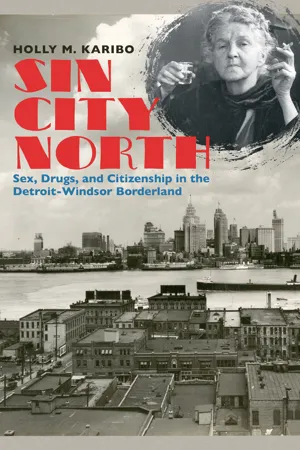
eBook - ePub
Sin City North
Sex, Drugs, and Citizenship in the Detroit-Windsor Borderland
- 226 pages
- English
- ePUB (mobile friendly)
- Available on iOS & Android
eBook - ePub
About this book
Information
Chapter 1: Building the “Detroit-Windsor Funnel”
Tourism, Prohibition, and Border Politics before World War II
On November 11, 1929, hundreds of thousands of Detroit and Windsor residents celebrated the opening of the Ambassador Bridge that connected the two cities over the Detroit River. Planned to coincide with Armistice Day celebrations, thousands of onlookers from both sides of the river stormed to the center of the 7,500-foot bridge to watch the ribbon-cutting ceremony. According to a New York Times reporter on the scene, “the throngs sensed the spirit of this gesture of friendliness, and burst into tremendous cheering. Canadian bands were on the American terminal playing ‘America’ the anthem while American bands were at the Sandwich end playing ‘Oh, Canada.’ Outstanding citizens of both communities looked on with bared heads. The miracle that was dreamed of fifty-five years ago had come to pass.” As part of the celebration, Michigan Governor Fred Green gave a speech in a radio broadcast explaining that this was “a physical connection between the highways of our own State and those of a friendly people who live across a national boundary from us. It is a spiritual bond of steel between the territories of two nations, each striving to achieve the best purposes of their own citizens and for the citizenship of the world.” Similarly, Charles McRae, Minister of Mines of Ontario, spoke for the Dominion: “The Ambassador Bridge opens today as another link in the friendship chain of the peoples of the United States and Canada.”1
There was no shortage of flowery language and hyperbole in the news reports that covered this event.2 For many, the opening of the bridge became an important symbolic moment representing the close relationship between Americans and Canadians and the modern methods of building and production that allowed this dream “of fifty-five years” to come to fruition. In the first decades of the twentieth century, the Detroit-Windsor border developed into the central crossing point between the two countries, with millions of tourists, commuters, and immigrants traveling across it. Between 1900 and 1939, people came to the region from across North America and the world, hoping to take part in growing industrial centers and the cross-border fluidity that allowed men and women to travel between the two countries with relative ease. They participated in industries, travel, and trade that crossed the national line and subsequently emboldened the transnational nature of the region. The opening of the Ambassador Bridge was both the result of this increased traffic and a symbol of the hopes of future prosperity, freedom of movement, and cross-border community building between Michigan and Ontario.
These jovial festivities, though, overshadowed an important paradox that developed in the borderland during the first decades of the twentieth century. While this period brought an increase in trade and travel across the national line, it also ushered in a range of legislative changes that curtailed the fluidity of the border in important ways. Sparked in part by growing fears over an influx of so-called new immigrants coming from Asia and Eastern and Southern Europe, Canadian and American federal officials began strengthening inspection procedures that would enable them to filter out “undesirables.” Consequently, between the 1890s and the 1930s, both countries passed increasingly stringent border control mechanisms that formalized the crossing process and changed the nature of the relationship between residents. The opening of the Ambassador Bridge itself was deeply embedded in this process. By providing expansive “modern” inspection booths and a highly structured crossing process, the bridge—while celebrated as a sign of friendship and freedom across the national divide—also reflected the growing incursions of the federal state in the lives of borderlanders who crossed for work and entertainment on a regular basis.
The tension between building a vibrant cross-border culture while tightly patrolling the national line that separated one side from the other became increasingly apparent with the rise of illicit economies in the border region. Though vice activities were deeply rooted in the fluid nature of working cultures in the border cities, which had long drawn large numbers of single men across the border for both labor and leisure, they emerged in full force when the United States outlawed the sale of alcohol in 1919. Capitalizing on disparate liquor laws in Michigan and Ontario, local residents built thriving smuggling networks to bring Canadian liquor into the United States. They subsequently gained reputations as wide-open towns where illegal economies were rampant and criminal gangs controlled much of the business. This increasingly unpopular legislative move also brought average citizens into contact with the law, and crossing the line to purchase alcohol or drinking illegal Canadian liquor on the Detroit side of the border became embedded in the social life of the borderlands community. By the 1930s, borderlanders were demonstrating the limits to strict border enforcement on a daily basis, helping to turn these boomtowns into vice towns where one could enjoy a range of illegal forms of entertainment, right under the noses of local and federal officials.
Ultimately, the first decades of the twentieth century brought profound changes to the border cities that would shape the Detroit-Windsor region for years to come. In the working-class cities, men and women crossed the border for labor and entertainment, helping to build a transnational region in which the lives of many Canadians and Americans became intimately intertwined. In turn, these transnational connections raised important questions about the nature of the national boundary and who should be allowed to cross. The Ambassador Bridge ceremony provided a positive narrative of cross-border friendship and cooperation, but a closer look at developments in the Detroit-Windsor region demonstrates the conflicting and often contradictory ways in which the national line shaped life in the urban borderland in the early-twentieth century. On the border, morality could be difficult to enforce, money difficult to trace, and the movement of people difficult to control.
Borders and Borderlands in the First Decades of the Twentieth Century
The histories of Detroit and Windsor were from their very start complex ones, weaving together native power brokering, colonial aspirations, and the troubled process of nation building. Ranging from peaceful and cooperative to violent and contested, the area that now forms the dividing line had been the site of renegotiation since at least the seventeenth century.3 What we might recognize as the modern borderland emerged in the last decades of the nineteenth century, as industrial growth, migration, and cross-border travel reshaped the Detroit-Windsor region in profound ways. As the quickly emerging automotive capital, Detroit in particular came to symbolize ideals of hope, prosperity, and modern manufacturing in the national imagination. While it did not invent the automobile, its contribution was in the organization of methods of production and distribution, “transforming what had been little more than a toy, into a universal and indispensable mass product whose impact upon cities has been equaled only by that of the steam engine and electricity.”4 Local industries built on businesses that had developed in the nineteenth century, converting them over the first decades of the twentieth century into massive production plants structured by the principles of Taylorism. By the 1940s, automotive and related industries made up more than 60 percent of the manufacturing in the region, with industries like furniture building, brewing, stove making, oil refineries, salt mines, steel mills, and food-processing plants also expanding in size and scope.5
Similarly, Windsor’s growth was due to several related factors that came together in the first decade of the twentieth century. The extensive rise of branch plants, in which American companies opened factories in Ontario to avoid international tariffs, meant that the city became increasingly intertwined with American corporate and economic interests.6 This began on a large scale in 1904, when the Ford Motor Company moved its Detroit-based operations across the river and into the surrounding Canadian cities of Windsor, East Windsor (later Ford City), Walkerville, and Sandwich (known collectively as the Border Cities). With the industrialization sparked by World War I, Ford became the predominant industry in the region, and in the early 1930s, the Border Cities merged politically into a single community with a population of more than 100,000.7 By then, more than 100 companies in Windsor had American affiliations, some among the largest industries in the country.8 These various car producers required plants that would manufacture automobile parts and accessories, and by 1935, thirty such plants were located in the city.9 By 1939, 65 percent of those employed in the newly amalgamated city worked in the thriving auto industry.10
Over the first decades of the twentieth century, men and women flocked to the border region in search of work, quickly turning the Detroit-Windsor corridor into one of the largest cosmopolitan centers in the Great Lakes region. This was especially true during World War I, when rapid industrialization for the war effort attracted men and women from across North America and the world. In 1910, foreign-born migrants from Canada, Russia, Austria, England, Hungary, Poland, Italy, Ireland, Scotland, and Belgium made up roughly a quarter of Detroit’s population.11 African American migrants from the rural South also moved to the northern city to work in the wartime industries, and the black population grew from a mere 1 percent of the population in 1910 to more than 7 percent of the population in 1930.12 By the end of the 1920s, Detroit boasted more than 1.7 million residents.13 At the same time, smooth connections between steamships, Great Lakes steamers, and railroads brought thousands of workers to Windsor.14 The first major influx of migrants occurred in the 1910s and was mainly members of the so-called New Migration.15 Ukrainians, Poles, Russians, Yugoslavians, Hungarians, Germans, Finns, Scandinavians, Italians, Greeks, and Syrians were chief among the newcomers, and the city’s population increased dramatically from 15,198 in 1901 to 55,935 in 1921.16
The hopes of high-paying jobs that drew men and women to the border cities also brought them across the national line, and in the first decades of the twentieth century, the region developed a strong transnational commuter culture. Because many lived on one side of the border but worked on the other, for thousands of local residents, crossing the border became engrained in their daily lives. In the morning and evening rush hours, one could stand on either side of the Detroit-Windsor Ferry docks and watch thousands of citizens returning home from jobs on the other side of the river.17 While this “reciprocity of citizens” worked in both directions, the booming metropolis of Detroit brought more Canadians across than the other way around.18 In 1913, almost 30,000 people crossed between the cities on a daily basis, including a sizable number of men working in Windsor who, due to a shortage of housing on the Canadian side of the border, chose to live in Detroit.19 By 1927, 15,000 of 25,334 employed residents of the Canadian Border Cities worked in Michigan, a situation unparalleled in any other large Canadian city.20
Prior to the opening of the bridge and tunnel in 1929 and 1930, the Detroit-Windsor Ferry provided the chief mode of travel across the river. The ferries carried passengers and automobiles in this two-way trade, dropping them in the heart of the cities’ business districts on Woodward and Ouellette Avenues. Canadians and Americans built on this convenient method of travel (when running smoothly, the ferries took between five and ten minutes), crossing the national line for everything from necessary services like doctor visits and cheap groceries to leisure activities and social outings.21 Sporting events, horse racing, amusement parks, and holiday celebrations became transnational events that brought Canadians and Americans together. Local businesses and civic leaders encouraged these cross-border excursions, seeing them as ways both to bring much-needed capital into the region and to build diplomatic ties between the two countries. As the Border Cities Chamber of Commerce promised Americans who came to visit, “in the Border Cities and District you will spend no dull moment. Excursion Steamers ply throughout the seasons to famous picnic parks and upon daylight and moonlight excursions. There are over 100 miles of beautiful driveways along the Lakes and River where sails the waterborne commerce of two nations. Bathing beaches, playgrounds, picnic parks, casinos, dance pavilions, lakeside hotels, public and private tourists’ camps, and summer homes abound.”22 The importance of attracting American visitors—and by extension American money—led the Chamber of Commerce to establish the annual “Good Will Tour” in the late 1920s. On these trips, representatives of the Border Cities headed to “distant section[s]” of the United States (as far as Brownsville, Texas, and Miami, Florida) to inform Americans about the excitement that awaited them in the booming border region.23 By 1920, the growing popularity of cross-border travel enabled Detroit-Windsor to surpass Welland County (despite its two bridges at Fort Erie and Niagara Falls) as the most popular crossing point between the United States and Canada.24 Dining, dancing, drinking, and cheering for sports teams in the neighboring city helped to maintain the permeability of the borderland and create cultural spaces in which Americans, Canadians, and recent newc...
Table of contents
- Cover Page
- Sin City North: Sex, Drugs, and Citizenship in the Detroit-Windsor Borderland
- Copyright Page
- Contents
- Illustrations
- Acknowledgments
- Introduction
- Chapter 1: Building the “Detroit-Windsor Funnel”
- Chapter 2: Border Brothels
- Chapter 3: Mainlining Along the Line
- Chapter 4: Sin, Slums, and Shady Characters
- Chapter 5: Prohibition, Enforcement, and Border Politics
- Conclusion
- Epilogue
- Notes
- Bibliography
- Index
Trusted by 375,005 students
Access to over 1.5 million titles for a fair monthly price.
Study more efficiently using our study tools.
Frequently asked questions
Yes, you can cancel anytime from the Subscription tab in your account settings on the Perlego website. Your subscription will stay active until the end of your current billing period. Learn how to cancel your subscription
No, books cannot be downloaded as external files, such as PDFs, for use outside of Perlego. However, you can download books within the Perlego app for offline reading on mobile or tablet. Learn how to download books offline
Perlego offers two plans: Essential and Complete
- Essential is ideal for learners and professionals who enjoy exploring a wide range of subjects. Access the Essential Library with 800,000+ trusted titles and best-sellers across business, personal growth, and the humanities. Includes unlimited reading time and Standard Read Aloud voice.
- Complete: Perfect for advanced learners and researchers needing full, unrestricted access. Unlock 1.5M+ books across hundreds of subjects, including academic and specialized titles. The Complete Plan also includes advanced features like Premium Read Aloud and Research Assistant.
We are an online textbook subscription service, where you can get access to an entire online library for less than the price of a single book per month. With over 1.5 million books across 990+ topics, we’ve got you covered! Learn about our mission
Look out for the read-aloud symbol on your next book to see if you can listen to it. The read-aloud tool reads text aloud for you, highlighting the text as it is being read. You can pause it, speed it up and slow it down. Learn more about Read Aloud
Yes! You can use the Perlego app on both iOS and Android devices to read anytime, anywhere — even offline. Perfect for commutes or when you’re on the go.
Please note we cannot support devices running on iOS 13 and Android 7 or earlier. Learn more about using the app
Please note we cannot support devices running on iOS 13 and Android 7 or earlier. Learn more about using the app
Yes, you can access Sin City North by Holly M. Karibo in PDF and/or ePUB format, as well as other popular books in Social Sciences & North American History. We have over 1.5 million books available in our catalogue for you to explore.