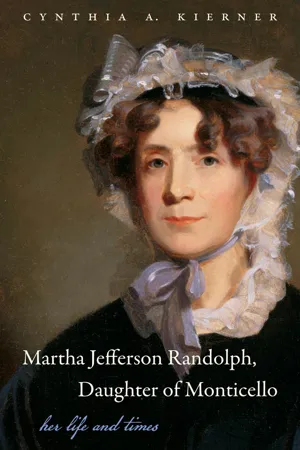
As the oldest and favorite daughter of Thomas Jefferson, Martha “Patsy” Jefferson Randolph (1772–1836) was extremely well educated, traveled in the circles of presidents and aristocrats, and was known on two continents for her particular grace and sincerity. Yet, as mistress of a large household, she was not spared the tedium, frustration, and great sorrow that most women of her time faced. Though Patsy’s name is familiar because of her famous father, Cynthia Kierner is the first historian to place Patsy at the center of her own story, taking readers into the largely ignored private spaces of the founding era. Randolph’s life story reveals the privileges and limits of celebrity and shows that women were able to venture beyond their domestic roles in surprising ways.
Following her mother’s death, Patsy lived in Paris with her father and later served as hostess at the President’s House and at Monticello. Her marriage to Thomas Mann Randolph, a member of Congress and governor of Virginia, was often troubled. She and her eleven children lived mostly at Monticello, greeting famous guests and debating issues ranging from a woman’s place to slavery, religion, and democracy. And later, after her family’s financial ruin, Patsy became a fixture in Washington society during Andrew Jackson’s presidency. In this extraordinary biography, Kierner offers a unique look at American history from the perspective of this intelligent, tactfully assertive woman.
- 376 pages
- English
- ePUB (mobile friendly)
- Available on iOS & Android
eBook - ePub
About this book
Information
Chapter 1
Love and Death at Monticello
Sunday, 27 September 1772, was a happy day for those who gathered at the bedside of Martha Wayles Skelton Jefferson in the small brick building that for the time being served as her husband’s mountaintop home. With the assistance of their friend and neighbor physician George Gilmer, and perhaps a sister or a skilled domestic servant, Martha safely delivered a baby girl, the first offspring of her union with Thomas Jefferson, whom she had married nine months earlier. The twenty-four-year-old mother, whose first husband died in 1768 at the age of twenty-four and whose four-year-old son, John, followed his father to the grave in 1771, again survived the treacherous ordeal of childbirth to begin a second family. Thomas, who had craved the domestic life his wedded friends enjoyed before he himself married at the relatively advanced age of twenty-nine, was now a father, too. The new parents, following the common practice in the colony, named their firstborn daughter Martha, after her maternal grandmother. The child, who became known as “Patsy,” did poorly during her first six months, in part because of her mother’s lack of milk. Happily, “a good breast of milk” from Ursula, the family’s enslaved housekeeper, restored the baby’s health.1
If she remained healthy, Patsy Jefferson could expect to enjoy a privileged life as a member of Virginia’s gentry elite. Though her father’s house, Monticello, was still a rudimentary work-in-progress, like most gentry homes, it was destined to be a two-story brick mansion that would appear both massive and stylish compared with the plain, two-room wooden “Virginia houses” of their less affluent neighbors.2 Like most children of the gentry, Patsy would grow up surrounded by slaves, a few of whom would become familiar to her as servants in her family’s house. At a time when fewer than half of the white men in Virginia were literate, the Jeffersons’ daughter would be reared in a world of books. She would be educated, though her father (like most men) did not consider females his intellectual equals.
Thomas Jefferson’s father, Peter, asserted his family’s claim to gentry status by marrying well, amassing property, and providing his children with the accoutrements of gentility. A successful but by no means aristocratic surveyor, Peter Jefferson married Jane Randolph, a member of one of Virginia’s oldest and most influential families. Between 1740 and 1755, Jane bore five daughters and four sons, though two of the boys died in infancy. The third child and oldest son, Thomas spent his youth at Tuckahoe, a Randolph plantation in Goochland County, where Peter managed the estate and oversaw the education of his own son and his orphaned cousin, Thomas Mann Randolph. In 1752, the Jeffersons moved to Shadwell, Peter’s house in Albemarle County. When Peter Jefferson died in 1757, he had accumulated substantial landholdings in central Virginia and claimed ownership of more than sixty slaves. His house was stocked with furniture, silver, china, and books denoting his family’s membership in Virginia’s gentry elite.3
Along with property and prestigious personal contacts, education and public service were key gentlemanly attributes in eighteenth-century Virginia.4 Accordingly, young Thomas Jefferson enrolled in the College of William and Mary in 1760, enjoying both the intellectual and social life of Williamsburg, Virginia’s colonial capital. He also studied law there and, in 1766, was admitted to the bar, which enabled him to practice law in the colony. In 1769, Jefferson took his seat in the colonial legislature, the House of Burgesses, as a representative of his home county of Albemarle. Although not yet famous, he had begun the process of distinguishing himself in Virginia politics and society.
By the standards of his time, moreover, Thomas Jefferson married well. While financial considerations trumped emotion in the marriage choices of earlier generations of Virginia gentry, those of Jefferson’s era, though still eager to acquire property, increasingly idealized unions based on companionship and romantic love. By all accounts, Thomas Jefferson and Martha Wayles Skelton were affectionate and compatible. Contemporaries described the young widow as a beautiful and amiable companion who shared certain common tastes and interests with her future husband. Like Thomas, Martha enjoyed reading, and both admired Laurence Sterne’s novel Tristram Shandy, which they sometimes read together. Both were also avid and accomplished musicians: Thomas played the violin, while Martha played harpsichord and pianoforte—the most highly regarded instruments for females—and perhaps also the guitar. Music played an important role in the couple’s courtship. The first substantial gift that Jefferson purchased for his future wife was an expensive harpsichord “of fine mahogany . . . worthy [of] the acceptance of a lady for whom I intend it.”5
As her refined tastes and accomplishments suggest, Martha Wayles Skelton also hailed from an affluent Virginia family. She was the eldest of four daughters—there were no sons—of John Wayles, a lawyer, merchant, and slave trader who acted as an agent for English tobacco merchants in Virginia. Her mother, the first of Wayles’s three wives, was Martha Eppes, who died a month after her daughter’s birth. A propertied widow when she married Jefferson in 1772, Martha Wayles Skelton received some 11,000 acres and 135 slaves when her father died the following year. Among these slaves were a mulatto woman named Elizabeth (or Betty) Hemings and her children, some of whom were the offspring of Jefferson’s late father-in-law and, therefore, half-siblings to Martha Wayles Skelton Jefferson (and half-aunts and -uncles to the infant Patsy). The presence of the Hemingses eventually would vastly complicate the lives of Thomas Jefferson and his family. In 1772, however, what was most apparent was the fact that, though Thomas Jefferson had married for love, his union with Martha Wayles Skelton also made him one of the wealthiest planters in the colony, at least in terms of ownership of land and slaves. Only thirty-four Virginians owned more acreage; only thirty-six had more bondpeople.6
A literate person who visited Virginia in 1772 might gauge the cultural aspirations and concerns of the Jeffersons and their peers by perusing the colony’s newspapers. Established in 1736 and published in Williamsburg, the provincial capital, the Virginia Gazette aspired to provide its readers with the “freshest Advices, Foreign & Domestick.” It featured news from Europe (especially England), polite essays, and commercial notices that both signified and enhanced the gentry’s privileged access to information, which, in turn, strengthened their collective claim to political and social authority. In 1766, another Williamsburg weekly that published similar fare (and was also named the Virginia Gazette) became the second newspaper in the colony. Newspaper issues that bracketed the birth of Patsy Jefferson at Monticello on 27 September 1772 revealed the vitality of Virginia’s gentry culture while signaling the imminent disruption of the routines of provincial life.
Even the most casual reader of the Virginia Gazette in 1772 would notice its cosmopolitan, outward-looking perspective. British and European news typically occupied the paper’s front page, where this week’s readers learned about the introduction of a new order of knighthood by King George III “for the Encouragement of Literature, the fine Arts, and learned Professions” and savored an essay titled “On the Power of England,” which celebrated the mother country’s commercial prowess and “the peculiar Felicity of our Constitution.”7 On subsequent pages—there were only four in all—local merchants and storekeepers proudly advertised apparel, patent medicines, stationery, and books recently imported from Britain, attesting to readers’ membership in a transatlantic cultural and commercial community. Histories, novels, and conduct manuals were especially popular among provincial readers who turned to books to acquire the etiquette and information they needed to shine in conversation and polite society.
Yet a cursory reading of the Virginia Gazette in September 1772 also would have revealed colonists’ incipient discomfort with their ties to Great Britain, despite their resumption of civil, if tense, relations with imperial officials in the wake of colonial resistance to parliamentary taxation, which resulted in the Stamp Act and Townshend Duties crises of the 1760s. A Latin motto added to the masthead of the original Virginia Gazette on 19 November 1767 asserted the necessity of free speech and free thought to the preservation of liberty—perhaps alluding to recent imperial political controversies—as did ongoing coverage of the saga of John Wilkes, an English radical who supported colonial rights and (seemingly partly for that reason) was repeatedly denied a seat in Parliament and persecuted by British authorities. Other front-page stories noted the extensive and dangerous power of allegedly corrupt Scots in the London-based imperial regime and reported that Scots emigrants fled to America to escape “the Oppression of their Superiours.” Readers also learned of the British crisis of credit, both public and private, which had dire implications for Virginia planters who were heavily indebted to English and Scottish merchants, who sold them imported consumer goods on credit and marketed their tobacco.8
Signs of planter indebtedness, which had worried Jefferson’s merchant father-in-law as early as 1764, were by 1772 ubiquitous in the province, as well as in the pages of the Williamsburg press. Perhaps responding to pressure from their own creditors in Britain, local agents for one London partnership demanded payment of outstanding debts by 20 October 1772, tersely adding that “no indulgence can be given” to delinquent debtors. Meanwhile, countless newspaper notices informed readers of local storekeepers seeking to settle their accounts, while others advertised the sale or auction of lands, slaves, livestock, and other property seized for debt. By 1772, when he advertised the sale of more than 2,000 acres, a tobacco warehouse, livestock, and “upwards of ONE HUNDRED FINE SLAVES, many valuable Tradesmen among them,” William Byrd III was only the most prominent of many casualties of insolvency born of unstable tobacco prices and planters’ unremittingly extravagant consumption of imported goods. Dissipated and penniless, Byrd committed suicide in 1777.9
Despite the political, economic, and cultural dominance of the gentry, cautionary vignettes suggesting the limits of their authority punctuated the pages of the Gazette. The issue published for 24 September 1772, for instance, contained ample evidence of dissatisfaction among the gentry’s imagined inferiors. One way for bonded workers to express their discontent was by running away from their masters. In this issue of the Gazette, eight masters placed newspaper notices seeking the return of a total of eight runaway slaves (six men and two women), a skilled white servant, and an English convict laborer. Another advertisement noted the capture of “a runaway woman named MOLLY” and requested that her “Owner” retrieve her from the James City County jail. Evidence from the Gazette suggests that free laborers, too, sometimes chafed under the bridle of gentry rule. On 24 September, the editors published an advertisement condescendingly encouraging “Any discreet Tradesman (especially a CARPENTER), content if he can make a genteel provision for himself and Family, by an honest Industry, and not ambitious to rank as a Gentleman,” to settle in the growing town of Richmond. In the paper’s next issue, “Mechanicks in the lower Parts of Virginia” responded angrily to these advertisers, who, they asserted, were “not simply [equipped with] the Qualifications of Extortion, Insolence, and Laziness, but rather Adepts therein; and, perhaps, may have the Addition of . . . Pride, Envy, and Malice.”10
But public outbursts of this sort were uncommon, and Virginia’s gentlemen expected to govern not only laboring men but also women of all social ranks. The law prescribed the subordination of women to men, and especially the authority of husbands over wives. The common-law doctrine of coverture erased a wife’s legal identity, making her husband her sole representative at law and thereby preventing her from controlling property, filing lawsuits, or executing contracts. The virtual nonexistence of legal divorce further institutionalized women’s formal subordination to men in both Britain and its colonies. At the same time, however, popular writers increasingly lauded feminine virtue as a potentially civilizing influence in families and—to a lesser extent—in society. This new appreciation of the possible benefits of women’s moral influence, in turn, generated concerns about the education of young females, at least within the colony’s elite.11
During the week of Patsy Jefferson’s birth, evidence from the Virginia Gazette pointed to both the opportunities and limits of female education in the province. On the one hand, the long list of books for sale in Williamsburg in September 1772 contained titles specifically aimed at female readers. These included prescriptive literature, such as Instructions for a young Lady in every Sphere and Period of Life, Moore’s Fables for the Female Sex, Letters to the Ladies on the Preservation of Health and Beauty, and The School, being a Series of Letters between a young Lady and her Mother. Also advertised were many novels whose titles bore the names of their heroines, which appealed to female readers. Such circumstantial evidence indicates that the wives and daughters of the gentry were reading at least certain types of literature by the 1770s.12
On the other hand, schools for girls were uncommon in Virginia, and on 24 September 1772, the editors of the Gazette reprinted an English essay that provided a rationale for parents’ preference for keeping their daughters (unlike their sons) at home to be educated. “The first Seeds of Vice are imbibed at a Boarding School,” this critic observed, where “vicious Girls” and other unsavory characters “will find sufficient Opportunities to taint the tender Minds of unsuspecting Innocence.” Loss of virtue meant utter ruin for young women, as the author of a poem that appeared in the Gazette a week later advised:
Virtue is Grace and Dignity,
’Tis more than Royal Blood,
A Gem the World’s too poor to buy;
Would you be fair, be good.13
’Tis more than Royal Blood,
A Gem the World’s too poor to buy;
Would you be fair, be good.13
The infant Patsy Jefferson was born into a seemingly genteel and orderly world that prized feminine virtue, masculine independence, and a social hierarchy in which gentlemen with polite manners and cosmopolitan tastes governed peaceably on behalf of their presumed inferiors. In fact, Virginia was on the threshold of dramatic change in 1772. The imperial crisis that began with the Stamp Act in 1765 and occasioned the establishment of a second (and more outspokenly critical) Virginia Gazette in Williamsburg in 1766 would lead to the Royal Navy’s bombardment of the Virginia coast a decade later, when Patsy’s own father would pen a manifesto that the Continental Congress in distant Philadelphia used to declare and justify the independence of Virginia and twelve other insurgent provinces. The ensuing years of war and revolution would aggravate the economic problems that already afflicted many Virginia planters in 1772 and—more troubling still, from the perspective of white Virginians—sow the seeds of slave rebellion.
The war also disrupted the normal routines of family life. Only four years old in 1776, Patsy Jefferson was too young to remember the earliest stages of the Revolution, but the military and political conflicts of the era profoundly shaped her childhood. Her father’s increasing prominence in the revolutionary movement affected where she lived and whom she met and—in the longer run—adversely affected her family’s finances. The Revolution was a formative experience for Patsy Jefferson, whose family in some respects sacrificed mightily for the patriot cause.
Children’s experiences in revolutionary America ranged from the prosaic to the profoundly unsettling. Those who lived far from the battlefields and army encampments and whose parents avoided military or political service could enjoy a secure and stable family life, perhaps blissfully unaware of the war and its attendant hardships. Others, by contrast, experienced wartime violence in communities under siege or as camp followers or underage soldiers; many more lost a father or another close relation in the unexpectedly long war that eventually claimed more than 25,000 American lives.14
Patsy Jefferson’s first decade—which coincided with the rise, progress, and ultimate triumph of the American Revolution—fell between these two extremes. Although the war brought military prisoners and eventually armed conflict to their Albemarle County neighborhood, the adult Jeffersons were surprisingly successful in isolating their home and family from the ill effects of war. Years later, when Patsy wrote a brief account of her childhood, her memories of the personal tragedies and political controversies of the era overshadowed those of the war itself.15
Patsy spent most of her first decade at Monticello, her father’s house in Albemarle, located just a few miles from Peter Jefferson’s Shadwell, which had been destroyed by fire in 1770. Begun in 1772, the first version of Monticello was nearly completed by the war’s end. Jefferson clearly planned his home as a bucolic refuge. It was far removed from the bustle of town life, perched atop an 867-foot mountain that took half an hour to climb, despite the road that his enslaved workers had laboriously cut through the heavily forested slopes. The nearest t...
Table of contents
- Cover Page
- Martha Jefferson Randolph, Daughter of Monticello
- Copyright Page
- Dedication
- Contents
- Illustrations
- Note on Names and Sources
- Introduction
- Chapter 1 Love and Death at Monticello
- Chapter 2 The Education of Patsy Jefferson
- Chapter 3 Wife, Mother, Plantation Mistress
- Chapter 4 The President’s Daughter
- Chapter 5 Return to Monticello
- Chapter 6 Decay and Dissolution
- Chapter 7 Honorable Poverty
- Chapter 8 No Longer a Home for the Family of Thomas Jefferson
- Epilogue
- Notes
- Bibliography
- Acknowledgments
- Index
Trusted by 375,005 students
Access to over 1.5 million titles for a fair monthly price.
Study more efficiently using our study tools.
Frequently asked questions
Yes, you can cancel anytime from the Subscription tab in your account settings on the Perlego website. Your subscription will stay active until the end of your current billing period. Learn how to cancel your subscription
No, books cannot be downloaded as external files, such as PDFs, for use outside of Perlego. However, you can download books within the Perlego app for offline reading on mobile or tablet. Learn how to download books offline
Perlego offers two plans: Essential and Complete
- Essential is ideal for learners and professionals who enjoy exploring a wide range of subjects. Access the Essential Library with 800,000+ trusted titles and best-sellers across business, personal growth, and the humanities. Includes unlimited reading time and Standard Read Aloud voice.
- Complete: Perfect for advanced learners and researchers needing full, unrestricted access. Unlock 1.5M+ books across hundreds of subjects, including academic and specialized titles. The Complete Plan also includes advanced features like Premium Read Aloud and Research Assistant.
We are an online textbook subscription service, where you can get access to an entire online library for less than the price of a single book per month. With over 1.5 million books across 990+ topics, we’ve got you covered! Learn about our mission
Look out for the read-aloud symbol on your next book to see if you can listen to it. The read-aloud tool reads text aloud for you, highlighting the text as it is being read. You can pause it, speed it up and slow it down. Learn more about Read Aloud
Yes! You can use the Perlego app on both iOS and Android devices to read anytime, anywhere — even offline. Perfect for commutes or when you’re on the go.
Please note we cannot support devices running on iOS 13 and Android 7 or earlier. Learn more about using the app
Please note we cannot support devices running on iOS 13 and Android 7 or earlier. Learn more about using the app
Yes, you can access Martha Jefferson Randolph, Daughter of Monticello by Cynthia A. Kierner in PDF and/or ePUB format, as well as other popular books in History & Historical Biographies. We have over 1.5 million books available in our catalogue for you to explore.