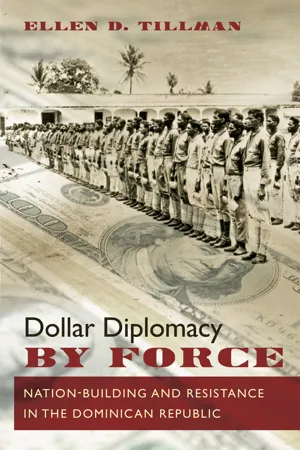
In the early twentieth century, the United States set out to guarantee economic and political stability in the Caribbean without intrusive and controversial military interventions—and ended up achieving exactly the opposite. Using military and government records from the United States and the Dominican Republic, this work investigates the extent to which early twentieth-century U.S. involvement in the Dominican Republic fundamentally changed both Dominican history and the conduct of U.S. foreign policy. Successive U.S. interventions based on a policy of “dollar diplomacy” led to military occupation and contributed to a drastic shifting of the Dominican social order, as well as centralized state military power, which Rafael Trujillo leveraged in his 1920s rise to dictatorship. Ultimately, this book demonstrates that the overthrow of the social order resulted not from military planning but from the interplay between uncoordinated interventions in Dominican society and Dominican responses.
Telling a neglected story of occupation and resistance, Ellen D. Tillman documents the troubled efforts of the U.S. government to break down the Dominican Republic and remake it from the ground up, providing fresh insight into the motivations and limitations of occupation.
eBook - ePub
Dollar Diplomacy by Force
Nation-Building and Resistance in the Dominican Republic
- 288 pages
- English
- ePUB (mobile friendly)
- Available on iOS & Android
eBook - ePub
About this book
Information
Chapter One: Markets, Militaries, and Modernization
U.S.–Dominican Relations to 1899
In the last half of the nineteenth century, trade and investment drew the United States and the Dominican Republic into an increasingly close relationship. The character of U.S. involvement and investment in the Dominican Republic, a product of U.S. economic expansionism of the time, was to be deeply shaped by Dominican military, governance, and tradition. As U.S. banks and investors turned increasingly to foreign markets, they understood and explained the evolving U.S. global role in terms of modernization defined by the period’s focus on scientific and professional progress. In the same period, the language among many Dominican merchants took on similar shades. As many in the United States argued for naval expansionism to compete in the global economy and protect burgeoning commerce, a growing number among the Dominican elite classes argued that Dominican regional traditions were “backward” and hoped to encourage foreign investments to modernize structures in their own country and take advantage of the globalizing world market.
While the coinciding of these discourses opened the door in limited ways to increased U.S. investment in the Dominican Republic, those Dominicans who hoped to centralize the country were up against an often militant regionalism in a country that lacked modern infrastructure. The general lack of regulation for U.S. investments abroad helped those in the Dominican Republic who sought to draw U.S. investors into a modernizing alliance in the very decades when U.S. postbellum expansionist discourse looked toward eventual annexation of surrounding countries to the United States. Talk of U.S. naval expansion and possible annexation added apparent security to Caribbean investments. While U.S. investment in this period was minimal compared to such investment in Cuba and other countries, it was enough to involve some Dominicans deeply in the change. While at first Dominican elites hoping to increase revenue struggled against caudillos protecting regional traditions, Dominican patterns of social class and status actually encouraged one such caudillo to take the lead in encouraging foreign investment. The result was a rapid and haphazard growth of U.S. and Dominican economicties that, by the late 1890s, began to force changes in both Dominican traditions and U.S. foreign policy.
THE PERSISTENCE OF CAUDILLO RULE and decentralization in the Dominican Republic can be traced to many factors, from the country’s colonial heritage to the terrain of the island of Hispaniola. Terrain complicated colonial administration, as it later would nineteenth-century governance. The tallest mountain range in the Caribbean, the Cordillera Central, runs through the center of the island, contributing to regional separation by making communication between regions difficult. Colonial administrators found that enslaved workers often escaped into the interior mountains, and soon found that production of sugar and control of the labor force were much easier in the neighboring colony of Cuba. The Spanish government allowed its colony on Hispaniola to fall into deep neglect that left land tenure through most of the territory undefined and unmonitored. From the sixteenth century on, the population spread out into regions that became increasingly autonomous units ruled by local elites or left to the care of cattle ranchers and subsistence agriculturalists. Over time, regional cultures defined law and order, and many Spanish elite families left for more lucrative colonies. Occasional Spanish attempts to regain control over the original colony by forcibly concentrating populations, especially after the French seizure of the western end of the island, only further damaged its economy.
The long Dominican struggles for independence increased the tendency toward caudillo rule. No sooner did the sparsely populated colony declare its independence from Spain and offer to become a part of Gran Colombia than it was overrun by armed forces from the recently formed Haitian government on the other side of the island. The Haitian government dominated a reticent Spanish-speaking population from 1822 to 1844, during which time controversial reforms and reimposition of foreign government fed a broadening movement to reassert independence. In the early 1840s, Dominicans fought a new independence war to free themselves from Haitian rule. Joining forces with Haitian antigovernment groups, they succeeded in bringing an end to Haitian rule after a long series of military campaigns in 1843–44. This long, second fight for independence left the fledgling country with a deep fear of another invasion, and the extensive revolutionary experience elevated military heroes. The new Dominican government prized military experience as a characteristic of good leadership and a guarantee for continued independence.
Combined with the already regional character of society, this emphasis on strong military leaders lent itself to caudillo rule, in which a weak central state maintained authority through acquiescence to pockets of local military rule. As the capital city of Santo Domingo was situated about two hundred miles from the Haitian border, central governments needed strong military forces on both sides of the Cordillera Central to protect against invasion. Lacking the central state apparatus and revenue to fund and monitor such forces, they depended on local leaders to field forces along the border. This in turn encouraged a strengthening of the regional caudillo system: the country’s first national leaders exemplified the period’s Latin American caudillos, military-political leaders who rose from regional to national prominence through charisma and military prowess. They retained political power by building strong support networks through patronage and bribing and supporting local military leaders, who in turn recruited local militia or guards throughout the scattered provinces.1 Extensive regionalism allowed caudillismo to persist in the Dominican Republic through the nineteenth century when it was declining throughout much of Latin America. The regional government system meant a lack of infrastructural development connecting the provinces and contributed to the growth of multiple distinct cultures and hierarchies, separated north to southeast or by their proximity to the Haitian border.
Adding to geographically defined regionalism were strong divisions fed by partisanship and the traditional social class structure.2 The country shared the liberal-conservative party divisions common throughout nineteenth-century Latin America, although party loyalties were often less important than loyalty to party leaders. Over the decades following independence, the conservative parties were made up primarily of the southern caudillos and commercial class and the bureaucracy of the capital, whereas the liberal parties were made up primarily of northern politicians and caudillos and the small but growing middle class. In all regions, urban society and much of the countryside were controlled by what some have called a caste system, separating the population between the traditional elite families, or gente de primera, and the gente de segunda. The former were defined by their descent from the early elite Spanish families and controlled military officership, while the latter were those from families that had gained some education and prominence in society, but whose lineage did not allow them entry into the ranks of the gente de primera. Outside of the cities, often working for elite landowners and some gente de segunda who had achieved prominence as rural merchants, the peasants formed the majority. From the years before Dominican independence, a large and vital peasantry that resisted urban domination was essential to the nation’s development, creating what historian Richard Turits has called a “protonational sense of local or creole culture in the Dominican countryside” based on subsistence agriculture, free access to land, and opposition to external control.3 Peasant autonomy, however, was tempered by region depending on the character of local rule.
In this highly divided system, which dominated nineteenth-century Dominican history, national leaders depended both on regional elites and on the placement of popular military-political leaders as vice presidents with their offices in the Cibao Valley, on the other side of the Cordillera Central from the capital city. Many nineteenth-century presidents only maintained a national base of support by allowing vice presidents to rule the Cibao separately, although leaders from the Cibao tended toward more liberal rule, widening the division of the country. In conjunction with the lack of roads and the difficulties of traveling in the 1800s, this led to a political system based largely on compromise between distinct regions. The history of larger landholdings in the south and east led to a larger conservative elite class and less free land for peasants, while the historical lack of regulation in the north allowed for a proliferation of subsistence landholdings. Along the Haitian border in the northwest and southwest, too, power dynamics were different. These regions grew in relative isolation from the capital, their economies connected more closely to foreign trade with Haiti or through their own ports than to primary Dominican cities. They developed distinct cultures as well as economies, often centered on fluid border populations that defied both Dominican and Haitian central government interests. With a general lack of infrastructure connecting them to the major cities, and a sometimes prosperous border trade, these regions fell under the leadership of caudillos who built growing landholdings and oversaw local government.4
In all regions, the differences between urban and rural society were notable, and those elite families who owned rural land were close to cities, where they had access to formal education. In the countryside, especially in the north, peasants worked on shared lands called terrenos comuneros and shared state lands for their agricultural needs—a tradition that encouraged peasant autonomy. Even as they entered the world market through the growing of tobacco, they maintained their subsistence plots and their autonomy in the countryside into the twentieth century. The wide autonomy of Cibao peasants allowed the integration, rather than destruction, of peasant production in the north. As Michiel Baud has convincingly argued, peasantries of the late-nineteenth and early-twentieth centuries were formed within, but not by, the modern capitalist system.5 The availability of open land, with lack of regulation on land ownership, also contributed to peasant autonomy throughout the country; when their land was encroached upon, peasants simply moved their small landholdings, or conucos, farther into the mountains or onto other unclaimed land. In the south and east, as sugar began to dominate, communal landholdings came into conflict with expanding sugar plantations, and Dominican peasants became agricultural laborers competing for work; the seasonal nature of sugar production meant spikes of high unemployment when each sugar harvest ended.
As merchants from among the gente de segunda began to push for foreign investments, a growing population came to depend economically on foreign trade, primarily with Germany and the United States. By the final decades of the nineteenth century, customs revenues became the source of funding for a centralizing national government. Trade with foreign buyers allowed this early growth but also contributed to regional division, as the interior and north oriented their trade toward tobacco and German markets whereas the south and southeast grew primarily sugar and gradually became more oriented toward U.S. investors and buyers.6 Because regionalism was often more divisive than class in Dominican society, late-nineteenth-century entry into the international market increased divisions between the Cibao and the southeast. The increasing connections of Dominican production to the world market in the late 1800s presented a new set of regionally defined complications even as decades of European and U.S. capitalist expansion brought major changes to society. Many Dominican investors and merchants developed a preference for changes that allowed for “modernization” in the economy, connecting Dominican trade to the benefits of international finance. From centralizing governments, this often meant emphasizing the growth of sugar to strengthen the export economy and increase central government revenue.
The late-nineteenth-century Dominican government orientation of trade toward sugar exports coincided with a new U.S. stage of commercial expansionism that precipitated renewed naval expansion.7 Extensive and largely unregulated U.S. economic growth, accompanied by a sometimes feverish search for new markets, encouraged the entry of Dominican sugar into international trade. For U.S. investors, the late nineteenth century presented what seemed to be limitless opportunities for growth, and many expected the eventual annexation of Caribbean countries to the United States. The language of Manifest Destiny—ideas of using commercial and territorial expansion to “uplift” and “civilize” the Americas, and even the world—imbued the writings of many who at this time embarked on Caribbean economic ventures. They were backed by popular language of U.S. cultural and institutional superiority, by the language of scientific race, and by a new growth in professional banking.8
As U.S. investment in the region rose, the lack of local capital and the Dominican government’s absence of revenue to fund or protect large sugar enterprises effectively meant that a growing presence of foreigners accompanied the growth of sugar. Sugar thereby fueled change, but also continued to impoverish much of the population. In addition to wide foreign ownership, the lack of property tax and other elements of the system meant that the majority of money gained in new enterprises could easily flow to foreign creditors rather than to the Dominican state. The foreign control of Dominican commerce fueled debates about the meaning of Dominican modernization, as the attraction of sugar for immigrant groups and foreign merchants and creditors complicated the racial makeup and definitions of the elite and merchant classes. Most immigrant groups, not fitting into any defined Dominican social class, remained outsiders despite their predominance in Dominican industry.9 Especially with the high number of foreign workers on sugar centrales, the situation in the late nineteenth century came to resemble that described in Fernando Ortiz’s 1940 Cuban Counterpoint, in which sugar represented standardization, vertical labor relations, large business, mechanization, and the foreign. In contrast, tobacco, mainly cultivated in the Cibao, boasted native origins in its culture and production and, at least according to many, protected a more traditionally Dominican way of life.
By the late 1800s, though, even the tobacco sector of the Dominican economy was heavily dependent on European and U.S. markets for both exports and imports. The customhouses at the country’s borders and ports early became central points of contention, as most state revenues came from import and export duties. As Michiel Baud has pointed out, resentment of foreign control in the export economy was especially strong in the north, where peasants and elites contended with a growing intermediary merchant class to define social relations. The rising merchant class in the region found itself losing authority to foreign buyers and the southeastern bureaucracy, and attempted to resist the changes as the nineteenth century wore on. As elsewhere in Latin America, definitions of the path to modernization were “widely divergent,” regional groups struggling to control the state and native landowners competing with foreign landowners to control labor while traditional elite caudillos resisted change.10 State efforts to control peasantry often were inconsistent, and “regional elite groups lived close to the peasantry and often functioned as buffers against an encroaching state.”11
Both regionalism and the struggle to define modernization also directly affected the development of the Dominican military. Defense against potential Haitian invasion required all men of fighting age—generally defined as between fifteen and fifty years—to take up arms in defense against the Haitian military and, of course, to protect the central and regional governments from internal overthrow. Up to the age of sixty, men were required to serve in the Civil Guard, as were foreigners living in the country for over three months.12 Among those many who managed to avoid official military service, younger men were often drawn into unofficial or local military duty, working with local patrons to defend crops from revolutionary groups or foreign invaders. Despite the lack of efficient centralized recruitment, therefore, most Dominican men had military experience at some point in their lives. Directly following independence, and especially because of the tendency toward awarding military rank in lieu of salaries, military experience and high-ranking military titles were very high throughout the country. While this declined at times through the century, a reannexation to Spain and a new fight for independence in 1865 renewed the emphasis on military service. Yet, despite the nominal existence of a national military that retained the right to conscript men throughout the provinces, the majority of recruits served in their local regions, a pattern that would continue throughout the nineteenth century and well into the U.S. occupation of 1916–24.13 Even the official organization of the central military betrayed its regional nature: the army was split into two major battalions that were geographically defined.
The nineteenth-century military, like the government, was centralized more in name than in f...
Table of contents
- Cover Page
- Title Page
- Copyright Page
- Contents
- Acknowledgments
- Introduction
- Chapter One: Markets, Militaries, and Modernization
- Chapter Two: Military Diplomats and Dollar Diplomacy
- Chapter Three: Involvement to Invasion
- Chapter Four: A Promiscuous Heaping of Adventurers
- Chapter Five: Regional Negotiation and Resistance
- Chapter Six: Opposing Networks for Change
- Chapter Seven: Products of Compromise
- Conclusion
- Notes
- Bibliography
- Index
Trusted by 375,005 students
Access to over 1.5 million titles for a fair monthly price.
Study more efficiently using our study tools.
Frequently asked questions
Yes, you can cancel anytime from the Subscription tab in your account settings on the Perlego website. Your subscription will stay active until the end of your current billing period. Learn how to cancel your subscription
No, books cannot be downloaded as external files, such as PDFs, for use outside of Perlego. However, you can download books within the Perlego app for offline reading on mobile or tablet. Learn how to download books offline
Perlego offers two plans: Essential and Complete
- Essential is ideal for learners and professionals who enjoy exploring a wide range of subjects. Access the Essential Library with 800,000+ trusted titles and best-sellers across business, personal growth, and the humanities. Includes unlimited reading time and Standard Read Aloud voice.
- Complete: Perfect for advanced learners and researchers needing full, unrestricted access. Unlock 1.5M+ books across hundreds of subjects, including academic and specialized titles. The Complete Plan also includes advanced features like Premium Read Aloud and Research Assistant.
We are an online textbook subscription service, where you can get access to an entire online library for less than the price of a single book per month. With over 1.5 million books across 990+ topics, we’ve got you covered! Learn about our mission
Look out for the read-aloud symbol on your next book to see if you can listen to it. The read-aloud tool reads text aloud for you, highlighting the text as it is being read. You can pause it, speed it up and slow it down. Learn more about Read Aloud
Yes! You can use the Perlego app on both iOS and Android devices to read anytime, anywhere — even offline. Perfect for commutes or when you’re on the go.
Please note we cannot support devices running on iOS 13 and Android 7 or earlier. Learn more about using the app
Please note we cannot support devices running on iOS 13 and Android 7 or earlier. Learn more about using the app
Yes, you can access Dollar Diplomacy by Force by Ellen D. Tillman in PDF and/or ePUB format, as well as other popular books in History & Latin American & Caribbean History. We have over 1.5 million books available in our catalogue for you to explore.