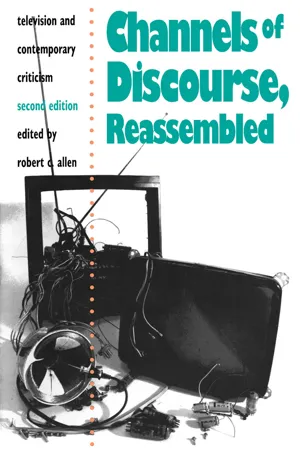
Since its original publication in 1987, Channels of Discourse has provided the most comprehensive consideration of commercial television, drawing on insights provided by the major strands of contemporary criticism: semiotics, narrative theory, reception theory, genre theory, ideological analysis, psychoanalysis, feminist criticism, and British cultural studies.
The second edition features a new introduction by Robert Allen that includes a discussion of the political economy of commercial television. Two new essays have been added — one an assessment of postmodernism and television, the other an analysis of convergence and divergence among the essays — and the original essays have been substantially revised and updated with an international audience in mind. Sixty-one new television stills illustrate the text.
Each essay lays out the general tenets of its particular approach, discusses television as an object of analysis within that critical framework, and provides extended examples of the types of analysis produced by that critical approach. Case studies range from Rescue 911 and Twin Peaks to soap operas, music videos, game shows, talk shows, and commericals.
Channels of Discourse, Reassembled suggests new ways of understanding relationships among television programs, between viewing pleasure and narrative structure, and between the world in front of the television set and that represented on the screen. The collection also addresses the qualities of popular television that traditional aesthetics and quantitative media research have failed to treat satisfactorily, including its seriality, mass production, and extraordinary popularity.
The contributors are Robert C. Allen, Jim Collins, Jane Feuer, John Fiske, Sandy Flitterman-Lewis, James Hay, E. Ann Kaplan, Sarah Kozloff, Ellen Seiter, and Mimi White.
- 428 pages
- English
- ePUB (mobile friendly)
- Available on iOS & Android
eBook - ePub
1 SEMIOTICS, STRUCTURALISM, AND TELEVISION
Contemporary television criticism derives much of its vocabulary from semiotics and structuralism. This chapter will introduce the basic terminology of these methods, offer a case study of structuralist methods applied to children’s television, and introduce some of the concepts the so-called post-structuralists have used to critique and expand upon semiotics and structuralism. The late Paddy Whannel used to joke, “Semiotics tells us things we already know in a language we will never understand.” Learning the vocabulary of semiotics is certainly one of its most trying aspects. This vocabulary makes it possible, however, to identify and describe what makes TV distinctive as a communication medium, as well as how it relies on other sign systems to communicate. Both questions are vital to the practice of television criticism, and these terms will be encountered in a broad range of critical methods from psychoanalysis to cultural studies.
Semiotics is the study of everything that can be used for communication: words, images, traffic signs, flowers, music, medical symptoms, and much more. Semiotics studies the way such “signs” communicate and the rules that govern their use. As a tool for the study of culture, semiotics represents a radical break from traditional criticism, in which the first order of business is the interpretation of an aesthetic object or text in terms of its immanent meaning. Semiotics first asks how meaning is created, rather than what the meaning is. In order to do this, semiotics uses a specialized vocabulary to describe signs and how they function. Often this vocabulary smacks of scientism to the newcomer and clashes with our assumptions about what criticism and the humanities are. But the special terminology of semiotics and its attempt to compare the production of meaning in a diverse set of mediums—aesthetic signs being only one of many objects of study—have allowed us to describe the workings of cultural communication with greater accuracy and enlarged our recognition of the conventions that characterize our culture.
The term semiotics was coined by Charles S. Peirce (1839–1914), an American philosopher, although his work on semiotics did not become widely known until the 1930s. The field was also “invented” by Swiss linguist Ferdinand de Saussure. The term he used to describe the new science he advocated in Course in General Linguistics, published posthumously in 1959, was semiology. Structuralism is most closely associated with anthropologist Claude Lévi-Strauss, whose studies of the logic and worldview of “primitive” cultures were first published in the 1950s. Although it relies on many of the principles of semiotics, structuralism engages larger questions of cultural meaning and ideology and thus has been widely used in literary and media criticism. Semiotics and structuralism are so closely related they may be said to overlap—semiotics being a field of study in itself, whereas structuralism is a method of analysis often used in semiotics.1
Structuralism stresses that each element within a cultural system derives its meaning from its relationship to every other element in the system: there are no independent meanings, but rather many meanings produced by their difference from other elements in the system. Beginning in the 1960s, some leading European intellectuals applied semiotics and structuralism to many different sign systems. Roland Barthes carefully analyzed fashion, French popular culture from wrestling to wine drinking, and a novella by Balzac. Umberto Eco turned his attention to Superman comic strips and James Bond novels. Christian Metz set out to describe the style of Hollywood cinema as a semiotic system. By addressing the symbolic and communicative capacity of humans in general, semiotics and structuralism help us see connections between fields of study that are normally divided among different academic departments in the university. Thus they are specially suited to the study of television.
The Sign
The smallest unit of meaning in semiotics is called the sign. Semiotics begins with this smallest unit and builds rules for the combination of signs. Fredric Jameson has pointed out that this concern with discerning the smallest unit of meaning is something that semiotics shares with other major intellectual movements of the twentieth century, including linguistics and nuclear physics, but it is an unusual starting point for criticism, which has tended to discuss works as organic wholes. Taking the definition of the smallest unit as a starting point indicates a shift in the sciences from perception to models: “where the first task of a science henceforth seems the establishment of a method, or a model, such that the basic conceptual units are given from the outset and organize the data (the atom, the phoneme).”2 Saussure conceptualized the sign as composed of two distinct parts, although these parts are separable only in theory, not in actual communication. Every sign is composed of a signifier, that is, the image, object, or sound itself—the part of the sign that has a material form—and the signified, the concept it represents.
In written language, the sign rain is composed of the grouping of four letters on this page (the signifier) and the idea or concept of rain (the signified)—that is, the category of phenomena we reserve for water falling from the sky. Saussure stressed that the relationship between the signifier and the signified in verbal language was entirely conventional, completely arbitrary. There is no natural or necessary connection between rain and the concept for which it stands. Furthermore, words have no positive value. A word’s meaning derives entirely from its difference from other words in the sign system of language. On the level of signifier, we recognize rain through its distinguishability from brain or sprain or rail or Braille or roan or reign. The signified is meaningful because of its difference from sprinkle, drizzle, downpour, monsoon, or from hail, sleet, or snow. Other words could be invented, such as raim or sain, that use the same alphabet and are pronounceable, but because these “words” do not enter into relationships with other signs in the system in a meaningful way, they remain at the level of nonsense.
Each language marks off its own set of meaningful differences: we can imagine an infinite number of possibilities for signifiers and signifieds, but each language makes only some differences important and detectable. Learning a second language is difficult because each language consists of a set of signs whose meanings derive from differences to which we might not be sensitive—phonetic distinctions we can’t “hear,” grammar rules that make distinctions unfamiliar to us, and words that are untranslatable into our first language. However, studying a second language does make us aware of Saussure’s point about the arbitrary nature of verbal languages. The signifier for rain changes to pluie in French and Regen in German. Neither has any more natural connection to the notion of water falling from the sky than does rain. Even onomatopoeia—words that seem to imitate the sounds they signify—turn out to be partly conventional. For English speakers, a rooster goes “eoek-a-doodle-doo.” For Germans he goes “Kikeriki.”
Saussure was interested in studying the structure of language as a system, and he bracketed off the real objects to which language refers: its referents. Semiotics does not concern itself with the referent of the sign rain, that is, actual water falling from the sky on a particular day at a particular place. The concept of rain is independent of any given occurrence of the actual event. Moreover, both Saussure and Peirce recognized that some signs have no “real” object to which they refer: abstractions (truth, freedom) or products of the imagination (mermaids, unicorns). More important, they wished to argue that all signs are cultural constructs that have taken on meaning through repeated, learned, collective use. Peirce emphasized that even when we try to define a sign, we are always forced to use another sign to translate it; he labeled the sign that we use to describe another sign the interpretant.
In this book, for example, we will be describing television’s audiovisual sign systems using linguistic signs (words on these pages) and black-and-white still photographs that are in many ways quite distant and different from the original object. To take another example, when an image on the television news is identified as “Corazon Aquino,” a sign produced by an electronic image is translated into another sign system—that of proper nouns. Proper names are a special class of signs that seem to have a real, easily agreed-upon referent. But our understanding of persons (especially those represented frequently on television) is filtered through sign systems: we don’t “know” anything or anyone (even ourselves) except through language.
Images do not have an unmediated relationship with their referents. The image of Aquino could be understood in terms of general categories ranging from “world leaders” to Filipino women. The referent of Aquino’s image will vary greatly depending on the cultural context—for example from the United States to Japan. The proper name could refer to another interpretant, such as “president of the Philippines.” Even if we were in the same room with Aquino and used our index fingers to point to her and say, “There is Corazon Aquino,” we would have used another set of signs, gestural and verbal ones. Charles S. Peirce saw the process of communication as an unending chain of sign production, which he dubbed “unlimited semiosis.” Peirce’s concept of the sign forces the realization that no communication takes place outside of sign systems—we are always translating signs into other signs. The conventions of the sign system control the ways we are able to communicate (that is, produce signifiers) and limit the range of meanings available (that is, what signifieds can be produced).
Umberto Eco defines a sign as “everything that, on the grounds of a previously established social convention, can be taken as something standing for something else.”3 Surprisingly, Eco means to include in this definition even those signs that at first glance seem to be more “natural” than linguistic ones. It is through social convention and cultural appropriation that a dark, cloudy sky becomes a sign for “impending storm.” Those same dark clouds could be used to signify bad luck, or nature responding in kind to one’s own gloomy mood (as in the literary convention of pathetic fallacy). The meaning of rain can vary greatly from one culture to another: in some Polynesian societies, a rainstorm is taken to mean that the sky is crying for the death of a child.
Eco’s conception of the sign is adapted from the work of Peirce, who did not limit himself to symbolic signs (language), as Saussure did, but attempted to account for all types of signs, including pictorial ones. To do so, he introduced specific definitions of the terms icon and index. The categories symbolic, iconic, and indexical are not mutually exclusive. Television constantly uses all three types of signs simultaneously. Television images are both iconic and indexical, and programs often use words (symbolic signs) on the screen and the soundtrack.
In the iconic sign, the signifier structurally resembles its signified. We must “learn” to recognize this resemblance just as we learn to read maps or to draw. The correspondence between a drawing of a dog, for example, and the signified “dog” (which might be a particular specimen of dog or the concept of dog in general) could take many different forms. The drawing could be skeletal or anatomical, in which case it might take a trained veterinarian or zoologist to recognize any structural similarity between the drawing and the signified “dog.” The iconic sign could be a child’s drawing, in which case another kind of expert decoder, for instance the child’s parent or teacher, might be required to detect the structural resemblance. Most drawings rely on rules that dictate point of view and scale; an “aerial view” of a dog, a head-on angle, or a drawing done twenty times larger than scale would be much harder for most of us to recognize than the conventional side-angle view in which two legs, a tail, a pointed ear, and whiskers will do the job, even if no attempt is made at coloration and the drawing appears only as an outline in black. Most of these admonitions about the conventionality of drawings hold true for video images as well, even though we think of television as more lifelike.
Indexical signs involve an existential link between the signifier and the referent: the sign relies on their joint presence at some point in time. Drawings do not qualify as indexical signs because we can make a drawing of something we have never seen. Maps are iconic rather than indexical because a cartographer can create a map solely on the basis of other iconic signs, such as diagrams and geological surveys; she may never have been to the place the map will signify.
Indexical signs are different from iconic ones because they rely on a material connection between signifier and signified: smoke means fire, pawprints mean the presence of a cat; a particular set of fingerprints signifies “Richard Nixon”; red spots signify “measles.” Most images produced by cameras belong to Peirce’s class of “indexical signs” because they require the physical presence of the referent before the camera lens at some point in time for their production. This fact about an image is, however, virtually impossible to verify without being present at the time the image was made. Stand-ins and look-alikes, trick photographs, special effects, computer-generated graphics, multiple exposures, and animated images can all be used to lie to the camera. Even images that we treat as particularly unique because they have as their signified an individual living creature may be dictated by convention. Throughout Lassie’s career as a television character, many different dogs (most of them male) have been used in the part, often within the same episode. Although many individual Lassies have now died, the iconic sign “Lassie” lives on, thanks to the skills of the various production crews and the animal trainers who find new dogs whenever a new version of the Lassie series is produced. It may be a blow to our faith in physiognomy, but we can be fooled by pictures of persons almost as easily.
Indexical signs are also established through social convention. Animals have left pawprints for as long as they have roamed the earth, but their pawprints became a sign only when people began to use them for tracking. As Umberto Eco explains: “The first doctor who discovered a sort of constant relationship between an array of red spots on a patient’s face and a given disease (measles) made an inference: but insofar as this relationship has been made conventional and has been registered as such in medical treatises a semiotic convention has been established. There is a sign every time a human group decides to use and recognize something as the vehicle for something else.”4 Indexical signs are no less tainted by human intervention than symbolic or iconic ones; they require the same accumulation of use and the same reinforcement and perpetuation by a social group to be understood as signs in the first place.
To understand television images, we must learn to recognize many conventions of representation. One of the characteristics of such representational codes is that we become so accustomed to them that we may not recognize their use; they become as “natural” to us as the symbolic signs of language, and we think of iconic signs as the most logical—sometimes as the only possible—way to signify aspects of our world. We can watch this learning taking place when infants and toddlers begin to watch television. Toddlers, for example, like to touch the screen frequently as they struggle to understand the two-dimensional nature of television’s iconic signs. Conventional expectations of scale, perspective, camera angle, color, lighting, lens focal length, and subject-to-camera distance (that is, non-representational aspects of the image) are acquired through exposure to television; if a camera operator violates too many of these conventions, we may not be able to “recognize” the image at all.
In its strict sense, Peirce’s model does not require the “intention” to communicate: signs may be produced by nonhuman agencies (such as when a TV set’s technical breakdown produces “snow” on the screen), for example, or by unconscious senders. Peirce’s model does not necessarily require a human receiver of the sign, or any receiver at all, although, because signs are social and conventional, there must be the possibility that a given sign would be understood by a potential receiver. Signification cannot take place outside of huma...
Table of contents
- Cover Page
- Channels of Discourse, Reassembled
- Copyright Page
- CONTENTS
- INTRODUCTION TO THE SECOND EDITION
- 1 SEMIOTICS, STRUCTURALISM, AND TELEVISION
- 2 NARRATIVE THEORY AND TELEVISION
- 3 AUDIENCE - ORIENTED CRITICISM AND TELEVISION
- 4 GENRE STUDY AND TELEVISION
- 5 IDEOLOGICAL ANALYSIS AND TELEVISION
- 6 PSYCHOANALYSIS, FILM, AND TELEVISION
- 7 FEMINIST CRITICISM AND TELEVISION
- 8 BRITISH CULTURAL STUDIES AND TELEVISION
- 9 TELEVISION AND POSTMODERNISM
- AFTERWORD
- TELEVISION CRITICISM
- NOTES ON THE CONTRIBUTORS
- INDEX
Trusted by 375,005 students
Access to over 1.5 million titles for a fair monthly price.
Study more efficiently using our study tools.
Frequently asked questions
Yes, you can cancel anytime from the Subscription tab in your account settings on the Perlego website. Your subscription will stay active until the end of your current billing period. Learn how to cancel your subscription
No, books cannot be downloaded as external files, such as PDFs, for use outside of Perlego. However, you can download books within the Perlego app for offline reading on mobile or tablet. Learn how to download books offline
We are an online textbook subscription service, where you can get access to an entire online library for less than the price of a single book per month. With over 1.5 million books across 990+ topics, we’ve got you covered! Learn about our mission
Look out for the read-aloud symbol on your next book to see if you can listen to it. The read-aloud tool reads text aloud for you, highlighting the text as it is being read. You can pause it, speed it up and slow it down. Learn more about Read Aloud
Yes! You can use the Perlego app on both iOS and Android devices to read anytime, anywhere — even offline. Perfect for commutes or when you’re on the go.
Please note we cannot support devices running on iOS 13 and Android 7 or earlier. Learn more about using the app
Please note we cannot support devices running on iOS 13 and Android 7 or earlier. Learn more about using the app
Yes, you can access Channels of Discourse, Reassembled by Robert Allen in PDF and/or ePUB format, as well as other popular books in Social Sciences & Media Studies. We have over 1.5 million books available in our catalogue for you to explore.