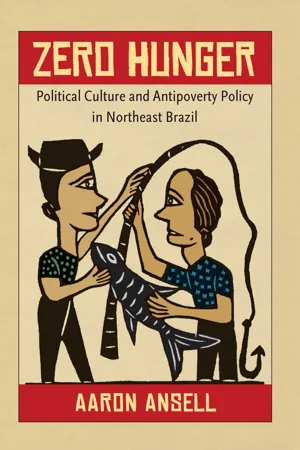
When Luiz Inácio Lula da Silva of Brazil’s Workers' Party soared to power in 2003, he promised to end hunger in the nation. In a vivid ethnography with an innovative approach to Brazilian politics, Aaron Ansell assesses President Lula’s flagship antipoverty program, Zero Hunger (Fome Zero), focusing on its rollout among agricultural workers in the poor northeastern state of Piauí. Linking the administration’s fight against poverty to a more subtle effort to change the region’s political culture, Ansell rethinks the nature of patronage and provides a novel perspective on the state under Workers' Party rule.
Aiming to strengthen democratic processes, frontline officials attempted to dismantle the long-standing patron-client relationships — Ansell identifies them as “intimate hierarchies” — that bound poor people to local elites. Illuminating the symbolic techniques by which officials attempted to influence Zero Hunger beneficiaries' attitudes toward power, class, history, and ethnic identity, Ansell shows how the assault on patronage increased political awareness but also confused and alienated the program’s participants. He suggests that, instead of condemning patronage, policymakers should harness the emotional energy of intimate hierarchies to better facilitate the participation of all citizens in political and economic development.
- 256 pages
- English
- ePUB (mobile friendly)
- Available on iOS & Android
eBook - ePub
About this book
Information
Chapter One: Convulsions of Democracy
From National Politics to Local Hunger
On the morning of October 27, 2002, hundreds of thousands of people poured into the streets of Rio de Janeiro in tearful celebration of what some called a democratic revolution. A child migrant turned metalworker—turned union organizer, turned political prisoner, turned party leader—had just completed his final transformation into President-Elect Luiz Inácio Lula da Silva. My friends from the headquarters of the Workers’ Party (Partido dos Trabalhadores—PT) embraced in the rapture of victory. While they were normally divided into factions that held widely ranging views on capitalism, state policy, and identity politics, on this day they could look to the future together. Like kings, they strode along the boardwalk of Ipanema in groups of twos and threes, miles from their homes on the lowland outskirts of the city. Or maybe they went to the larger, adjacent beach of Copacabana, where there is always a little more trouble to get into. I’m not exactly sure how it all looked. I couldn’t be with them that morning because my mother had called two nights before to summon me home to my father’s bedside in Los Angeles. But my friends from the PT wrote to me about the euphoria they felt, which they treasured all the more because they knew that the following day their party would have to make good. The PT had been the opposition party for twenty years. Now it would have to enact solutions to Brazil’s countless problems. The first name that Lula gave to his plan was “Zero Hunger,” and the first place where Zero Hunger would happen was Piauí, a destitute state in the semiarid (sertão) region of the Northeast. I followed Zero Hunger into Piauí, thinking that if I could understand the program’s dynamics in its small pilot town (Passarinho), I might offer a glimpse into the workings of a modern left-wing state.
The structure of President Lula’s antipoverty policies and the culture of the state agents who implemented them must be considered in light of the euphoria of Lula’s long-awaited victory, which was part of a cycle of revolutionary excitement and disappointment that had exhausted and confused the Brazilian Left for over a century. This cycle demonstrates a long-standing feature of Brazilian politics, the ambivalent posture that politicians, the elite, and the middle classes have assumed with regard to the ideals of freedom and equality. The Lula administration could not escape this tradition of ambivalence and compromise, yet it also sketched a model of democracy that married poverty amelioration to the promotion of egalitarian participation in the political sphere. This was the impulse behind the Zero Hunger program, and it manifested not only in its formal policy structure, but also in the informal and often implicit efforts by state agents to undermine the relations of patronage (“intimate hierarchy”) that ordered the lives of beneficiaries. Piloted in the small municipality I call Passarinho, Zero Hunger changed the lives of corn and bean cultivators who had already been struggling to understand democracy and development on their own terms. As for me, I was uncertain as to whether I would throw my hat in with the Zero Hunger officials whose critiques of rural patronage seemed at times so astute, and at other times, somewhat oblivious.
In this chapter, I lay out three levels of ethnographic material central to this book. The first level pertains to Brazil’s fraught history with liberal democracy, a history that led the Left to attribute a democratizing function to Zero Hunger. The second level prioritizes the context of Passarinho, a place where deep inequality and egalitarian aspirations intertwined to shape a key setting where Lula’s policies were implemented. The final level is a reflection on my own entry into Piauí, on my role in the implementation of Zero Hunger (and later Bolsa Família), and on the ethical dilemmas I faced during my two years in the field.
Patronage, Democracy, and the Emergence of the PT Administration
Democracy has led a troubled life in Brazil, a place where liberal philosophical tenets—universal rights, equality before the law, free trade, habeas corpus, economic rationality, and individualism—were never fully institutionalized.1 One can always argue that even when these liberal virtues are upheld in full, they mainly serve to justify a society’s hidden forms of coercion and exploitation. Perhaps. But, in Brazil, liberalism never even expressed the outward appearance of social relations. Liberalism’s presence in Brazil has always seemed to be, as Roberto Schwarz (1992: 23) puts it, a “misplaced idea” or what Sérgio Buarque de Holanda (1982 [1926]: 119) earlier called a “lamentable misunderstanding.” After all, Brazil maintained a parliamentary monarchy even after its independence from Portugal in 1822, and it remained a slave-driven economy until 1888. Thus, liberal ideas, which entered Brazil in the nineteenth century, were put to use in the service of the powerful.
During much of the nineteenth century, only the most radical statesmen called for full democracy and the abolition of African slavery (Viotti da Costa 1985: 53–78). Instead, the merchant class touted ideals of free trade to protest the commercial constraints imposed by the Crown, and the regional agricultural bosses used similar rhetoric in their struggle against the centralized government in Rio because they wanted to preserve absolute power in their localities. Moderate liberals held parliamentary majorities several times before the end of the Second Empire (1840–89), but they rarely implemented policies that benefited the poor. When they did legislate against slavery (which ended only in 1888), it was with the intent of supporting the free-labor coffee sector in the Southeast over the less efficient, slave-driven sugar industry in the Northeast (ibid.: 82). In parliament, members of both the Liberal and Conservative Parties (and the two were often hard to distinguish ideologically) worried that without slavery, the rural poor would not go to work on the plantations. The Land Law of 1850, supported by many Liberals, made squatting on common (royal) lands illegal and granted private titles only to large estates. This forced the rural poor to reside on large estates and to pay for that privilege with their labor, crop yields, and other tokens of loyalty (ibid.).
The end of the Empire (1889) and the beginning of republican government represented a liberal victory but not the empowerment of the popular classes. The First Republic (1889–1930) brought a limited democracy, with suffrage restricted to literate, propertied men and a legal system that codified their privilege over the masses (Holston 2008: 100–104). The winners were the regional elites, who gained more independence from the central government, and thus more oligarchic control within their regions, what would later be called “states” (Roett 1999: 28–29). At the subregional (municipal) level, however, big landowners saw their wealth decline and with it their absolute control over dependent laborers who resided on their lands. Their authority was further challenged by the advent of the vote (even with its limited suffrage).2 According to the famous thesis of Victor Nunes Leal, these factors converged to form a compromise: The economically weakened local landowner—often called the “colonel” (coronel)—corralled the votes of the rural poor, not only for himself but for the reigning governor, and, in exchange, the governor and his associates allowed the coronel to distribute state-level resources as he saw fit, awarding them to the loyal and subservient poor, whose “weakness, desolation, and disillusionment” allowed the local coronel to “delude himself with a semblance of power and prestige, obtained at the price of [his] political submission [to the state government]” (Leal 1977 [1948]: 24–25).
Reflecting on this history, literary critic Roberto Schwarz (1992) observes that Brazilian ideological life was shaped not so much by slavery as by the more ambiguous relationship between the powerful propertied classes and the legally free masses who needed their help to survive. The caricature of the free worker was that of the agregado, the propertyless man or woman who needed to attach (agregar) to the extended family of a propertied seignior. Less clear than contractual slavery, this informal hierarchy required ideological elaboration, giving rise to a general culture of “favour.” Schwarz writes that, “under a thousand forms and names, favour formed and flavoured the whole of national life . . . present everywhere. . . . As the professional depended on favour to exercise his profession, so the small proprietor depended on it for the security of his property, and the public servant for his position. Favour was our quasi-universal social mediation. . . . Slavery gives the lie to liberal ideas; but favour, more insidiously uses them, for its own purposes, originating a new ideological pattern” (23). What Schwarz calls “favour” operated through networks that cut across various organizations and official capacities, allowing power to move without record, as the law was selectively applied to one’s allies within these networks. The perpetual exempting of one’s self and friends from the inconveniences of the law led to a sense of collective bad faith with respect to liberal principles. Others simply flouted these principles, especially the regional agrarian bosses “who were proud of the fact that the law never entered the gates of their land” (Weffort 1988: 333). Popular cynicism about liberal civic virtue abounded, and this “cynicism [was] mirrored in the ironic smiles of the powerful, for whom the lack of popular expectations serve[d] as a license to act arbitrarily” (ibid.: 332).
The First Republic ended in 1930, when Getúlio Vargas, a clever military man, canceled the results of a national election and, in so doing, broke the backs of the regional oligarchs, submitting them to a central government that would promote industrialization. Vargas was able to situate himself at the nexus of various interests—domestic industrialists, anarchist-inspired communists, progressive unionists, left-wing lieutenants, and so on—playing them off one another. He eventually shored up a dictatorship by manipulating mass fear of a communist threat (Levine 1980: 59). His dictatorial New State (1937–45) established institutionalized labor legislation that allowed only for state-sanctioned unions. The idea was to suppress the communist and anarchist activists and make workers more “depend[ant] on the resources of the state” (Maybury-Lewis 1994: 14). In Vargas’s rhetoric, this social arrangement (scholars call it “corporatism”) originated with the state’s generous “outorga [derived from outorgar, meaning ‘to grant, confer, award or bestow’]” (John French 1992: 49). In theory corporatism relied on a patronage chain in which benefits (e.g., medical assistance, sick leave, retirement packages) flowed from the Labor Ministry to obedient union leaders. Yet, would-be patrons within the Labor Ministry often lacked “any direct ties to the unpaid local union leaders,” at least in industrial São Paulo (ibid.: 136). If corporatism entailed institutionalized patronage, that patronage often broke down in practice. At the same time, Vargas’s labor legislation, even if designed to co-opt urban labor, provided legal protections for workers that empowered unions to take individual workers’ grievances to the courts (ibid.: 111–21). In short, while institutionalized patronage characterized much of Brazil’s midcentury labor regime, subordination to the state was a double-edged sword.
Vargas’s New State lost much of its popular appeal when Brazil entered World War II on the side of the allies, and the glaring contradiction between Vargas’s dictatorship and the democratizing rhetoric of the war motivated a return to free elections (Weffort 1988: 343). During the era of Populist Democracy (1945–64) that followed, Brazil saw the rise of competitive mass politics. Literate urban workers, an expanding population, had gained the right to vote. Populist politicians used new media (radio, loudspeakers, television) to appeal to the interests of a class that had once been excluded from political institutions. Scholars often allege that the populist politician’s ambitions reflected his “narrow, parochial sense of satisfying his new ‘clientele’” (Roett 1999: 32, 96–123). Yet progressive national policies and social movements periodically emerged during this era. The early 1960s saw a sharp increase in rural unrest prompted in part by the mobilization efforts of urban leftists (Bastos 1984; Morais 1997). Peasant Leagues emerged in the Northeast that called for the redistribution of unproductive lands and contested the armed encroachment of the sugar and cattle elite onto small properties. In 1963, the left-leaning president Goulart signed the Rural Workers Bill, legalizing rural unionization and including conditions that impeded landowners from dominating those unions (Cehelsky 1979: 43). Goulart also supported extending suffrage to illiterates, which would have led to an unprecedented inclusion of the rural masses in the political process, and he tried to push through a land reform bill that called for government expropriation of lands that would have forced wealthy landowners to lease their unused lands to the rural poor (ibid.: 56, 88–90).
As Goulart’s politics took a “left turn,” conservative Brazilians and the U.S. government grew increasingly wary of Brazilian populism. The Cold War had been in full swing for over a decade. During the 1950s, populist presidents had played on U.S. fears of a communist threat in Brazil to secure foreign aid. But aid was slow in coming, even after Fidel Castro’s 1959 Cuban Revolution redoubled the Eisenhower administration’s fear that South America was going red. Wary of the United States, Brazilian leaders during the early 1960s “demonstrated a sympathy for the basic tenets of nonaligned states—anticolonialism, coexistence with the Soviet bloc nations, ideological pluralism in the Third World . . . and a radical restructuring of economic relations between North and South” (Roett 1999: 194). In 1964, a U.S.-backed military coup responded by throwing out President Goulart, claiming that democracy had grown corrupt and chaotic. The generals who assumed power suspended elections for important executive branch offices, outlawed the formation of political parties, and hunted down activists in an effort to “restore the influence of the patrimonial regime” (ibid.: 127).3
It is perhaps because liberal institutions (however limited) eventually threatened economic hierarchy during the Populist Era that Brazil’s underground leftist movements assumed that once they brought down the military dictatorship, a restoration of democracy would yield left-wing governance. They were sorely disappointed when the slow demise of the dictatorship brought a rash of civilian presidents who showed little interest in easing the suffering of Brazil’s poor. As a result, many people on the left began to consider democracy to be an insufficient, if necessary, feature of social justice. During the decade following redemocratization, “socialism” (however ill-defined) became the Left’s rallying cry.
THE PT, POLITICAL ETHICS, FOOD SECURITY, AND PARTICIPATION
During the late 1960s, a period of intense political persecution, urban unions (led by Lula among others), progressive intellectuals, outspoken students, peasant leaders, and other dissidents hid from the state security apparatus. They took cover in Christian base communities led by priests and lay clergy who were sympathetic to anticapitalist and antiauthoritarian struggles. A Christian base community was a group of neighbors who “belong[ed] to the same popular quarter, shantytown, village or rural zone, and [met] regularly to pray, sing, celebrate, read the Bible and discuss it in the light of their own life experience” (Lowy 1996: 48). Brazil, more than any other Latin American country, experienced a powerful surge of what Michael Lowy calls “liberationist Christianity” (a combination of liberation theology and popular Christian mobilization) that contradicted the Vatican’s general endorsement of Brazil’s military dictatorship (also see Burdick 1993). Brazil’s liberationist priests and lay clergy spoke out against state torture and emphasized mutual aid among neighbors as the solution to social problems instead of appeals to the state or to private charity. Proponents of liberationist Christianity generally opposed “the three main political traditions of the country: clientelism . . . populism . . . and verticalism” (Lowy 1996: 89). The movement infused the Marxist and union activists with “the spiritual and ethical dimension of revolutionary struggle: the faith (mystical), the solidarity, the moral indignation, the total commitment at the risk of one’s own life . . . an attempt to re-enchant the world through revolutionary action” (ibid.: 18; also see Burdick 1993). Thanks to the combined voices of secular and religious objectors, the dictatorship lost most of its legitimacy by 1973; a host of clerical, union, peasant, residential, and professional (e.g., attorneys) movements were organizing to bring back representative democracy.4
In 1980, this diverse group of left-wing dissidents founded the socialist Workers’ Party (PT) with Lula as its leader. The PT called for popular elections, a break with the capitalist free market, a rejection of the Soviet model of top-down party control over workers, and strategic alliances with more conservative opposition parties in order to expedite the end of the dictatorship.5 The PT’S struggle to gain national office throughout the next twenty years proved that opposition to capitalism was impractical from an electoral standpoint. PT affiliates and sympathizers began to imagine a new kind of state policy that a Lula presidency would implement in the context of the capitalist market. The fight against hunger eventually fulfilled this purpose.
Wendy Hunter (2007) observes that while the party line officially remained one of uncompromising commitment to “socialism” during the 1980s, the PT’S experiences in government at the municipal level (and some governorships) taught it the value of pragmatism. PT politicians, perhaps taking council from a senior generation of communist union leaders in their midst, realized that Marxist concerns with the long-term project of building socialism did not speak to the many single-issue social movements that had immediate, specific worries about housing, transportation costs, sewage, and so on (Keck 1992: 50–52). These officials had to make immediate practical decisions about allocating limited resources to conflicting segments of the population. Numerous municipal experiments in participatory democracy (especially participatory budgeting) both helped PT officials diffuse the grievances that came with such a task and deepened party members’ thinking about the meaning of democracy itself (Hunter 2010: 96). The challenge, as leading PT intellectual Plinio de Arruda Sampaio (1986: 112) once wrote, was “to make democracy an inalienable space of everyday life and not just an instrument that one uses while it’s useful to gain or maintain power.” For many in the PT, this entailed deemphasizing the struggle against capitalism and focusing instead on the everyday concerns of the organized masses. Debates among the party’s rank and file did not produce consensus on this point; many (Sampaio included) insisted that the party must continually remind movement leaders that “reformist struggles . . . will not resolve the deepest questi...
Table of contents
- Cover Page
- Zero Hunger
- Copyright Page
- Dedication
- Contents
- Tables and Figures
- Acknowledgments
- Introduction
- Chapter One: Convulsions of Democracy from National Politics to Local Hunger
- Chapter Two: Hunger, Envy, and Egalitarianism in Passarinho
- Chapter Three: Intimate Hierarchy and its Counters
- Chapter Four: The Prodigal Children Return to the Countryside
- Chapter Five: Induced Nostalgia
- Chapter Six: Programmatic Pilgrimage
- Chapter Seven: Marginalizing the Mayor
- Conclusion
- Appendix
- Notes
- Bibliography
- Index
Trusted by 375,005 students
Access to over 1.5 million titles for a fair monthly price.
Study more efficiently using our study tools.
Frequently asked questions
Yes, you can cancel anytime from the Subscription tab in your account settings on the Perlego website. Your subscription will stay active until the end of your current billing period. Learn how to cancel your subscription
No, books cannot be downloaded as external files, such as PDFs, for use outside of Perlego. However, you can download books within the Perlego app for offline reading on mobile or tablet. Learn how to download books offline
Perlego offers two plans: Essential and Complete
- Essential is ideal for learners and professionals who enjoy exploring a wide range of subjects. Access the Essential Library with 800,000+ trusted titles and best-sellers across business, personal growth, and the humanities. Includes unlimited reading time and Standard Read Aloud voice.
- Complete: Perfect for advanced learners and researchers needing full, unrestricted access. Unlock 1.5M+ books across hundreds of subjects, including academic and specialized titles. The Complete Plan also includes advanced features like Premium Read Aloud and Research Assistant.
We are an online textbook subscription service, where you can get access to an entire online library for less than the price of a single book per month. With over 1.5 million books across 990+ topics, we’ve got you covered! Learn about our mission
Look out for the read-aloud symbol on your next book to see if you can listen to it. The read-aloud tool reads text aloud for you, highlighting the text as it is being read. You can pause it, speed it up and slow it down. Learn more about Read Aloud
Yes! You can use the Perlego app on both iOS and Android devices to read anytime, anywhere — even offline. Perfect for commutes or when you’re on the go.
Please note we cannot support devices running on iOS 13 and Android 7 or earlier. Learn more about using the app
Please note we cannot support devices running on iOS 13 and Android 7 or earlier. Learn more about using the app
Yes, you can access Zero Hunger by Aaron Ansell in PDF and/or ePUB format, as well as other popular books in Social Sciences & Social Policy. We have over 1.5 million books available in our catalogue for you to explore.