- 216 pages
- English
- ePUB (mobile friendly)
- Available on iOS & Android
eBook - ePub
About this book
State of Health takes readers inside one of the most controversial regimes of the twenty-first century—Venezuela under Hugo Chávez—for a revealing description of how people’s lives changed for the better as the state began reorganizing society. With lively and accessible storytelling, Amy Cooper chronicles the pleasure people experienced accessing government health care and improving their quality of life. From personalized doctor’s visits to therapeutic dance classes, new health care programs provided more than medical services. State of Health offers a unique perspective on the significance of the Bolivarian Revolution for ordinary people, demonstrating how the transformed health system succeeded in exciting people and recognizing historically marginalized Venezuelans as bodies who mattered.
Information
Publisher
University of California PressYear
2019Print ISBN
9780520299290
Edition
1eBook ISBN
9780520971080
ONE
Introduction
MY FIRST EXPOSURE TO VENEZUELAN HEALTH CARE was a dance party in a high school courtyard. Old people grooved to salsa music blaring from a boom box. They passed around pieces of homemade cake and juice spiked with whiskey. Little boys kicked a fútbol while the girls took turns riding rusty mountain bikes. They cruised around the rutted concrete, shrieking and skidding to avoid collisions. A contact brought me to the party for my research, but I had no idea why.
I came to Venezuela to study a government health program called Barrio Adentro (Inside the Barrio).1 Barrio Adentro was a cornerstone of the leftist government of Hugo Chávez that aimed to reverse decades of unequal access to health care by focusing on the poorest and most underserved communities. The ambitious project employed thousands of Cuban doctors to work in neighborhood clinics. As a medical anthropologist I was intrigued by this investment in free and universal access to health care. It flew in the face of global trends in which governments offloaded responsibilities for health care to private companies, nongovernmental organizations, and individuals. No other country was attempting something like Barrio Adentro. This was a historic moment when people experienced a radical transformation in their health care. More than a change in medical institutions, health care under Chávez made disenfranchised people feel valued and empowered by the government. Although Venezuelans’ lives have changed dramatically since this period, this book remains a unique account of how poor people experienced this radical social and political change.
This first day of fieldwork demonstrated that studying government health care would mean observing more than what happened inside clinics. At the school that day I met Lilian, a woman with a mane of bleached hair who presided over the festivities.2 Lilian’s red shirt and cargo vest identified her as a government worker, providing the first clue that what I was observing was not just a party. I explained my desire to research Venezuelan health care, hoping Lilian would inform me about new clinics in the neighborhood. Instead she nodded to confirm I was in the right place, waved her arms around the courtyard, and yelled, “Yes! Yes! Look around, all of this is therapy!”
Only after talking to Darwin, a Cuban sports trainer who welcomed me with a hug and a homemade cocktail, did I learn that the partygoers belonged to a Grandparents Club (Club de Abuelos), a Barrio Adentro program to promote community health. The Venezuelan government employed him to lead dance therapy (bailoterapia) classes to help with high blood pressure, heart disease, and other medical concerns (fig. 1). The club was celebrating its members’ June birthdays, which explained the refreshments, though subsequent research revealed that bailoterapia classes were dependably playful (they just had less cake).
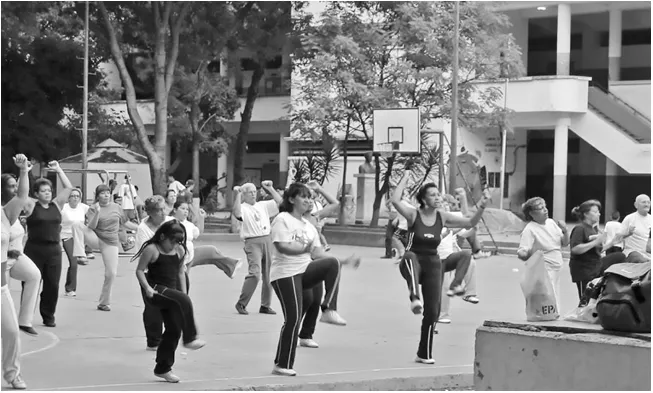
FIGURE 1. Grandparents Club practicing bailoterapia in a public school courtyard, 2006. Photo by the author.
Because people were having so much fun, at first I could not believe this was a government health program. As Darwin led the older adults in a series of vigorous dance moves, some ignored his cues and danced to their own beat. Dancers reached out to people on the sidelines and called out, “¡Baila! ¡Suda!” (Dance! Sweat!). Old women pulled me into their row, demanding that I exercise with them. People laughed and cheered, growing breathless with exertion. When an unexpected downpour began, nobody missed a beat. We hurried up the stairs to a covered stage and continued dancing.
The pleasure that people took in government-sponsored bailoterapia classes exceeded the gratification we might expect when feeling our bodies becoming stronger. Grandparents Clubs were fun for their own sake. People took joy in dancing and group outings to the beach. Before Barrio Adentro, they said, nothing like this existed for older adults: a safe public space for socializing and exercising. Some people expressed satisfaction that the government was taking older people’s well-being into account after what they perceived as decades of neglect. Knowing that the clubs were government sponsored produced its own kind of pleasure.
When I began research in Venezuela I did not expect to observe people taking pleasure in health care. I definitely did not anticipate writing an entire book about the pleasures of government medicine. Yet as I accumulated field notes and interviews, I was forced to acknowledge that joy, excitement, and satisfaction were central to people’s experiences of Barrio Adentro and other government health programs. Participants expressed pleasure even in medical encounters with their doctors, in clinical sites that we typically do not associate with such a feeling.
One example of this is Teresa’s story. Teresa was a retired secretary and longtime Santa Teresa resident who experienced encounters with Barrio Adentro doctors as a source of gratification. Teresa seemed proud of her strong constitution and self-reliance, even at the age of eighty-seven. Her petite frame belied an outsized personality that she expressed in impassioned, often belligerent discussions on topics such as the lack of manners among Venezuelan youth and proper fitness regimes for aging adults. Teresa volunteered family remedies for herbal and plant medicine but insisted that she never got sick. She openly scorned pharmaceuticals, saying she did not trust them and did not want their “toxins” inside her body.
Yet by her own admission, Teresa badly needed medical care. She had suffered knee pain for eleven years because she had no money to pay private practice physicians and did not have health insurance through her former employer, where the injury occurred. Teresa also was developing blurred vision. She learned about Barrio Adentro in 2003 from a stranger who noticed her struggling to descend a staircase. At the clinic a Cuban doctor diagnosed her cataracts and referred her for two Venezuelan state-funded trips to Havana for treatment, in which two hundred other Venezuelans participated. The surgeries included airfare, accommodation, and meals for three weeks. Teresa relished her memories of the food, gift bags, and toiletries she received, calling the experience, “Beautiful, totally beautiful!”
A spry yoga aficionado, Teresa was convinced she was right about most things and rarely expressed approval of other people’s behavior. She commonly attacked medical professionals she had met in the past for being rude and uncaring. Teresa reserved her rare praise for Barrio Adentro doctors. In field notes recorded after one of my first encounters with Teresa, I wrote:
“[The Cuban doctors] are very good,” she told me. “They will treat you well, spend time with you, and look you in the eyes. . . . The Venezuelan doctors here are not good. They will never look at you, and they only spend two or three minutes with you.” About two years ago she was seeing a doctor, and he was writing down what she said without looking at her, and she confronted him about it.
Teresa explained that doctors in Venezuela often treated poor patients with disdain, but Barrio Adentro doctors (whether Cuban or Venezuelan) treated them with compassion and solidarity. I followed Teresa for a year as her knee was treated in government clinics. She strategized her use of medical sites to get fast and personalized care at each stage of the process. She questioned neighbors and local doctors to find the closest Barrio Adentro diagnostic center that would provide same-day radiology services. After suspecting a hospital doctor of corruption because he told her she had to pay for testing before he could provide a diagnosis, she found another doctor she viewed as more trustworthy at a different government clinic.
A few months after surgery Teresa sought me out and reported she had completed thirty of forty prescribed physical therapy sessions at a Barrio Adentro rehabilitation clinic, demonstrating her progress with some energetic kicks. The eighty-seven-year-old grandmother urged me to acknowledge the intensity and height of her kicks, which she said were all due to the Barrio Adentro doctors. For Teresa, engagements with state medical services were pleasant, vital experiences. She seemed to enjoy the long process of optimizing her body and health. She felt she was receiving the kind of care she deserved.
Teresa understood these experiences of patienthood as politically meaningful. In her memoirs, which she was writing when I met her in 2008, she recorded:
Thank God! Thanks to President Hugo Chávez, for having consolidated and strengthened Barrio Adentro with all the missions that comprise it. . . .
Doctor Ana Martinez, Orthopedic Surgeon, from the “new generation” of doctors, operated on me, and God grant her long life, energy, and love so that she can continue working for the poor. She knows how to treat patients with care and respect, and these are the things that every patient needs and yearns for in those critical moments.
Finally, the suffering in my knee has disappeared! . . . Do you know how much this kind of surgical intervention costs? From eleven to twelve million bolívares [approx. US$5,200].3 How much did it cost me? Absolutely nothing. They did exams, MRIs, bone density tests, X-rays, electrocardiograms, etc., etc. All for free! I did not spend a single bolívar.
Teresa’s astonishment that a government might care about her knee exemplifies a pattern of enthusiasm that my interlocutors expressed about Barrio Adentro. Teresa celebrated access to medical services she could not gain access to in the past. She took pleasure in encounters with government doctors and government medical care that exceeded their therapeutic results. Her memoirs commented on the significance of being taken seriously by the state. Teresa was free from the pain in her knee, but she was also excited because the government was treating her (and people like her—“the poor”) as deserving of compassionate medical care.
Health care was a deeply political issue for poor Venezuelans who, like Teresa, had long lacked reliable access to adequate biomedical care. Biomedicine refers to what many in the United States simply call “medicine,” which is rooted in biology and physiology. Biomedical professionals like doctors and nurses focus on curing diseases by means of technical interventions. I sometimes use the term “biomedicine” to clarify what I mean because many medical traditions coexist in Venezuela. Teresa and other poor people might not have had access to biomedicine, but they relied on a variety of other healing practices and specialists.4
Historically, Venezuelan society was divided along stark class lines. Vast income inequalities meant that while a small elite enjoyed access to high-quality private biomedical clinics whenever they needed them, the majority poor and working classes often suffered long lines, indifferent doctors, and inaccessible treatments from an overstretched network of public hospitals. This dynamic began changing at a moment of significant political upheaval in 1998 when Hugo Chávez won successive national elections by emphasizing the injustice of socioeconomic inequalities and promising to redistribute national wealth. Never before had a radical, pro-poor, leftist president been elected to power. He promised to empower historically disempowered groups—the poor, indigenous people, women, Afro-Venezuelans—exciting people who felt excluded from formal politics. Chávez spoke directly to these people and promised them a greater role in determining their quality of life and the shape of their government. Barrio Adentro was a big part of the government’s promised changes, the idea being to revolutionize health care by making biomedicine community based and universally accessible.
Stories like Teresa’s provide insight into how people in Venezuela responded to health care during a high point of government investment in health and suggest that the new programs differed in meaningful ways from preexisting medical services. But as stand-alone stories, they do not explain why pleasure, satisfaction, and excitement were common responses to Chávez-era government health programs. Analyzing these stories systematically in cross-cultural and historical context reveals how ordinary people like Teresa experienced periods of momentous political change. These kinds of responses are not commonly reported in research on people’s experiences of health care in Latin America.
PLEASURE IN MEDICINE
Decades of research on how people experience government health care in Latin America show that poor and working-class people, particularly women and indigenous people, often experience humiliation, dehumanizati...
Table of contents
- Title
- Copyright
- Dedication
- Contents
- Acknowledgments
- 1 • Introduction
- 2 • Moving Medicine Inside the Barrio
- 3 • Clinical Intimacies as Macropolitics
- 4 • Beyond Biomedicine
- 5 • Pleasures of Participation
- 6 • The Limits of Citizenship
- Conclusion
- Notes
- References
- Index
Trusted by 375,005 students
Access to over 1.5 million titles for a fair monthly price.
Study more efficiently using our study tools.
Frequently asked questions
Yes, you can cancel anytime from the Subscription tab in your account settings on the Perlego website. Your subscription will stay active until the end of your current billing period. Learn how to cancel your subscription
No, books cannot be downloaded as external files, such as PDFs, for use outside of Perlego. However, you can download books within the Perlego app for offline reading on mobile or tablet. Learn how to download books offline
Perlego offers two plans: Essential and Complete
- Essential is ideal for learners and professionals who enjoy exploring a wide range of subjects. Access the Essential Library with 800,000+ trusted titles and best-sellers across business, personal growth, and the humanities. Includes unlimited reading time and Standard Read Aloud voice.
- Complete: Perfect for advanced learners and researchers needing full, unrestricted access. Unlock 1.5M+ books across hundreds of subjects, including academic and specialized titles. The Complete Plan also includes advanced features like Premium Read Aloud and Research Assistant.
We are an online textbook subscription service, where you can get access to an entire online library for less than the price of a single book per month. With over 1.5 million books across 990+ topics, we’ve got you covered! Learn about our mission
Look out for the read-aloud symbol on your next book to see if you can listen to it. The read-aloud tool reads text aloud for you, highlighting the text as it is being read. You can pause it, speed it up and slow it down. Learn more about Read Aloud
Yes! You can use the Perlego app on both iOS and Android devices to read anytime, anywhere — even offline. Perfect for commutes or when you’re on the go.
Please note we cannot support devices running on iOS 13 and Android 7 or earlier. Learn more about using the app
Please note we cannot support devices running on iOS 13 and Android 7 or earlier. Learn more about using the app
Yes, you can access State of Health by Amy Cooper in PDF and/or ePUB format, as well as other popular books in Social Sciences & Anthropology. We have over 1.5 million books available in our catalogue for you to explore.