In the Peninsula Campaign of spring 1862, Union general George B. McClellan failed in his plan to capture the Confederate capital and bring a quick end to the conflict. But the campaign saw something new in the war — the participation of African Americans in ways that were critical to the Union offensive. Ultimately, that participation influenced Lincoln’s decision to issue the Emancipation Proclamation at the end of that year. Glenn David Brasher’s unique narrative history delves into African American involvement in this pivotal military event, demonstrating that blacks contributed essential manpower and provided intelligence that shaped the campaign’s military tactics and strategy and that their activities helped to convince many Northerners that emancipation was a military necessity.
Drawing on the voices of Northern soldiers, civilians, politicians, and abolitionists as well as Southern soldiers, slaveholders, and the enslaved, Brasher focuses on the slaves themselves, whose actions showed that they understood from the outset that the war was about their freedom. As Brasher convincingly shows, the Peninsula Campaign was more important in affecting the decision for emancipation than the Battle of Antietam.
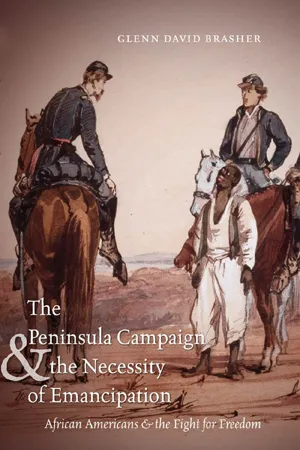
eBook - ePub
The Peninsula Campaign and the Necessity of Emancipation
African Americans and the Fight for Freedom
- 296 pages
- English
- ePUB (mobile friendly)
- Available on iOS & Android
eBook - ePub
The Peninsula Campaign and the Necessity of Emancipation
African Americans and the Fight for Freedom
About this book
Information
1
Preludes
War, Slavery, and the Virginia Peninsula
In May 1862, a debate raged in the U.S. Congress as the Army of the Potomac prepared to attack the capital of the Confederacy. For months, radical Republicans had insisted that because slaves were a Confederate asset it was a “military necessity” to liberate them. Slaves labored for the southern army, and several congressmen also claimed that Rebel troops were using some blacks in combat. Ohio’s abolitionist senator Benjamin Wade, for example, was outraged to “see black regiments put forward to shoot down my sons who are in the war … [and to] see these black chattels thrust forth in front of their ‘chivalrous’ owners to shoot down, murder, and destroy our men.” Such allegations were not new—many Northerners had widely published and discussed these controversial and provocative claims since the early days of the war. At the same time, however, several congressmen pointed out that slaves on the Virginia Peninsula were demonstrating their desire to aid the Union army by providing military intelligence and labor. Referring to the American Revolution to illustrate his point, New York representative Charles B. Sedgwick summarized the military rationale for emancipation by maintaining that when fighting an enemy that possessed slaves, “no civilized nation ever failed” to weaken its opponent and strengthen itself by “proclaim[ing] the freedom of the slaves.”1
As Sedgwick pointed out, the Peninsula Campaign is only one example of the connection between war and slavery. During the Civil War, Northerners were shocked to hear reports of slaves fighting alongside their masters. They should not have been surprised to find slaves laboring and fighting on both sides of the conflict, however. Throughout history, warfare has frequently served as a means of emancipation, and although most often slaves have gained freedom by aiding their masters’ enemies, they frequently have done so by demonstrating “loyalty” to their owners.
“We had used them to good advantage”
For as long as slavery has existed, warfare has been one of the primary liberators of slaves. For example, during the Persian and Peloponnesian wars of the ancient world, slaves gained their freedom either by fighting for their masters or by joining the invaders. During the Punic Wars, even the Romans offered freedom to their slaves if they would fight for the Republic. In the fifteenth century, the Portuguese began the transatlantic African slave trade, and they ironically led the way in offering freedom to their African slaves as a reward for military service. During the seventeenth century, slaves won their freedom fighting for both sides as the Dutch and the Portuguese sought control over Brazil. In the Caribbean, all the European powers offered freedom to slaves who would fight. In the eighteenth and early nineteenth centuries, for example, the British army recruited and employed large numbers of blacks in the region. As a result, thousands received their freedom by fighting for the side that had previously held them in bondage.2
In contrast, slaves in the pre-Revolutionary North American colonies seldom served in the military. In 1619, a Dutch ship brought the first Africans known to have arrived in the British North American colonies to the Virginia Peninsula. Planters there attempted to solve the young colony’s labor shortage by importing both slaves and indentured servants. By the end of the seventeenth century, however, the supply of indentured servants dramatically declined and death rates stabilized, making slaves a better investment than servants. As the number of slaves rapidly expanded, Virginia and the other southern colonies increasingly enacted laws that placed restrictions on the black population and drew significant color lines between the races. Because of economic self-interest, sensitivity to property rights, and the obvious fear of arming slaves, most colonial legislatures forbade the regular military enlistment of Africans.3
Wartime necessity, however, led to occasional black enlistments. For example, during the War of Spanish Succession (Queen Anne’s War), with the South Carolina frontier threatened by isolated Indian raids, the colonial legislature authorized “stout negro men to be enlisted” in the militia. As an incentive, lawmakers decreed that any slave who killed or captured a member of the enemy’s forces or was wounded while fighting for the colony would be freed. South Carolina repeated this offer a few times over the next few decades during times of military crisis, freeing those few slaves who fought alongside their masters. However, the Stono Rebellion in 1739 put an abrupt end to the idea of arming slaves. For the next two decades, few colonies allowed blacks to serve in the militia.4
Nevertheless, at the outbreak of the Seven Years War, white colonists called upon blacks yet again. For the most part, this service was limited to the northern colonies, but there were instances in which southern militia units also resorted to the practice of using blacks. In addition, British general Edward Braddock carried slaves from the Virginia Peninsula with him during his campaign into Pennsylvania. The black men fought side by side with the white soldiers and suffered casualties. Later in the war, George Washington used black laborers to construct defenses on the Virginia frontier.5
At the start of the American Revolution, a small group of slaves from the Virginia Peninsula appeared at the governor’s house in Williamsburg and offered to help suppress the impending rebellion of their masters. Lord Dunmore sent them away, but the slaves had confirmed his belief that if a rebellion occurred he could count “all slaves on the side of the Government.” The royal governor later declared “all indented servants, Negroes, or others, free, that are able and willing to bear arms.”6
As a result, some blacks made their way down the Peninsula to the sheltering arms of Dunmore’s forces. Talk of a Negro “stampede” led to increased patrols and other measures to prevent a mass exodus of slaves. Masters told their slaves that the British were no friends of the black man and would only sell them to the West Indies, where they would endure much harsher conditions. Nevertheless, despite the increased vigilance of whites, within a week of the proclamation approximately 300 blacks had evaded the patrols and made it behind British lines. Dunmore quickly put them to work in small-scale raiding, and they saw action at the Battle of Great Bridge, where they performed admirably. In time, the regiment grew to perhaps as many as 800 black soldiers. Aside from their limited role in combat, Dunmore’s Ethiopian Regiment engaged in foraging for supplies badly needed by the troops stationed on ships in Chesapeake Bay.7
Dunmore’s military use of slaves infuriated white Americans, but as in other wars, the colonists eventually proved willing to raise black troops themselves. Many colonial legislatures initially opposed the use of slaves, but once the crisis worsened, and especially after the British offered freedom to slaves who would join them, the northern colonies began to see the value in enlisting both free blacks and slaves in their militia units. The southern colonies, however, rarely allowed blacks to serve in the militia. Nevertheless, as early as December 1775, manpower shortages led Washington to accept the enlistment of black troops into the Continental army, especially because he feared that if African Americans were not allowed to serve, “they [might] Seek employ in the [British] Army.” At any given time during the war, between 6 and 12 percent of Washington’s forces were black. Many of these were slaves who eventually earned their freedom by serving with Patriot troops.8
Even Virginia found uses for blacks in the war against the British. Like most of the southern states, Virginia opposed using slaves in their militia units but did allow the enlistment of free blacks. Many of them enlisted as substitutes for whites who chose to buy their way out of military service. In addition, white owners often passed their slaves off as free men, placed them on the militia rolls as their substitutes, and thus avoided the draft. Other slaves ran away from their owners and pretended to be free men in order to enlist. African Americans served in the various Virginia units of the Continental army, fighting side by side with white soldiers in each of Washington’s major engagements. Black men also acted as spies, gathering intelligence behind British lines by posing as runaways. In addition, Virginia authorized the military to purchase and hire slaves to help construct forts and other defenses.9
Nevertheless, the British were far more successful at exploiting Virginia’s black labor. Lord Dunmore’s promise of freedom eventually became official British policy, and thus when Lord Cornwallis arrived on the Virginia Peninsula in 1781, his troops brought hundreds of blacks they had gathered in the southern states. So many runaways accompanied Cornwallis that one Hessian officer recalled, perhaps with some exaggeration, that “every soldier had his Negro who carried his provisions and bundles.” On his march up from North Carolina, Cornwallis had used African Americans to forage, and now he put these black laborers to work on the fortification of the lower Peninsula around Portsmouth, Gloucester, and Yorktown.10
Eventually, the Patriots hemmed Cornwallis into his lines around Yorktown, and the fateful siege by American forces began. Inside the British lines were 4,000 to 5,000 blacks who had taken refuge with the redcoats and constructed the fortifications standing between them and their former masters. Meanwhile, the Continental army and navy also benefited from the services of hundreds of blacks. No less than white Americans, blacks who fought in the American Revolution were committed to bettering their condition. For some, that meant casting their lot with the side that had openly offered freedom—the British—while others sided with those who had enslaved them—the Patriots. Whichever side gave them the best hope of obtaining the “inalienable rights” that Jefferson spoke of was likely to find a willing recruit.11
As conditions inside besieged Yorktown grew bleaker and provisions scarcer, Cornwallis decided that he could no longer keep the blacks within his lines. Sadly, the men and women who had rushed to his banner, who had foraged for him, acted as servants for his troops, and helped construct the lines that protected him, were now forced out and back into the hands of their former masters. One Hessian officer watched in shame and later recalled how “we had used them to good advantage and set them free, and now, with fear and trembling, they had to face the reward of their cruel masters.”12
Washington ordered the slaves returned to their owners and opened up the lines so that masters could reclaim their property. He also decreed that any unclaimed blacks should be put to work immediately and that advertisements be placed to help locate their owners. After Cornwallis’s surrender and the evacuation of British troops from Yorktown, Americans discovered the ravages that smallpox had inflicted upon many of the blacks who had been with the redcoats. The town and its surroundings contained the bodies of the barely living and the dead.13
During the American Revolution, African Americans had willingly gambled by using the war to gain their freedom. Aside from the slaves that were with Cornwallis, the British carried most of these runaways to freedom when they withdrew, but the sight of slaves being returned to the mercy of their vindictive owners at Yorktown, as well as the hundreds of smallpox-ridden bodies stacked for burial, graphically demonstrates that the gamble had not paid off for many of the slaves who had sided with their masters’ enemy.
Ironically, however, the American victory resulted in a dramatic increase in the number of free blacks in Virginia. Many of the thousands of slaves who had escaped during the war managed to avoid recapture and now passed themselves off as free men. Other slaves were given their freedom as a reward for supporting the Patriot cause. The Virginia legislature, disturbed by reports that owners who had used their slaves during the war as conscript substitutes were now re-enslaving them, declared that such acts were “contrary to the principles of justice” and passed legislation that freed all such men. In addition, for those masters who were troubled by the philosophical incompatibility of fighting for freedom while denying it to others, many southern states made it easier for them to free their slaves. Repealing a fifty-nine-year-old law, Virginia made it possible for owners to liberate their slaves by will or deed. Most slaves who were freed had demonstrated loyalty to their masters during the Revolutionary War.14
The Peninsula’s slaves were able to again use war as a means of liberation during the War of 1812. For a second time, the area became the target of British raiding parties designed to stir up the slave population. The memory of the redcoats acting as liberators during the Revolution perhaps lingered in the slave community, and the British again extended the offer of freedom to anyone who would rally to their flag.15
In the spring of 1813, British forces began a series of hit-and-run raids along the Virginia coastline designed to damage the American economy and cause general chaos that would disrupt the collaboration of state militia units with the American army. The British offered runaways the chance to enlist in a special regiment or be transported to British possessions in the West Indies. From the beginning, the redcoats underestimated how many blacks would accept such an offer. Throughout the summer of 1813, escapees crowded the decks of British ships. Transports carried most of these slaves to the West Indies, but many demonstrated a desire to fight. One British captain claimed that some slaves came aboard declaring, “Me free man, me go cut massa’s throat, give me a musket.”16
In the spring and summer of 1814, the British presence in the region suddenly increased, and a new commander, Sir Alexander Cochrane, took charge of blockading the coast. The commander established a camp on Tangier Island in the Chesapeake to receive runaway slaves. With black labor used to fortify the position with entrenchments, the camp became a base of operations for the British. Cochrane trained and equipped a number of these blacks as soldiers, and runaway slaves fought in every significant engagement in the Chesapeake region until the end of the war. In August, these former slaves served in the advance unit that routed the Americans at Bladensburg and went on to sack and burn Washington.17
As in the Revolution, Americans also benefited from black laborers during the war. When Cochrane’s forces moved on Washington and Baltimore, they contended with fortifications constructed and defended with the aid of both slaves and free blacks. Of course the most famous African Americans serving with U.S. forces during the war were in Louisiana. Despite criticism, General Andrew Jackson gladly welcomed a few hundred free blacks and slaves into his army, and they played a prominent role in his successful defense of New Orleans. Thus, African Americans served on both sides in the War of 1812, and by the end of the conflict, between 3,000 and 5,000 Chesapeake slaves had seized the opportunity to liberate themselves.18
Whenever armies and navies had come to the Virginia Peninsula, thousands of slaves had used the moment to obtain freedom, if only temporarily. In 1861, forty-six years after the flow of slaves to the British stopped, armies would again arrive on the Peninsula and in numbers unheard of in 1776 or 1812. As could have been predicted by anyone familiar with the historical relationship between slavery and warfare, slaves would be active on both sides of the struggle. Whether a few chose to fight for their enslavers in the hope that their owners would reward their loyalty, or others sought freedom by helping their masters’ enemies, Peninsula slaves would seize any advantages they might secure from the tumult and bloodshed of war.
Antebellum life on the Virginia Peninsula and in Richmond prepared the region’s African Americans to become valuable assets to both the Confederate and Union armies during the Civil War. The area’s relatively diversified economy made blacks skilled in the types of labor needed to support a military campaign, and both sides would come to greatly depend on their physical exertions. Moreover, although the Peninsula’s small farms usually did not require slaves to work quite as hard as those in the lower South or in other parts of the state, Peninsula slaves felt all the injustices of slavery and were more than ready to exploit any wartime opportunities to lighten or even escape their burdens. To resist complete domination by their owners, slaves had developed unique skills and talents. Fooling their masters, slipping off the plantation at night, and evading patrols were forms of daily resistance practiced by the slaves, and these experiences gave them expertise and knowledge that would make them valuable assets to the Union army as more than just laborers.
“No one could desire to live in a more favorable place”
In the yea...
Table of contents
- Cover Page
- The Peninsula Campaign & the Necessity of Emancipation
- Copyright Page
- Dedication
- Contents
- Illustrations and Maps
- Introduction
- 1 Preludes
- 2 Contraband of War
- 3 War Is a Swift Educator
- 4 The Best Informed Residents in Virginia
- 5 The Monuments to Negro Labor
- 6 Those by Whom These Relations Are Broken
- 7 An Invaluable Ally
- 8 A Higher Destiny
- Conclusion
- Notes
- Bibliography
- Acknowledgments
- Index
Trusted by 375,005 students
Access to over 1.5 million titles for a fair monthly price.
Study more efficiently using our study tools.
Frequently asked questions
Yes, you can cancel anytime from the Subscription tab in your account settings on the Perlego website. Your subscription will stay active until the end of your current billing period. Learn how to cancel your subscription
No, books cannot be downloaded as external files, such as PDFs, for use outside of Perlego. However, you can download books within the Perlego app for offline reading on mobile or tablet. Learn how to download books offline
Perlego offers two plans: Essential and Complete
- Essential is ideal for learners and professionals who enjoy exploring a wide range of subjects. Access the Essential Library with 800,000+ trusted titles and best-sellers across business, personal growth, and the humanities. Includes unlimited reading time and Standard Read Aloud voice.
- Complete: Perfect for advanced learners and researchers needing full, unrestricted access. Unlock 1.5M+ books across hundreds of subjects, including academic and specialized titles. The Complete Plan also includes advanced features like Premium Read Aloud and Research Assistant.
We are an online textbook subscription service, where you can get access to an entire online library for less than the price of a single book per month. With over 1.5 million books across 990+ topics, we’ve got you covered! Learn about our mission
Look out for the read-aloud symbol on your next book to see if you can listen to it. The read-aloud tool reads text aloud for you, highlighting the text as it is being read. You can pause it, speed it up and slow it down. Learn more about Read Aloud
Yes! You can use the Perlego app on both iOS and Android devices to read anytime, anywhere — even offline. Perfect for commutes or when you’re on the go.
Please note we cannot support devices running on iOS 13 and Android 7 or earlier. Learn more about using the app
Please note we cannot support devices running on iOS 13 and Android 7 or earlier. Learn more about using the app
Yes, you can access The Peninsula Campaign and the Necessity of Emancipation by Glenn David Brasher in PDF and/or ePUB format, as well as other popular books in History & American Civil War History. We have over 1.5 million books available in our catalogue for you to explore.