When Zandria Robinson returned home to interview African Americans in Memphis, she was often greeted with some version of the caution “I hope you know this ain’t Chicago.” In this important new work, Robinson critiques ideas of black identity constructed through a northern lens and situates African Americans as central shapers of contemporary southern culture. Analytically separating black southerners from their migrating cousins, fictive kin, and white counterparts, Robinson demonstrates how place intersects with race, class, gender, and regional identities and differences.
Robinson grounds her work in Memphis — the first big city heading north out of the Mississippi Delta. Although Memphis sheds light on much about the South, Robinson does not suggest that the region is monolithic. Instead, she attends to multiple Souths, noting the distinctions between southern places. Memphis, neither Old South nor New South, sits at the intersections of rural and urban, soul and post-soul, and civil rights and post–civil rights, representing an ongoing conversation with the varied incarnations of the South, past and present.
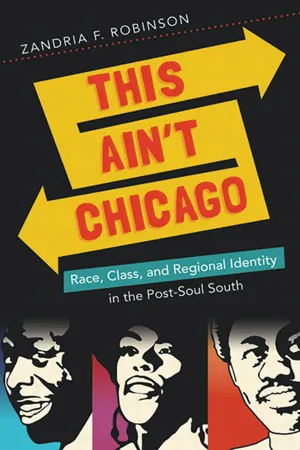
eBook - ePub
This Ain't Chicago
Race, Class, and Regional Identity in the Post-Soul South
- 238 pages
- English
- ePUB (mobile friendly)
- Available on iOS & Android
eBook - ePub
About this book
Information
CHAPTER ONE
Finding the Black South
“They think we slow, backwards, always at church, always cooking, riding horses because we don’t have real roads or cars, farming, saying ‘yessuh’ and ‘yessum’ to white folks, and singing and dancing all the time,” said forty-four-year-old Marie, an employee of a local media affiliate. Marie described herself as a new southerner, sophisticated, and knowledgeable about world affairs. However, as she bustled about her bright red kitchen baking cookies for a function at her church, she talked about how many people from outside of the South see the region and its inhabitants as trapped in an imagined plantation past. The “they” she referred to includes anybody outside of the South, and specifically her cousins who live in Chicago, who frequently came up in our conversations. When I first met Marie (during an interview with another respondent), she was dashing off to prep her Sunday dinner on a Thursday. As many southerners do out of routine courtesy but perhaps without the fullness of meaning, Marie invited us to that dinner, after which she quickly became one of my key respondents. Whether or not she genuinely wanted us to come to dinner that Sunday, I never asked.
I was sitting in my usual spot in her South Memphis home: a tidy stool at her kitchen’s movable island. As usual, the island was covered in flour, which rose and settled as she inadvertently bumped the counter space, transferring cookie dough to a baking sheet. I pointed out the irony of at least part of her assertions—specifically, the ones about southerners always being at church and always cooking—vis-à-vis her current activity. With a “humph,” she looked down at her apron, around the kitchen, then down at the cookie sheet, lined with four neat rows of evenly spaced, evenly measured, soon-to-be chocolate chip cookies. As she sent the sheet clattering into the red oven, she retorted: “Well, I ain’t never known nobody in Memphis, Tennessee, or anywhere else in the South for that matter to ride a horse to work.”
Enduring stereotypes about the South and southerners, like these and others whom Marie and other respondents talked about at length, are the residue of the boundary work between individuals, groups, and places. The perpetuation of stereotypes and myths about the South is essential to this boundary work. Not only do they accomplish and reify the idea of the South as a distinct place, but they also ensure that the South functions as the polar opposite to the rest of the nation. As Toni Morrison has argued persuasively about the relationship between blackness and whiteness in American culture, the South is constructed as the backdrop against which American national identity is formed and without which it cannot exist. The perpetuation of stereotypes and myths about the region are essential to the construction of the South-as-backdrop. These processes not only accomplish the South as a distinct place but also accomplish the non-South as the region’s polar opposite.
Myths about the black South are carefully constructed, undergirding its mysterious pull for migrants, beyond the obvious benefits of warmer weather, a cheaper cost of living, and better employment opportunities. Corporations and cultural elites are especially invested in accomplishing the South as a sacred space, temporally fixed in a simpler moment and imbued with the highest of moral values. As the South is made and remade in the increasingly hypermediated contexts of social media and reality television, myths take on new life, becoming entrenched and more difficult to disentangle from lived experience. This mythmaking occurs in multiple contexts and over several generations, such that the idea of a place becomes rooted in national collective memory. As the nation’s region, whose economic, political, and social mores have driven the national consciousness since slavery, the South has often served as a repository for national illness, quarantined, sealed off, and punished in order to maintain a national facade of progress and morality. Similarly, southern cultural products, from the blues to hip-hop, are exported as representative of America’s distinct cultural gifts in international contexts. With so many investments in contorting the region in service of national identity, distinguishing the idea of the place (as country, backwards, rural, for instance) from the lived reality of a place (the South that Marie and other respondents said they live in) becomes a Sisyphean exercise.
Respondents in this study reject these negative southern stereotypes and the national weight they carry as fallacious and burdensome. When non-southerners negatively connote “country,” respondents are especially incensed and quickly reframe country knowledge as, in fact, cosmopolitan. Marie, for instance, implored the figurative and omnipresent black Yankees not to let her cooking fool them. “Cooking is how the slave women killed many a master and a mistress,” she often said, which made me slightly paranoid about eating as much of her food as I did.
Yet, despite their often negative connotations, southern myths are imbued with interpersonal currency, providing individuals with a virtually unending source of social and cultural capital. As I discovered throughout the course of my research, respondents readily traded or cashed in on these myths to legitimate and bolster their claims to a better blackness. For instance, although most post-soul southerners have little direct experience with the kinds and frequency of racial violence visited upon previous generations, they wax knowledgeable about incidents that happened to their parents, grandparents, and first cousins thrice removed. The often third- and fourth-hand nature of the stories accords them myth status, which therefore makes them both irrefutable and unverifiable. Yet, authenticating narratives of white terrorism is less important than understanding how such narratives function and proliferate in the post-soul black southern imagination. Narratives of white racial terror afford the storyteller social and cultural capital. Bearing witness or being proximate to egregious white racism, especially in an era of more subtle (though no less pernicious) color-blind racism, is a rite of passage for black folks. The experience of old-fashioned, overt southern white racism, the stuff of films and history, provides not only a racially authentic experience but also a site through which to claim a robust and resilient blackness.
Narratives of white racism constituted one dimension of respondents’ perpetuation of southern myths in exchange for social capital. Respondents often called upon rural folkways, also second- and thirdhand, to cure colds, fix a flat tire, beat the summer heat, and cultivate urban gardens. Sometimes erupting into heated arguments and country competitions—is cod liver oil or castor oil better for this or that ailment?—discussions of rural folkways helped respondents distinguish themselves from each other as well as from their non-southern counterparts. Further, even those respondents who self-identified as atheists or who do not attend church used religious language frequently in discussions, sometimes to cross cultural boundaries but more often to erect a shared culture governed by a higher power, even if everyone is not a believer. Buddhists, Muslims, Christians, and atheists alike called or signified on a cultural Jesus to participate in a shared southern black culture. Still, such discursive moves occurred in specific and delimited contexts. Espousing a certain kind of fervent black southern religiosity could firm intraracial regional boundaries. For instance, southern black megachurches and their often notoriously conservative stance on the rights of women and LGBT communities cause rifts in black political solidarity. Finally, food and culinary metaphor was ubiquitous in respondents’ narratives with ample talk of soul food and barbecues. Respondents worked hardest to perpetuate myths about the superiority of southern cooking. Though Marie took exception to northerners’ perceptions of southerners as in a perpetual state of preparing to cook, cooking, and eating, respondents and their friends, uncles, mothers, and cousins were, in fact, often cooking or eating when I encountered them. I returned the courtesy on several occasions when respondents sat for long interviews. Food-as-boundary served as an umbrella for food-related boundary work, from discussions of veganizing traditional soul food dishes to talk of “clean eating” and avoiding the consequences of a traditional soul food diet. Nuances notwithstanding, respondents frequently cited food as a distinct element of black southern identity in our initial discussions. Food, respondents argued, is the ultimate form of social capital, in that it leads to other forms of social capital, including a significant other. Collectively, these myths and respondents’ appropriations of them draw on country ideologies, extricating the negative, provincial aspects of country medicine, religion, and food with a cosmopolitan spin and claim to authenticity and superiority.
Yet, beyond the usual myths perpetuated about the black South, like southern blacks being too submissive to whites, well-versed in folk cures, unreasonably beholden to religion, or cooking excessively, very little is known about the intricacies of everyday black cultural life in the South. To reconcile representations of black southern identity and the lived experience of post-soul southerners, I retrace the idea of the black South, and the South as an artifact of black collective memory, in black arts and letters and black public culture. Behind the heavy doors of the region’s closed society,1 what were the features of black cultural life? Over the course of the Great Migration, how did black southern cultures differ from the cultures of black southern diasporas rapidly proliferating in the metropolises of the West, Northeast, and Midwest? How did changes in the region ushered in by the civil rights era affect how black southerners conceptualized and expressed regional identity? Moreover, how were cultural differences and cultural change represented in popular media and academic research?
To answer these questions and locate “missing” black South(s), this chapter begins with a discussion of the place of region in African American identity. Next, I uncover the discursive black South as it has been produced and consumed by myriad publics, especially African American publics. By traversing the black South(s) popularized in the American imagination by literature, art, dance, film, music, and television, I elucidate the narratives emergent from and in the name of the black South and the function of such narratives for black identities historically and contemporarily. Finally, I show how processes of place accomplishment and regional representation inform post-soul southern identity.
Region, Race, and Native Black Identity
Like other axes of identity and difference, region and regional distinction can be difficult to measure empirically because of contested boundaries, definitions, and changes over time. Endless debates over the “real South”—what geographically and culturally counts as the South, whether the region is a “state of mind” rather than a geographically located place, and who can legitimately be called a southerner—make complicated work of locating the region in popular memory and imagination. Is Kentucky in the South? Or is Washington, D.C.? Is the South all states below the Mason-Dixon Line? States that seceded from the Union? Or states that owned slaves? Because of the “Southernization of America,”2 is the “South” a uniquely American state of mind that exists all over the nation, beyond the geographic and historical boundaries of region? If one were to answer these questions based on the plethora of how-to guides on the market, from A Southern Belle Primer to The Grits (Girls Raised in the South) Guide to Life, southern identity is merely performative, something to be taken on and off like a set of clothes, and therefore easily achievable by anyone who can follow directions and make clearly delineated, distinctively southern choices. Further, the historical obfuscations, what Tara McPherson calls “lenticular logic,” upon which white southern memory, culture, and identity are based, are increasingly being called into question.3
In popular media contexts and everyday life, African American southerners are less concerned with whether or not the South exists, or whether or not it is bounded on the north by the Mason-Dixon Line or, as Malcolm X suggested, by the U.S.-Canadian border. Further, unlike their white counterparts, African Americans are not generally reconciling their identities with a reconstructed history. That is, while white guilt complicates white folks’ abilities to confront a troubled racial, regional, and national past that includes slavery, lynch mobs, and Jim Crow, these facts of black life and histories have been integrated into African American and diasporic black identities more broadly. Still, as a physical and geographical source of racial shame, some African Americans’ relationship to the South is tenuous and rife with discomfort. Images that have come to signify racial subservience, like Aunt Jemima and Uncle Tom, give particular regional significance to flying accusations of “cooning,” such as those lodged against Tyler Perry by Spike Lee or against southern hip-hop artists by their East and West Coast counterparts.
Even in interregional jest, blacks from outside of the South often characterize the region as a place where folks have yet to receive the memo about emancipation. This is especially the case in non-southerners’ strategic forgetting of the South’s urban centers, supplanting southern cities with the supposedly wide, easy fields of a rapidly disappearing rural landscape. Such critiques are more prominent today, as the growing success of the black South challenges the hegemony of Harlem, South Side Chicago, and Oakland as central disseminators of authentic black culture. Ultimately, while black and white southerners’ qualms with the region are different, they are nonetheless similarly wrapped up in powerful discourses about identity in the post–civil rights—or as Michael Kreyling has termed it (implicitly for whites), “postsouthern”—South.4
In and through the idea of the South, African Americans can cultivate a native black identity, a static reference point for black culture—and the limits of authentic blackness—in the United States and beyond. This native black identity is grounded in processes of racial formation, which compel the development of shared political strategies and social practices in response to structural conditions. In response to how blackness is constructed in legal, sociopolitical, and popular media contexts, sets of performative ideals for native black identity are formed. Informed by the construction of blackness, these performances cull together historical and contemporary tropes of authentic blackness to create an authentic self that can serve as recognizable shorthand for “black American.”
A host of assumptions constitute a native black identity. First, a native black identity is predicated upon the enslavement of one’s ancestors in the American South, especially in the historical Black Belt that included the Arkansas and Mississippi Deltas, Louisiana, Alabama, and Georgia. Second, native blacks are distinguished by their experience of and connection to the Jim Crow South. Third, traditions of resistance, rooted in Protestantism and Old Testament religiosity, are central to native black identity. Specifically, these resistance traditions are embodied by social and collective memories of slavery and the civil rights movement. The cultural products that emerge from these collective memories and experiences, including gospel, blues, jazz, rhythm and blues, and soul, also factor prominently into a native black identity. These shared assumptions about what constitutes a native, or authentic, black American identity lead to innumerable conclusions about what black is and what black ain’t, as well as about what black people do and do not do. When black folks fall out of these boxes of conclusions—by being lesbian or gay, experiencing mental illness, looking for the murdering maniac in the woods or following the suspicious sound instead of running away like stereotypical black characters in a horror film, or playing in an indie rock band—they fall out of the confines of native black identity. Because of the complexity of individual identity intersections and social tastes, most African Americans must work diligently to stay put or to jump into native blackness. This is a constraining truth even for those who are culturally closest to this native blackness: black southerners.
Whether the performance is of native black identity, southern black identity, or southern black identity as native black identity, negotiations and theorizations of racial and regional identity are also deeply rooted in African American signifying practices. As such, they are sincere in another way—as true, genuine presentations of thoughts, actions, and feelings that exist beyond the measurement boundaries of authenticity. While respondents like Ruth Ann, who claimed, “We just do things better down here,” might explicitly reject the notion of performance, they are nonetheless aware of cultural differences that render them distinct from their non-southern counterparts. They are, then, sure to point to something that lends their southern presentations of self some verisimilitude, especially in mixed company. In practice, this kind of boundary work erects a relatively rigid dichotomy that reduces non-southern, or northern, to a monolith category and virtually ignores the diasporic reach of the South, cultivated over several generations of migration out of the region. Most of my respondents believe wholeheartedly in the negatively transformative power of the city, or the North, on black identity, experience, and authenticity and therefore invalidate their northern kin’s version of blackness, even if they are only up the road in Chicago. Respondents construct a north, or a “No’f,” to account for everywhere else but the South, even if directionally the place in question is due west. Its geographic inaccuracy notwithstanding, this construction of a monolith North functions as an important symbolic boundary for respondents as well as for popular culture elites to draw distinctions in worldviews and identity outcomes. I was careful to challenge my respondents’ monolith rendering of the non-South and to treat such renderings as indicative of a particular southern worldview—one that privileges conceptions of a racial homeland, proximity to civil rights traditions, and expressions of native black identity.
Burying the South
“The South is always hot,” Keith, a thirty-two-year-old high school English teacher, told me on the front porch of a soul music café in midtown Memphis. Indeed, the July heat was bothering even me a bit (and I generally pride myself on withstanding the summer humidity from the Mississippi River). Keith, however, was not talking about the weather. He was “learning” me on the ongoing significance of the South in African American culture. He continued: “The Harlem Renaissance? Southern stories stolen from the South made to seem like they were native to Harlem Negroes’ experience. Gospel, blues, jazz, funk, soul? The South. Dance? The South. [Alvin] Ailey? The South. Hip-hop? The South. Atlanta? The South.”
Keith is a key respondent and a native Memphian who grew up in a predominantly black community in the shadows of Elvis Presley’s palatial Graceland home and tourist hotspot. After attendi...
Table of contents
- Cover Page
- Title Page
- Copyright Page
- Dedication
- Contents
- Preface
- Acknowledgments
- INTRODUCTION Region, Race, and Identities
- CHAPTER ONE Finding the Black South
- CHAPTER TWO Post-Soul Blues
- CHAPTER THREE Not Stud’n’ ’em White Folks
- CHAPTER FOUR Belles, Guls, and Country Boys
- CHAPTER FIVE Southern Is the New Black
- CONCLUSION Black Identity Redux
- Notes
- Bibliography
- Index
Trusted by 375,005 students
Access to over 1.5 million titles for a fair monthly price.
Study more efficiently using our study tools.
Frequently asked questions
Yes, you can cancel anytime from the Subscription tab in your account settings on the Perlego website. Your subscription will stay active until the end of your current billing period. Learn how to cancel your subscription
No, books cannot be downloaded as external files, such as PDFs, for use outside of Perlego. However, you can download books within the Perlego app for offline reading on mobile or tablet. Learn how to download books offline
We are an online textbook subscription service, where you can get access to an entire online library for less than the price of a single book per month. With over 1.5 million books across 990+ topics, we’ve got you covered! Learn about our mission
Look out for the read-aloud symbol on your next book to see if you can listen to it. The read-aloud tool reads text aloud for you, highlighting the text as it is being read. You can pause it, speed it up and slow it down. Learn more about Read Aloud
Yes! You can use the Perlego app on both iOS and Android devices to read anytime, anywhere — even offline. Perfect for commutes or when you’re on the go.
Please note we cannot support devices running on iOS 13 and Android 7 or earlier. Learn more about using the app
Please note we cannot support devices running on iOS 13 and Android 7 or earlier. Learn more about using the app
Yes, you can access This Ain't Chicago by Zandria F. Robinson in PDF and/or ePUB format, as well as other popular books in Social Sciences & North American History. We have over 1.5 million books available in our catalogue for you to explore.