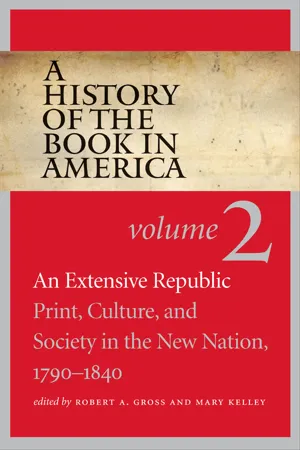
Volume Two of A History of the Book in America documents the development of a distinctive culture of print in the new American republic.
Between 1790 and 1840 printing and publishing expanded, and literate publics provided a ready market for novels, almanacs, newspapers, tracts, and periodicals. Government, business, and reform drove the dissemination of print. Through laws and subsidies, state and federal authorities promoted an informed citizenry. Entrepreneurs responded to rising demand by investing in new technologies and altering the conduct of publishing. Voluntary societies launched libraries, lyceums, and schools, and relied on print to spread religion, redeem morals, and advance benevolent goals. Out of all this ferment emerged new and diverse communities of citizens linked together in a decentralized print culture where citizenship meant literacy and print meant power. Yet in a diverse and far-flung nation, regional differences persisted, and older forms of oral and handwritten communication offered alternatives to print. The early republic was a world of mixed media.
Contributors:
Elizabeth Barnes, College of William and Mary
Georgia B. Barnhill, American Antiquarian Society
John L. Brooke, The Ohio State University
Dona Brown, University of Vermont
Richard D. Brown, University of Connecticut
Kenneth E. Carpenter, Harvard University Libraries
Scott E. Casper, University of Nevada, Reno
Mary Kupiec Cayton, Miami University
Joanne Dobson, Brewster, New York
James N. Green, Library Company of Philadelphia
Dean Grodzins, Massachusetts Historical Society
Robert A. Gross, University of Connecticut
Grey Gundaker, College of William and Mary
Leon Jackson, University of South Carolina
Richard R. John, Columbia University
Mary Kelley, University of Michigan
Jack Larkin, Clark University
David Leverenz, University of Florida
Meredith L. McGill, Rutgers University
Charles Monaghan, Charlottesville, Virginia
E. Jennifer Monaghan, Brooklyn College of The City University of New York
Gerald F. Moran, University of Michigan-Dearborn
Karen Nipps, Harvard University
David Paul Nord, Indiana University
Barry O'Connell, Amherst College
Jeffrey L. Pasley, University of Missouri-Columbia
William S. Pretzer, Central Michigan University
A. Gregg Roeber, Pennsylvania State University
David S. Shields, University of South Carolina
Andie Tucher, Columbia University
Maris A. Vinovskis, University of Michigan
Sandra A. Zagarell, Oberlin College
eBook - ePub
A History of the Book in America
Volume 2: An Extensive Republic: Print, Culture, and Society in the New Nation, 1790-1840
- 720 pages
- English
- ePUB (mobile friendly)
- Available on iOS & Android
eBook - ePub
A History of the Book in America
Volume 2: An Extensive Republic: Print, Culture, and Society in the New Nation, 1790-1840
About this book
Information
Index
Note: Italicized page numbers indicate figures. Names of fictional characters are followed by (fict.)
- Abercrombie, John, 133, 134
- Abolitionist literature, 47, 64, 217, 243, 487, 493
- Abolitionists, 185, 379, 463–64, 492–93, 525
- Abridgment of English Grammar (Murray), 308
- Abridgments, 539
- ABS. See American Bible Society
- Academician (journal), 313
- Academy of Natural Sciences, 258
- Accessibility of the press, 179–80
- Access to library collections, 278–79, 322
- Account book of Worcester bookbinder, 534
- Accounting practices, 95
- “Account of Louisiana, and of the Missouri and Columbia Rivers” (anonymous), 253
- “Act for the Encouragement of Learning” (1790), 21, 177, 202–3
- Act of Union (1801), 108
- Adams, Alexander, 325
- Adams, Daniel, 314, 316
- Adams, Hannah, 102, 311, 368
- Adams, John: and American Academy of Arts and Sciences, 14; distrust of popular government, 445; and the free press, 394; on free-press doctrine, 59; on literacy and the free press, 516; and the press, 180; on science of government, 248; and U.S. mail, 216; on Wirt’s biography of Patrick Henry, 463
- Adams, John A., 433
- Adams, John Quincy, 143, 183–84
- Adams, Joseph Alexander, 434
- Address to the Congress (Brown), 277
- Address to the Whites (Boudinot), 504
- Adjutant booksellers, 87, 88
- Advance sheets, 41
- Advertisements, 86, 134, 264, 368, 422
- Advocate of Moral Reform (newspaper), 404
- African American newspapers, 167, 357, 402, 493
- African American publications, best-known, 490
- African Americans: and commitment of women writers to racial betterment, 379; diversity and flexibility of, 484; and ideal of impartial press, 11; intellectual heritage of, 492–93; literacy, association of with freedom, 483; literacy and print, deployment of, 351, 467–68, 494; literary societies of, 379; personal achievement and group advancement, 486–92; print culture as force for integration of, 529–30; in printing offices, 167; threats and racial solidarity among, 467; vernacular practices, adaptation of to alphabetic literacy, 485–86, 528. Se...
Table of contents
- Cover Page
- A History of the Book in America Volume 2: An Extensive Republic Print, Culture, and Society in the New Nation, 1790–1840
- Copyright Page
- Contents
- Contributors
- Editors’ and Authors’ Acknowledgments
- Introduction: An Extensive Republic
- Section I. A Republic in Print: Ideologies and Institutions
- Section II. Spreading the Word in Print
- Section III. Educating the Citizenry
- Section IV. Gendering Authorship and Audiences
- Section V. Genres of Print
- Section VI. New Reading and Writing Publics
- Bibliography and the AAS Catalog: A Note on Tables
- Notes
- Index
Trusted by 375,005 students
Access to over 1.5 million titles for a fair monthly price.
Study more efficiently using our study tools.
Frequently asked questions
Yes, you can cancel anytime from the Subscription tab in your account settings on the Perlego website. Your subscription will stay active until the end of your current billing period. Learn how to cancel your subscription
No, books cannot be downloaded as external files, such as PDFs, for use outside of Perlego. However, you can download books within the Perlego app for offline reading on mobile or tablet. Learn how to download books offline
Perlego offers two plans: Essential and Complete
- Essential is ideal for learners and professionals who enjoy exploring a wide range of subjects. Access the Essential Library with 800,000+ trusted titles and best-sellers across business, personal growth, and the humanities. Includes unlimited reading time and Standard Read Aloud voice.
- Complete: Perfect for advanced learners and researchers needing full, unrestricted access. Unlock 1.5M+ books across hundreds of subjects, including academic and specialized titles. The Complete Plan also includes advanced features like Premium Read Aloud and Research Assistant.
We are an online textbook subscription service, where you can get access to an entire online library for less than the price of a single book per month. With over 1.5 million books across 990+ topics, we’ve got you covered! Learn about our mission
Look out for the read-aloud symbol on your next book to see if you can listen to it. The read-aloud tool reads text aloud for you, highlighting the text as it is being read. You can pause it, speed it up and slow it down. Learn more about Read Aloud
Yes! You can use the Perlego app on both iOS and Android devices to read anytime, anywhere — even offline. Perfect for commutes or when you’re on the go.
Please note we cannot support devices running on iOS 13 and Android 7 or earlier. Learn more about using the app
Please note we cannot support devices running on iOS 13 and Android 7 or earlier. Learn more about using the app
Yes, you can access A History of the Book in America by Robert A. Gross, Mary Kelley, Robert A. Gross,Mary Kelley, David D. Hall in PDF and/or ePUB format, as well as other popular books in History & Business History. We have over 1.5 million books available in our catalogue for you to explore.