In many ways, religion was the United States' first prejudice—both an early source of bigotry and the object of the first sustained efforts to limit its effects. Spanning more than two centuries across colonial British America and the United States, The First Prejudice offers a groundbreaking exploration of the early history of persecution and toleration. The twelve essays in this volume were composed by leading historians with an eye to the larger significance of religious tolerance and intolerance. Individual chapters examine the prosecution of religious crimes, the biblical sources of tolerance and intolerance, the British imperial context of toleration, the bounds of Native American spiritual independence, the nuances of anti-Semitism and anti-Catholicism, the resilience of African American faiths, and the challenges confronted by skeptics and freethinkers.
The First Prejudice presents a revealing portrait of the rhetoric, regulations, and customs that shaped the relationships between people of different faiths in seventeenth- and eighteenth-century America. It relates changes in law and language to the lived experience of religious conflict and religious cooperation, highlighting the crucial ways in which they molded U.S. culture and politics. By incorporating a broad range of groups and religious differences in its accounts of tolerance and intolerance, The First Prejudice opens a significant new vista on the understanding of America's long experience with diversity.
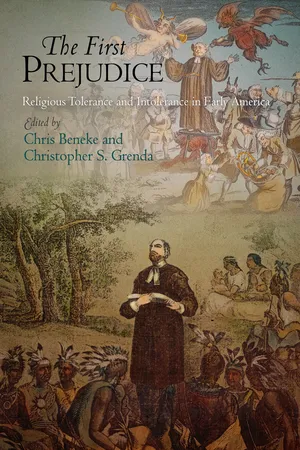
eBook - ePub
The First Prejudice
Religious Tolerance and Intolerance in Early America
- 408 pages
- English
- ePUB (mobile friendly)
- Available on iOS & Android
eBook - ePub
The First Prejudice
Religious Tolerance and Intolerance in Early America
About this book
Information
PART I
Ideologies of Tolerance and Intolerance in Early America
Chapter 1
Faith, Reason, and Enlightenment
The Cultural Sources of Toleration in Early America
The issue of religious toleration in early America is enormously complex. The essays in this volume highlight that complexity by revealing the range of ideas, social practices, and legal norms that determined the extent of toleration in early American society, both before and after the American Revolution. Yet even while considering this range, as well as the intolerance that preceded and survived the Revolution, one thing is clear: The idea of religious toleration was increasingly discussed in the burgeoning public sphere of the seventeenth- and eighteenth-century North Atlantic world of early America relative to earlier periods. The sheer volume of philosophical treatises, political pamphlets, and newspaper articles addressing toleration was far weightier in the seventeenth and eighteenth centuries than before. The defense and practice of religious intolerance certainly survived. At times, intolerance even thrived. Yet the impact of the discussions about religious toleration was felt in important ways. Apologists of intolerance increasingly found themselves on the defensive and sought to justify their views as never before. Thus by the mid-eighteenth century it was nearly impossible to write a comprehensive treatise of moral philosophy, the queen of the eighteenth-century social sciences, without addressing the issue of religious toleration, usually with approval. The discussion of the subject had simply become too prevalent for most commentators to avoid.
Although the discussions about religious toleration in the North Atlantic world of early America varied by time and place, they reflected persistent forms of reasoning across generations and boundaries. Thus even as contributors in various times and places addressed different contexts, their discussions contained patterned structures and processes of argumentation that were flexible and nuanced enough to fit those contexts and, as such, persisted over time, considerably forming the understandings and degrees of toleration throughout the period. Three such structures or forms of reasoning predominated. The first was a sacred form of reasoning. It started with biblical text and reasoned from key biblical concepts and passages to the conclusion that religious toleration was a divine directive and thus a requirement of the Christian faith. The second was a secular form of reasoning. It started with principles of utility and reasoned from the safety concerns of state or political society to the conclusion that toleration was necessary for the peace and stability of the polity. The third was an Enlightenment form of reasoning. It started with epistemology and reasoned most often from an empirical theory of knowledge to the conclusion that toleration was required by the nature of the human understanding.
None of these three forms of reasoning circumscribed the traditions of which they were a part. Biblical, reason-of-state, and Enlightenment thinking were all diverse phenomena comprised of various and often competing strains. These forms of reasoning, moreover, overlapped as few early modern writers, to cite one example, conceived of the state in strictly a-religious terms. Yet the three forms of reasoning were nonetheless distinct and informed the discussions about religious toleration in the seventeenth- and eighteenth-century North Atlantic world of early America. Whether contributors viewed biblical, reason-of-state, or Enlightenment reasoning as compatible or not, each privileged one form over the other and, very often, showed an awareness of doing so. The seventeenth-century English advocate of toleration Ralph Wallis, for example, privileged the sacred form of reasoning by redefining the safety concerns of secular writers in terms of biblical precept: “let’s all submit to Christ / Our Prophet, Priest, and King / It’s this t’ our Countrey, State and selves / In the end will safety bring.”1 The eighteenth-century Scottish sponsor of toleration David Hume, in turn, used epistemological terms to dismiss such religious argumentation as “altogether unaccountable, and seeming quite beyond the reach of our ordinary faculties.”2
Examining the reasoning processes of the early modern North Atlantic discussions about religious toleration is important for three reasons. First, it will reveal different and shifting understandings of toleration throughout the period, nuances not always appreciated in the historical literature and often masked by contemporaries’ use of ambiguous terms such as the word “toleration” itself and corollaries such as “liberty of conscience” and “natural rights.” Second, the examination will raise the following question about the American Revolution and Founding: To what extent were discussions of religious toleration and religious liberty at the Founding derivative discussions, dependent upon inherited forms of reasoning, and to what extent were they original discussions, generating original conceptions of religious liberty? This question—one of continuity and change—approaches the issue of religious toleration as a window through which to measure how transformative the American Revolution really was. It thus provides a fruitful point of scholarly comparison with other essays in this volume. Chris Beneke, in particular, sees the Revolution as fundamentally progressive in creating uniquely durable and universal forms of religious liberty, benefiting not just traditional Protestants, but Catholics, Jews, and upstart Protestant sects as much as others. Yet Christopher Grasso and Owen Stanwood are not so sure. They see more continuity than change in late eighteenth-century America in terms of a limited or inadequate toleration of non-Protestants and religious skeptics.
The examination of the early modern discussions of religious toleration sheds some light on this scholarly debate by suggesting a significant degree of continuity in late eighteenth-century America; the Revolutionary generation inherited the largely Protestant-derived arguments about religious toleration and religious liberty that they employed. Yet the examination also suggests important elements of change; the Revolutionary generation began a process approaching Beneke’s vision of a distinct turn toward religious liberty by implementing the inherited arguments in public policy to a degree previously unknown. The result was a distinct development in the codification of old ideas. Thus even as Revolutionary Americans added little substantive novelty to the debate about religious toleration and religious liberty, they nonetheless added the all-important procedural novelty of codification itself. As several authors in this volume wrestle with this question of continuity and change surrounding the American Revolution, it bears considering how their analyses relate to the larger interpretive question of identifying when American culture accommodated the rights of individualism and the pursuit of individual fulfillment as a basis for the American civil order. Analyses indicating significant religious change during the Revolution suggest locating that accommodation earlier in American history, namely the late eighteenth century, than analyses emphasizing religious continuity on either side of the Founding.3
Finally, the examination will address a theoretical issue regarding religion, providing a second point of scholarly comparison. This issue is the role of religiously informed social thought in the processes by which a culture transitions from religiously less tolerant to religiously more tolerant attitudes and habits. Despite continued intolerance, such a transition was certainly occurring in this period. The boundaries of religious toleration were wider at the close of the American Revolution than at the opening of the seventeenth century. Significantly, during this process, the sacred form of reasoning grounded in biblical text often provided the most robust understandings of religious toleration and a primary impetus for the move from religious toleration to religious liberty. The influence of religiously informed social thought—as the influence of all forms of social thought, sacred or secular—was not, of course, one-dimensional. As both Jon Corrigan and Susan Juster indicate in this volume, religious argumentation continued to inform theories and practices of religious intolerance throughout the period. And as many scholars have noted elsewhere, secular and Enlightenment forms of reasoning were no doubt important in the development of religious toleration. These facts constitute important features of the early modern era. Absorbing them, however, should not distort the equally compelling reality that many early modern sectarians immersed in and armed with religious argumentation were often at the forefront of the discussions concerning religious toleration and religious liberty, not only in terms of their numbers, but also in terms of their theoretical contributions. Parts of this story have been told before, as in William McLoughlin’s magisterial work on late eighteenth-century New England Baptists.4 Yet a wider geographical and chronological perspective is needed. And this longue durée curiously suggests that transitions to broader religious toleration and developments in religious liberty can be compatible with the extensive engagement of religion and public culture in an increasingly open and accessible public sphere.
The Seventeenth Century
The seventeenth-century North Atlantic world was rife with religious intolerance. National laws of religious uniformity, state-sanctioned persecutions for religious dissent, and acts of religiously inspired violence littered the century’s cultural landscape. Religious conflicts fueled Europe’s Thirty Years’ War (1618–48) between Catholics and Protestants, and the English civil wars (1642–49) among Protestant sects. Such intolerance and conflict inspired the western world’s first sustained discussions of religious toleration. The most vocal proponents of toleration in the early century period were sectarians who, in dissenting from state churches, founded Baptist congregations in Amsterdam and secret Baptist gatherings in London. They included John Smyth, Thomas Helwys, Leonard Busher, and John Murton.5 Such Baptists found early seventeenth-century England inhospitable because the English state made dissent from the Protestant Episcopal Church of England illegal; required subjects to pay religious taxes to support the national or established church; and required membership in its Episcopal Church as a prerequisite for holding public office. State and church leaders also tightly controlled the press and the formation of public opinion through a strict licensing system for publications.
In this context of religious intolerance—persecuting dissenters from an established church, religiously taxing them, and restricting their access to public office and publication—Thomas Helwys wrote A Short Declaration of the Mistery of Iniquity (1612) and forwarded a copy to the king of England, James Stuart.6 Helwys opposed such intolerance by quoting 2 Corinthians 10:4 in which the Apostle Paul explained, “the weapons of our warfare are not worldly but have divine power to destroy strongholds.” Many sectarians dissenting from state or established churches viewed this biblical text as a foundation for the “two swords” and “two kingdoms” doctrines from which they reasoned for religious toleration. According to these doctrines, God had created an earthly kingdom with a carnal sword, which was the state’s penal power to punish criminal offenders. The state thus possessed jurisdiction over the “outward things” of the subjects’ bodies, goods, and behavior. God had also, according to these doctrines, created a heavenly kingdom with a spiritual sword, which was the power of God’s Word in the act of persuasion. This power possessed jurisdiction over the “inward things” of the subjects’ understandings, wills, and consciences. As Helwys explained, “God hath given unto the K[ing] an earthly kingdome”7 with “all worldly power which tendeth to all the goods and bodies of his servants.”8 Yet “the God of Gods, and lord of Lords . . . hath reserved to himself a heavenly kindgome . . . & that with this [heavenly] kindgome, our lord the King hath nothing to do (by his kingly power) but as a subject himself: and that Christ is King alone.”9 The objects of Christ’s kingdom were the inward things of the human mind,10 which were subject only to the persuasion or illumination of the “spiritual swerd of the Lambe, which is the word of God.”11 Upon these sectarian principles, Helwys built a broad theory of religious toleration, which included Christians and non-Christians: “Let them be heretikes, Turks, Jewes, or whatsoever, it appertaynes not to the earthly power to punish them in the least measure.”12 He also included Catholics13 because, as he noted, “men should chuse their religion themselves.”14
Helwys’s understanding of those who would qualify for religious toleration—the scope of his proposed toleration—was quite broad. Yet his understanding of what religious toleration meant—his theory of toleration—was relatively narrow. Helwys believed that Protestant sectarians, heretics, Turks, Jews, Catholics, and others should have the right to worship without suffering legal penalty by the state’s carnal sword.15 Penalties for religious dissent assumed many forms in the seventeenth century such as fines, arrest, confiscation of property, or banishment. Other forms of legal penalty for religion included religious taxation to support an established church, religious tests for public office, and exclusion from the public sphere. Because Helwys did not address these other forms of penalty, his discussion of toleration focused on the right to worship without the persecution of fines, arrest, confiscation, or banishment. In this, he offered a broad toleration, which included many groups, but a theoretically narrow toleration, which only sought the right to worship, not freedom from established churches, from religious taxes, or from religious restrictions on public office and the public sphere.16
Helwys’s sectarian colleague Leonard Busher developed sacred reasoning into a more expansive theory of religious toleration in A Plea for Liberty of Conscience (1614), presented “to King James, and the High Court of Parliament then sitting.”17 Busher repeated Helwys’s proposal for a broad toleration—“Christians; yea, Jews, Turks, and pagans”18—by also citing 2 Corinthians 10:4. He then added Hebrews 4:12, wherein the Apostle states, “the word of...
Table of contents
- Cover
- Half title
- Title
- Copyright
- Contents
- Introduction
- Part I Ideologies of Tolerance and Intolerance in Early America
- Part II Practices of Tolerance and Intolerance in Colonial British America
- Part III The Boundaries of Tolerance and Intolerance in Early America
- Part IV The Persistence of Tolerance and Intolerance in the New Nation
- Notes
- List of Contributors
- Index
Trusted by 375,005 students
Access to over 1.5 million titles for a fair monthly price.
Study more efficiently using our study tools.
Frequently asked questions
Yes, you can cancel anytime from the Subscription tab in your account settings on the Perlego website. Your subscription will stay active until the end of your current billing period. Learn how to cancel your subscription
No, books cannot be downloaded as external files, such as PDFs, for use outside of Perlego. However, you can download books within the Perlego app for offline reading on mobile or tablet. Learn how to download books offline
Perlego offers two plans: Essential and Complete
- Essential is ideal for learners and professionals who enjoy exploring a wide range of subjects. Access the Essential Library with 800,000+ trusted titles and best-sellers across business, personal growth, and the humanities. Includes unlimited reading time and Standard Read Aloud voice.
- Complete: Perfect for advanced learners and researchers needing full, unrestricted access. Unlock 1.5M+ books across hundreds of subjects, including academic and specialized titles. The Complete Plan also includes advanced features like Premium Read Aloud and Research Assistant.
We are an online textbook subscription service, where you can get access to an entire online library for less than the price of a single book per month. With over 1.5 million books across 990+ topics, we’ve got you covered! Learn about our mission
Look out for the read-aloud symbol on your next book to see if you can listen to it. The read-aloud tool reads text aloud for you, highlighting the text as it is being read. You can pause it, speed it up and slow it down. Learn more about Read Aloud
Yes! You can use the Perlego app on both iOS and Android devices to read anytime, anywhere — even offline. Perfect for commutes or when you’re on the go.
Please note we cannot support devices running on iOS 13 and Android 7 or earlier. Learn more about using the app
Please note we cannot support devices running on iOS 13 and Android 7 or earlier. Learn more about using the app
Yes, you can access The First Prejudice by Chris Beneke, Christopher S. Grenda, Chris Beneke,Christopher S. Grenda in PDF and/or ePUB format, as well as other popular books in History & Early American History. We have over 1.5 million books available in our catalogue for you to explore.