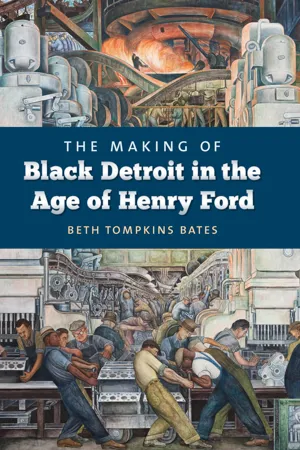
In the 1920s, Henry Ford hired thousands of African American men for his open-shop system of auto manufacturing. This move was a rejection of the notion that better jobs were for white men only. In The Making of Black Detroit in the Age of Henry Ford, Beth Tompkins Bates explains how black Detroiters, newly arrived from the South, seized the economic opportunities offered by Ford in the hope of gaining greater economic security. As these workers came to realize that Ford’s anti-union “American Plan” did not allow them full access to the American Dream, their loyalty eroded, and they sought empowerment by pursuing a broad activist agenda. This, in turn, led them to play a pivotal role in the United Auto Workers' challenge to Ford’s interests.
In order to fully understand this complex shift, Bates traces allegiances among Detroit’s African American community as reflected in its opposition to the Ku Klux Klan, challenges to unfair housing practices, and demands for increased and effective political participation. This groundbreaking history demonstrates how by World War II Henry Ford and his company had helped kindle the civil rights movement in Detroit without intending to do so.
- 360 pages
- English
- ePUB (mobile friendly)
- Available on iOS & Android
eBook - ePub
The Making of Black Detroit in the Age of Henry Ford
About this book
Information
Chapter One
With the Wind at Their Backs
Migration to Detroit
With ever watchful eyes and bearing scars, visible and invisible, I headed North, full of a hazy notion that life could be lived with dignity.
—Richard Wright, Black Boy
Early in the twentieth century, the social, economic, and political landscape of Detroit was dramatically transformed as the automotive industry turned this medium-sized city, known for its peace and beauty, into a whirlwind of activity. The siren of new Detroit was “motion . . . the motion of . . . life and energy and unceasing prosperity.” People were drawn to the city, it was said, because it was known as “a land flowing with milk and honey and opportunity.”1 What had been a moderately diversified manufacturing center in 1900 was, by 1920, the urban area most committed to manufacturing in the nation, driven increasingly by one industry. By 1919, the automobile industry employed 45.4 percent of the manufacturing workforce, a pattern that continued for decades, making Detroit more specialized in motor vehicle manufacturing by 1940 than Pittsburgh was in iron and steel or Washington, D.C., was in government. Detroit placed fourth in the nation in terms of dollar value of manufactured goods in 1916, moving to third, after New York and Chicago, in the early 1920s.2 The hub of this wheel of fortune was the Ford Motor Company (FMC). In 1915 the company marketed four times as many cars as its closest competitor, Willys-Overland.3
The new automotive industry required enormous numbers of workers, boosting Detroit’s population ranking from thirteenth in the nation in 1900 to fourth in 1920, with 1,165,153 people in the metropolitan area. Growth was the result of both internal and foreign migration. Newcomers came from American farms, mines, lumber camps, the rural South, and an increasing number of different countries. Although the percentage of foreign-born Detroiters had been decreasing since the 1900s, the diversity of countries represented in the migration flow increased between 1900 and 1920. Poland was the birthplace of the single largest group of foreign-born Detroiters in 1920 (19.6 percent); Canadians were second (19.1 percent). Germans, Russians, Britons, Austrians, Italians, and Hungarians contributed smaller but significant proportions. When World War I cut off nearly all foreign-born immigration, the demographics shifted as the migration of southerners, especially blacks, increased several fold beginning in 1916.4
Detroit’s black population increased 611.3 percent—from 5,741 in 1910 to 40,838 in 1920—the most rapid growth for any large city and three times faster than the average for other metropolitan areas. The greatest swell in black migration occurred between 1916 and 1920, as industrialists sought a new group of workers to fill positions previously held by immigrants.5 Forrester B. Washington, the first administrator of the Detroit Urban League (DUL), recorded “1,000 Negroes a month . . . arriving in the city” during May, June, and July of 1917. He estimated that by 1920 the figure was over 1,000 a week. The postwar economic downturn did little to stem the flow, and the black population doubled again between 1920 and 1925 to 81,000, with an estimated 15,000 new residents arriving in 1923 alone. By 1930, the 120,000 black Detroiters accounted for nearly 8 percent of the city’s population, up from 1 percent in 1910, or a 2,000 percent increase in African Americans since 1910.6
Coleman A. Young, Detroit’s first black mayor (elected in 1974), and his family were among the 15,000 African Americans arriving in 1923. The Young family, like many others who moved to Detroit, came from Alabama, traveling, most likely, on a one-way ticket. The northern destination was determined by the placement of the rail lines as well as job possibilities. For that reason, the majority of black Detroiters traveled from rural areas and towns in Alabama, Mississippi, Tennessee, Georgia, South Carolina, and Florida.7 The decision to migrate was usually made after years of frustration with the South’s racial restrictions.8 Young described the Great Migration as not so much an orchestrated, collective movement as a “cataclysm of personal watersheds.”9 The migration process represented, he recalled, “the accumulation of generations of social degradation and economic despair, of lynchings and whippings and fires and rages, of second-class citizenship and third-world living conditions . . . of ruthless planters cheating their sharecroppers at the autumn settlement . . . of mud floors, of trampled spirits.”10
Nationally, the pool of migrants came largely from the first generation of black southerners to grow up free from the shackles of slavery. Yearning for the chance to realize the promise of Emancipation, they were most impatient with the restoration of the old order of white supremacy in the post-Reconstruction South.11 Asa Philip Randolph, who at the age of twenty-two migrated to Harlem on the eve of World War I, believed that actual emancipation could no longer be denied, that it was time to complete “the unfinished task of emancipation.”12 Despite the nation’s retreat from the hopes raised by Emancipation and Reconstruction, a political culture, grounded in self-determination and independence from white control, took hold in the latter part of the nineteenth century beyond the surveillance of whites within black communities across the South.13 By 1916, as James R. Grossman observes, the new generation turned to “industry, to the city, and to the North for access to the perquisites of American citizenship.”14
Coleman Young’s recollections corroborated data collected for a 1920 survey by Forrester Washington, director of the Detroit Urban League, who looked explicitly at why African Americans decided to migrate to Detroit. Using only black investigators, Washington limited his study to heads of black families who had recently migrated and were living in Detroit. When families were asked why they left home, the overwhelming majority cited social factors. Within the category of “social factors,” 73 percent noted “unbearable conditions,” and another 17 percent cited “oppression.” Of the 190 heads of families surveyed, 148 stated that social reasons caused them to leave.15 Nevertheless, more is needed to understand the Great Migration; inhumane treatment was not new.
Unprecedented opportunity for industrial employment, which opened up with World War I, was new. As the United States closed the door to European immigration, industries geared up to supply the war effort, creating a critical shortage of workers in the North. The labor crisis, in turn, opened the door to economic opportunities for African Americans in meatpacking plants, steel mills, and the foundries of the automotive industry, all areas where industrialists had traditionally employed European immigrants. From an all-time high of 1,218,480 in 1914, total immigration fell to 110,618 in 1918, more than a 90 percent drop.16 Northern industrialists took a sudden interest in African Americans, sending labor agents to entice black workers to leave the South. Some 400,000 blacks left the South between 1910 and 1920, followed by close to a million more in the twenties, almost all of them heading for the large cities and industrial centers of the Northeast and Midwest, areas rich with economic opportunity.17
Both “push” and “pull” factors galvanized the refugees fleeing southern oppression, seeking increased wages, better educational opportunities, voting rights, escape from violence, and a chance to participate as equals in society.18 Writing in the Negro Year Book (1918–19), sociologist Monroe N. Work noted that no event since “Emancipation” had “so profoundly influenced the economic and social life of the Negro.” If the “Thirteenth Amendment granted physical emancipation, the conditions brought about by World War I made for the economic emancipation of the Negro,” because the war had made it possible for the first time to find “employment along a great many lines, many of which had hitherto [been] closed entirely to him.” Many referred to their escape from the South in terms of the “Second Emancipation.”19 The impulse connecting the Great Migration to Emancipation was reinforced as the nation mobilized for World War I under the rubric of making the world safe for democracy. African Americans amended the patriotic call, emphasizing the need to “fight for citizenship at home” as well as across the sea.20 The ethos unleashed by the war lived on in the hearts and minds of African Americans and fueled the hope that World War I would mark a significant turning point in the black freedom struggle. However southern blacks may have expressed their reasons for migrating, their aim was to secure independence from the oppressive social relations that structured life in the Jim Crow South and to pursue the chance to begin life anew in the North.21
Coleman Young’s family had to leave Alabama because his father had “used up his southern options,” a reference to his “bad” attitude, demonstrated by selling and circulating prominent black newspapers—the Pittsburgh Courier and the Chicago Defender. When Young’s father was advised by a white friend to leave, the family wasted little time packing their bags for Detroit.22 Social reasons also drove the family of David William Lamar Moore—a future leader in the labor movement in Detroit—from their home in Beech Island, South Carolina, in 1923. Though his father was a locomotive fireman, a position coveted by black men, Moore’s family left abruptly to escape Jim Crow sanctions after Moore befriended a young white girl from an elite family in the neighboring town of Aiken, a clear breach of socially acceptable behavior. Moore, who was eleven at the time, remembered fleeing during the dark of night to catch a train in Atlanta that took his family to Columbus, Ohio, where they had relatives. After a few years in Ohio, the family moved to Detroit in 1927, drawn by the hope of working at the FMC.23
C. J. Young (no relation to Coleman Young), from Port Arthur, Texas, told the Detroit League on Urban Conditions Among Negroes in 1917 that he had wanted to go North in order to “make a ‘man’ of himself.” An Alabama resident connected the terror of a recent local lynching with his desire to leave. Another Alabamian attributed his desire to migrate to the fact that he was “counted no more thin a dog” where he lived. A Georgian, in his forties, said he was trying “to make an honest living and all of it seems to be a failure.” He heard that better treatment and higher wages could be found up North. A resident of Sanford, Florida, wanted to go to another part of the country where he could “better my condishion” while “beaing asshured some protection as a good citizen under the Stars and Stripes.”24
Skilled and educated along with uneducated agricultural and manual laborers were subject to a southern racial code designed to diminish the humanity and independence of blacks. The successful were debased and humiliated by a system that locked them into a dangerous paradox: the more African Americans succeeded in pulling themselves up by their bootstraps, the greater the chance white supremacists would attack them for being uppity. Ida B. Wells-Barnett identified the conundrum when she exposed the lynching of three successful black businessmen in Memphis, Tennessee, in 1892. They were, as Wells-Barnett argued, lynched for the crime ...
Table of contents
- Cover Page
- Copyright
- Contents
- Illustrations
- Acknowledgments
- Abbreviations
- Introduction
- 1: With the Wind at Their Backs
- 2: Henry Ford Ushers in a New Era for Black Workers
- 3: The Politics of Inclusion and the Construction of a New Detroit
- 4: Drawing the Color Line in Housing, 1915–1930
- 5: The Politics of Unemployment in Depression-Era Detroit, 1927–1931
- 6: Henry Ford at a Crossroads
- 7: Behind the Mask of Civility
- 8: Charting a New Course for Black Workers
- 9: Black Workers Change Tactics, 1937–1941
- Epilogue
- Notes
- Bibliography
- Index
Trusted by 375,005 students
Access to over 1.5 million titles for a fair monthly price.
Study more efficiently using our study tools.
Frequently asked questions
Yes, you can cancel anytime from the Subscription tab in your account settings on the Perlego website. Your subscription will stay active until the end of your current billing period. Learn how to cancel your subscription
No, books cannot be downloaded as external files, such as PDFs, for use outside of Perlego. However, you can download books within the Perlego app for offline reading on mobile or tablet. Learn how to download books offline
Perlego offers two plans: Essential and Complete
- Essential is ideal for learners and professionals who enjoy exploring a wide range of subjects. Access the Essential Library with 800,000+ trusted titles and best-sellers across business, personal growth, and the humanities. Includes unlimited reading time and Standard Read Aloud voice.
- Complete: Perfect for advanced learners and researchers needing full, unrestricted access. Unlock 1.5M+ books across hundreds of subjects, including academic and specialized titles. The Complete Plan also includes advanced features like Premium Read Aloud and Research Assistant.
We are an online textbook subscription service, where you can get access to an entire online library for less than the price of a single book per month. With over 1.5 million books across 990+ topics, we’ve got you covered! Learn about our mission
Look out for the read-aloud symbol on your next book to see if you can listen to it. The read-aloud tool reads text aloud for you, highlighting the text as it is being read. You can pause it, speed it up and slow it down. Learn more about Read Aloud
Yes! You can use the Perlego app on both iOS and Android devices to read anytime, anywhere — even offline. Perfect for commutes or when you’re on the go.
Please note we cannot support devices running on iOS 13 and Android 7 or earlier. Learn more about using the app
Please note we cannot support devices running on iOS 13 and Android 7 or earlier. Learn more about using the app
Yes, you can access The Making of Black Detroit in the Age of Henry Ford by Beth Tompkins Bates in PDF and/or ePUB format, as well as other popular books in Social Sciences & Automobile Industry. We have over 1.5 million books available in our catalogue for you to explore.