Challenging assumptions about the separation of high politics and everyday life, Belinda Davis uncovers the important influence of the broad civilian populace — particularly poorer women — on German domestic and even military policy during World War I.
As Britain’s wartime blockade of goods to Central Europe increasingly squeezed the German food supply, public protests led by “women of little means” broke out in the streets of Berlin and other German cities. These “street scenes” riveted public attention and drew urban populations together across class lines to make formidable, apparently unified demands on the German state. Imperial authorities responded in unprecedented fashion in the interests of beleaguered consumers, interceding actively in food distribution and production. But officials' actions were far more effective in legitimating popular demands than in defending the state’s right to rule. In the end, says Davis, this dynamic fundamentally reformulated relations between state and society and contributed to the state’s downfall in 1918. Shedding new light on the Wilhelmine government, German subjects' role as political actors, and the influence of the war on the home front on the Weimar state and society, Home Fires Burning helps rewrite the political history of World War I Germany.
eBook - ePub
Home Fires Burning
Food, Politics, and Everyday Life in World War I Berlin
- 368 pages
- English
- ePUB (mobile friendly)
- Available on iOS & Android
eBook - ePub
About this book
Information
Topic
HistoireSubtopic
Histoire de l'Allemagne1 GERMANY FROM PEACE TO WAR
Germany entered the war in 1914 a country in which rapid industrialization and urbanization had helped to produce a polarized society, often discontented and anomic, a nation that inspired both great pride and a gnawing sense of inadequacy among its subjects. Germany boasted a booming commercial sector and unequaled consumer offerings coupled with inflation, reliance on imports, new strains on small shops, and a perceived distancing between merchant and customer. In the years before the war, the young nation experienced the power of mass politics and the rise of extremist pressures on politics. In this mix, people formulated notions of what it meant to be German. Such notions made war appealing to some. In turn, the war experience drew on and transformed these notions.
WILHELMINE STATE AND SOCIETY
Throughout 1890 to 1918, Wilhelmine officials sought to rule by coalition, buttressing the leadership of the Conservative and National Liberal Parties with, variously, Center and Free Liberal Party support while attempting to stave off the growing influence of the Social Democratic Party (Sozialdemokratische Partei Deutschlands, or SPD). As historians have often characterized Wilhelmine rule, its leaders offered reforms from above to quash populist challenges and nourished popular societal divisions to create inner enemies, segments of the population whose true Germanness was cast in doubt. Yet Wilhelmine leaders were from the outset sensitive to popular desires and demands, contradictory as they were, and often conceded to them in some fashion. The state attempted to diminish its susceptibility to popular influences at the outbreak of war, a war fought in part in deference to such forces.1 Officials invoked the Prussian Law of Siege, instituting new chains of command, intensifying restrictions in public expression and public assembly, and permitting more general militarization of civil society. Despite such measures, the Wilhelmine government grew increasingly vulnerable to the popular mood in the course of the war, in part as a consequences of its own strategies.
The structure of the German political hierarchy bred crossed jurisdictions and considerable resentment between imperial and Prussian authorities, between the executive and legislative branches, between civilian and military officials, and between state and locality. Rancorous conflicts among the parties, the Prussian ministries, and the states contributed to the discord. Powerful extragovernmental interest groups offered a chorus of opinions on government policy, including representatives of heavy industry and large-scale agriculture.2 The conflicts of these multiple interests were intensified at the outbreak of war, as state-level and other subordinate offices were put under dual civilian and military authority. Prussian dominance was built into the governing structures. Prussian ministries overpowered imperial-level offices. The structure of the Bundesrat (federal council), the supreme imperial organ, guaranteed Prussia’s dominance over imperial politics and left relatively little authority to the popularly elected Reichstag. Prussia’s own franchise was the narrowest in the empire, despite ongoing prewar campaigns for reform, constituting the infamous “three-class vote,” through which the will of 90 percent of the population was expressed in the lowest of the three classes.3
Universal manhood suffrage for Reichstag elections nonetheless made the SPD the lead vote getter in the 1912 elections, despite executive efforts to suppress the party’s appeal.4 The SPD’s electoral success is traceable to numerous factors, including its rapprochement with trade union reformism and integration into the Wilhelmine system, and its record in providing a range of services and opportunities to its membership.5 Central among these factors was the party’s role in opposing Free Conservative Chancellor Theobald von Bethmann Hollweg’s 1911 tariffs, new indirect taxes, and other measures that promoted the ongoing inflation.6 Consumer interests were central in the coalition of Free Liberals and Social Democrats in the prewar battles against protective agricultural tariffs. This must also account in part for the SPD’s major electoral wins in 1903 and relate to Chancellor Bernhard von Bülow’s defeat in 1909. These electoral results might seem to indicate both a functioning mass politics in Germany (if at limited levels and without the formal participation of women) and the legitimacy of the Wilhelmine system, broadly speaking. Yet polarization and divisiveness marked both Wilhelmine politics and society. Bloc politics fell apart in the last decade before the war, while the state’s fiscal condition weakened.
These new divisions reflected prevailing controversies over who and what was German. By the 1890s, many Germans asserted new, biologically rooted notions of nationality; increasingly, unmitigated devotion to the state was insufficient to mark one’s Germanness. It was in this period that Jews joined Social Democrats in the minds of many as non-German and as potential or actual enemies of the nation.7 Some Germans espoused the notion of a “community of the people” (Volksgemeinschaft) in this period, though during the war this idea solidified into a broadly compelling notion of popular sovereignty.8 Germanness meant living the culture too, through ritual and material objects, even as that culture was transformed in this period of great social flux. Living the culture remained highly relevant in war, as Berliners and others contested issues of “eating German” and transacting business in “German” fashion.
For most Wilhelmine Germans, including most in positions of power, the nation was located in the state. As such, German subjects held few real entitlements. Turning points such as passage of the Civil Code in 1896 and the 1913 Citizenship Reform Act attended little to new rights for German citizens or expansion of citizenship within the empire.9 Otto von Bismarck’s well-known “social insurance” of the 1880s was pathbreaking in its provision of health insurance, worker’s compensation, and pension benefits for (male) workers. But these programs clearly maintained traditional relations of authority; moreover, they placed the primary obligation on communal officials. Only the churches, private charities, and communal governments offered poor relief, in the form of haphazard aid that stigmatized and marginalized its recipients.10 As consumers rather than producers, Germans received nothing from the state; it was Germans’ responsibility to serve rather than to be served.
Despite interest in the idea of a community of the people, divisions among social classes and other cleavages deepened in the years before the war. The urgent questions concerning rising food prices and economic distress more generally contributed to these rifts. Working-class Berliners protested that they could ill afford wheat and meat products, part of the modern, urban diet.11 Social Democrats in the Reichstag were unable to reverse the new fiscal policies despite their majority status in 1912. National Liberal and Conservative leaders looked increasingly to the powers of war to unify Germans and distract them from such domestic discontents.12
The greater German population began to accept the idea of an imminent war in the years before hostilities. For some the international conflagrations in Asia, in Morocco, and in the Balkans in the years before the war exposed the nation’s need to prove itself militarily.13 For others, war represented a cathartic cleansing of the nation and the victory of a hard, male, German culture over the soft, degenerate Western civilization into which the nation had sunk.14 Many came to support the idea of a defensive, even preventative, war fought on one’s own terms, though the majority of the population seems to have experienced ambivalent and even negative feelings about a looming confrontation.15
The question of food supply and inflation was also relevant to any move to hostilities. From 1905 Germans heard rumors that if Britain entered the war, it planned to exercise a full economic blockade on goods into Germany. Germany depended on imports to feed its population of 67 million.16 A key German war aim was to open new markets, over which it would have control.17 Thus, military planners wanted least of all to instigate Britain’s entry into the war or to fight a long war. In 1911 imperial officials charged a special committee to organize for domestic consumer needs, coincident with the arrangements for requisite military raw materials. While the latter flourished at some level at least, members dissolved the former committee in 1913, laying their hopes on military strategists’ plans for a brief war and determining to concentrate efforts instead on domestic propaganda.18 Formal political control, military pressures, popular politics, and the availability and affordability of food remained in conflict and provided a springboard to domestic political crisis in the war years that followed.
POLICE AND OTHER “INTERMEDIARIES” BETWEEN STATE AND SOCIETY
Policing developed alongside the state in Europe, providing security, maintaining order, and protecting the state from danger—especially revolutionary danger.19 Police had long protected the citadel of Prussian power and ensured Prussia’s monopoly over power and violence throughout the nineteenth century.20 In the course of the 1890s the police in Prussia (as elsewhere in Germany) underwent professionalization and, in principle, both demilitarization and reform of their habit of physical violence.21 But professionalization accompanied a “policecization” of society: the growth of the police, both in numbers and in spheres of influence.22 And, in practice, the physical violence continued as officials’ fear of “enemies” to the unified empire intensified in the wake of urbanization, industrialization, and the growth of the SPD.23
Protector of state and empire, the Berlin police commission was the largest and most politically powerful in the country. The police commissioner held unique direct relations with Prussian and even imperial authorities. The position was directly subordinate to the powerful Prussian interior minister. The commissioner acted simultaneously as the president of the district of Berlin, giving him considerable control over municipal politics. Thus, the Berlin police force mediated directly between the edifice of the state and the broad population of Germans. These connections were strengthened, expanded, and explicitly militarized at the outset of the war, as Kaiser Wilhelm II made the police commissioner directly subordinate to the military high commander in the marches. The Berlin police commissioner reigned over an expanding hierarchy of forces. As war commenced this included 177 officers, 460 police sergeants, and 5,559 patrolmen.24 This hierarchy included a political police force (other large cities also boasted such forces), operating under an impressively wide definition of what constituted the political.25 Until the outbreak of war, plainclothes political police spent much of their time at Social Democratic and other suspect political assemblies.26
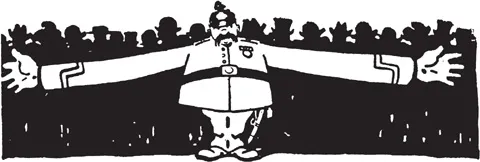
Caricature of Berlin policeman in Wilhelmine Germany. The policeman protects the state and nation from the masses. (Karl Dietz Verlag)
Regular patrolmen also closely monitored activities of the German working class in capital streets and neighborhoods; Berliners fashioned jingles about policemen’s irritating ubiquity. Patrolmen carried sabers and guns and, from 1898, were charge...
Table of contents
- Cover Page
- Home Fires Burning
- Copyright Page
- Dedication
- CONTENTS
- ILLUSTRATIONS
- MAPS AND FIGURES
- ACKNOWLEDGMENTS
- INTRODUCTION
- 1 GERMANY FROM PEACE TO WAR
- 2 BREAD, CAKE, AND JUST DESERTS
- 3 WOMEN OF LESSER MEANS
- 4 BATTLES OVER BUTTER
- 5 ONE VIEW OF HOW POLITICS WORKED IN WORLD WAR I BERLIN
- 6 A FOOD DICTATORSHIP
- 7 SOUP, STEW, AND EATING GERMAN
- 8 FOOD FOR THE WEAK, FOOD FOR THE STRONG
- 9 THE END OF FAITH
- 10 GERMANY FROM WAR TO PEACE?
- CONCLUSION
- NOTES
- BIBLIOGRAPHY
- INDEX
Trusted by 375,005 students
Access to over 1.5 million titles for a fair monthly price.
Study more efficiently using our study tools.
Frequently asked questions
Yes, you can cancel anytime from the Subscription tab in your account settings on the Perlego website. Your subscription will stay active until the end of your current billing period. Learn how to cancel your subscription
No, books cannot be downloaded as external files, such as PDFs, for use outside of Perlego. However, you can download books within the Perlego app for offline reading on mobile or tablet. Learn how to download books offline
Perlego offers two plans: Essential and Complete
- Essential is ideal for learners and professionals who enjoy exploring a wide range of subjects. Access the Essential Library with 800,000+ trusted titles and best-sellers across business, personal growth, and the humanities. Includes unlimited reading time and Standard Read Aloud voice.
- Complete: Perfect for advanced learners and researchers needing full, unrestricted access. Unlock 1.5M+ books across hundreds of subjects, including academic and specialized titles. The Complete Plan also includes advanced features like Premium Read Aloud and Research Assistant.
We are an online textbook subscription service, where you can get access to an entire online library for less than the price of a single book per month. With over 1.5 million books across 990+ topics, we’ve got you covered! Learn about our mission
Look out for the read-aloud symbol on your next book to see if you can listen to it. The read-aloud tool reads text aloud for you, highlighting the text as it is being read. You can pause it, speed it up and slow it down. Learn more about Read Aloud
Yes! You can use the Perlego app on both iOS and Android devices to read anytime, anywhere — even offline. Perfect for commutes or when you’re on the go.
Please note we cannot support devices running on iOS 13 and Android 7 or earlier. Learn more about using the app
Please note we cannot support devices running on iOS 13 and Android 7 or earlier. Learn more about using the app
Yes, you can access Home Fires Burning by Belinda J. Davis in PDF and/or ePUB format, as well as other popular books in Histoire & Histoire de l'Allemagne. We have over 1.5 million books available in our catalogue for you to explore.