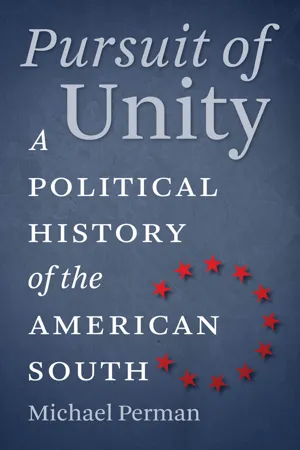
In Pursuit of Unity, Michael Perman presents a comprehensive analysis of the South’s political history. In the 1800s, the region endured almost continuous political crisis — nullification, secession, Reconstruction, the Populist revolt, and disfranchisement. For most of the twentieth century, the region was dominated by a one-party system, the “Solid South,” that ensured both political unity internally and political influence in Washington. But in both centuries, the South suffered from the noncompetitive, one-party politics that differentiated it from the rest of the country. Since the passage of the Voting Rights Act in 1965, Perman argues, the South’s political distinctiveness has come to an end, as has its pursuit of unity.
- 408 pages
- English
- ePUB (mobile friendly)
- Available on iOS & Android
eBook - ePub
About this book
Information
PART I.
ONE-PARTY DOMINANCE, 1800–1861
1
A One-Party South
REPUBLICAN ASCENDANCY
The presidential election of 1800 brought the ten-year-old American republic to the brink of disaster. The vote in the Electoral College was tied, with the two leading candidates each obtaining 73 votes. According to the Constitution, which had been adopted twelve years earlier, this meant that the House of Representatives was now required to resolve the matter. But the House found this task very difficult to accomplish. It spent an entire week of bargaining and scheming until, after thirty-five ballots, it finally produced a winner. This second, or “contingent,” election, as it was then called, was further complicated by the unfortunate fact that the two rival candidates were from the same party. The decision as to which of the two Republicans, Thomas Jefferson or Aaron Burr, would become president lay therefore in the hands of their opponents, the Federalists. When the Federalists eventually decided to end their unsuccessful efforts in support of Burr and to switch most of their votes to Jefferson, the Virginian became the third president, thanks to the hated Federalists.
This closely contested election, with the Federalist, John Adams, receiving just eight votes fewer than the two tied Republicans, produced an electoral deadlock, which then precipitated a constitutional crisis. Such a dangerous state of affairs had arisen because the new Constitution’s provisions for choosing a president and a vice president had proven unworkable. Electors had each been given two votes, the “dual vote” as it was called, but they were not allowed to rank them. Yet, with the emergence of political parties in the 1790s, it was essential that the vice president be not just the second-largest vote getter but also a member of the winner’s party. This problem had already become evident in 1796 when John Adams, the Federalist, was elected president and the runner-up, Jefferson, the preeminent Republican, was elected vice president. Since this anomaly was not remedied by the time the next election took place, the federal system stumbled through an electoral process that proved to be prolonged, frustrating, and almost disastrous.
Despite all these shortcomings, the contest in 1800 was one of the pivotal presidential elections in American history. And it was decisive because its consequences transformed the political landscape. In 1804, at the end of Jefferson’s first term, the Federalist Party suffered a massive defeat, winning just 14 votes in the Electoral College to the Republicans’ 162. The Federalists revived somewhat in Jefferson’s second term and in Madison’s first, when the ill-conceived Embargo and commercial retaliation against Britain over its interference with American shipping gave the Federalists a political opportunity. But even so, Charles C. Pinckney, of South Carolina, the party’s presidential candidate in 1808, could only expand the Federalist electoral vote to 47. And by 1812, the Federalists were reduced to running DeWitt Clinton, a dissident Republican from New York, for president. Four years later, after it had opposed the war with Britain, the party was dead. Its presidential nominee in 1816, Rufus King, received a mere 34 electoral votes to James Monroe’s 183, almost all of them coming from Massachusetts, the state where King had spent his childhood. Once the center of Federalism, Massachusetts was now its one remaining outpost.
The Republicans in Power
The rapid decline of the Federalists after the close contest of 1800 and their disappearance as an effective political force sixteen years later meant that the Republicans had attained dominance. In fact, they had become preeminent and were no longer confronted by any organized party opposition. For the South, this was a moment of triumph that it has never again experienced in its history. For the Republican Party was a southern party, and so was its leadership. Jefferson, Madison, and Monroe, all southerners, held the presidency from 1800 until 1824. More than that, they were neighbors living close to each other on their plantations in the foothills of central Virginia. As the rest of the country became increasingly Republican after 1800, it came to resemble the South, which had been solidly Republican even before that critical election. Throughout this quarter century, therefore, the party that dominated the South dominated the nation. The South was in the enviable position of being the majority within the majority party.
The core constituency of the Republicans was located in the South. In the election of 1796, when the newly emerging political parties were first in evidence in a presidential contest, John Adams obtained just two electoral votes in the southern states of Virginia, North Carolina, South Carolina, and Georgia, as well as in the recently admitted states of Kentucky and Tennessee. Meanwhile, Thomas Jefferson received not a single vote north of Pennsylvania. And the picture was almost as bleak for the Federalists in the South’s congressional delegations and state assemblies. Between 1790 and 1797, the Federalists sent, on average, just five congressmen from the seaboard southern states of Virginia, the Carolinas, and Georgia, out of a possible total of around thirty-five.
But in the congressional elections of 1798–99, the Federalists managed to cut into the Republicans’ southern stronghold by winning a dozen seats from their opponents. The war scare of that year and a concerted effort by Alexander Hamilton, aided by the former president from Virginia, George Washington, accounted for the Federalist success in countering the “Opposition-Faction,” which, Hamilton feared, was assuming “so much a Geographical complexion.”1 A year or so later, however, the Republicans surged back, reversing a 63–43 Federalist majority in Congress to generate a 65–41 Republican majority in 1800. And, in the presidential race, Jefferson received 85 percent of the South’s electoral vote. Adams, by contrast, obtained 56 of his 65 votes from outside the South, while Jefferson won not a single vote in New England.
The southern origins of the Republican Party are not hard to explain. Long-standing friends from Virginia, James Madison, the leader of the House of Representatives, and Thomas Jefferson, secretary of state until he resigned and returned to Virginia in 1794, were the coordinators of the opposition to the domestic policy initiatives of the Washington administration. Their objections to the government’s policies were sharp and deep, and they arose at the outset when Alexander Hamilton, the secretary of the treasury, presented to the First Congress his plans for the new republic’s economy. Hamilton’s was no modest proposal—but a grand design that envisaged an extensive role for the federal government in shaping public finance and private enterprise. His central idea was to use the public debt of the United States as a device to solidify and empower the new national government and to forge an enduring alliance with its creditors. He also proposed the creation of a national bank. The government’s funds would be deposited in the bank and its stock would be payable in government securities, thus making the bank and the government closely connected and interdependent. The third element in Hamilton’s plan was his proposal for the government to encourage the growth of manufacturing, so as to enable the United States to produce its own finished goods, a development that would be encouraged by subsidies and a protective tariff.
These measures would create a powerful and active national government, closely allied to financial interests in the northeastern and middle states and to investors and manufacturers who wanted to change the nature and direction of the American economy. To Madison and Jefferson, this agenda was anathema. Both were nationalists who had been eager to strengthen the central government in the 1780s, and they were now playing prominent roles within the governmental structure created in 1787–89. But Hamilton and the Federalist leadership envisioned a system even more powerful and expansive than the two Virginians had imagined. What was more, its effect was to shift resources and benefits toward the northeast and away from the southeast.
The Federalists’ blueprint for the fledgling United States at its formative moment was undoubtedly based on Britain’s centralized and finance-driven government and its hierarchical society, in a word, the monarchical system that Americans had just recently waged a war to repudiate. Emulation of Britain’s system of government and its social order was almost certain to continue the close commercial connections of northeastern shippers and merchants with British interests, which, in turn, would hamper America’s ability to break out of its colonial dependence. This unwillingness to sever the ties with Britain that perpetuated America’s economic and cultural subservience became problematical when Britain and France went to war in the wake of the French Revolution. The United States became implicated in the hostilities and soon felt compelled to take sides, during the 1790s. Predictably, the Federalists aligned with the British, while the Republicans found themselves siding with the French. Thus, foreign affairs further sharpened the differences already evident between the emergent parties over the vital domestic issues of the early 1790s.
Because Hamilton’s policies were presented as interconnected parts of a grand scheme, they were bound to provoke a reaction that a less ambitious set of proposals would almost certainly have prevented. Jefferson and Madison, and others who would join them in opposition to this vision, saw it as antithetical to their own interests and priorities. In the first place, Hamilton’s plan was regional and exclusive in its origins and impact. The southern end of the country, and even much of the middle section, would not play a major part in the future shaping of America’s political economy. A second objection, stemming from the first, was that the financial and commercial interests were to be the protagonists and beneficiaries. And these were located in the more populous urban areas of the country, in its ports and large towns. By contrast, the countryside, with its farms and plantations and its villages and market towns, where the vast majority of the population lived and worked, was ignored and would soon, it was feared, become subordinated to the cities and their commercialized inhabitants. In direct contrast with Hamilton’s vision, Jefferson and Madison, who were plantation owners in the rural South, imagined a very different future. They saw the United States as a nation of industrious and virtuous farmers who fed themselves and were self-sufficient but who were also involved in the marketplace when they sold their surplus produce, even selling abroad if the staple crops were tobacco, rice, or, later, cotton.2
A third point of contrast with the Federalists’ scenario was the Republican view of the ideal role of government. “A wise and frugal government” was how Jefferson, in his first inaugural address, described a system with few powers and limited resources. And its strength lay, not in its ability to enforce obedience, but in its winning the support of the citizenry. Confronted with Federalist designs for an imposing governmental establishment armed with authority and power, the opposition’s response was to prevent these accumulations of energy and responsibility and, in effect, to save the structure created by the Constitution from being expanded and changed beyond recognition.
And, finally, the opposition sought to prevent the Federalists from modeling the United States on Britain. Jefferson detested Britain and found France far more congenial, partly because he had lived there for many years but also because the French had overthrown their own monarchy and embarked on a republican revolution that, initially at least, was similar to America’s. In Jefferson’s view, the preferred course for the United States was not to model itself on any other nation but instead to act independently and develop a government and an economy that were natural and appropriate for the new republic itself. That is, it should neither emulate nor become entangled with any country, and it should be willing to trade with them all.
The Federalists’ initiative was definitive and daring and it aimed to create a prosperous, powerful United States that could very soon take its place among the nation-states of Europe. Attractive though that prospect might have appeared, the means for attaining it opened the Federalists up to a broadly based attack that they proved incapable of repelling. Exclusive and favoring a few regions and interests, expanding the central government beyond what had been feared in 1787–89, and emulating and aligning with its recent British enemy, the Federalist formula was hard to defend. Since a wide swath of opinion felt excluded and was instinctively opposed to the direction in which the Federalists intended to take the country, the Republicans did not really have to develop a proposal of their own. All they had to do was counter and criticize Federalist initiatives. And even when the Republican Party obtained power nationally, it still functioned in an oppositional mode. For its objective, its justification, was simply to restrict and curb the Federalists and their ambitious plans in order to rescue the constitutional system envisaged by the Framers and allow the republic’s economy to develop naturally and gradually along primarily agricultural lines.
Federalists in the South
The Republicans’ formulation of the issue in the great political struggle of the 1790s resonated deeply in the southern states, leaving little room for opposition to emerge. Despite their brief revival during the war scare of 1798–99, the Federalists proved unable to return to their previous level of support after Jefferson’s election in 1800. Instead, they went into a decline in the South more rapid than in any other part of the country. By the end of the Virginian’s first term, in fact, the Federalists no longer functioned “as an effective opposition in the South.”3 The extent of the Federalists’ collapse was evident in the next presidential election when Jefferson won every electoral vote in the South, with the exception of a few in North Carolina. A year later, in the congressional elections, only four Federalists contended for seats in Virginia, the Carolinas, and Georgia. Two won and two lost, but around forty seats were not even contested. The party’s plight was captured by North Carolina’s Wilmington Gazette in an apocryphal story about two Federalists who met on the street one day. “Federalism begins to look up,” remarked one of them. “Very true,” replied the other. “Being on its back, it can look no other way.”4
This precipitous collapse can be explained partly by the success of President Jefferson’s first term. And, of course, this hurt the Federalists outside the South too. Not only did Jefferson manage the transition of power from one party to another with great political dexterity, but he also presided over a period of peace and prosperity, after the turbulence of the 1790s. Rather than attacking the Federalists frontally, as his opponents had expected him to do, the politician who had disparaged Federalists as “monarchists” and usurpers proceeded with great caution but also firmness. He reduced the federal debt considerably and repealed the unpopular excise and direct taxes levied by the Federalists. Meanwhile, he pared down the federal civil service and shrank substantially the army and navy, which his predecessors had built up in preparation for war with the French in 1799. Finally, he reserved the patronage positions within his power for Republicans, while removing only a few Federalists, often eliminating not the incumbents themselves, but their offices. After establishing a diminished government manned by Republican loyalists but without giving the Federalists much grounds for opposition, Jefferson capped these achievements with his purchase from the French in 1803 of the vast territory of Louisiana. This initiative cost little ($15 million) but generated enthusiastic support from the Republicans’ southern base. It offered to the South the enticing prospect of extensive westward migration, while other regions welcomed the acquisition because it more than doubled the size of the national domain.
For the southern Federalists, there were, however, more specific and local reasons for their party’s collapse. In the first place, the South’s Federalists proved incapable of expanding their base beyond a few coastal ports and commercial centers. In Georgia, the party was confined to the trading centers of Savannah and Augusta; in South Carolina, to Charleston and a few neighboring parishes; in North Carolina, to the port of Wilmington and the commercial area around Fayetteville; and in Virginia, to urban areas such as Richmond, Norfolk, and Alexandria and along the eastern shore. Outside these enclaves, where merchants and bankers were the party’s main supporters, Federalists generated very little enthusiasm. Nor did they attempt to expand the party into the rural areas of the South where the region’s economic life and its population were mainly to be found.
And this propensity highlighted the second problem with southern Federalists. Men who aligned themselves with the party were invariably well-off and status-conscious members of the social and economic elite who did not relish getting involved in organizing the party or campaigning among the voters. Consequently, they did not confer with each other as election time approached in order to coordinate and plan their activities. Instead, they acted as individuals in announcing their candidacies, frequently waiting until late in the campaign. The inevitable result was that more than one candidate often ran for the same office, and, of course, none had any plans to electioneer and get out the vote. A notable exception occurred in Charleston, where Federalist tickets for city elections and house-to-house canvassing were not unknown after 1800.
The party’s elitism and the location of its base in the coastal cities prevented it from taking advantage of the popular issues that percolated through southern politics during the early nineteenth century dealing with legislative reapportionment, constitutional revision, and judicial reform. These demands came from the rapidly growing numbers of settlers in the western sections of each state, who wanted greater representation in the legislature and increased participation as voters. Only in Virginia were some Federalists in the west actively involved in this contest. In the 1810s, Charles Fenton Mercer of Loudoun County, in northern Virginia, who had become the leading Federalist in the state, tried to create a Federalist beachhead in the democratizing western counties by proposing a public system of primary education. But his objective in proposing this plan was to control, rather than elevate and liberate, “the idle, worthless, ignorant and corrupt mass of the population.”5 With attitudes like these, Mercer presented the Republicans with sufficient ammunition to expose the initiative’s motives and thus defeat it. In South Carolina, on the other hand, the Republicans precluded any Federalist attempt to broaden the party’s base by securing their dominance over the state through the “Settlement of 1808.” This arrangement reapportioned the legislature and vastly increased its power to appoint state and local officials, thereby giving the Republican-dominated assembly overwhelming control of state government for years to come.
Out of touch with each other and with the voters, the southern Federalists were also disconnected from their counterparts elsewhere. Conspicuous by their absence were the southern representatives at the quadrennial meetings to select a presidential candidate. On each occasion, the party notables gathered together, usually in New York, and produced a ticket with a southerner on it. This had quickly become the custom since the Washington-Adams ticket in 1792. It acknowledged a widely perceived reality that the vice presidential position was supposed to balance the ticket and that there existed only two elements that needed to be balanced, that is, the two regions, the South and the Northeast. And this regional division of the American polity was not lost on the Republicans either, because they too aligned their tickets regionally. At any rate, the Federalists selected Charles Cotesworth Pinckney of South Carolina and Rufus King of New York to run in 1804 and again in 1808. Pinckney and King ran again in 1816, though in the reverse order this time, with King heading the ticket. The only exception was 1812, when the nominees were DeWitt Clinton of New York, a Republican who opposed the war with Britain, and Jared Ingersoll of Pennsylvania.
Even though a southern candidate was usually selected and southern Federalists were specifically invited to attend the meeting of party leaders in 1804 and 1808, no official delegates showed up. On one occasion, in 1808, John Rutledge Jr. of South Carolina happened to be in New York at the time of the meeting, so he attended, albei...
Table of contents
- Cover Page
- Pursuit of Unity
- Copyright Page
- Dedication
- CONTENTS
- ILLUSTRATIONS AND MAPS
- ACKNOWLEDGMENTS
- INTRODUCTION
- PART I. ONE-PARTY DOMINANCE, 1800–1861
- PART II. NO-PARTY POLITICS, 1861–1865
- PART III. ONE-PARTY HEGEMONY, 1865–1901
- PART IV. ONE-PARTY SYSTEM, 1901–1965
- PART V. FROM ONE PARTY TO TWO, 1965–1994
- CONCLUSION
- NOTES
- BIBLIOGRAPHY
- INDEX
Trusted by 375,005 students
Access to over 1.5 million titles for a fair monthly price.
Study more efficiently using our study tools.
Frequently asked questions
Yes, you can cancel anytime from the Subscription tab in your account settings on the Perlego website. Your subscription will stay active until the end of your current billing period. Learn how to cancel your subscription
No, books cannot be downloaded as external files, such as PDFs, for use outside of Perlego. However, you can download books within the Perlego app for offline reading on mobile or tablet. Learn how to download books offline
Perlego offers two plans: Essential and Complete
- Essential is ideal for learners and professionals who enjoy exploring a wide range of subjects. Access the Essential Library with 800,000+ trusted titles and best-sellers across business, personal growth, and the humanities. Includes unlimited reading time and Standard Read Aloud voice.
- Complete: Perfect for advanced learners and researchers needing full, unrestricted access. Unlock 1.5M+ books across hundreds of subjects, including academic and specialized titles. The Complete Plan also includes advanced features like Premium Read Aloud and Research Assistant.
We are an online textbook subscription service, where you can get access to an entire online library for less than the price of a single book per month. With over 1.5 million books across 990+ topics, we’ve got you covered! Learn about our mission
Look out for the read-aloud symbol on your next book to see if you can listen to it. The read-aloud tool reads text aloud for you, highlighting the text as it is being read. You can pause it, speed it up and slow it down. Learn more about Read Aloud
Yes! You can use the Perlego app on both iOS and Android devices to read anytime, anywhere — even offline. Perfect for commutes or when you’re on the go.
Please note we cannot support devices running on iOS 13 and Android 7 or earlier. Learn more about using the app
Please note we cannot support devices running on iOS 13 and Android 7 or earlier. Learn more about using the app
Yes, you can access Pursuit of Unity by Michael Perman in PDF and/or ePUB format, as well as other popular books in History & North American History. We have over 1.5 million books available in our catalogue for you to explore.