"I cannot praise the author enough for rising to the challenge of providing students with an accessible trip through time to show the emergence of the one-party South and how the South evolved over time."
—Keith Lee, Georgia College
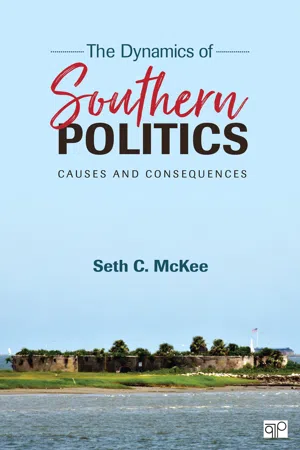
Taking a hard look at the changing demographics in the American South, The Dynamics of Southern Politics discusses how this region remains exceptional while also addressing how that exceptionalism is eroding. Author Seth McKee tells a historically rich story going back to the end of the Civil War, tracks electoral changes to the present, and explores some of the most significant components contributing to partisan change. Supported by a host of detailed tables and figures, this book pairs a strong historical foundation with an in-depth analysis of the contemporary region.
- 432 pages
- English
- ePUB (mobile friendly)
- Available on iOS & Android
eBook - ePub
About this book
Information
1 The Long Arc of Southern Political History
In 1949, V. O. Key’s masterpiece Southern Politics in State and Nation was published. More than six decades later this treatise on southern politics is revered as the cornerstone from which scholars continue to consult in their latest studies of the region. The depth and breadth of this work is such that no one expects there to ever be another account on the politics of the American South that can rival it. And, interestingly enough, the book came out just as the “Solid South”—the common expression for the one-party Democratic system—was on the verge of collapse. The 1948 presidential election, the last race Key chronicles, was notable for the intra-party fight between national Democrats and southern Democrats, with the latter embracing the moniker “Dixiecrats” to emphasize their fervent support of the white supremacist status quo prevailing in the region. Democratic President Harry S. Truman and Dixiecrat J. Strom Thurmond split the South’s electoral votes, but 1948 would be the last time Dixie was a presidential stronghold for the Democratic Party.
After 1948, the Republican Party established a permanent presence in presidential elections in the South, and since the late 1960s, the party has routinely dominated these contests (Black and Black 1987). The 1964 election would prove to be another critical turning point in southern politics. The national parties permanently reversed positions on the race issue, with Democratic President Lyndon Johnson spearheading passage of the 1964 Civil Rights Act and his opponent, Arizona Republican Senator Barry Goldwater, voting against it (Carmines and Stimson 1989). Ever since this fateful contest, southern blacks have been firmly aligned with the Democratic Party, whereas southern whites have continued to shift in favor of the Grand Old Party (GOP). V. O. Key died in October of 1963—just short of a year before the 1964 election set in motion the southern secular realignment to the Republican Party. Thirty years after the 1964 contest, southern Republicans finally captured a majority of the U.S. House delegation; the last time they had control was in 1874. Two decades since the 1994 “Republican Revolution,” the southern GOP now dominates presidential, congressional, and state legislative elections. It appears the transformation of the South from a Democratic redoubt to a Republican bastion is complete.
The current state of the southern party system highlights Republican dominance (McKee 2012a), but below the surface, Democratic promise is easy to spot. The historic election of Barack Obama in 2008 sent shockwaves across the country, and for numerous reasons beyond the obvious fact that the United States finally elected a president of color. The Obama campaign assembled a winning coalition that proved resilient by securing reelection in 2012. The assemblage of minorities, women, younger voters, and lower income earners is likely to have staying power for the Democratic Party—a coalition that, thanks to favorable demographic trends, can establish a national majority in presidential elections for years to come. This development is a national phenomenon, and it has repercussions in the South where the share of Latino residents continues to grow.
After back-to-back Republican shutouts in 2000 and 2004, in 2008 Obama carried Florida, North Carolina, and Virginia. In 2012, Obama held onto Florida and Virginia but narrowly lost North Carolina to Republican challenger Mitt Romney, which was the third most competitive state based on victory margin. These three southern states share compositional features that foretell increasing Democratic competitiveness: (1) strong in-migration of northerners who are more aligned with the Democratic Party than the GOP and (2) a growing minority population—especially Latinos, who are more inclined to back Democrats. These demographic developments create changes to the culture of these states such that their electorates are shifting in favor of the Democratic Party. As will be shown repeatedly in this book, success at the top of the ticket in presidential races reverberates to lower offices. Indeed, the general pattern of Republican growth in southern politics has been referred to as “top-down advancement” (Aistrup 1996). Likewise, expect a revival of Democratic competitiveness in presidential elections in select southern states to filter down to congressional and state legislative contests.
At present, it appears that southern politics may be moving from a position of Republican hegemony to one in which the Democratic Party finds increasing territory to be competitive and, in some places, controlling electoral outcomes. In other words, the party system is once again entering a state of flux because of substantial compositional alterations to the electorates in various southern states. It seems that the long arc of southern political history is bending slowly back to the Democratic Party. But the contemporary southern Democratic Party shares very little resemblance to its Solid South predecessor, in terms of its policy positions and adherents. In fact, it is hardly a stretch to claim that over the last century and a half, the Republican and Democratic parties have essentially traded places (Miller and Schofield 2008). This book seeks to explain the leading causes and consequences that have shaped and reshaped the southern party system since the United States was torn asunder by a bloody Civil War that forever altered the course of politics in Dixie and the nation at large.
Overview of the Book
Elections are the thread that guides this account of southern politics. The changing state of two-party competition in presidential, statewide, congressional, and even state legislative races provides the strongest signal as to how the past and present will affect future political dynamics. Elections serve to anchor the reader and signal minor and major changes to the political system, but they are far from capable of telling the richness of southern political history. And because elections are outputs, the end state of any given political cycle, they leave enormous room for interpretation. This explains why there remain several unsettled debates regarding the primary causes and consequences of the southern partisan transformation. To be clear, this book does not attempt to resolve some of the more intractable disagreements. That is not its purpose. Rather, the objective is to present the student with a broad, yet at times detailed, view of the changing state of southern politics since the 1860s. In satisfying this goal, it will be necessary to favor and advance certain perspectives over others, but this will be done with evidence, not polemics. To the extent that this work proves informative, explanatory, and empirically credible, the author will deem it a success.
Because of palpable and enduring alterations to southern politics, it seems natural to begin the textbook with four chapters (chapters 2–5) that provide historical narratives of the changing state of the southern party system from the end of the Civil War to the present. These chapters equip the student with a theoretically driven and empirically supported overview of how southern politics has transformed over the last century and a half. One must have a firm understanding of historical events before comprehending the various dynamics undergirding these occurrences. After establishing the historical narrative of political change, the next four chapters (chapters 6–9) focus more specifically on the leading factors shaping southern politics from the end of the Solid South to now. In consecutive order, these chapters assess the role that generational change, issues, geographic distinctions, and demographic trends have had in overturning a one-party Democratic system and leading to the current partisan balance, which tips overwhelmingly in favor of the GOP.
Demographic change is the major impediment to the maintenance of GOP control, and thus chapter 10 offers a detailed account of how Republican control of most southern states has enabled the party to further advantageous redistricting plans and, perhaps more notably, the recent trend among most southern state legislatures to pass laws that marginally raise the costs of voting. These restrictive measures seem extremely shortsighted and insufficient for sustaining majority status, but most southern Republicans have embraced them. Chapter 11 moves beyond the confines of Dixie in order to compare the way changes within the South reflect or vary from those found in the rest of the United States. This chapter demonstrates that even after the first decade of the new millennium, the South remains politically exceptional. Finally, chapter 12 peers down the road a bit to consider the future of southern politics. Given current conditions, most of the informed speculation centers on Republican political strategy crafted in response to the undeniable trend of a growing minority and “non-southern” population.
Explanations of Southern Political Change
V. O. Key (1949, 10) once made the observation that “attachments to partisan labels live long beyond events that gave them birth.” In other words, much of the electorate will hold to a party affiliation even when significant changes to the positions the parties take on major issues suggest voters should reconsider their partisan loyalty. This statement is an accurate assessment of the gradual movement of southern whites in favor of the Republican Party. Indeed, the decades it took for a dominant Democratic Party to give way to an ascending and now currently superior GOP speaks directly to the tendency of most voters to hold firm in their identification with a political party (Campbell et al. 1960).
In 1955, V. O. Key wrote an article titled “A Theory of Critical Elections.” In this account, he argued that there are rare occasions when the strength of the major parties can be fundamentally and permanently altered by certain pivotal elections, like 1860 (precipitating the Civil War) and 1932 (the election of Democratic President Franklin D. Roosevelt). These elections stick out because they constitute indisputable turning points in which the extant national majority party (e.g., Republicans before 1932) subsequently becomes the national minority party, whereas the previous minority party (e.g., Democrats before 1932) is now the majority party not just at the time of the noted critical election, but for many elections thereafter. This conception of critical elections as turning points that are responsible for bringing about a reversal of partisan control of the American political system (especially control of national offices like the presidency and Congress) has become the classic statement of partisan realignment in American politics.
Nonetheless, these critical/realigning elections appear to be exceedingly rare. Further, even Key doubted the veracity of such a rapidly dynamic process accounting for partisan change. In 1959, Key wrote another article titled “Secular Realignment and the Party System.” By “secular” Key meant “gradual,” and thus, with a look at the same data used in his 1955 article, Key reinterpreted the findings, arguing instead that partisan change may exhibit a short-term phenomenon resembling a critical election, but preceding such an event were years of incremental trends leading to the flashpoint.1 In other words, according to Key, it can take decades (in his words, even upwards of fifty years) for a partisan realignment to run its course. This suggested length of time is well within the bounds of the secular realignment of southern whites to the GOP—sparked by a critical election in 1964 and culminating in a clear Republican electoral advantage by the mid-1990s.
Interestingly, the realignment of southern blacks into the Democratic Party is highly reminiscent of a critical election–type pattern. The swift and permanent shift of African Americans to the Democratic Party in 1964 appears to be a function of civil rights being the paramount issue for this group. Because a Democratic president (Lyndon Johnson) and the Democratic Party outside the South embraced the civil rights cause, southern African Americans overwhelmingly severed their ties with the party of Lincoln (the GOP), even though the southern Democratic Party at first, and for many years to come, resisted the move in favor of civil rights (Black and Black 2002).
Further complicating an understanding of southern political change is the fact that it often does not conform to the dynamics occurring outside the region. For instance, the national realignment in favor of the Democratic Party in 1932 took place because the party finally became electorally competitive in the North. In the South, the Democratic Party had been dominant since the end of Reconstruction (in 1876), and hence 1932 only strengthened the party’s grip in Dixie. By contrast, at present the two major parties compete vigorously for control of the presidency and Congress. But the evidence of a highly competitive national party system belies considerable regional disparities in partisan strength (Black and Black 2007). Now, instead of Democrats exhibiting disproportionate electoral power in southern politics, it is the GOP that reigns supreme. Republican influence is not as great outside the South, where the Democratic Party is typically stronger than the Republican Party in the rest of the United States.
Political change involves numerous working parts, but the key to understanding the dynamic lies with the position-taking of the major parties over the small bundle of issues most salient to voters. In the South, these core issues are race, religion, and economics. Going back to the country’s great sectional crisis, the Civil War, a northern Republican Party stood for free soil and free labor, and their southern Democratic opposition seceded in order to protect a slave-based economic system. The political status quo in the South held steady from the turn of the nineteenth century until the 1960s when the most significant issue, civil rights, reached a turning point because the major parties reversed course on this issue (Carmines and Stimson 1989). Similarly, the large segment of white southerners who can be labeled evangelical/born-again Christians did not show any signs of abandoning their Democratic political allegiance until the parties altered their views on a set of moral issues of tremendous importance to this group of voters after the Supreme Court declared a woman’s right to an abortion in the controversial 1973 Roe v. Wade decision. In the 1970s and early 1980s, white religious conservatives converted to the GOP because Republicans had become the defenders of the faith-based positions (e.g., pro-life and favoring prayer in school) vociferously advocated by this substantial southern constituency.
The emphasis on issues and the manner in which the major parties and their leaders respond to them is the primary agent driving political change, and this constitutes the explanatory tool for understanding the nature of southern politics and, by extension, the American electoral system. In this book, several theories of political change will be introduced and utilized to assist the student in understanding the changing nature of southern politics. No political system remains stagnant; it will invariably change. But what distinguishes the South from the rest of the nation is that for so long one political party was in control of its electoral politics: the Democratic Party. In addition, it is perhaps even more intriguing that the party that for so long had hardly any electoral strength, the GOP, is now more powerful in Dixie than in any other section of the United States. Finally, because of demographic trends that are growing the base of Democratic supporters, there is now evidence that the Republican Party will face a real...
Table of contents
- Cover
- Half Title
- Acknowledgements
- Title Page
- Copyright Page
- Contents
- Table List
- Illustration List
- Sidebar List
- Publisher Note
- Preface
- Acknowledgments
- About the Author
- 1 The Long Arc of Southern Political History
- 2 Before a “Solid South”
- 3 Democratic Past
- 4 Competitive Transition
- 5 Republican Present
- 6 Generational Change and GOP Growth
- 7 Issues: Race, Economics, and Religion
- 8 Sectional and Locational Differences
- 9 The Changing Southern Electorate
- 10 Republican Responses to Demographic Change
- 11 The South in Comparative Perspective
- 12 The Future of Southern Politics
- References
- Index
Trusted by 375,005 students
Access to over 1.5 million titles for a fair monthly price.
Study more efficiently using our study tools.
Frequently asked questions
Yes, you can cancel anytime from the Subscription tab in your account settings on the Perlego website. Your subscription will stay active until the end of your current billing period. Learn how to cancel your subscription
No, books cannot be downloaded as external files, such as PDFs, for use outside of Perlego. However, you can download books within the Perlego app for offline reading on mobile or tablet. Learn how to download books offline
Perlego offers two plans: Essential and Complete
- Essential is ideal for learners and professionals who enjoy exploring a wide range of subjects. Access the Essential Library with 800,000+ trusted titles and best-sellers across business, personal growth, and the humanities. Includes unlimited reading time and Standard Read Aloud voice.
- Complete: Perfect for advanced learners and researchers needing full, unrestricted access. Unlock 1.5M+ books across hundreds of subjects, including academic and specialized titles. The Complete Plan also includes advanced features like Premium Read Aloud and Research Assistant.
We are an online textbook subscription service, where you can get access to an entire online library for less than the price of a single book per month. With over 1.5 million books across 990+ topics, we’ve got you covered! Learn about our mission
Look out for the read-aloud symbol on your next book to see if you can listen to it. The read-aloud tool reads text aloud for you, highlighting the text as it is being read. You can pause it, speed it up and slow it down. Learn more about Read Aloud
Yes! You can use the Perlego app on both iOS and Android devices to read anytime, anywhere — even offline. Perfect for commutes or when you’re on the go.
Please note we cannot support devices running on iOS 13 and Android 7 or earlier. Learn more about using the app
Please note we cannot support devices running on iOS 13 and Android 7 or earlier. Learn more about using the app
Yes, you can access The Dynamics of Southern Politics by Seth C. McKee in PDF and/or ePUB format, as well as other popular books in Política y relaciones internacionales & Gobierno estadounidense. We have over 1.5 million books available in our catalogue for you to explore.