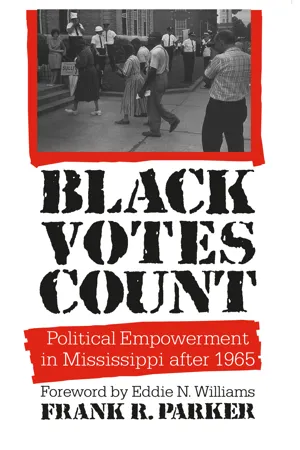
Most Americans see the passage of the Voting Rights Act of 1965 as the culmination of the civil rights movement. When the law was enacted, black voter registration in Mississippi soared. Few black candidates won office, however. In this book, Frank Parker describes black Mississippians' battle for meaningful voting rights, bringing the story up to 1986, when Mike Espy was elected as Mississippi’s first black member of Congress in this century.
To nullify the impact of the black vote, white Mississippi devised a political “massive resistance” strategy, adopting such disenfranchising devices as at–large elections, racial gerrymandering, making elective offices appointive, and revising the qualifications for candidates for public office. As legal challenges to these mechanisms mounted, Mississippi once again became the testing ground for deciding whether the promises of the Fifteenth Amendment would be fulfilled, and Parker describes the court battles that ensued until black voters obtained relief.
- 272 pages
- English
- ePUB (mobile friendly)
- Available on iOS & Android
eBook - ePub
About this book
Information
1 Mississippi in 1965
The Struggle for the Right to Vote
From the summer of 1962 to the spring of 1963, Leflore County, a predominantly black county in the Mississippi Delta in northwest Mississippi, was the testing ground for democracy for the civil rights movement. The Leflore County voter registration campaign was part of a massive effort of the Council of Federated Organizations (COFO), the Mississippi civil rights umbrella organization, and the Student Nonviolent Coordinating Committee (SNCC), the Atlanta-based activist civil rights group, in the predominantly black Delta region. As described by Lawrence Guyot, a SNCC worker and later chair of the Mississippi Freedom Democratic party, “Our objectives were very clear. It was not to desegregate the two or three good local white restaurants. It was simply to register people to vote.”1
In 1962, on the eve of COFO's arrival, only 268 of the county's 13,567 black adults were registered to vote (1.98 percent), although 70 percent of the white adults were registered.2 As a result of SNCC's organizing efforts, hundreds of black people attempted to register. Not only did the county registrar refuse to register black applicants, but this voter registration campaign was met with a reign of terror from the white community. The SNCC office was attacked by a group of armed whites, forcing the SNCC workers to flee through a second-story window; the county board of supervisors cut off the federal surplus food program upon which most black families were dependent; SNCC workers were arrested on trumped-up charges; and black homes were shot into and black businesses and the SNCC office were burned.
In February 1963, on the highway outside Greenwood, the county seat, three whites in a car pulled alongside of and fired a burst of gunfire into a car containing Robert Moses, SNCC leader and COFO voter registration director; Randolph Blackwell of the Voter Education Project (VEP) in Atlanta, the primary funding source for the campaign; and SNCC worker Jimmie Travis. Travis, the driver, was seriously wounded in the neck and shoulder.
These incidents of violence and intimidation spurred numerous protests and marches on city hall and the county courthouse by the outraged black community. In March, shots were fired into the home of Dewey Greene, a voter registration worker and father of two SNCC workers, and more than one hundred black people marched on city hall in protest. Even before the more highly publicized incidents in Birmingham, Alabama, the demonstrators in Greenwood were met by a line of armed police officers, and a police dog attacked the marchers. When the marchers retreated to a local black church, the police waded into the crowd and arrested Moses and seven other SNCC organizers of the voter registration effort who were then convicted of disorderly conduct, sentenced to four months in jail, and fined $200 each. The sense of terror evoked by the police suppression of the Leflore County voter registration campaign was recalled in a 1989 New Yorker interview with Marian Wright Edelman, who, as a third-year Yale Law School student, went to Mississippi during her spring break to provide legal assistance to the movement. As Edelman told author Calvin Tomkins,
My last day in Greenwood, Bob [Moses] took a group of people down to the courthouse to register. He walked at the head of that scraggly bunch of courageous people; I was at the end of the line, behind an old man on crutches. This was the first time I'd seen police dogs in action, and I've been scared of them ever since. If I see a German shepherd on the street, to this day I'll cross over to avoid him. The cops came with the dogs, and led them to attack us. I remember seeing a dog jump on Bob Moses and tear his pants, and then it was just a terrifying scene—people running away, Bob and the other S.N.C.C. kids getting arrested, and throwing me their car keys as they were being led off.3
The Justice Department filed a lawsuit seeking to void the convictions and to enjoin police interference with the voter registration effort. But the lawsuit was dismissed when the Justice Department agreed to a deal under which all charges against the SNCC organizers were dropped, without any court order protecting the voter registration effort.
Justice Department statistics show that from March to June, 1963, at least 681 black citizens applied for voter registration but only 8 were registered.4 From June 1962 to January 1964 there was a net gain of only 13 black citizens added to the county's voter registration rolls.5 The VEP, the principal source of funds for voter registration efforts in Mississippi, concluded that without massive federal intervention further efforts were futile and refused to fund any additional voter registration activity in the state. After spending over $50,000 in Mississippi during 1962 and 1963, the VEP-funded effort had registered no more than 4,000 black voters.6
Black voters in Mississippi were barred from participating as a significant force in the electoral politics of the state until 1965, when the Voting Rights Act was passed, and that year marks the starting point for measuring the new black political emergence. Although most southern states began to rid themselves of their “Jim Crow” political and social systems beginning in 1954, as late as 1965 little had changed in Mississippi. As New York Times reporter Anthony Lewis observed, “The revolution that so profoundly changed American race relations between 1954 and 1964 stopped at the borders of Mississippi.”7 Despite the Brawn v. Board of Education decision of 1954 banning school segregation and the passage by Congress of the Civil Rights Acts of 1957, 1960, and 1964, Mississippi in 1965 was still a rigidly segregated and oppressive society for blacks.
Five years of statewide voter registration activity and black community organizing more intense than anywhere in the South had produced no more than 28,500 black registered voters out of an eligible black voting-age population of over 400,000, had not produced a single black elected official outside of the all-black Delta town of Mound Bayou, and had not desegregated a single school district. Black people remained economically and socially oppressed. The chief occupations of black males were field hand, yardman, and chauffeur, and the chief occupations of black women were maid, nursemaid, and cook. Civil rights protest efforts aimed at eliminating the rigid segregation of the society were ruthlessly suppressed by police harassment, economic reprisals, and Ku Klux Klan terrorism.
Socioeconomic conditions. For most of the South, the period from 1950 to 1960 was a time of substantial social and economic transformation. The populations of all other southern states had undergone a transformation from predominantly rural-based to predominantly urban-based, and manufacturing had replaced farming as the primary source of income. But economically, little had changed in Mississippi. The 1960 census revealed that almost two-thirds of Mississippi's population still resided in rural areas, making it the most rural state in the South, and farming remained the major source of income. Jackson, the state's largest city, had a population of less than 150,000.
In 1960 Mississippi was the poorest state in the nation, with a per capita income of only $1,119, compared with a national figure of $2,263. But black Mississippians, trapped in an economically and socially oppressive system, were the poorest of the poor. The extremes of white wealth and black poverty in Mississippi were vividly described by a New York Times reporter, Claude Sitton, in a 1963 New York Times Magazine article:
Mississippi offers a study in contrasts, especially in the Delta. Greek-revival mansions and rambling ranch houses in groves of shade trees look out on weather-beaten rows of clapboard cabins and tar-paper shacks, most of which have open privies and some of which lack even running water. A planter dressed in expensive western boots and hat gets up from a leisurely meal in a restaurant and displays a rare dime valued at $90 from his coin collection. Less than a mile away, a Negro mother arises and prepares a breakfast of sugar syrup and hoecake for her children, some of whom cannot attend school because they have no shoes.8
As table 1.1 shows, in 1960 the black median family income ($1,444) was only 34 percent that of whites ($4,209), while nearly 83 percent of all black families had incomes below the poverty level ($3,000 per year). Half of the black population had completed only six years or less of schooling, and over 32,000 black adults had no formal education at all. In contrast, half of all white adults in the state had completed eleven or more years of school. Less than 8 percent of adult blacks were high school graduates, compared with more than 42 percent of whites. Most blacks in Mississippi worked in menial and low-paying positions. More than 40 percent of all employed black men were farm workers and laborers, and almost 65 percent of all employed black women were maids, cooks, servants, and other service workers. Most black families (61.9 percent) lived in rented housing, while 69 percent of all white families owned their own homes. Blacks occupied three-fourths of all dilapidated housing in Mississippi, and one in four black-occupied homes was substandard. Almost half of all black-occupied housing units were overcrowded (more than one person per room) and had no running water. More than two-thirds of all black-occupied homes had no bathing facilities, while only slightly more than one-fourth of all white-occupied homes lacked bathing facilities.
Segregation in education. The Supreme Court's Brawn v. Board of Education decision outlawed racial segregation in the public schools as contrary to the Fourteenth Amendment and required public school desegregation “with all deliberate speed.”9 Although resistance to the Brawn mandate was southwide, Mississippi successfully avoided any school desegregation for ten years, longer than any other southern state. In the first two years after the school desegregation ruling, Arkansas, Tennessee, and Texas began to desegregate their public schools. North Carolina began the desegregation process in the 1957–58 school year, Virginia achieved some desegregation in 1958–59, and Florida, Louisiana, and Georgia followed in the next three school
Table 1.1. Selected Socioeconomic Characteristics of White and Black Mississippians, 1960 | |||||||
| All Mississippians | Whites | Percent of All Mississippians | Percent of All Whites | Blacks | Percent of All Mississippians | Percent of All Blacks | |
| Family Income | |||||||
| Median | $2,884 | $4,209 | $1,444 | ||||
| Below $3,000 | 258,549 | 111,589 | 43.2 | 34.5 | 146,960 | 56.8 | 82.9 |
| Over $10,000 | 25,924 | 25,149 | 97.0 | 7.8 | 775 | 3.0 | 0.4 |
| Public Assistance | |||||||
| All categories | 115,462 | 44,272 | 38.3 | 71,190 | 61.7 | ||
| Aid to dependent children | 20,898 | 3,937 | 18.8 | 16,961 | 81.2 | ||
| Education (adults) | |||||||
| Median years of school completed | 8.9 | 11.0 | 6.0 | ||||
| No school years completed | 40,640 | 8,444 | 20.8 | 1.2 | 32,196 | 79.2 | 8.4 |
| Four years of high school or more | 317,100 | 288,085 | 90.8 | 42.2 | 29,015 | 9.2 | 7.6 |
| Four years of college or more | 59,273 | 52,523 | 88.6 | 7.7 | 6,750 | 11.4 | 1.8 |
| Occupations | |||||||
| White-collar | 199,324 | 182,160 | 91.4 | 42.3 | 17,164 | 8.6 | 6.8 |
| Blue-collar | 233,006 | 159,518 | 68.5 | 37.1 | 73,488 | 31.5 | 29.2 |
| Service workers | 95,765 | 25,633 | 26.8 | 6.0 | 70,132 | 73.2 | 27.8 |
| Farm workers | 137,157 | 57,995 | 37.9 | 12.1 | 85,162 | 62.1 | 33.8 |
| Housing | |||||||
| Owner-occupied | 327,894 | 248,835 | 75.9 | 69.0 | 79,059 | 24.1 | 38.1 |
| Renter-occupied | 240,176 | 111,624 | 46.5 | 31.0 | 128,552 | 53.5 | 61.9 |
| Sound condition | 346,821 | 276,997 | 79.9 | 76.8 | 69,824 | 20.1 | 33.6 |
| Dilapidated | 76,237 | 18,624 | 24.4 | 5.2 | 57,613 | 75.6 | 27.8 |
| More than one person per room | 133,428 | 48,454 | 36.3 | 13.4 | 84,974 | 63.7 | 40.9 |
| Hot and cold piped water | 343,802 | 302,932 | 88.1 | 71.9 | 40,870 | 11.9 | 19.7 |
| No piped water | 175,056 | 74,918 | 42.8 | 17.8 | 100,138 | 57.2 | 48.2 |
| Flush toilet | 380,974 | 311,604 | 81.8 | 73.9 | 69,730 | 18.3 | 33.6 |
| No flush toilet | 247,971 | 110,090 | 44.4 | 26.1 | 137,881 | 55.6 | 66.4 |
| Bathtub or shower | 355,282 | 308,084 | 86.7 | 73.1 | 47,198 | 13.3 | 22.7 |
| No bathtub or shower | 273,663 | 113,250 | 41.4 | 26.9 | 160,413 | 58.5 | 77.3 |
Sources: U.S. Bureau of the Census, 1960 C...
Table of contents
- Cover Page
- Black Votes Count
- Copyright Page
- Dedication
- Contents
- Maps and Figures
- Acknowledgments
- Foreword
- Introduction
- 1 Mississippi in 1965
- 2 Mississippi's Massive Resistance to Black Political Empowerment
- 3 The Judicial Response to Massive Resistance
- 4 The Struggle against Discriminatory Legislative Redistricting
- 5 The Impact of the Struggle for Black Political Participation on Mississippi Politics
- 6 The Impact of Mississippi Litigation on National Voting Rights Law
- 7 Race and Mississippi Politics
- Notes
- Bibliography
- Index
Trusted by 375,005 students
Access to over 1.5 million titles for a fair monthly price.
Study more efficiently using our study tools.
Frequently asked questions
Yes, you can cancel anytime from the Subscription tab in your account settings on the Perlego website. Your subscription will stay active until the end of your current billing period. Learn how to cancel your subscription
No, books cannot be downloaded as external files, such as PDFs, for use outside of Perlego. However, you can download books within the Perlego app for offline reading on mobile or tablet. Learn how to download books offline
Perlego offers two plans: Essential and Complete
- Essential is ideal for learners and professionals who enjoy exploring a wide range of subjects. Access the Essential Library with 800,000+ trusted titles and best-sellers across business, personal growth, and the humanities. Includes unlimited reading time and Standard Read Aloud voice.
- Complete: Perfect for advanced learners and researchers needing full, unrestricted access. Unlock 1.5M+ books across hundreds of subjects, including academic and specialized titles. The Complete Plan also includes advanced features like Premium Read Aloud and Research Assistant.
We are an online textbook subscription service, where you can get access to an entire online library for less than the price of a single book per month. With over 1.5 million books across 990+ topics, we’ve got you covered! Learn about our mission
Look out for the read-aloud symbol on your next book to see if you can listen to it. The read-aloud tool reads text aloud for you, highlighting the text as it is being read. You can pause it, speed it up and slow it down. Learn more about Read Aloud
Yes! You can use the Perlego app on both iOS and Android devices to read anytime, anywhere — even offline. Perfect for commutes or when you’re on the go.
Please note we cannot support devices running on iOS 13 and Android 7 or earlier. Learn more about using the app
Please note we cannot support devices running on iOS 13 and Android 7 or earlier. Learn more about using the app
Yes, you can access Black Votes Count by Frank R. Parker in PDF and/or ePUB format, as well as other popular books in Social Sciences & African American Studies. We have over 1.5 million books available in our catalogue for you to explore.