The lasting effects of slavery on contemporary political attitudes in the American South
Despite dramatic social transformations in the United States during the last 150 years, the South has remained staunchly conservative. Southerners are more likely to support Republican candidates, gun rights, and the death penalty, and southern whites harbor higher levels of racial resentment than whites in other parts of the country. Why haven't these sentiments evolved or changed? Deep Roots shows that the entrenched political and racial views of contemporary white southerners are a direct consequence of the region's slaveholding history, which continues to shape economic, political, and social spheres. Today, southern whites who live in areas once reliant on slavery—compared to areas that were not—are more racially hostile and less amenable to policies that could promote black progress.
Highlighting the connection between historical institutions and contemporary political attitudes, the authors explore the period following the Civil War when elite whites in former bastions of slavery had political and economic incentives to encourage the development of anti-black laws and practices. Deep Roots shows that these forces created a local political culture steeped in racial prejudice, and that these viewpoints have been passed down over generations, from parents to children and via communities, through a process called behavioral path dependence. While legislation such as the Civil Rights Act and the Voting Rights Act made huge strides in increasing economic opportunity and reducing educational disparities, southern slavery has had a profound, lasting, and self-reinforcing influence on regional and national politics that can still be felt today.
A groundbreaking look at the ways institutions of the past continue to sway attitudes of the present, Deep Roots demonstrates how social beliefs persist long after the formal policies that created those beliefs have been eradicated.
eBook - ePub
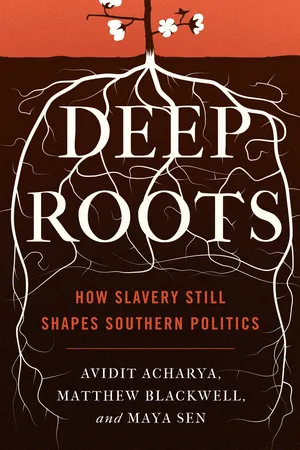
Deep Roots
How Slavery Still Shapes Southern Politics
- 296 pages
- English
- ePUB (mobile friendly)
- Available on iOS & Android
eBook - ePub
About this book
Information
Publisher
Princeton University PressYear
2018Print ISBN
9780691203720
9780691176741
eBook ISBN
9781400889976
Subtopic
Governo americanoCHAPTER ONE
INTRODUCTION
“98% probably of white people in Mississippi were segregationists. My family was, my father was, I
was, everybody was. Everybody that I knew was for segregation.”
was, everybody was. Everybody that I knew was for segregation.”
Greenwood, Mississippi, resident
Greenwood, Mississippi (2010 pop. 15,205), is, by all accounts, a typical town in the Mississippi Delta. It isn’t big, but it is bigger than many others in the area. The town’s gridded streets line up in a roughly north-south direction, and its two rivers—the Tallahatchie and the Yazoo, parts of the web of smaller rivers forming the Mississippi flood plains—roughly encircle it. North of the Yazoo, historic mansions line Greenwood’s “Grand Boulevard,” and cotton and corn fields dot the roads leading away from the city. South of the Yazoo, in the historic city center, long-standing restaurants and shops—some of which have been in existence for decades—continue to serve Delta specialties like broiled shrimp and crabmeat. But perhaps Greenwood’s greatest claim to fame, at least today, is serving as the birthplace and former home to a number of great blues artists, including Robert Johnson.
Looking around the town—and elsewhere in the broader Mississippi Delta region—it is easy to see remnants of older, different times. The Mississippi Delta is an alluvial plain, and its system of rivers have provided rich, fertile soil for agricultural use for two centuries. To cultivate these lands in the early 1800s, white entrepreneurs forced the transportation of enslaved African Americans westward into this region. The area is part of the broader hook-shaped region of the South known as the Black Belt, due to the rich color of the soil. Together, the fertile land, the “inexpensive” enslaved labor force, and the area’s navigable rivers made cities like Greenwood the engines behind “King Cotton,” with Mississippi providing roughly 480 million pounds of ginned cotton in 1859—nearly a quarter of all cotton production in the United States that year.1 In turn, this production helped to propel the nation through the Industrial Revolution in the late nineteenth century. This past is evident today in Greenwood’s Grand Boulevard district, with its mansions and wide, tree-lined streets. A sign on the outskirts of town still proudly welcomes visitors to “Greenwood, Cotton Capital of the World.”
But, as in many cities across the Mississippi, these economically rich times did not last. Starting in the 1940s, the mechanization of cotton production dramatically reduced the need for agricultural labor; in tandem with the Great Depression and the migration of African Americans out of the rural South, cities like Greenwood fell into cycles of recession, further exacerbated by racial tensions through the 1950s and 1960s. Between 1940 and the present day, close to half of the population of the Mississippi Delta left for opportunities elsewhere, and, today, downtown Greenwood is peppered with boarded-up buildings and vacant lots. In the traditionally African American neighborhood of Baptist Town, just outside the city center, many abandoned shotgun-style houses line the streets, calling to mind a past when mostly black agricultural workers lived there.
Forces such as these have hit African American communities in Black Belt cities like Greenwood particularly hard. In Greenwood, which was sixty-seven percent black in 2010, the unemployment rate for African Americans is nearly twice that of the state average, which in turn is higher than the national average. Incomes for African Americans in Greenwood are also lower than state and national averages, with half of Greenwood families headed by African Americans living in poverty. The median income of the city has been around half of the national median income for most of the last decade. Residential and institutional segregation is also persistent. For example, following the legally mandated desegregation of public schools in the 1960s, many Black Belt towns such as Greenwood established private “segregation academies” for white students, leaving desegregated public schools mostly African American and starved of resources. Today, Greenwood High School is ninety-seven percent African American, while the nearby Pillow Academy—founded in 1966 to provide segregated schooling for Greenwood’s white children—is ninety percent white.2
These racial divides are echoed in the political environment of the Delta. At a city level, the politics of cities like Greenwood have followed the trajectory of African American politics more generally (although, as we will discuss throughout this book, this has not always been the case). Since African American voters today tend to overwhelmingly side with the Democratic Party, this means that Greenwood—like other majority-black cities throughout the Black Belt—has sided with Democratic candidates. The same does not hold, however, for Greenwood’s white residents. For example, in 2008 and 2012, Democratic presidential candidate Barack Obama won nearly no support from the area’s white voters.3 Indeed, at the county level, nearly all of the votes of Leflore County’s white residents went to Obama’s two Republican opponents, John McCain (2008) and Mitt Romney (2012). This pattern—black voters supporting Democratic candidates, but white voters overwhelmingly supporting more conservative candidates—is one we see again and again throughout the South’s Black Belt.
Greenwood’s historical and political trajectory contrasts with another Southern city, Asheville, North Carolina (2010 pop. 83,393). Whereas Greenwood’s fertile land was its primary natural resource, Asheville’s location in western North Carolina was by far less friendly to large-scale agriculture, setting its course on a different path. Indeed, Greenwood was settled primarily as a base for the production and shipment of cotton, but Asheville and Buncombe County, a region in the Blue Ridge and Smoky Mountains, was settled with the intent of establishing a trading outpost. For that reason, the city remained small for most of the eighteenth and nineteenth centuries, and it was only upon the arrival of the turnpike and the railroad later in the nineteenth century that the area started to blossom. For the early parts of the twentieth century, its crisp climate and mountain location made it a desirable vacation destination for Southerners from hotter lowland areas, and, over time, its boardinghouses started housing travelers from around the country.
Asheville today stands in contrast to the cities of the Black Belt in its demographic and economic profile. Of city residents, 43.3 percent have bachelor’s degrees or higher, a figure that far outpaces both the North Carolina average (27.3 percent) and the national average (30.4 percent). In addition, a thriving tourist industry brings visitors to Buncombe County’s famous Blue Ridge mountains and to cultural attractions like the Biltmore Estate. The city is also home to a variety of other industries, including health care, grocery and retail, and higher education, with the University of North Carolina at Asheville generating a well-educated workforce. In terms of the city’s minority populations, only around fifteen percent of Asheville residents (and six percent of Buncombe County residents) are black, but inequality between people of different races is more muted than elsewhere in the South (though still present). The median 2010 black household income in Asheville was thirty thousand dollars per year; the same measure in Greenwood was around half that: seventeen thousand dollars. Both were lower than the corresponding white household income, but the black-white gap in Asheville was, and continues to be, narrower.
Importantly, Asheville also differs from Greenwood in its politics. In 2008, for example, Democrat Barack Obama won over most of Buncombe County’s white voters. In fact, he won the county with fifty-seven percent of the vote, but blacks make up only six percent of the population. Assuming that Obama won every single black vote, he still won over half of the white vote—a very high figure in the U.S. South. Of course, many of these votes surely came from the retirees and the university students who call Asheville home. But, even accounting for this mobile population, many whites whose families have lived in the Asheville area for generations supported a fairly liberal, black candidate. This is a voting pattern that is corroborated by Asheville’s long-standing reputation as a relatively progressive Southern city, where, for instance, Lyndon Johnson won sixty-two percent of the vote in Buncombe County against Barry Goldwater in 1964. In comparison, Johnson only received 6.4 percent of the (overwhelmingly white) vote in Leflore County, Mississippi.
These two cities—Greenwood and Asheville—are illustrations of the broader puzzle that we explore in this book. The South has strong intraregional differences in political attitudes, a fact long noted by political scientists such as V. O. Key, who wrote about this in his seminal work, Southern Politics in State and Nation. Places like Asheville, Atlanta, Nashville, and Charlotte are relatively liberal in their politics. Even whites in rural areas away from the old plantation counties, like northeastern Alabama, vote for Democratic candidates with some frequency. But in Black Belt cities such as Birmingham, Greenwood, and Jackson, white voters are among the most ideologically and politically conservative in the entire country, despite these cities having large numbers of African Americans who lean in a Democratic direction. These differences in turn are reflected in national policy. As scholars such as Key have noted, the Southern Black Belt is one of the most conservative parts of the country on issues of redistribution, civil rights, and law enforcement, and politicians from these areas have been at the forefront of fighting for conservative causes at the national level and have been so for generations. Thus, a key question for understanding American public opinion specifically—and American politics more broadly—is what explains these important patterns. Why are whites in Greenwood so conservative and why are whites in Asheville comparably more liberal? Why did these differences develop? And why do these differences persist? In a time of increased polarization and divided polities, these are remarkably relevant questions.
This contemporary puzzle forms the basis for this book. However, even though this puzzle focuses on regional differences in present-day political beliefs, we believe that the most compelling explanation for such present-day differences lies in the history of these places. Specifically, we argue in this book that political attitudes persist over time, making history a key mechanism in determining contemporary political attitudes. Looking at regional differences across the U.S. South, we focus this argument on the “peculiar institution” that drove the South’s economy and politics for nearly 250 years: chattel slavery. We argue that Southern slavery has had a lasting local effect on Southern political attitudes and therefore on regional and national politics. Whites who live in parts of the South that were heavily reliant on slavery and the inexpensive labor that the institution provided—such as Greenwood (sixty-eight percent enslaved in 1860) and other places in the Southern Black Belt—are more conservative today, more cool toward African Americans, and less amenable to policies that many believe could promote black progress. By contrast, whites who live in places without an economic and political tradition rooted in the prevalence of slavery—places like Asheville (fifteen percent enslaved in 1860, for example)—are, by comparison, more progressive politically and on racial issues. These regional patterns have persisted historically, with attitudes being passed down over time and through generations. As we discuss below, this persistence has been reinforced both by formal institutions, such as Jim Crow laws (a process known as institutional path dependence), and also by informal institutions, such as family socialization and community norms (a process we call behavioral path dependence). Present-day regional differences, then, are the direct, downstream consequences of the slaveholding history of these areas, rather than being simply attributable exclusively to contemporary demographics or contemporary political debates.
To go back to our original question, what explains regional political differences in cities like Greenwood versus places like Asheville? Why are whites so much more conservative in the Black Belt versus other parts of the South? What we argue in this book, and what we show using empirical evidence, is that the differences in the politics of cities like these can be traced in part to one important fact: places like Greenwood were places where the local economy was rooted in slavery prior to the Civil War, but places like Asheville were not. The history of these areas, in tandem with attitudes being passed down over time via behavioral path dependence, helps drives these political differences.
1.1 HOW CAN HISTORY SHAPE POLITICAL ATTITUDES?
Many people may think that the claim that the past still somehow shapes our political attitudes is outlandish. We tend to think of our political beliefs as well reasoned and carefully considered, or, at worst, determined by what’s happening around us right now. In terms of slavery and Southern white attitudes, it seems implausible that something that happened so long ago, and which has since been abolished, could possibly affect people’s attitudes today. It seems remote to think that all of the things that happened between 1860 and today haven’t served to diminish those sorts of influences.
This is a reasonable viewpoint—one shared by many political observers and scholars of public opinion. Slavery ended over 150 years ago, at a time when the U.S. population numbered around thirty-one million, about ten percent of what it is today. In the 1850s, roads in the United States were mostly unpaved, horses and wagons were the modal form of transportation, and railroads were just beginning to replace steamboats as the standard way to transport goods across the country. Alexander Graham Bell wouldn’t make his first telephone call for another twenty-five years, and the Wright brothers wouldn’t take their first flight for fifty more. Women couldn’t vote, there were only thirty-three states in the United States, and Buffalo was America’s tenth largest city. This younger United States had also yet to face the wave of internal and international migration that would characterize the twentieth century. Much has changed in American society and culture in the 150 years since slavery was abolished.
From the vantage point of politics and of race relations, these changes appear especially salient. The institution of slavery was itself permanently abolished, initially by the Emancipation Proclamation (1863) and more forcibly by the defeat of the South in the U.S. Civil War (1861–65). The subsequent involvement of the federal government during Reconstruction (1865–77) brought additional progress, including the enactment of the Thirteenth, Fourteenth, and Fifteenth Amendments to the U.S. Constitution, which together formally abolished slavery, established for all residents the right to equal protection of the laws, and guaranteed newly freed African Americans the right to vote. Although historians have questioned the extent to which these amendments were enforced (as we will discuss later in this book), slavery as a formal institution had collapsed by the 1860s, marking a significant transition point in the American racial order. Many have argued that the inclusion of African Americans into public life moved, at best, in fits and starts, but it would be misleading to say that these massive political and economic forces didn’t substantially shift and shape political and social attitudes through history.4
Additional movements toward equality have been made in the twentieth century, further distancing the United States from its slave past. To name some milestones, the 1920s and 1930s saw the remarkable rise of African American visionaries in disparate fields, including literature (Langston Hughes, Zora Neale Hurston), the arts (Marian Anderson, Josephine Baker), and athletics (Jesse Owens, Joe Louis, Jackie Robinson). Within politics as well, the voice of black political and intellectual leaders such as W.E.B. Du Bois, Marcus Garvey, and Booker T. Washington guided the nation toward a fairer treatment of African Americans. By the 1960s, these efforts had culminated not just in the formal constitutional disavowal of state-mandated segregation (with the Supreme Court ruling in 1954 of Brown v. Board of Education), but also with the massive grassroots civil rights movement. From a legal perspective, landmark pieces of legislation brought new protections for minority rights; these included not just the far-reaching Civil Rights Act of 1964 and the Voting Rights Act of 1965, but also the Fair Housing Act (1968), the Equal Opportunity and Employment Commission, and the promotion of minority hiring by state and federal governments via the use of affirmative action. In terms of criminal justice, many jurisdictions have stronger sentences for hate crimes or other kinds of crimes targeted toward minority groups. And the political inclusion of African Americans has extended not just to the 2008 election of Barack Obama, the nation’s first black president, but also the appointments of two Supreme Court Justices (Thurgood Marshall and Clarence Thomas), two Secretaries of State (Condoleeza Rice and Colin Powell), two Attorneys General (Eric Holder and Loretta Lynch), and numerous other high-level federal and state officials. Scholars have also demonstrated progress toward equality in white attitudes on race during this time especially in the period following the civil rights movement and especially on questions of institutionalized discrimination.5
The South has been no exception to this progress. A visitor from the 1860s would hardly recognize the city of Atlanta today. In the 1860s, Atlanta was a small city (pop. 9,554, about the size of Greenwood), mostly reliant on local railroads for business and trade. Today, Atlanta is a reflection of the “New South,” home to a large and growing black middle and upper class—one that contributes significantly to the local economy and provides substantial cultural contributions to the city. In more recent years, Atlanta and other cities like it have lured many middle-and upper-class African Americans away from cities in the North and back to the South. For many African Americans, this “New South” is a far more welcoming environment than many parts o...
Table of contents
- Cover Page
- Title Page
- Copyright Page
- Dedication Page
- Contents
- List of Tables
- Acknowledgments
- 1: Introduction
- 2: A Theory of Behavioral Path Dependence
- I: Slavery’s Contemporary Effects
- II: The Origins of Divergence
- III: Mechanisms of Persistence and Decay
- Appendix
- Notes
- Bibliography
- Index
Trusted by 375,005 students
Access to over 1.5 million titles for a fair monthly price.
Study more efficiently using our study tools.
Frequently asked questions
Yes, you can cancel anytime from the Subscription tab in your account settings on the Perlego website. Your subscription will stay active until the end of your current billing period. Learn how to cancel your subscription
No, books cannot be downloaded as external files, such as PDFs, for use outside of Perlego. However, you can download books within the Perlego app for offline reading on mobile or tablet. Learn how to download books offline
Perlego offers two plans: Essential and Complete
- Essential is ideal for learners and professionals who enjoy exploring a wide range of subjects. Access the Essential Library with 800,000+ trusted titles and best-sellers across business, personal growth, and the humanities. Includes unlimited reading time and Standard Read Aloud voice.
- Complete: Perfect for advanced learners and researchers needing full, unrestricted access. Unlock 1.5M+ books across hundreds of subjects, including academic and specialized titles. The Complete Plan also includes advanced features like Premium Read Aloud and Research Assistant.
We are an online textbook subscription service, where you can get access to an entire online library for less than the price of a single book per month. With over 1.5 million books across 990+ topics, we’ve got you covered! Learn about our mission
Look out for the read-aloud symbol on your next book to see if you can listen to it. The read-aloud tool reads text aloud for you, highlighting the text as it is being read. You can pause it, speed it up and slow it down. Learn more about Read Aloud
Yes! You can use the Perlego app on both iOS and Android devices to read anytime, anywhere — even offline. Perfect for commutes or when you’re on the go.
Please note we cannot support devices running on iOS 13 and Android 7 or earlier. Learn more about using the app
Please note we cannot support devices running on iOS 13 and Android 7 or earlier. Learn more about using the app
Yes, you can access Deep Roots by Avidit Acharya,Matthew Blackwell,Maya Sen in PDF and/or ePUB format, as well as other popular books in Politica e relazioni internazionali & Governo americano. We have over 1.5 million books available in our catalogue for you to explore.