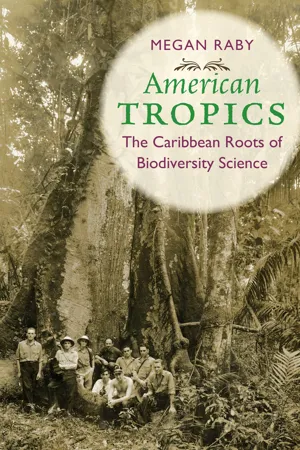
Biodiversity has been a key concept in international conservation since the 1980s, yet historians have paid little attention to its origins. Uncovering its roots in tropical fieldwork and the southward expansion of U.S. empire at the turn of the twentieth century, Megan Raby details how ecologists took advantage of growing U.S. landholdings in the circum-Caribbean by establishing permanent field stations for long-term, basic tropical research. From these outposts of U.S. science, a growing community of American “tropical biologists” developed both the key scientific concepts and the values embedded in the modern discourse of biodiversity.
Considering U.S. biological fieldwork from the era of the Spanish-American War through the anticolonial movements of the 1960s and 1970s, this study combines the history of science, environmental history, and the history of U.S.–Caribbean and Latin American relations. In doing so, Raby sheds new light on the origins of contemporary scientific and environmentalist thought and brings to the forefront a surprisingly neglected history of twentieth-century U.S. science and empire.
- 336 pages
- English
- ePUB (mobile friendly)
- Available on iOS & Android
eBook - ePub
About this book
Information
Table of contents
- Cover
- Series Page
- Title Page
- Copyright
- Contents
- List of Illustrations, Maps, and Table
- Acknowledgments
- Abbreviations in the Text
- Introduction: From Tropicality to Biodiversity
- Chapter One: An American Tropical Laboratory
- Chapter Two: Making Biology Tropical
- Chapter Three: Jungle Island
- Chapter Four: The Question of Diversity
- Chapter Five: A Global Resource
- Epilogue: Postcolonial Ecology
- Notes
- Bibliography
- Index
Trusted by 375,005 students
Access to over 1.5 million titles for a fair monthly price.
Study more efficiently using our study tools.
Frequently asked questions
Yes, you can cancel anytime from the Subscription tab in your account settings on the Perlego website. Your subscription will stay active until the end of your current billing period. Learn how to cancel your subscription
No, books cannot be downloaded as external files, such as PDFs, for use outside of Perlego. However, you can download books within the Perlego app for offline reading on mobile or tablet. Learn how to download books offline
We are an online textbook subscription service, where you can get access to an entire online library for less than the price of a single book per month. With over 1.5 million books across 990+ topics, we’ve got you covered! Learn about our mission
Look out for the read-aloud symbol on your next book to see if you can listen to it. The read-aloud tool reads text aloud for you, highlighting the text as it is being read. You can pause it, speed it up and slow it down. Learn more about Read Aloud
Yes! You can use the Perlego app on both iOS and Android devices to read anytime, anywhere — even offline. Perfect for commutes or when you’re on the go.
Please note we cannot support devices running on iOS 13 and Android 7 or earlier. Learn more about using the app
Please note we cannot support devices running on iOS 13 and Android 7 or earlier. Learn more about using the app
Yes, you can access American Tropics by Megan Raby in PDF and/or ePUB format, as well as other popular books in Biological Sciences & Latin American & Caribbean History. We have over 1.5 million books available in our catalogue for you to explore.