In February 1971, racial tension surrounding school desegregation in Wilmington, North Carolina, culminated in four days of violence and skirmishes between white vigilantes and black residents. The turmoil resulted in two deaths, six injuries, more than $500,000 in damage, and the firebombing of a white-owned store, before the National Guard restored uneasy peace. Despite glaring irregularities in the subsequent trial, ten young persons were convicted of arson and conspiracy and then sentenced to a total of 282 years in prison. They became known internationally as the Wilmington Ten. A powerful movement arose within North Carolina and beyond to demand their freedom, and after several witnesses admitted to perjury, a federal appeals court, also citing prosecutorial misconduct, overturned the convictions in 1980.
Kenneth Janken narrates the dramatic story of the Ten, connecting their story to a larger arc of Black Power and the transformation of post–Civil Rights era political organizing. Grounded in extensive interviews, newly declassified government documents, and archival research, this book thoroughly examines the 1971 events and the subsequent movement for justice that strongly influenced the wider African American freedom struggle.
eBook - ePub
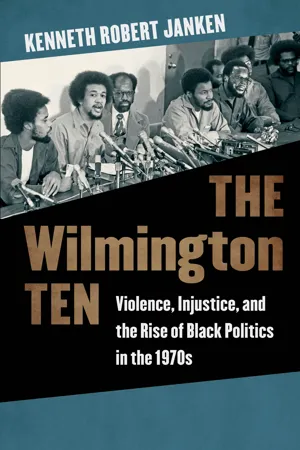
The Wilmington Ten
Violence, Injustice, and the Rise of Black Politics in the 1970s
- 256 pages
- English
- ePUB (mobile friendly)
- Available on iOS & Android
eBook - ePub
The Wilmington Ten
Violence, Injustice, and the Rise of Black Politics in the 1970s
About this book
Information
Chapter 1: Vigilante Injustice
The events surrounding what would become known as the Wilmington Ten began on Monday, 25 January 1971. A fight between black and white students from New Hanover High School in Wilmington, North Carolina, broke out during school hours at the Wildcat, a student hangout about a block from campus. It spilled over to the campus before being broken up by the police. Several students were injured, including Barbara Swain, an African American tenth grader who was cut with a knife by an unidentified white male student. But when Swain reported her injury to the school principal, he showed no interest in identifying the assailant, instead suspending her and four other black students. This incident capped a month of interracial conflict in Wilmington’s high schools. Three days later, one hundred African American students from the city’s two high schools assembled at Gregory Congregational Church to discuss their grievances. For instance, school administrators punished black students for fighting while letting whites go scot-free. The principal permitted adult-age white toughs to loiter on campus and assault black students. White male teachers harassed black students, and in one case a coach beat a black student over the head. They also demanded the establishment of a black studies curriculum and the commemoration of Martin Luther King’s birthday. Connie Tindall, one of the student leaders, declared Friday, 29 January, “Liberation Day” and announced a boycott of school until the school board addressed their grievances. “We’re not getting an education anyway,” said another student, “so why shouldn’t we stay out?”1
The boycott, which continued through the first week of February, was met with white Wilmington’s iron fist. The school board clamped down with suspensions and expulsions. The paramilitary Rights of White People group, aided and abetted by the police and the mayor, attacked the boycotters’ headquarters at Gregory Congregational Church in nighttime drive-by shootings. In response, students and community members, many of them veterans or active-duty soldiers from nearby military bases, established an armed defense of the church. Other blacks in Wilmington retaliated with arson, and property damage over the week of violence was estimated at hundreds of thousands of dollars. The violence culminated during the overnight hours of 6–7 February, when Mike’s, a grocery store near Gregory Church, was burned: the police shot and killed student leader Steve Mitchell, who had gone to check on it, and church defenders shot and killed Harvey Cumber, a white man who made it through police lines, parked his truck in front of the church, and pulled out a gun. On Sunday, 7 February, the North Carolina National Guard occupied Wilmington and imposed some level of order, though racial clashes persisted in the schools and struggles for justice continued in the streets.
The case of the Wilmington Ten emerged out of the events of February 1971. In an effort to lay blame for the violence and remove the effective and popular organizer Benjamin Chavis, the Wilmington police and state prosecutor—assisted by the U.S. Bureau of Alcohol, Tobacco, and Firearms (BATF)—concocted a case against Chavis, eight other black men (five of them high school students), and one white woman. Arrested more than a year after the disturbances, they were charged with conspiracy, burning Mike’s Grocery, and shooting at the firefighters and police who responded to the fire. (Ann Shepard was charged only with conspiracy.) The prosecutor, with the assent of the presiding judge, illegally excluded blacks from the jury. He solicited perjured testimony from his main witnesses to convict the Ten, who were sentenced to a total of 282 years in prison. Their convictions sparked a campaign across North Carolina, the nation, and the world to free them. This movement attracted support from religious institutions, black nationalists, leftists, and civil libertarians. It garnered the involvement of Amnesty International and successfully pressured the administration of President Jimmy Carter to take action, too. The movement forced Governor Jim Hunt to reduce their sentences in 1978, which freed most of them after five years’ imprisonment. In 1980 a federal appeals court overturned their convictions, and the state did not retry them.2
Embedded in the story of the Wilmington Ten are imbricated themes that both define the timeline of the incident and its aftermath and were central to the transformation of black protest and insurgent action into the more recognizable black politics of the late twentieth and early twenty-first centuries. The conflict in the Port City grew from the demands of African American students for an equal and relevant education. In the early 1930s, the great attorney and legal strategist Charles Hamilton Houston identified segregated education as a concentrated expression of all the ills and indignities suffered by African Americans. Following this observation, blacks in Wilmington went to federal court several times in the second half of the 1960s to force the school system to desegregate. But for the high school students of the 1970s, occupying common space with white students was no gift. They insisted on equal access to sympathetic principals, counselors, and teachers. This core issue of educational equality touched off numerous confrontations in North Carolina and elsewhere in the 1970s and continues to do so. The outward forms of the conflicts vary—contestation over ending busing, the diversion of public monies to support vouchers and a proliferation of charter schools, continuing efforts to privatize the public schools, the criminalization of disruptive conduct of minority students while similar behavior by white students is treated as simply a school matter, to identify four that have dominated the news in the early 2000s—but the constant is the continued denial of an equal education to African Americans and other ethnic minorities.
The students who struggled for a decent education in Wilmington’s high schools had to craft their own way forward. The city’s traditional and established African American leaders were hat-in-hand gradualists. Their recipes for change amounted to acting with rectitude, being patient, and waiting for change to occur. Students who wanted to force change received no help from them. Sensing the shifting national spirit, the students improvised on what they had learned from the Black Panther Party and nationalist and anticolonial ideas. The students’ search for protest strategies, tactics, and organization fortuitously met rapidly evolving black nationalist trends in North Carolina, which was a leader in this respect.
With these connections made, local Wilmington activists took up the concerns not just of students but of disenfranchised blacks generally and disseminated an eclectic mix of revolutionary and pragmatic black nationalism. There was a reciprocal effect as well. As the leading black nationalist and revolutionary organizations championed the cause of the struggle in the Port City, the Wilmington Ten became one of the most publicized cases of racial and political injustice. In the 1970s in North Carolina especially but also throughout the United States, women and men who wished to take part in and lead the black freedom struggle had to address this case. Because revolutionaries and black nationalists were guiding the struggle, aspiring African American politicians and race leaders were obliged to join the radicals in a united front. The Wilmington Ten became a prominent example of a new, Left-leaning black politics, one that was concerned with the substantive redistribution of power in America and not merely with a shuffling and reshuffling of names of officeholders. This energetic united front approach held sway into the 1980s, when it was overwhelmed by internal divisions, external repression, and the appearance of the “race leader” from the chrysalis of mass struggle.
African Americans who participated in the Wilmington events or observed them say that the racial trouble in the high schools began in 1968, when Williston, the high school for blacks, was closed down at the end of the school year. As elsewhere in North Carolina and the South, the New Hanover County public schools were under a federal court order to desegregate. But rather than send black and white students to all three of the district’s high schools, the New Hanover County Board of Education, over the vigorous objections of the black community, shut down a critical black institution and dispersed African American students to New Hanover and John T. Hoggard High Schools, which had until that point been exclusively white. Community feelings ran high, leading to intensified distrust of the school system.3 School board chairman Emsley Laney asserted without much explanation that
we felt it would be very difficult to integrate Williston High School and send white students there. It was in a black neighborhood, and this was never discussed a great deal, but we felt that for the benefit of the community as a whole and the school system, the best thing to do was take the black students from Williston and split them between the two white high schools. . . . Williston was a long-time all-black school, so in the process of integration, we deemed it best to change it, and we felt the best thing to do was to send the black students to all-white senior high schools.4
In other words, the community good was defined by what was acceptable to whites.
The effects of such imperiousness rippled through Wilmington’s black community. African American educators in the newly desegregated system were denied avenues for professional advancement and shunned by white teachers. Bertha Todd, the Williston librarian and one of the few of either race in the school system with an advanced degree, was left without employment when the school was shut down. Because of her outspokenness over the years, the school board thought to let her go rather than transfer her to an open position at Hoggard. Only the intervention of a sympathetic administrator got her, rather than a white librarian from Sampson County, that job. Still, she said, the white faculty ignored her and her black colleagues.5 Ernest Swain, a Morehouse and University of Chicago graduate who was principal of James B. Dudley Middle School, was convinced that because of his race he was never seriously considered to be Hoggard High School’s founding principal, despite a stellar administrative record. The school board, he said, hired someone whose main qualification was that he was a retired marine major and a disciplinarian. “He tried to clean it out using army tactics, or marine tactics, I guess. He kept them going and coming, suspending them[;] he did what they hired him to do, no doubt about it.”6
For African American students, the move to the city’s two previously all-white high schools was disastrous on multiple levels. Fights with racial overtones were fairly common in the years following the closing of Williston. A bump in a crowded hallway might very well be followed by racist taunts and then fisticuffs. Eight years after the fact, a black student remembered being suspended after a fight while his white opponent was not. They were called “niggers, coons, spooks,” and other “racial slurs,” recalled “Barnabus.” “The racism was blatant, overt, it wasn’t hidden, it wasn’t concealed racism.” “Daniel Banks,” a pseudonym for another black student at the time, remembered that he and his friends formed a self-defense squad to fight whites who bothered blacks, especially black females. Timothy Tyson recalled similar episodes when he was in a Wilmington middle school in the early 1970s. In addition, fights were started by nonstudent whites who came to the high school apparently with the intention of harassing blacks.7
Some of the insults affected particular groups. Bertha Todd commented that Williston students who were active in student government were forcibly sidelined in their new schools. Coaches refused to play talented black athletes on an equal basis with whites. Connie Tindall, a student leader who later became one of the Wilmington Ten, was perhaps the best-known example. A star football player at Williston with the potential to be a standout in college and even in the professional ranks, Tindall was used sparingly on the Hoggard team. That there were some African American assistant coaches seemed to make no difference. They held little sway over their bosses and were regarded as lapdogs by the students, who demanded that a black coach “function as a coach and not a bell boy.”8
Other black students were punished for speaking their minds. A student at New Hanover High School who worked part-time as a hospital janitor wrote an essay about what he termed a typical dead-end job for blacks in a typical southern town, and during class discussion he talked about racial discrimination in the labor force. The teacher accused him of being provocative, and the principal suspended him for a week. In another example, a music teacher charged Alphonso Pierce with being disruptive because he would not move to the back of the class and called her a “white bitch.” In his defense, Pierce said he was moving to the back and had only mumbled “white bitch” to himself; the teacher, he said, never reacted to the white students who disrupted music. The real issue, he claimed, was that the teacher objected to the leather jackets and Black Panther emblems that he and other black students wore. Nationally, student protests against school desegregation and for civil rights often incorporated a cultural dimension related to personal appearance. Black student revolts sought not only curricular reconfiguration but also to break adult authority’s control over personal expression. From students’ standpoint, a large Afro hairstyle and Black Power attire were repudiations of a racial system that attempted to limit and control them. Even when articulated aesthetically and not politically, these fashion choices were understood by students and school authorities alike as overt challenges to the status quo. “Barnabus” remembered a history of abandonment of black students by white teachers: “They would take time to advise the white students, you know, go over work with the white students, classroom assignments, and the black students were neglected. . . . [I]f you were just an average student and you were black, chances are your grades were pretty bad, because the teachers didn’t take the time that they took with the white students, special tutorial help, you know.”9
Exclusion of black students from their schools’ activities sparked protests. The morning of 7 May 1970 began with about 125 black students at New Hanover protesting the exclusion of black girls from the cheerleading squad and demanding the recognition of black organizations by the school principal. Representatives of the state Good Neighbor Council, which was established by Governor Terry Sanford in 1963 to manage race relations during a time of civil rights insurgency, were called in to mediate, but they could not persuade the students to stand down. Instead, the students gathered in the front of the school, where they were confronted by a group of seventy-five “out of school whites.” Just after lunchtime, an adult white female drove up, got out of her car, and made “a number of distasteful comments” regarding the presence of blacks outside the school. A black female student argued with her, and when a black male student joined in, the white woman slapped him in the face. Only when he pushed her in return did the police, who had been present the entire time, intervene: they arrested the male student and struck a different black female student in her face with a billy club. Meanwhile, Hoggard High School was closed for the day following a morning full of fights, also set off by the exclusion of black females from cheerleading. Despite the presence at both schools of aggressive whites, the only arrests were of blacks, and the Wilmington Morning Star inflamed the situation with misleading and false reports of blacks run amok. “Tension and anger boiled over into mindless violence,” was the paper’s lead in reporting the incident; “throughout the troubled day, police rounded up troublemakers.” As an injured student was loaded into an ambulance, the article reported, “A school bus loaded with black students rolled up alongside. ‘Run over the pigs! Kill the pigs!’ screamed black youngsters from the bus.” By contrast, Aaron Johnson, a black Baptist minister from Fayetteville and racial conservative on the Good Neighbor Council who was pres...
Table of contents
- Cover Page
- The Wilmington Ten
- Copyright Page
- Dedication
- Contents
- Illustrations and Maps
- Introduction
- Chapter 1: Vigilante Injustice
- Chapter 2: The Making of a Movement
- Chapter 3: They’re Taking Our Boys Away to Prison
- Chapter 4: Alliances and Adversity
- Chapter 5: Free the Wilmington Ten at Once!
- Conclusion
- Notes
- Bibliography
- Acknowledgments
- Index
Trusted by 375,005 students
Access to over 1.5 million titles for a fair monthly price.
Study more efficiently using our study tools.
Frequently asked questions
Yes, you can cancel anytime from the Subscription tab in your account settings on the Perlego website. Your subscription will stay active until the end of your current billing period. Learn how to cancel your subscription
No, books cannot be downloaded as external files, such as PDFs, for use outside of Perlego. However, you can download books within the Perlego app for offline reading on mobile or tablet. Learn how to download books offline
Perlego offers two plans: Essential and Complete
- Essential is ideal for learners and professionals who enjoy exploring a wide range of subjects. Access the Essential Library with 800,000+ trusted titles and best-sellers across business, personal growth, and the humanities. Includes unlimited reading time and Standard Read Aloud voice.
- Complete: Perfect for advanced learners and researchers needing full, unrestricted access. Unlock 1.5M+ books across hundreds of subjects, including academic and specialized titles. The Complete Plan also includes advanced features like Premium Read Aloud and Research Assistant.
We are an online textbook subscription service, where you can get access to an entire online library for less than the price of a single book per month. With over 1.5 million books across 990+ topics, we’ve got you covered! Learn about our mission
Look out for the read-aloud symbol on your next book to see if you can listen to it. The read-aloud tool reads text aloud for you, highlighting the text as it is being read. You can pause it, speed it up and slow it down. Learn more about Read Aloud
Yes! You can use the Perlego app on both iOS and Android devices to read anytime, anywhere — even offline. Perfect for commutes or when you’re on the go.
Please note we cannot support devices running on iOS 13 and Android 7 or earlier. Learn more about using the app
Please note we cannot support devices running on iOS 13 and Android 7 or earlier. Learn more about using the app
Yes, you can access The Wilmington Ten by Kenneth Robert Janken in PDF and/or ePUB format, as well as other popular books in History & North American History. We have over 1.5 million books available in our catalogue for you to explore.