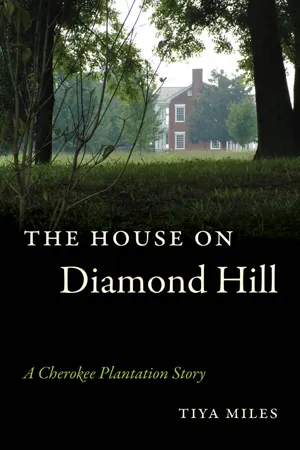
At the turn of the nineteenth century, James Vann, a Cherokee chief and entrepreneur, established Diamond Hill in Georgia, the most famous plantation in the southeastern Cherokee Nation. In this first full-length study to reconstruct the history of the plantation, Tiya Miles tells the story of Diamond Hill’s founding, its flourishing, its takeover by white land-lottery winners on the eve of the Cherokee Removal, its decay, and ultimately its renovation in the 1950s.
This moving multiracial history sheds light on the various cultural communities that interacted within the plantation boundaries — from elite Cherokee slaveholders to Cherokee subsistence farmers, from black slaves of various ethnic backgrounds to free blacks from the North and South, from German-speaking Moravian missionaries to white southern skilled laborers. Moreover, the book includes rich portraits of the women of these various communities. Vividly written and extensively researched, this history illuminates gender, class, and cross-racial relationships on the southern frontier.
- 336 pages
- English
- ePUB (mobile friendly)
- Available on iOS & Android
eBook - ePub
About this book
Information
CHAPTER 1
This Soul-House Built of Mud
Let me live out my years in heat of blood!
Let me die drunken with the dreamer's wine!
Let me not see this soul-house built of mud
Go toppling to the dusk—a vacant shrine.
Let me die drunken with the dreamer's wine!
Let me not see this soul-house built of mud
Go toppling to the dusk—a vacant shrine.
Let me go quickly, like a candle light
Snuffed out just at the heyday of its glow.
Give me high noon—and let it then be night!
Thus would I go.
—John G. Neihardt, “Let Me Live Out My Years,” in A Bundle of Myrrh (1907)
Snuffed out just at the heyday of its glow.
Give me high noon—and let it then be night!
Thus would I go.
—John G. Neihardt, “Let Me Live Out My Years,” in A Bundle of Myrrh (1907)
Introducing James Vann
What manner of man was James Vann? What was the content of his character? These questions troubled Vann's Cherokee countrymen from the Upper Towns on the Little Tennessee River, who described Vann as “a turbulent and dangerous man” in a meeting with President Thomas Jefferson in 1808.1 Another Cherokee, the young leader John Lowrey, charged that Vann “intended to turn boney part” in the way of the famed French ruler Napoléon Bonaparte, who had recently wrested power through military prowess and political stealth.2 More nettled still were white contemporaries who viewed James Vann with anxious consternation. Federal officials labeled him a “villain,” “assassin,” and “desperado,” and Christian missionaries claimed he was caught in the “hands of the evil enemy who has him completely under his power!”3
Modern-day historians and visitors to the Chief Vann House are also beset by the problem of Vann's personality. Attend a Vann House gathering, read a local history bulletin, and the question of Vann's boorish behavior is always at the fore. In 2008, the Athens-based Georgia Gazette radio show posted a less than becoming riddle for listeners to solve on its blog:
Here stands the home of a would-be assassin,
A man so drunk he could not kill
A leader so vengeful no one would test him
Especially his wives, whom he beat for cheap thrills
A man so drunk he could not kill
A leader so vengeful no one would test him
Especially his wives, whom he beat for cheap thrills

Cherokee settlements, circa 1817–23. From Henry Thompson Malone, Cherokees of the Old South: A People in Transition (University of Georgia Press, 1956). Used by permission of the University of Georgia Press.
Around 1800, this man found religion
And he brought the lord's workers to teach his tribe
But he kept drinking whiskey like it was a source of nutrition
Clutching a bottle and glass even as he died.4
And he brought the lord's workers to teach his tribe
But he kept drinking whiskey like it was a source of nutrition
Clutching a bottle and glass even as he died.4
The answer to the riddle was the Chief Vann House, the man profiled so harshly, James Vann. By many accounts both then and now, Vann was a selfish, impulsive person who drank heavily, angered quickly, and often resorted to violence. But several letters penned by Vann and posted to the federal Indian agent document behind-the-scenes political activities that show Vann to be a principled protector of fellow Cherokees. Rather than the boorish, caricatured figure of the radio riddle, my research, in conjunction with the more sensitive historical accounts, reveals James Vann as a person whose life was marked by contrast, as would befit his time and position in a Cherokee Nation pressed by aggressive U.S. settler colonialism. Vann fought valiantly for Cherokees harassed by white frontiersmen, while abusing members of his own Cherokee family. He looked and dressed like a white gentleman but battered whites who visited his home. He welcomed missionaries of the Christian faith yet rudely rejected their God. He danced and drank with black slaves but burned them alive in punishment. According to John Howard Payne, a journalist and playwright who interviewed Cherokees for a work of history in the 1830s, James Vann was “aristocratic, impetuous, and full of chivalric daring” and acted in ways both cruel and patriotic. In a 1950s classic work on Cherokee history, Henry Thompson Malone embellished Payne's portrait, describing Vann as “a peculiar combination of benevolent leader and rip-snorting hoodlum.”5
Throughout his life, James Vann collected a series of enemies, from indignant American officials who criticized his lack of “respectability,” to Cherokee leaders who envied his growing political influence, to righteous black slaves seeking self-liberation and justice.6 It should not be surprising that a man like this lost his life to an act of violence. One missionary who lived near Vann's estate even predicted such an outcome for him, writing in a letter in 1806: “We don't believe that he will die a natural death for his life style and his behavior is such that one can presume he will some day be done in before he expects it.”7 That fateful day came on the 19th of February in 1809. On this blustery evening, James Vann was downing whiskey in a tavern owned by Thomas Buffington. Vann held a bottle in one hand, a glass in the other, and was accompanied by an unnamed slave who was armed, like his master, with “a double pair of pistols, a rifle & a dirk.”8 Vann's favored son, Joseph, a boy of eleven, was sleeping soundly in a chamber on the upper floor. All was well until midnight, when, according to John Howard Payne's account, “the door [of the tavern], which swung loosely, was silently pressed open by the point of a rifle. In an instant, James Vann was dead, and no one has ever known his slayer. He was forty four.” John Norton, a Cherokee raised in England and later adopted by Mohawks, wrote just after Vann's death: “It is said, that the deceased, altho' of considerable natural talents and capable of serving his country; on account of his violent disposition was not generally beloved: this perhaps may be the reason why no greater exertions have been made to bring the culprit to justice.”9
After Vann was gunned down in the dead of night, his missionary neighbors opined that he had been a “well-known man, loved by few, hated by many, feared by almost the whole Cherokee Nation.”10 William McLoughlin, a preeminent historian of Cherokee life, wrote in 1984: “Vann had never been a popular leader and had many enemies.… He seems to have been reckless, a man grown rich and cynical and tired of living.”11 The list of possible suspects for the crime was so long, and the murderous act, in many onlookers' view, so justified, that no one was charged with the shooting. Payne reported, as Norton intimated, that a criminal investigation was never pursued.12
And it is no wonder. The James Vann of nineteenth-century primary accounts was shrewd, selfish, and unpredictable; his oddly paired passions for violence and justice seemed to know nearly no bounds. And the motivating force behind Vann's conduct remained cloaked in mystery upon his death, further disquieting those who sought a plausible cause. Hence, for the two centuries since James Vann lived and died, observers have speculated about the nature of his character. Many contemporary writers have sought to pinpoint the catalyst for Vann's erratic aggression, which was unparalleled among his Cherokee compatriots. Their interpretations—perhaps influenced by our modern-day cultural surround of pop psychology and addiction awareness—range from the political to the psychological and even to the metaphysical, indicating what William McLoughlin has described as the “many dimensions” of James Vann, “this intemperate patriot.”13
In written speculations on what motivated Vann's extreme behavior, alcohol addiction is the most common conclusion. Historian Thurman Wilkins describes Vann as “homicidal,” “a thoroughly godless man,” who “kept gargantuan supplies of brandy and whiskey and dealt drinks like a lord to his followers.” Wilkins suggests that alcoholism enabled Vann's brutal conduct, writing: “He was himself frequently in his cups and when drunk was liable to turn vicious and become as deadly as a water moccasin.”14 Georgia historian Don Shadburn, an expert in the local documents, argues that Vann's uncontrolled drinking shaped Vann's later adulthood, which Shadburn terms “the outlaw years.” “He had taken to the bottle so often,” Shadburn writes, “that his once charitable, diplomatic nature suddenly turned to acts of violence and personal vengeance.”15 These interpretations of alcohol addiction are grounded in the primary documents from Vann's era, but they take on added connotations in public discourse today in which the stereotypical drunken Indian permeates popular culture. The Georgia radio contest described above stigmatizes Vann in a way that taps into that racialized stereotype, as do, it must be noted, historical accounts that describe Vann in animalistic terms such as “water moccasin.”
Contemporary memoirist and Vann descendant Barbara Vann Pommer attempts to defend Vann against the charge, and perhaps the stereotype, of drunkenness. She asserts in an undated, self-published book that Vann had schizophrenia, a condition that she argues has been overlooked due to a focus on his drinking. Vann House chief interpretive ranger Julia Autry also speculates about the possibility of mental illness. She wonders if James Vann contracted syphilis at a young age and slowly deteriorated as a result, since syphilis was a commonly undiagnosed illness in the nineteenth century that could lead to brain damage and mental and emotional instability.16 Autry also points to an odd exchange between Vann and his missionary neighbors in the summer of 1805. Vann called for the missionaries to come see him, at which point one of the brethren found Vann “almost out of his mind with pain because a live creature had gotten into his ear,” and reported that “[h]e [Vann] himself believed he would pass away on this occasion.”17 Autry speculates that since the summer of 1805 marked the height of Vann's violent activity, this “creature” may have been a behaviorally debilitating parasite.
Building on Autry's observation of the importance of this passage and drawing from the anthropological notion of ethnomedicine that ascribes experiences of illness and healing to particular cultural understandings, another interpretation of this incident is that Vann believed there was a creature in his ear as the result of a spiritual assault.18 Like many peoples then and now, Cherokees believed in witchcraft and sorcery. They saw the witch's chief talents as the ability to think bad things into being and attributed to witches the malevolent insertion and withdrawal of objects into and from the body. The latter characteristic was so fundamental to the witch's being that one Cherokee term for sorcerer (dida:hnese:-sgi) was translated by Cherokee anthropologists Jack and Anna Kilpatrick as meaning: “putter-in and drawer-out of them, he.”19 As a Cherokee who steadfastly rejected Christianity, Vann would have known that “psychological discomfort or pathological illness” could be caused by a witch's “magical introjection of objects or minute animate beings into the victim.”20 He also knew himself to be a man with many enemies. Vann's exchange with the missionary might have reflected Vann's belief that he had been bewitched by the implantation of a live foreign creature. This spiritual attack, or the belief in it, could have led Vann to paranoia, increased substance abuse, and the deterioration of his mental faculties. Vann's missionary neighbors would have agreed with Pommer's assessment that Vann, because of causes natural or supernatural, was at least temporarily mentally ill and concurred with Autry's dating of the onset of that illness to the summer of 1805, since they wrote in their diary in July of that year: “Recently he [Vann] conducts himself generally so that one might think he has lost his mind.”21
Continuing in a vein more psychoanalytical then psychomedical, in a biographical booklet, Vann descendant James Bell attributes Vann's “inexplicability” and “turbulence” to his “half-blood nature” and the “conflicts inherent in these two ethnic worlds.”22 In what would now be viewed by many readers as overly simplistic phrasing that discounts the cultural sophistication of Indian individuals, Bell explains that Vann, the child of a native mother and European father, struggled to “adapt to the ways of the white man” yet was “compelled to follow the way of his ancient tribal heritage” and was therefore “a man torn between two worlds.” Added to this internal burden, Bell rightly argues, were the extreme pressures of leadership in a native nation beset by turmoil.23 William McLoughlin shares this view of acculturation strain, writing: “[Vann] desperately wanted to be admired and respected, but only on his own terms. Caught between the irreconcilable worlds of red and white, he was consumed by a profound impulse toward self-destruction.”24
Although some of these interpretations are tinged by limited views of Native American subjectivity, each contains a measure of insight. It is persuasive that a combination of causes—alcoholism, mental instability caused by physical illness or the belief in supernatural attack, the pressures of identity strain and leadership responsibility, and the character flaw of impetuous arrogance—could have produced a man like James Vann. But borrowing from the recent work of Native American studies scholars like Ned Blackhawk, Philip Deloria, and Andrea Smith, we might add to these an additional, critical factor: the context and culture of U.S. colonialism and concomitant violence. James Vann was surely idiosyncratic in his quest for personal dominance, and he may have had an Achilles heel–like addiction to alcohol, but overshadowing these personal failings and even shaping them, was the reality of European and American conquest of indigenous nations. In short, the content of James Vann's character was shaped by both his unique personality traits and the socio-historical circumstance he shared with other Cherokees. The story of James Vann and his plantation enterprise emerges from a larger framework that Ned Blackhawk has called the “[h]arrowing, violent histories of Native peoples caught in the maelstrom of colonialism.”25
From the time of James Vann's boyhood in the 1760s to the time of his young manhood in the 1790s, the Cherokee Nation was under a devastating economic and military attack that had begun with British incursions in the late 1600s and would continue long after Vann's death.26 Vann learned early, and above all else, of the vulnerability of the Cherokee people and the role of violence in their subjection and defense. Like youngsters born into battlescarred countries in our own time, James Vann was a child of war. Perhaps this is why, in the absence of sufficient documented material about James Vann's early life, two legendary stories about the young Vann survive. Both stories feature a boy in mortal danger amid the chaos of cultural disorientation and the onslaught of violence. In the first story, Vann himself is the boy in trouble; in the second, he attempts to rescue another boy from harm. Both tales highlight a context of limited options in which unthinkable bloodshed is the inevitable outcome.
The single surviving story of James Vann's childhood can be traced back to one of the most extensive English-language sources on Cherokee history—John Howard Payne's fourteen volumes of not...
Table of contents
- Cover Page
- Title Page
- Copyright Page
- Dedication
- Contents
- Illustrations
- Housewarming A PROLOGUE
- This Old House AN INTRODUCTION
- CHAPTER 1 This Soul-House Built of Mud
- CHAPTER 2 House-Raising
- CHAPTER 3 The Big House/The Slave Quarter
- CHAPTER 4 A House Divided
- CHAPTER 5 House of Prayer
- CHAPTER 6 In My Father's House Are Many Mansions
- Bleak House AN EPILOGUE
- Open House A CONCLUSION
- Acknowledgments
- APPENDIX 1 RESEARCH PROCESS, METHODS, AND FINDINGS
- APPENDIX 2 BLACK SLAVES AND FREE BLACKS ON THE VANN PLANTATION, Compiled by Julia Autry and William Chase Parker, Chief Vann House State Historic Site
- Appendix 3 THE MEMOIR OF MARGARET ANN CRUTCHFIELD (PEGGY SCOTT VANN), Written by Anna Rosina Gambold
- Notes
- Bibliography
- Index
Trusted by 375,005 students
Access to over 1.5 million titles for a fair monthly price.
Study more efficiently using our study tools.
Frequently asked questions
Yes, you can cancel anytime from the Subscription tab in your account settings on the Perlego website. Your subscription will stay active until the end of your current billing period. Learn how to cancel your subscription
No, books cannot be downloaded as external files, such as PDFs, for use outside of Perlego. However, you can download books within the Perlego app for offline reading on mobile or tablet. Learn how to download books offline
Perlego offers two plans: Essential and Complete
- Essential is ideal for learners and professionals who enjoy exploring a wide range of subjects. Access the Essential Library with 800,000+ trusted titles and best-sellers across business, personal growth, and the humanities. Includes unlimited reading time and Standard Read Aloud voice.
- Complete: Perfect for advanced learners and researchers needing full, unrestricted access. Unlock 1.5M+ books across hundreds of subjects, including academic and specialized titles. The Complete Plan also includes advanced features like Premium Read Aloud and Research Assistant.
We are an online textbook subscription service, where you can get access to an entire online library for less than the price of a single book per month. With over 1.5 million books across 990+ topics, we’ve got you covered! Learn about our mission
Look out for the read-aloud symbol on your next book to see if you can listen to it. The read-aloud tool reads text aloud for you, highlighting the text as it is being read. You can pause it, speed it up and slow it down. Learn more about Read Aloud
Yes! You can use the Perlego app on both iOS and Android devices to read anytime, anywhere — even offline. Perfect for commutes or when you’re on the go.
Please note we cannot support devices running on iOS 13 and Android 7 or earlier. Learn more about using the app
Please note we cannot support devices running on iOS 13 and Android 7 or earlier. Learn more about using the app
Yes, you can access The House on Diamond Hill by Tiya Miles in PDF and/or ePUB format, as well as other popular books in Social Sciences & North American History. We have over 1.5 million books available in our catalogue for you to explore.