Tracing the deep roots of women’s activism in America, Anne Boylan explores the flourishing of women’s volunteer associations in the decades following the Revolution. She examines the entire spectrum of early nineteenth-century women’s groups — Protestant, Catholic, and Jewish; African American and white; middle and working class — to illuminate the ways in which race, religion, and class could bring women together in pursuit of common goals or drive them apart.
Boylan interweaves analyses of more than seventy organizations in New York and Boston with the stories of the women who founded and led them. In so doing, she provides a new understanding of how these groups actually worked and how women’s associations, especially those with evangelical Protestant leanings, helped define the gender system of the new republic. She also demonstrates as never before how women in leadership positions combined volunteer work with their family responsibilities, how they raised and invested the money their organizations needed, and how they gained and used political influence in an era when women’s citizenship rights were tightly circumscribed.
- 360 pages
- English
- ePUB (mobile friendly)
- Available on iOS & Android
eBook - ePub
About this book
Information
Chapter One: Patterns of Organization
Women’s voluntary societies proliferated in the postrevolutionary years. As much as did men, American women helped create “the age of benevolent institutions” so striking to Noah Worcester in 1816, and so impressive to Alexis de Tocqueville in 1832.1 Some were little more than fund-raising agencies dedicated to a particular purpose—such as sending missionaries to convert nonbelievers—while others conducted far-flung charitable businesses that raised money, ran institutions such as orphanages or old age homes, lobbied politicians, and found foster homes for needy children. Still others devoted their energies to mutual aid and self-help, or to the eradication of specific social practices, such as prostitution. Many had nothing in common with others but the sex of their founders.
Paralleling the emergence and spread of these groups were important changes in women’s social experiences and in ideologies about womanhood. The same decades that witnessed the development of the first permanent women’s societies saw a major refiguring of the colonial gender system to accommodate the economic, political, and religious upheavals that accompanied and followed the American Revolution. The coincidence among these developments was not a mere temporal accident. After all, the earliest groups emerged in urban areas among Protestant women whose personal experience and social location provided both the motivation and the means to remake the traditional almsgiving woman into the modern organized benefactor. Moreover, the existence of collectively organized, publicly visible female benevolence quickly came to symbolize the new womanhood of the nineteenth century, and an individual’s participation in associational endeavors came to be accepted and admired as evidence of her claims to “true womanhood.” Only in the 1830s did some organized women—notably abolitionists—come under attack for their labors, and then only for their methods and goals, not for organizational activity per se.2
In both laboring and justifying their labors, the founders of women’s organizations helped create and reproduce a gender system to fit the times. Although it remained hierarchical by sex, the new gender system incorporated democratic ideals, largely by defining women’s secondary status within society as separate from and complementary to men’s. Just as the primacy and political independence of the free male citizen would rest upon his control of property and dependents (wife, children, servants, or slaves), the authority of the democratic patriarch would devolve from his ability solely to represent the interests of the entire family unit in the public arenas of politics and law.3 By founding organizations and incorporating organizational work into new definitions of femininity, some women helped shape the new gender system and define the feminine sphere. At the same time, by setting limits on appropriately feminine activities, their labors created new distinctions among women themselves and new hierarchies of acceptable female behavior.4
Nineteenth-century gender ideology obscured these hierarchies by considering masculine and feminine “spheres” as equal, and by stressing women’s common experiences as women. The concept of a unitary female nature rooted in biology served many useful functions in nineteenth-century society, including “contribut[ing] to many women’s sense of power and autonomy … [and] to a process of middle-class self-definition.” In embracing that notion, women activists shaped the new gender ideology while also justifying the extraordinary proliferation of woman-run organizations. New female social experiences, gender ideologies, and women’s associations took root and blossomed together, their vines inextricably intertwined. In the process, the republican mother of the 1790s became the “true woman” and Christian mother of the 1830s, as femininity and religiosity came to be closely associated.5 The contradictory consequences that ensued from these new definitions of femininity can be seen in the differing experiences of women in different associations (as well as of their clients). For some, social experience and ideology blended seamlessly, offering personal validation and collective power. For others, especially those women whose racial, class, or religious identities made them ineligible for membership in the best-known and most prestigious organizations, ideology and experience could be confusingly at odds. Although they all gazed into the same ideological mirror, looking for the unitary “woman” of nineteenth-century lore, often the image became a fun-house reality fractured by the deep divisions of nineteenth-century urban life.
Examining the patterns of organization evident among various groups of women in New York and Boston over the decades from the 1790s to the 1840s enables us to see how the dominant antebellum gender ideology evolved and to connect it to new practices in class relations. For as historians have frequently noted, in the nineteenth century, gender ideology and class definition were closely linked, and both found expression in the associations people joined.6 When we look at how different types of women’s organizations came into being, created conditions for additional groups to form, institutionalized opportunities for organizational activity, formed networks or snapped linkages, and in general rooted associational activity deeply into women’s “sphere,” we can better understand both gender ideology and class formation in antebellum New York and Boston.
The First Wave, 1797–1806
Several patterns recurred independently in the two cities. The first pattern was temporal. Both cities witnessed an initial wave of organizing at the turn of the nineteenth century, followed by a cascade of activity during and after the War of 1812, then an ebb in the 1820s, followed by a new surge in the late 1820s and 1830s. (See Appendix 1 for a list of organizations.) The latter surge contained within it smaller waves that broke separately, creating a succession of three organizational types: benevolent associations, which arrived first and remained the most numerous and ubiquitous throughout the era; mutual benefit or mutual aid societies, which arose in each city during the 1820s; and reform associations, which arrived in the 1830s.
Women in each city established the tradition of organized female benevolence in the 1790s; by 1840, both had an array of such groups. Devoted to improving the temporal and spiritual welfare of clients ranging from widows and orphans to ministerial students and prostitutes, such endeavors responded to concrete economic changes, especially in the conditions facing poor urban women and children. These efforts also reflected parallel alterations in well-off women’s lives. Both “subjective necessity” and objective reality transformed individual charity into organized benevolence.7 Like their charitable forebears, members of benevolent associations assumed a vertical relationship between benefactor and client; unlike them, they employed a “rhetoric of female benevolence” that presupposed a uniform experience of womanhood. New York’s Society for the Relief of Poor Widows with Small Children, initiated in 1797 with a singularly descriptive title, fit the genre, as did an offshoot for orphaned clients, the Orphan Asylum Society (1806), and the Female Association (1798), a Quaker group providing “donations to the Poor” and then opening a school for children “whose parents … are evidently unable to defray the expenses of their education.” So, too, did Boston’s Female Asylum (1800), whose organizers created a refuge for young female orphans, and its Female Missionary Society (1800), which raised “an annual collection for the express purpose of aiding” Congregationalist and Baptist missions.8
In creating formal associations with written constitutions, elected officers, fund-raising mechanisms, printed reports, and (sometimes) incorporated legal status, the founders of these societies cast conventional female charity into a new mold. Existing men’s societies provided an accessible model, on which women drew freely, but the sources of their formalizing instincts were more numerous and diverse. One was certainly the revolutionary experience, when American women had first organized independently to pursue a collective public goal. Another was the Quaker tradition of women’s meetings, which provided the proximate model for New York’s Female Association. Still another was the long history of organized women’s prayer meetings, which were well entrenched in evangelical practice by the 1790s. Yet a fourth was the experience of aiding men’s groups; Isabella Graham had labored actively for the London and New York Missionary Societies, “gathering intelligence and endeavoring to collect money,” before helping initiate the Society for the Relief of Poor Widows with Small Children, and the Orphan Asylum Society. But such specific precedents were less important than key alterations in northern urban women’s experiences between the 1760s and the 1790s, including improved access to formal schooling, increased exposure to a new world of printed books and magazines, practical immersion in the rapidly changing commercial economy of the late eighteenth-century city, broader exposure to nonfamilial and noncongregational forms of religious proselytizing, and a new consciousness of gender as a way of organizing social experience.9
In various ways, changed female experience led separate groups of women to create these pioneering organizations. Within the ranks of their founders were women who embodied some or all of the elements of that changed experience. New York’s Female Association, made up largely of young unmarried Quaker women, owed its existence not only to the long Friends’ tradition of benevolence but also to the founders’ superior educations, their awareness that literacy provided through formal schooling was becoming valuable currency in the new commercial world of the nineteenth century, and their temporary freedom from direct family responsibilities. The older, wealthier married women who founded Boston’s Female Asylum drew upon a different experiential base, but stressed the same need to teach orphaned girls “to read, write, sew and do all kinds of domestic business.” As treasurer, fifty-seven-year-old Elizabeth Peck Perkins could marshal thirty years’ experience as a shopkeeper and businesswoman; undoubtedly it was her advice that led the founders to decide at their very first monthly meeting to invest donated funds in stock and use the interest for operating expenses. When Perkins died in 1807, her place was taken by Eleanor Peirce Davis, born in 1750, who had wide experience managing her late husband’s property and running a sugar refinery. New Yorker Mary Weygand Chrystie, a china and glass merchant, contributed similar worldly financial expertise to the Society for the Relief of Poor Widows with Small Children, as did Isabella Graham, owner and principal of female academies in Scotland and then New York since 1776.
With extensive literary and epistolary contacts on both sides of the Atlantic, Graham represented yet another strain in the founders’ experience. Like many of them, she regularly read English and Scottish publications; she also sent examples of American publications to her correspondents. But more than most, she was immersed in an evangelical religious world, one that fostered affiliation and outreach and worked against narrow sectarian parochialism. In this she resembled Bostonian Mary Webb, the twenty-one-year-old founder of the Female Missionary Society who by 1817 was corresponding with women in ninety-seven similar organizations. Whether evangelical or not, the founding generation inhabited a mental world increasingly constructed through printed materials circulating through national and transatlantic arteries. They also shared an understanding of gender—the experience of womanhood or manhood—that stressed common feminine experiences and common values. Members of the Boston Female Asylum might phrase their mission in terms of women’s collective sympathy for “those of their own sex, when unprotected by Parents or Friends,” while members of the Female Missionary Society voiced their plans in specifically evangelical appeals to “females professing godliness,” but the effect was similar. In uniting as women (albeit as white, Protestant, and privileged women), both evangelical and nonevangelical founders harnessed new understandings of womanhood and new beliefs in the importance of shared feminine experience. As they did, they “conflat[ed] … the virtuous with the feminine” and justified creating pockets of authority for themselves through associations.10
The authority they sought was to be exercised primarily over other women and over children. The same economic and social changes that altered the founders’ lives, opening new possibilities to them, simultaneously rendered many poorer women’s lives more precarious and changed their relationship with their social “betters.” The poor widow and her orphaned children, cast unprotected onto a cutthroat labor market, figured centrally in the founders’ plans as the embodiments of an alternate fate. When the women of New York’s Orphan Asylum Society invoked the “divine compassion” that “has marked the fatherless” as “peculiar subjects” of concern, they did so without irony. Motherlessness was a sad fate; fatherlessness could be devastating. Without a protector, an inheritance, or a remunerative skill, the widow and her children were thrust into a situation where women’s work commanded the lowest wages, and children were liabilities. References by members of the Boston Female Asylum to girls lacking “patronage” or being left “unprotected by Parents or Friends” reflected stark realities. But if, in an earlier time, individual charity and almsgiving had sufficed to enable the fortunate giver to assist her poorer counterpart, by the turn of the century “protection” or “patronage” seemed best furnished collectively.11
These early associations facilitated the formation of subsequent organizational waves by creating precedents and clearing paths that remained open for all successor groups. Leaders of both the New York Society for the Relief of Poor Widows with Small Children and the Boston Female Asylum, as pioneers in their cities, faced down criticisms that quickly evaporated. Seven years after helping found the New York group, Isabella Graham marveled at the change she had witnessed: initial “ridicule” and “opposition” had turned to approbation and fame. Whereas at first “the men could not allow our sex the steadiness and perseverance necessary to establish such an undertaking,” she told the young women who operated the society’s school, by 1804 God’s “seal upon it” was evident in its prosperity. Almost as she spoke, members of the Boston Female Asylum could read letters in a local paper challenging the group’s plans. “The direction of property requires masculine exertions,” wrote their critic; it was “unnatural” for “frail feeble woman, to thwart the design of her creation,” as asylum leaders proposed, by organizing formally. “The indelicacy, the indecency of the thing is manifest,” he concluded. Although asylum founder Hannah Morgan Stillman had (anonymously) used the public press to propose such an endeavor, fearing “objections and delay … [and] unmerited censure from some,” she had held the first meeting in a private house.12 Like Graham’s group, hers prevailed, not only in organizing but in acquiring legal standing through incorporation. Later societies might sometimes face severe obloquy, but whatever criticism came their way focused on their particular programs or activities, not their right to formal existence. Once settled, that question remained settled.13
So too did issues surrounding organizations’ legal status and financing techniques. Once the Society for the Relief of Poor Widows with Small Children had acquired corporate status under New York State law in 1802 and Boston’s Female Asylum had done the same under Massachusetts law in 1803, future groups’ right to incorporate was not challenged. Not all women’s organizations sought acts of incorporation, but those that did had the process smoothed and simplified by their predecessors. Legislatures in both states quickly got used to treating women’s associations exactly as they treated other petitioners for incorporation—churches, men’s voluntary societies, joint stock companies—and granted most requests automatically. This occurred despite the ironic reality that, as several historians have underscored, corporate status granted the collective female body a range of legal rights that none of the wives within it could claim individually, including the right to own property, bring legal suits, indenture minor children, invest funds, and control wages. Whether incorporated or not, early societies drafted constitutions and by-laws and composed annual reports to supporters; when they published some or all such documents, they established their right of access to the public media. (See Figures 1.1 and 1.2.) Later societies (such as moral reform groups) might be roundly disparaged for the content of their publications or the purposes of their asylums, but the critique of a specific group never turned into an attack on all of organized womanhood.14
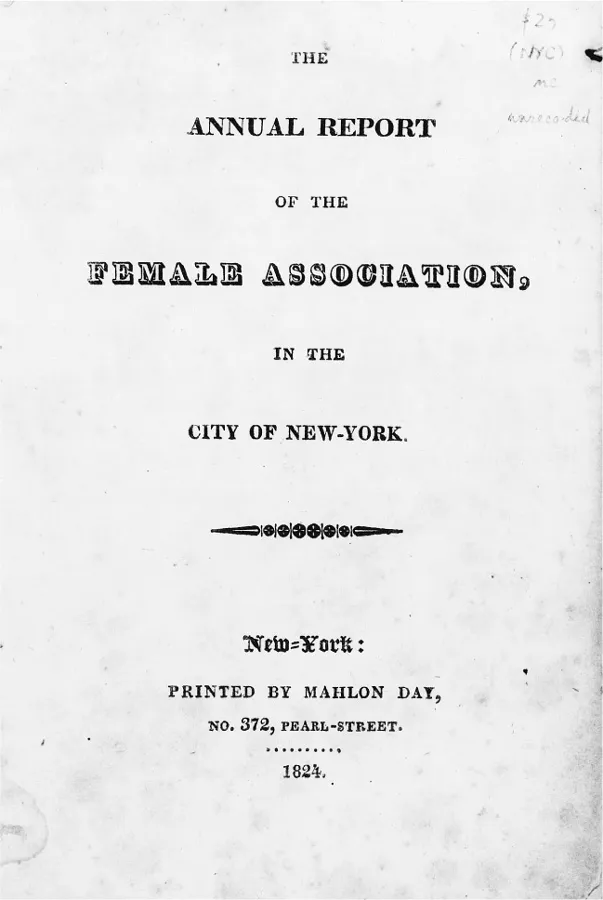
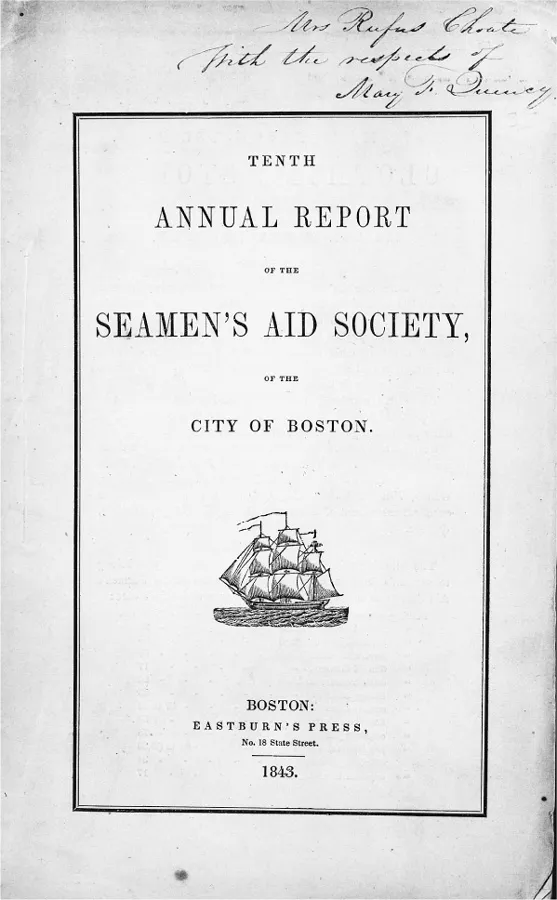
FIGURES 1.1 AND 1.2. Title pages of the New York Female Association’s 1824 Annual Report and the Boston Seamen’s Aid Society’s 1843 Annual Report. The Seamen’s Aid Society’s report is inscribed by the secretary, Mary F. Quincy, to Mrs. Rufus Choate, a subscriber. Published reports and circulars ranged from simple four- or eight-page pamphlets to larger productions with illustrations. (Courtesy of the Library Company of Philadelphia)
In developing fund-raising and financing techniques, too, early organizations smoothed the route for others. Women’s first efforts to collect funds for public purposes dated to the Revolutionary War, when Philadelphian Esther De Berdt Reed instigated a campaign to provide monetary bonuses to soldiers in the Continental Army. The permanent organizations that followed the Revolution elaborated on techniques employed by Reed and her associates, including door-to-door solicitations and annual or lifetime membership subscriptions. The anniversary sermon delivered by a sympathetic and admiring clergyman was another existing technique; adapted from men’s organizations, it proved a mainstay of women’s fund-raising for generations. And selling clients’ products or access to their labor power was a popular practice derived from revolutionary-era poor-relief project...
Table of contents
- Cover Page
- The Origins of Women’s Activism New York and Boston, 1797–1840
- Copyright Page
- Dedication
- Contents
- Acknowledgments
- Introduction
- 1 Patterns of Organization
- 2 Domesticity and Organizational Work
- 3 Portraits of Women Organizers
- 4 Politics
- 5 Economies
- Conclusion
- Appendix 1: Women’s Organizations
- Appendix 2: Tables
- Notes
- Index
Trusted by 375,005 students
Access to over 1.5 million titles for a fair monthly price.
Study more efficiently using our study tools.
Frequently asked questions
Yes, you can cancel anytime from the Subscription tab in your account settings on the Perlego website. Your subscription will stay active until the end of your current billing period. Learn how to cancel your subscription
No, books cannot be downloaded as external files, such as PDFs, for use outside of Perlego. However, you can download books within the Perlego app for offline reading on mobile or tablet. Learn how to download books offline
Perlego offers two plans: Essential and Complete
- Essential is ideal for learners and professionals who enjoy exploring a wide range of subjects. Access the Essential Library with 800,000+ trusted titles and best-sellers across business, personal growth, and the humanities. Includes unlimited reading time and Standard Read Aloud voice.
- Complete: Perfect for advanced learners and researchers needing full, unrestricted access. Unlock 1.5M+ books across hundreds of subjects, including academic and specialized titles. The Complete Plan also includes advanced features like Premium Read Aloud and Research Assistant.
We are an online textbook subscription service, where you can get access to an entire online library for less than the price of a single book per month. With over 1.5 million books across 990+ topics, we’ve got you covered! Learn about our mission
Look out for the read-aloud symbol on your next book to see if you can listen to it. The read-aloud tool reads text aloud for you, highlighting the text as it is being read. You can pause it, speed it up and slow it down. Learn more about Read Aloud
Yes! You can use the Perlego app on both iOS and Android devices to read anytime, anywhere — even offline. Perfect for commutes or when you’re on the go.
Please note we cannot support devices running on iOS 13 and Android 7 or earlier. Learn more about using the app
Please note we cannot support devices running on iOS 13 and Android 7 or earlier. Learn more about using the app
Yes, you can access The Origins of Women's Activism by Anne M. Boylan in PDF and/or ePUB format, as well as other popular books in Social Sciences & North American History. We have over 1.5 million books available in our catalogue for you to explore.