The history of modern liberalism has been hotly debated in
contemporary politics and the academy. Here, Judith Stein uses
the steel industry — long considered fundamental to the U.S.
economy — to examine liberal policies and priorities after World
War II. In a provocative revision of postwar American history,
she argues that it was the primacy of foreign commitments and the
outdated economic policies of the state, more than the nation’s
racial conflicts, that transformed American liberalism from the
powerful progressivism of the New Deal to the feeble policies of
the 1990s.
Stein skillfully integrates a number of narratives usually
treated in isolation — labor, civil rights, politics, business,
and foreign policy — while underscoring the state’s focus on the
steel industry and its workers. By showing how those who
intervened in the industry treated such economic issues as free
trade and the globalization of steel production in isolation from
the social issues of the day — most notably civil rights and the
implementation of affirmative action — Stein advances a larger
argument about postwar liberalism. Liberal attempts to address
social inequalities without reference to the fundamental and
changing workings of the economy, she says, have led to the
foundering of the New Deal state.
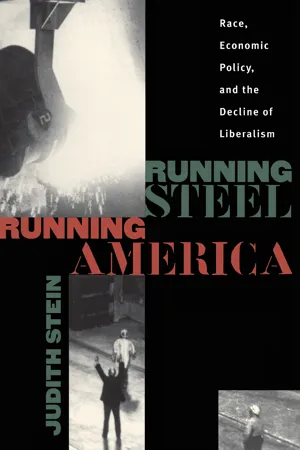
eBook - ePub
Running Steel, Running America
Race, Economic Policy, and the Decline of Liberalism
- 432 pages
- English
- ePUB (mobile friendly)
- Available on iOS & Android
eBook - ePub
About this book
Information
Chapter One: The Politics of Steel Fundamentalism: The Long 1950s
In 1951 Benjamin F. Fairless, chairman and CEO of U.S. Steel, proclaimed that the American steel industry “is bigger than those of all the other nations on earth put together.” Fairless praised workers and managers, saying their joint achievement “stands as a glorious tribute to the men who make steel and the men who built steel in America.” The causes were not as self-evident as the chairman implied, and his arithmetic was imperfect, but the supremacy was real. In that year, for the first time the industry produced over 100 million tons of steel, about 45 percent of the world’s total output. Measured by technology, size, and efficiency, the United States was the leading global producer. Fairless, like the nation, had feared a return to the economic stagnation of the 1930s after World War II. But buoyant consumer demand and later the military spending that accompanied the Korean War dramatically altered gloomy forecasts, allowing the normally dour chairman to express the pride of the industry.1
U.S. Steel itself accounted for nearly 30 percent of the nation’s output, a sizable figure but lower than the two-thirds share it held earlier in the century. Over 250 companies made steel, but twelve controlled 80 percent of the capacity. These twelve, and other integrated firms, performed three operations: made pig-iron in blast furnaces, turned the iron into steel in open-hearth furnaces, and cast or rolled the steel into different shapes, such as sheets, plates, structural beams, rails, bars, and pipes. The execution of these three main operations on one site was the most efficient means of production. Some of the largest companies, especially U.S. Steel and number-two Bethlehem Steel, also owned ore and coal mines, limestone quarries, and other raw materials necessary to produce steel. At the other end of the cycle, they fabricated products like bridges and ships. But in the main, the companies sold steel to other manufacturers.2
The steel they made reflected the growth of new markets. Workers cooked and poured, dipped and bathed, rolled and coiled rivers of steel for the automobile, appliance, and food-processing industries. They made structural beams to gird new office towers and steel sidings for houses and warehouses. They pressed and welded steel plate into huge arteries of oil and natural gas, which were rapidly replacing coal throughout the economy. They made steel for earth-moving equipment and urban infrastructure as well as for newer computers and household gadgets. The industry’s downstream additions tapped new consumer markets. In 1944, U.S. Steel acquired an interest in Gunning Housing Corporation, a pioneer in prefabricated homes. It subsequently sold its subsidiary Federal Shipbuilding and Dry Dock Company to the Navy, and later did the same with its steamship company. In the new America, houses were in, ships were out.3
The twentieth-century trend that shifted production from Pennsylvania to the Midwest, the industrial core of the nation, continued. But steel output increased in every region. West coast facilities, constructed during the war to produce plates for ships, now supplied steel for the region’s growing cities and canning industries. New mills in Texas supplied the oil and gas industry. Older ones in Alabama were supermarkets for an industrializing South.
Fairless’s optimism, matched by that of many other industrialists, added up to a utopian vision of the American, even the global, future. In 1955, the decade’s peak year for steel production, a group of British industrialists spent several weeks studying American steel foundries and returned singing the praises of the industry’s use of technology, manpower, and time. The magazine Fortune believed their appraisal heralded a social and cultural revolution:
Man-made abundance is making the average man wealthy by the standards of fifty years ago, swiftly eliminating poverty and distress, stamping out disease, prolonging life, undermining useless or obsolete institutions, building up useful ones, helping other nations to struggle up the difficult and often disappointing road to efficiency, creating more and more leisure, and changing swiftly and radically the tastes and habits of the people world over. Nothing, perhaps, has altered the world more in all the history of Western civilization than rising American productivity has in the last half century.4
Fortune’s giddy projections were exaggerated, but they were not invented. Recall the situation of the typical steelworker on the eve of Pearl Harbor. His income reached 80 percent of the cost of maintaining the following modest standard of living for a family of four or five: a new coat for each parent every six years, a new pair of shoes every two, two-and-a-half shirts for the husband and two dresses for the wife each year, a rented apartment of five or six rooms, and an old used car. In 1942, 15 percent of steelworkers had lived in homes without running water and 30 percent had no indoor bathroom.5
During the fifteen years after the war, rising productivity advanced the GNP 37 percent in real terms, and the wage component of national income rose slightly. Disposable income increased 15 percent in real dollars. Three-fifths of all families had discretionary income. Steelworkers obtained paid vacations, holidays, pensions, and health insurance, which became norms of working-class life. For the generation that had lived through the Great Depression these improvements and the low unemployment seemed miraculous. During the 1930s, jobless rates ranged from 14 to 25 percent; in the 1950s the average was 4.6 percent.6
Many workers now were homeowners living outside of the cities. Fortune called blue-collar suburbanites “the new masses.” By 1960 the number of suburbanites equaled the number of city dwellers. Fourteen of fifteen cities with more than 1 million people lost population during the 1950s. The migrations were made possible by higher wages, thirty-year GI mortgages, the application of mass-production techniques to home-building, federal highway construction, and corporate decisions to locate operations away from cities. Young, large families provided a ready market for all sorts of household goods that had been out of the reach of their parents. The washing machine, refrigerator, and vacuum cleaner had come to the working class, along with novelties that some made the signature of the era: color TV in 1953, all-transistor radios and polyurethane foams in 1955, synthetic diamonds in 1957, and stereophonic records in 1958. The automobile became the vehicle of choice. Americans owned 40 million cars in 1950, 62 million by 1960. They would eventually travel on 41,000 miles of fast roads—turnpikes, freeways, thruways—planned by the Interstate Highway Act of 1956.7
The academy added an approving voice. “Convergence theory” was based upon economist Simon Kuznets’s argument that earning disparities declined as productivity increased. In plain language, class would no longer be a salient division in American life. Many liberals agreed and abandoned the union movement that no longer seemed to be the underdog.8 Left-wingers sometimes disposed of workers along with their Marxism. The ex-Socialist Daniel Bell, then a writer at Fortune, sympathized with the “unorganized middle-class” and “petits rentiers.”9
Intellectuals discovered new afflictions. Rising living standards transformed the mass political and economic opposition of the 1930s and 1940s into elite psychological and aesthetic dissent. The young African American novelist Paule Marshall and white anthropologist Eleanor Leacock complained that they felt “isolated, . . . powerless to direct our own lives; and increasingly threatened with becoming objects.”10 Others decried banal mass culture, the conformity of “the lonely crowd,” and the bureaucratic monotony and status seeking of the corporate world. John Kenneth Galbraith’s The Affluent Society (1958) lamented the impoverishment of the nations public sector and exhorted Americans to pursue values more noble than productivity. But Galbraith, like his contemporaries, believed that America had eliminated most of the “uncertainties of economic life.”11
The German émigré Herbert Marcuse was more critical than Galbraith, but he agreed that western culture had solved the age-old scarcity problem. Marcuse’s Eros and Civilization (1955) argued only that abundance would not usher in Fortune’s utopia. While the technology that produced affluence eliminated the necessity for social and sexual repression, he claimed, the practices and values of the era of scarcity remained. Humans would achieve happiness, Eros would be liberated, only if the organization of production, now termed “surplus repression,” ended. How this could be done was another question.12
The men who made steel probably never heard of Marcuse, but they agreed that the steel industry was not dedicated to Eros. Still, unlike the philosopher, they were not so certain about the permanence of affluence, despite their public oratory. They worried about markets, labor, and capital, all altered after the war. The health of the steel industry depended on the volatile consumer and producer durable market. Thus, the industry had an unusually strong interest in effective management of business cycles and growth. And although Fortune and Kuznets did not credit the birth of mass unionism with working-class progress, others did. The steelmen learned that unlike in the past, wages could not be reduced and work intensified to compensate for downturns or to accumulate investment capital. Finally, to meet increased demand, compete with new materials, and make the kind of steel required by new products, the industry had to expand and modernize, which was expensive, as the capital component of output rose. For the nation, it boiled down to a question of whether the pairing of efficient production and a thriving working class was an enduring or a contingent marriage.
Directly and indirectly, the state shaped the answer. But only in 1964 did the government explicitly intervene to maintain what the celebrants and critics of affluence had assumed was self-generating prosperity. In the short run, the huge Kennedy-Johnson tax cuts did the trick, producing the celebrated prosperity of the decade. But the questions the steel industry had faced from the beginning of the postwar years did not go away.
State and Industry
In the nineteenth century, state intervention in the steel industry was nurturing. During and after the Civil War, the government expanded markets by constructing railroads and legislating tariffs and guaranteed sufficient labor by encouraging immigration. Still, the nations legal traditions blocked the resolution of the industry’s major problem at the end of the century—competition. Steel companies incurred large capital costs and produced a homogeneous product, whose demand was inelastic. During economic downturns, firms cut prices to dispose of their surplus steel. As they did, many firms went under and the others saw the value of their assets decline. American culture and courts frowned upon the prophylactic cartel and other cooperative devices used in other nations.13 Mergers became the American alternative. After a nasty depression during the 1890s, the steel industry effected a series of combinations, capped by the formation of the United States Steel Corporation, the nation’s first billion-dollar company, in 1901.14
Mergers created problems for other Americans and inaugurated the nation’s regulatory tradition—keeping the market free of the distortions arising from uncompetitive behavior. Many believed that the large corporation was an illegitimate predator, which swallowed rivals, pushed aside traditional suppliers, degraded labor, manipulated the financial system, and corrupted democratic institutions. In 1890, before the creation of U.S. Steel, the Sherman Anti-Trust Act registered popular opposition to big business.15 In 1914, Congress added the Clayton Act, which targeted specific business practices that promoted concentration and supplemented Justice Department policing by creating the Federal Trade Commission (FTC).
The laws raised as many questions as they answered. As with many economic controversies in the United States, lawyers and the judiciary decided most of them. Courts came down hard on acts like market sharing or price fixing but not on size per se. In 1920, the Supreme Court declared that the attorney general had failed to demonstrate that U.S. Steel engaged in predatory behavior. Bigness itself was not illegal so long as there was “no adventitious interference . . . to either fix or maintain prices.”16 But the threat of prosecutions surely ended any ambition of U.S. Steel to increase its market share, which had fallen from 66 to 40 percent at the time of the court decision. Shortly afterwards, the FTC concluded that the industry’s method of quoting prices and freight as if all steel sold originated in Pittsburgh, was monopolistic and put an end to the practice.17
Critics who accused the steel industry of monopoly had not followed industrial developments. In fact, the size and dynamics of the economy fostered newcomers. Eyeing Pittsburgh, the center of the U.S. Steel empire, such critics ignored the growing Midwest, where Armco, Inland, Youngstown Sheet and Tube, and Republic grew quickly. At the time of the Supreme Court decision, Charles Schwab had already taken Bethlehem to the front ranks of steelmakers, dominating the markets in the Middle Atlantic region. Subsequent critics necessarily attacked the market behavior of oligopolists, not monopolists.
These early regulatory acts, reflecting the interests of smaller bus...
Table of contents
- Cover Page
- Running Steel Running America
- Copyright Page
- Dedication
- Contents
- Acknowledgments
- Abbreviations
- Introduction
- Chapter One: The Politics of Steel Fundamentalism: The Long 1950s
- Chapter Two: Birmingham Before and After King: Racial Change in Steel
- Chapter Three: The Strange Career of Title VII of the Civil Rights Act of 1964: The Segregation of Racial and Economic Policies
- Chapter Four: Title VII in the Mills, Agencies, and Courts: Theories and Practices
- Chapter Five: Tales of Lackawanna and Sparrows Point: Implementing the Kerner Commission Report
- Chapter Six: Litigation Is Everything: The Nixon Years
- Chapter Seven: The Limits of Fair Employment: The Consent Decrees and the Economic Crisis of the 1970s
- Chapte Eight: U.S. Foreign and Domestic Policies in Steel: The Creation of Conflict, 1945–1974
- Chapter Nine: The Locomotive Loses Power: Jimmy Carter’s Industrial and Trade Policies
- Chapter Ten: An Industrial Policy for Steel? The Decline of the Democratic Party
- Chapter Eleven: Steel Is Not So Fundamental: The Reagan Reconstruction and Contemporary America
- Conclusion: Steel and the History of Postwar America
- Notes
- Index
Trusted by 375,005 students
Access to over 1.5 million titles for a fair monthly price.
Study more efficiently using our study tools.
Frequently asked questions
Yes, you can cancel anytime from the Subscription tab in your account settings on the Perlego website. Your subscription will stay active until the end of your current billing period. Learn how to cancel your subscription
No, books cannot be downloaded as external files, such as PDFs, for use outside of Perlego. However, you can download books within the Perlego app for offline reading on mobile or tablet. Learn how to download books offline
We are an online textbook subscription service, where you can get access to an entire online library for less than the price of a single book per month. With over 1.5 million books across 990+ topics, we’ve got you covered! Learn about our mission
Look out for the read-aloud symbol on your next book to see if you can listen to it. The read-aloud tool reads text aloud for you, highlighting the text as it is being read. You can pause it, speed it up and slow it down. Learn more about Read Aloud
Yes! You can use the Perlego app on both iOS and Android devices to read anytime, anywhere — even offline. Perfect for commutes or when you’re on the go.
Please note we cannot support devices running on iOS 13 and Android 7 or earlier. Learn more about using the app
Please note we cannot support devices running on iOS 13 and Android 7 or earlier. Learn more about using the app
Yes, you can access Running Steel, Running America by Judith Stein in PDF and/or ePUB format, as well as other popular books in History & North American History. We have over 1.5 million books available in our catalogue for you to explore.