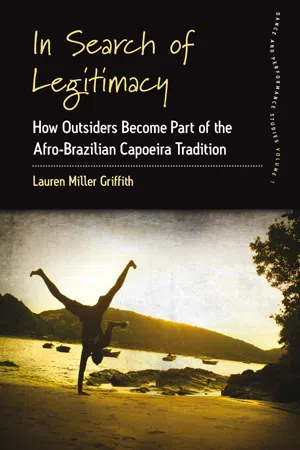
Every year, countless young adults from affluent, Western nations travel to Brazil to train in capoeira, the dance/martial art form that is one of the most visible strands of the Afro-Brazilian cultural tradition. In Search of Legitimacy explores why "first world" men and women leave behind their jobs, families, and friends to pursue a strenuous training regimen in a historically disparaged and marginalized practice. Using the concept of apprenticeship pilgrimage—studying with a local master at a historical point of origin—the author examines how non-Brazilian capoeiristas learn their art and claim legitimacy while navigating the complexities of wealth disparity, racial discrimination, and cultural appropriation.
Trusted by 375,005 students
Access to over 1.5 million titles for a fair monthly price.
This traditional song, a ladainha, is often sung at the start of a capoeira event. It was the first ladainha I ever learned, and I loved its words so much that I recited it as poetry before I learned its proper rhythm. For me, this song exemplifies what it means to be a capoeirista, particularly in this era of globalization. No longer is this martial art restricted to poor, Afro-Brazilian men as it was during Brazil’s colonial period and the early days of the New Republic; today it can theoretically be practiced by generals and doctors too. Initially, I found this song to be comforting because it gave me confidence that I, as a white woman from the United States, could also become a capoeirista. But over time, I began to question its idealism. I wondered if generals and doctors really could become capoeiristas, and even if they could, I wondered if they should, especially if their adoption of the art might detract from the liberatory potential of the practice. For now, let me put this question on hold by pointing out that the lyrics indicate that these new populations will be welcomed into the fold only if they are willing to put in the time and effort needed to learn from the masters.
As suggested in this song, many practitioners believe that the best way to learn capoeira is by training in Salvador da Bahia, Brazil. The city of Salvador, sometimes referred to simply as Bahia, is known domestically and internationally as a bastion of traditional African culture. For the non-Brazilian capoeirista, traveling to Bahia has become an almost essential part of their advancement within the social field. Yet the question exists whether or not this kind of travel is enough to grant a general, a doctor, or a white female anthropologist full membership in the capoeira community. This book provides some answers.
Introduction
To begin this chapter, I offer a vignette of a typical capoeira event in the hopes that it will allow my readers to picture this metagenre (MacAloon 1984; Marion 2008), which is often referred to as a “dance-fight-game.” I also describe the two primary styles of capoeira. While this book is primarily focused on the Capoeira Angola style, understanding the difference between the two has important implications for some of the ideological debates that affect students. The primary debate introduced in this chapter is whether capoeira is an African or a Brazilian invention.
It is my position that the actual origins of capoeira are less important than the discourse about its origins. As I argue, the idea of capoeira being a local invention fit handily into the early twentieth-century movement to identify certain arts as being quintessentially Brazilian. On the other hand, the idea of capoeira being an African invention that endured despite repression during the colonial period aligns more closely with the black consciousness movement.
Many of the non-Brazilians who encounter capoeira through television and film will not be exposed to these issues. However, for those who want to become capoeiristas themselves, they will be increasingly involved in these ideological debates. Those individuals may ultimately have to grapple with a conflict between their own social identities and those most valued in capoeira. They, like myself, may come to question whether or not the song quoted above accurately describes the ease of nontraditional capoeiristas entering the social field.
The Dance-Fight-Game Known as Capoeira
As the designated hour approaches, a student lays out the instruments in their proper order on a long wooden bench. This is not just any student, this is someone who has been trusted to handle the most sacred objects involved in the capoeira event. The three berimbaus occupy a privileged place in the center of the bench. Students are scattered about the room, stretching, practicing their handstands, and talking in small clusters. Gradually, some of the players move to the bench and pick up an instrument. The most advanced ones take the berimbaus, and the novices pick up the cowbell and the scraper.
Once every instrument has been claimed, and the remaining capoeiristas sit in a ring around the orchestra. Two capoeiristas squat in front of the berimbaus, waiting for the appropriate moment to enter the circle and begin their game. Ding, ding, ding, ding, ding, the gunga berimbau calls the room to order. Ching, ching, dong, ding [rest], ching, ching, dong, ding [rest], the gunga starts the rhythm. The medio chimes in next: ching, ching, ding, dong [rest], ching, ching, ding, dong. Now the viola: ching, ching, ding, dong, dong, ching, ching, ding, dong, dong. Now that the three berimbaus are in harmony, the pandeiros (tambourines) begin.
The mestre belts out a loud “Iê,” stretching the second syllable out over two or three seconds. His voice jars the assembly into attention, signaling a break between the profane and the sacred. The students sitting in a circle create a physical barrier between the ritual space and the rest of their environment; the music activates this space. The mestre sings a ladainha, a litany that evokes the ancestors and tells a story about the city of Bahia. A foreign capoeirista visiting Bahia closes her eyes and lets the memories of these recently visited places wash over her. As the mestre finishes this song, he starts a call and response song. As this song begins, the other percussive instruments begin to play. “Long live God,” the capoeiristas sing, and the two players at the foot of the berimbau open their arms toward the sky. “Long live my mestre,” they continue, “the one who taught me.” The two players gesture toward their teacher. The mestre starts to lead a new song and lowers the gunga to the ground, signaling to the two players that they may begin.
One player touches his fingertips to the ground and then to his forehead; the other makes the sign of the cross on her chest. The players tentatively edge away from the orchestra, trying to sense what the other will do. The brief stalemate is broken when one player presses her weight into her hands, balancing on one leg while the other sweeps in a circular motion. Her opponent dodges, extending his body as close to the ground as possible, dreadlocks puddled on the floor. From this position, he propels his body into a headstand, completes a 360-degree spin, and ends the movement by lowering his legs into an outstretched V on the floor. To avoid this trap, his opponent does a cartwheel over his legs. She pauses in midair, holding a handstand position for a fraction of a second before crashing to the ground. The onlookers erupt into laughter, and the mestre immediately switches to a different song: O facão bateu em baixo, A bananeira caiu (the machete struck low, the banana tree fell). For those in the know, the mestre’s song choice underscores the girl’s folly, comparing her to a banana tree that has just been chopped down.
Dusting herself off, the girl gets up, and the two players resume their game. The spinning, leaping, kicking, and dodging continues under the watchful eye of the mestre who is always ready to enhance the spectacle with an appropriate song. He is also responsible for calming the players down if their game becomes too heated. Gasping and sweating, the players eventually hear the gunga calling them back to their starting positions. With a brief embrace, the two players exit the ring, and two more take their place.
Capoeiristas do not spar, fight, or dance capoeira; they “play.” Portuguese has three words that translate into English as play. Tocar is used for playing an instrument, jogar is used for playing a sport, and brincar connotes the carefree play of childhood. Capoeiristas most often use the second word, though brincar is used on occasion to celebrate the most joyous, friendly, and fun performances. Practitioners are called capoeiristas, and their masters are called mestres. Both the circle in which they play capoeira and the performance event itself are referred to as a roda. At the front of the roda is an orchestra that is typically composed of three berimbaus, one or two pandeiros, an atabaque (drum), an agôgô (double cowbell), and a reco-reco (scraping instrument).1 These terms are West African in derivation; the same terms are used for musical instruments in Candomblé, the African-derived spirit possession religion that thrives in Bahia.
The berimbau is the most revered instrument in the capoeira orchestra. It consists of a wooden bow with a wire stretched across it. Today, this wire is taken from the inside of a tire, and capoeira academies often have a stack of discarded tires in a corner, waiting for more experienced students to don gloves and carefully strip out the wire with a knife. Affixed to the bow is a hollow gourd, which acts as a resonating chamber. Striking the wire with a stick called a baqueta while holding a smooth stone or old coin in one of three positions determines the pitch. A basket rattle looped over the middle and ring fingers accompanies this percussive sound. These instruments are often embellished with decoration. Sometimes geometric patterns will be burned into the wood. Other times, the bow and/or gourd might be painted with colors that signify an affiliation with the state of Bahia, the nation of Brazil, or even the Rastafarian’s green, yellow, and red. Oftentimes the colorful lembrança (remembrance) ribbons that have come to symbolize the city of Salvador are tied to the top of the instrument.
The roda begins before anyone picks up an instrument. Players typically dress better for these events than they do for their regular training sessions. Khaki pants replace the sweatpants worn during training, and some of the older mestres may even arrive wearing dress shoes instead of their typical soccer shoes. In some academies, a special offering may be made to the mestre’s primary orixa (deity), or incense may be burned to cleanse and sanctify the space. When it is time to begin, two players kneel in front of the berimbau, sometimes using their hands to draw invisible religious signs such as crosses on their bodies or on the ground, while someone sings a solo to commemorate people and places dear to capoeira. The players’ gestures sometimes signal a religious affiliation, normally either Candomblé or Christianity, though the participation of nonreligious capoeiristas means that just as often these gestures are hollow facsimiles of an embodied tradition.2
After a short call and response song praising God, old mestres, the slaves who brought this tradition to Brazil, or the city of Salvador, the players cartwheel into the center and begin a playful, embellished physical dialogue in which they plan their moves with the foresight of champion chess players. Players trade “questions” and “answers” in these improvised bodily conversations.3 The mestre or an advanced student will lead a call and response song, which the other participants echo, that comments on the action in the roda. Lewis (1992) identifies the physical game of capoeira as the primary channel of communication and songs as metacommunicative devices that add nuance to the participants’ and spectators’ interpretations of the exchange going on within the roda. There are no points awarded, but capoeiristas believe that one player has been victorious when the other runs out of responses to her attacks.
There are two primary styles, Capoeira Angola and Capoeira Regional, though hybrids certainly exist and are growing in popularity. While I have had the opportunity to observe both, my participation was limited to the Capoeira Angola style and thus forms the backbone of this book’s analysis. Both styles incorporate instruments and singing in their play, though the exact composition of the orchestra is more flexible in the Capoeira Regional style. Many of the same songs are used in both styles, but they are sung faster in Capoeira Regional than they are in the Capoeira Angola style. The basic step in both styles is the ginga, a swaying motion in which players’ feet essentially trace the shape of a W on the floor while their arms swing from side to side, blocking their face with the arm closest to the midline of the W. This is the moving base from which many movements originate and a neutral stance to which players may return at any moment during the game.
Despite these similarities, visually, the two styles are readily distinguishable from one another. J Lowell Lewis, anthropologist and performance scholar, characterizes Capoeira Angola as more of a playful pastime and Capoeira Regional as “fundamentally agonistic” (1992: 113). Capoeiristas in the Capoeira Regional style wear white clothing for their training. Angoleiros, on the other hand, often wear black pants and their academy’s T-shirt, the color of which often signifies their lineage. Capoeira Regional players wear a colored belt to denote their rank; however, there is no standardized color system, and the ranking system varies from one academy to the next. Angoleiros wear no such belts. Capoeira Regional, in general, is played at a much faster pace than is Capoeira Angola. The body is also held more upright in Capoeira Regional, and players focus on fast, high kicks, often executed from a spinning base. Arial movements such as back flips or back handsprings are not uncommon in this type of play. Angoleiros keep their movements much closer to the ground, and the most common attack movements are kicks, spinning or straight, executed from a crouched position with one or both hands on the ground for support. Evasive movements are kept very close to the floor and require more strength and control than speed. However, Capoeira Angola players do occasionally return to a standing position, particularly during the chamada, which is an interlude during play that is sometimes incorrectly used as a recovery period, but traditionally has greater significance.
The chamada is a particularly sophisticated, ritualistic aspect of the capoeira that is particularly apparent in the Capoeira Angola style. One player will “call” the other over to him or her by posing with arms outstretched in one of a handful of prescribed positions. Generally, the caller’s feet will be placed hips-width apart with one several inches behind the other. Distributing his or her weight in this manner provides the caller with a more secure base. Standing with one’s feet together often results in the other player bringing the caller down with a leg sweep; however, skilled players will sometimes stand in this way to underscore their confidence and superiority. When the other player meets the caller, they move back and forth together for several seconds with their bodies held close together, often touching at the hands or, less often, with one player’s head p...
Table of contents
Cover Page
Title Page
Copyright Page
Table of Contents
Acknowledgements
Introduction
Chapter 1. A Brief History of Capoeira
Chapter 2. The Challenges of Teaching and Learning Capoeira Abroad
Chapter 3. Travel as a Way to Overcome Doubts
Chapter 4. Preparing for the Pilgrimage
Chapter 5. A World in Which the Black Brazilian Man Is King
Chapter 6. How the Rest of Us Get Our Foot in the Door
Chapter 7. Does Form Really Matter?
Chapter 8. Will I Ever Be Good Enough?
Chapter 9. Conclusion and future Directions
Glossary
Index
Frequently asked questions
Yes, you can cancel anytime from the Subscription tab in your account settings on the Perlego website. Your subscription will stay active until the end of your current billing period. Learn how to cancel your subscription
No, books cannot be downloaded as external files, such as PDFs, for use outside of Perlego. However, you can download books within the Perlego app for offline reading on mobile or tablet. Learn how to download books offline
Perlego offers two plans: Essential and Complete
Essential is ideal for learners and professionals who enjoy exploring a wide range of subjects. Access the Essential Library with 800,000+ trusted titles and best-sellers across business, personal growth, and the humanities. Includes unlimited reading time and Standard Read Aloud voice.
Complete: Perfect for advanced learners and researchers needing full, unrestricted access. Unlock 1.5M+ books across hundreds of subjects, including academic and specialized titles. The Complete Plan also includes advanced features like Premium Read Aloud and Research Assistant.
Both plans are available with monthly, semester, or annual billing cycles.
We are an online textbook subscription service, where you can get access to an entire online library for less than the price of a single book per month. With over 1.5 million books across 990+ topics, we’ve got you covered! Learn about our mission
Look out for the read-aloud symbol on your next book to see if you can listen to it. The read-aloud tool reads text aloud for you, highlighting the text as it is being read. You can pause it, speed it up and slow it down. Learn more about Read Aloud
Yes! You can use the Perlego app on both iOS and Android devices to read anytime, anywhere — even offline. Perfect for commutes or when you’re on the go. Please note we cannot support devices running on iOS 13 and Android 7 or earlier. Learn more about using the app
Yes, you can access In Search of Legitimacy by Lauren Miller Griffith in PDF and/or ePUB format, as well as other popular books in Media & Performing Arts & Dance. We have over 1.5 million books available in our catalogue for you to explore.