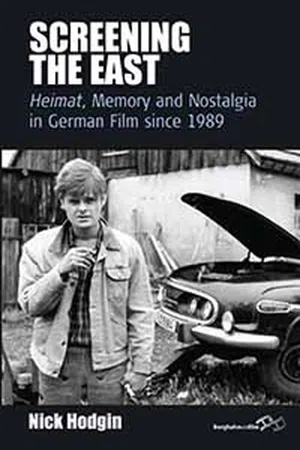
Screening the East considers German filmmakers' responses to unification. In particular, it traces the representation of the East German community in films made since 1989 and considers whether these narratives challenge or reinforce the notion of a separate East German identity. The book identifies and analyses a large number of films, from internationally successful box-office hits, to lesser-known productions, many of which are discussed here for the first time. Providing an insight into the films' historical and political context, it considers related issues such as stereotyping, racism, regional particularism and the Germans' confrontation with the past.
eBook - ePub
Screening the East
<I>Heimat</I>, Memory and Nostalgia in German Film since 1989
- 272 pages
- English
- ePUB (mobile friendly)
- Available on iOS & Android
eBook - ePub
About this book
Trusted by 375,005 students
Access to over 1.5 million titles for a fair monthly price.
Study more efficiently using our study tools.
Information
Chapter 1
MAPPING IDENTITY
Angela Merkel's accession to Chancellor of Germany in October 2005, which counted as a double triumph since she was both the first woman and the first east German to head the German government, would appear to disprove any suspicion that the east Germans have been denied the opportunities for advancement in the new Germany or sidelined from positions of power. But what was interesting in judging Merkel's rise through the CDU is quite how much her eastern background was used as a point of reference. Although she emphatically criticized the former GDR regime, something that was necessary if she was to convince diehard CDU voters of her candidature, she was and continues to be described in terms of reductive eastern stereotypes. Evelyn Finger, writing in Die Zeit, noted how journalists focused on what were considered to be distinctive (and mostly negative) east German qualities: ‘her malleability and her unscrupulousness, that deviousness, suspiciousness and, above all, ingratitude’.1 Not long after Merkel's pyrrhic victory, Der Spiegel ran a lead article on the new chancellor and her fellow east German politician (albeit for the rival Social Democrats), Matthias Platzeck, in an issue whose cover page also invoked the GDR past by parodying an East German propaganda poster from 1952.2 Politicians are rarely able to dodge their past; biographical details have a habit of surfacing at awkward moments in their political careers, often compromising their present commitments and undermining their reputation in the process. But in eastern Germany the past is ever present in the lives of ordinary east Germans, too, and the limiting reference points and stereotypes that accompany many discussions regarding the head of the German government are part of the complex identity discourse which began almost as soon as the two states became one. The debates have often been divisive. Failed expectations, perceived injustices, mutual suspicions and emerging prejudices have been central to the debate.
Issues of German identity have long been a subject of scrutiny for historians, social scientists, political scientists, cultural commentators, and filmmakers alike. Konrad Jarausch claims that ‘Germans keep searching for a collective sense of themselves, while outside commentators continue trying to define what these perplexing people might really be like’, while Mary Fulbrook describes the quest to discover national identity as a ‘remarkably dogged search for a remarkably elusive holy grail’.3 There are, however, a number of useful theoretical guides to mapping identity. Anthony D. Smith's influential work on national identity signposts routes one might take in order to arrive at a satisfactory account of identity and his research might usefully be applied to the Germans’ post-unification situation.4 ‘Unity’, he suggests, ‘has a plain and a more esoteric nationalist meaning. At the simplest level, it refers to unification of the national territory or the homeland, if it is divided, and the gathering together within the homeland of all nationals’.5 Those who remain beyond these boundaries are, according to Smith's thesis, considered lost by the remaining population. This was, to some extent, evident in post-war Germany, where it was the population of the GDR who were considered absent from the ‘real’ Germany. Over the years, the FRG (Federal Republic of Germany) began to show signs of having accepted the division and the East Germans, stranded on the other side of the German/German border, were given up as victims lost to the exigencies of the Cold War. With little hope or belief in unification, an idea that strengthened rather than weakened, the FRG appeared to have accustomed itself to the post-war arrangement. Certainly, it seemed as if the FRG had more or less come to terms with the East German irredenta: a survey conducted in the very month in which the East Germans took to the streets revealed the extent to which the West German population had come to accept division, with only 24 per cent of respondents expressing a belief that reunification might one day be possible.6 But unification ceased being a ‘nostalgic phantasm’ after 1989.7 Finally a reality, it created something of a predicament for the west German population. To be suddenly confronted with 16 million new compatriots was almost certain to provoke some hostility and to problematize the position of abstract sympathy (or indifference) that had typified the West German attitude.8 Previously, the sympathy directed at the East Germans had been aroused by a vague understanding of their plight. This centred mostly on the East Germans as victims of political repression, geographical restrictions, and, above all, of the Stasi, the notorious State security (though the actual extent of the Stasi's dealings had been underestimated, and post-GDR revelations came as a shock to many). By the following spring, a survey commissioned by the public television corporation, ZDF, gave some indication of the disparate reactions to recent events. Where 41 per cent of those in the east were ‘very pleased’ with unification, less than half that figure were as enthusiastic in the west, leading some commentators to conclude that ‘West Germans were quite sympathetic to the East Germans as a people and quite hostile to East Germany as a state’.9 Unification ultimately affected this sympathy when those previously given up as lost became the newly arrived and only briefly welcomed.
Theories of national identity tend towards individual self-perception based on a shared sense of who we are – the ‘imagined communities’ to employ Benedict Anderson's influential phrase. Anderson's seminal study holds that a collective identity evolves from shared historical, cultural and linguistic experience, and is disseminated via the printed word. Though Anderson's study focuses on print capitalism, his analysis has gained vital theoretical cachet among film scholars keen to stress film's role in producing and shaping a national consciousness.10 Applied to the two German states, such a culturalist perspective would hold that the intra-German borders did not inhibit a pan-German national identity. The idea that the two states had always in a sense been one, the forty years of separation notwithstanding, was indeed one of the attitudes expressed at the time of unification. It signalled the desire by some former GDR citizens to participate in the economic success of the FRG, but it also signalled a degree of political triumphalism among commentators on the right who were keen to discredit the communist state and deny the existence of a separate socialist German identity – an argument that appeared to be vindicated by Chancellor Kohl's first resounding electoral triumph in the east. These were early days, however, and it soon became apparent that the two states’ historical, cultural and linguistic experiences, those precepts that help determine national identity, had left their imprint on the two populations, and it was in these areas that one might identify factors that distinguished the two nations. Forty years of separation had seen to it, for example, that the populations of both states viewed their past through different ideological prisms, which the subsequent removal of communist heroes from street signs and the renaming of certain public holidays could not undo at a stroke. Unlike the more substantial reminders of the previous regime such as the state statuary, street names were easily changed, making them ‘tempting targets for politicians eager to make a symbolic gesture’.11 However, the new nomenclature was often understood by east Germans as a further attempt to wipe clean the GDR past.
The culture and language of each state had also been shaped by their respective political, economic and social environments, and the many differences were perhaps even more apparent after 1989. Language, a key element in collective national consciousness, had developed many distinguishing features. These were not just distinctions of dialect characterizing regional linguistic differences, but informed by cultural distinctions. The everyday socialist rhetoric and jargon that made little sense to those from the West was, according to one observer, part of a strategy of using ‘language that set the GDR apart from the Federal Republic and created its identity’.12 That the two Germanys did share a common history and past culture was a fact recognized by each and, unless supervised appropriately, had serious implications for their individually assumed identity and sovereignty. The West had preferred to think of itself in terms of the real Germany, continuing the cultural tradition that had been briefly hijacked by the National Socialists (NS), and of the GDR as the renegade state, the Sozialistische Einheitspartei Deutschlands (SED – Socialist Unity Party of Germany) as Soviet lackeys. The GDR, on the other hand, never made any claim upon the other Germany, seeing itself as the breakaway state. Yet, paradoxically, it also saw itself as the legatee of a carefully defined Germany, as the final link in a concatenation of historical revolutionary thought and action. Thus, the GDR simultaneously sought to balance these two ideas, that of a new Germany which could look eastwards, towards Moscow, for inspiration and support, and as a Germany that could continue to draw upon the (state sanctioned) traditions of the German past.
The differences between the two states were not as easily dismantled as the wall, and were still manifest after 1989. Fashion, commodities, and language came to serve as cultural signifiers distinguishing east from west. These often lent themselves to stereotyping, be it the east Germans in their snow-wash jeans and Trabant or the well-attired west Germans driving their Mercedes – symbols and props that have proved especially popular in post-unification film. References to the east Germans’ post-unification unease have not been uncommon. This appears to have been confirmed by the data collected in social surveys and questionnaires, in voting behaviour and in artistic self-expression. It is reflected, too, in a number of issues associated with unification: high unemployment (a fact more acute in the east than the west), the political marginalization of the east, the related social problems and Ostalgie. This significant 1990s neologism was coined in order to describe the east Germans’ post-unification nostalgia for their GDR past. Over time it also came to express an attitude that reinvigorated and celebrated a problematic east German identity whilst simultaneously rejecting or eliding many of the less appealing features associated with unification and with the west.
After Unity: Stereotypes and Dissent
The GDR was, as I have indicated, a more abstract land to West Germans than were its western neighbours, France, Britain and especially the US, which had, as one of the characters in Wim Wenders's Im Lauf der Zeit (Kings of the Road, 1976) memorably observed, colonized their consciousness. As for actual experiences of life in the GDR, only 10 per cent of West Germans could reasonably claim to have witnessed it first-hand, and then only temporarily.13 For some commentators, the rush to unification constituted a threat to the west's post-national republic. The political triumphalism that followed the GDR's implosion risked a return to a national patriotism rather than the ‘constitutional patriotism’ (and its implicit commitment to European integration) that had been proposed and supported by intellectuals like Jürgen Habermas.14 Some on the left perceived the collapse of the East German state as a critical blow to utopian ideals, something that is certainly borne out in a number of films made after 1989. Ill-prepared for dealing with the events that had taken place, their situation has been described as one in which ‘mourning utopia replaced an engagement with the new realities’.15 Nevertheless, the coup de théâtre that was the success of the demonstrations in the East came initially as a happy surprise for those in the FRG, a large percentage of whom had given up expecting to see unification in their lifetime, though their interest in coming together was less enthusiastic than that of the east Germans. One commentator summed up the asymmetrical interest, wryly noting that it was only on east German cars that one saw stickers declaring ‘we are one people’.16 A further indication of the imbalance in the Germans’ interest in one another was confirmed by the west Germans’ singular lack of interest in visiting the eastern states, with less than 3 per cent choosing to go east even after the borders had opened.17 Traffic continued to be a one-way affair.
As memorable as the sight of sputtering Trabis crossing into the west was the image of determined east Germans storming once-dreaded Stasi headquarters and the documents and dossiers spilling out of the windows of its centre of operations at Normannenstrasse in Berlin. A population so long kept in check by the invidious activities of the Stasi was naturally eager to have access to their files, to expose the Ministry's employees and the thousands of unofficial informants. Allegations, recriminations and revelations were commonplace, and those that involved some of the high-profile cultural figures, notably the acclaimed east German writer Christa Wolf, aroused frenzied media interest that was inevitably disproportionate to the actual facts. This (mostly west German) media focus on the apparent moral and ideological transgressions of such a key cultural figure not only served to undermine her position. It put the FRG's intellectual left into an uncomfortable position of continuing to support their old GDR colleagues amid a series of problematic accusations and highlighted the extent of the east Germans’ collusion with the regime. The dissolution of the GDR had already precipitated a crisis for the left, whose intellectual credibility had been undermined by their support for East Germany, a state whose population had just overwhelmingly voted for Kohl's centre-right party. These gleeful accusations of hypocrisy have in turn been criticized. John Milful has suggested that, ‘It will be a tragic irony if those writers who were once stylized in the West into dissidents…are now condemned as quislings who failed to lead their people to the barricades.’18 Certainly, key dissidents, who before 1989 had been fêted in the west for their criticism of the regime, were, following revelations of their apparent duplicity, condemned as hypocritical collaborators, who had duped colleagues and good-natured liberals in the FRG. Daily disclosures ensured that the GDR was regarded as a ‘land of Stasi agents, Stalinists, privileged elites [and] fellow travellers’ leading many west Germans to view their eastern compatriots with an increasing amount of suspicion.19
There are mitigating factors in the emergence of this attitude, of course, not least the fact that the GDR's relative stability was largely due to its tightly structured and controlled nature. It was also a society controlled by a regime that knew how to punish and reward. Scholars often describe the socialist regime as a corrupt and corrupting force, which sought ‘to govern by concluding bargains with each citizen, or potential dissenter’.20 This ‘informal, tacit “social contract” between…state and society’ was instrumental to the GDR's relative longevity.21 The actual number of Stasi agents and informants exposed contracts of a more insidious nature, and the subsequent disclosure of Stasi files revealed just how widespread their activities were. The DEFA studios, too, had been home to a diligent network of spies. With roughly two informants for every hundred employees (as opposed to the usual ratio of one per hundred throughout the wider GDR population), the potential subversion at the Babelsberg studios was clearly a matter of some concern for the SED, and many screenwriters and directors were monitored by the Stasi, a theme that was central to what is perhaps the best-known post-unification film, Das Leben der Anderen.22 Nevertheless, it was, and continues to be, a source of frustration to east Germans to be judged according to such a narrow frame of reference and could only harm plans for social integration.
The West Germans' abstract solidarity with those in the GDR, which had required very little in the way of active support, was ruptured by unification. The reasons for the ensuing change in attitude are manifold: the disclosure of Stasi activities, the assumed culpability of the GDR population...
Table of contents
- Cover Page
- Title Page
- Copyright Page
- Contents
- List of Illustrations
- Acknowledgements
- Introduction
- 1 - Mapping Identity
- 2 - Heimat Stories: East Meets West
- 3 - Lost Landscapes
- 4 - At the Back of Beyond: Heimat East
- 5 - Berlin: Disorientation/Reorientation
- 6 - Good Bye, Ostalgie?
- Conclusion
- Filmography
- Bibliography
- Index
Frequently asked questions
Yes, you can cancel anytime from the Subscription tab in your account settings on the Perlego website. Your subscription will stay active until the end of your current billing period. Learn how to cancel your subscription
No, books cannot be downloaded as external files, such as PDFs, for use outside of Perlego. However, you can download books within the Perlego app for offline reading on mobile or tablet. Learn how to download books offline
Perlego offers two plans: Essential and Complete
- Essential is ideal for learners and professionals who enjoy exploring a wide range of subjects. Access the Essential Library with 800,000+ trusted titles and best-sellers across business, personal growth, and the humanities. Includes unlimited reading time and Standard Read Aloud voice.
- Complete: Perfect for advanced learners and researchers needing full, unrestricted access. Unlock 1.5M+ books across hundreds of subjects, including academic and specialized titles. The Complete Plan also includes advanced features like Premium Read Aloud and Research Assistant.
We are an online textbook subscription service, where you can get access to an entire online library for less than the price of a single book per month. With over 1.5 million books across 990+ topics, we’ve got you covered! Learn about our mission
Look out for the read-aloud symbol on your next book to see if you can listen to it. The read-aloud tool reads text aloud for you, highlighting the text as it is being read. You can pause it, speed it up and slow it down. Learn more about Read Aloud
Yes! You can use the Perlego app on both iOS and Android devices to read anytime, anywhere — even offline. Perfect for commutes or when you’re on the go.
Please note we cannot support devices running on iOS 13 and Android 7 or earlier. Learn more about using the app
Please note we cannot support devices running on iOS 13 and Android 7 or earlier. Learn more about using the app
Yes, you can access Screening the East by Nick Hodgin in PDF and/or ePUB format, as well as other popular books in Media & Performing Arts & Film & Video. We have over 1.5 million books available in our catalogue for you to explore.