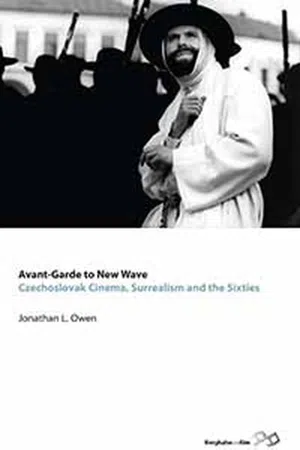
The cultural liberalization of communist Czechoslovakia in the 1960s produced many artistic accomplishments, not least the celebrated films of the Czech New Wave. This movement saw filmmakers use their new freedom to engage with traditions of the avant-garde, especially Surrealism. This book explores the avant-garde's influence over the New Wave and considers the political implications of that influence. The close analysis of selected films, ranging from the Oscar-winning Closely Observed Trains to the aesthetically challenging Daisies, is contextualized by an account of the Czech avant-garde and a discussion of the films' immediate cultural and political background.
- 256 pages
- English
- ePUB (mobile friendly)
- Available on iOS & Android
eBook - ePub
About this book
Trusted by 375,005 students
Access to over 1.5 million titles for a fair monthly price.
Study more efficiently using our study tools.
Information
CHAPTER 1
Inspirations, Opportunities: Cultural and Historical Contexts
Marching In Step, Swimming Against the Current: The Troubled History of the Czech Avant-Garde
The story of Surrealism has been told many times and in numerous languages. Yet that standard history comprises only one story, a story in which the Surrealist movement is rendered synonymous with a small group of avant-garde artists and intellectuals who lived in Paris between the wars. Famous émigrés from Germany or Spain generally comprise a few of the lead characters, though that is as far as the coverage of Surrealism's international dimension goes. The story of Czech Surrealism has never received a comprehensive telling in English, and in so far as the Czech movement is even mentioned it is in the guise of a subplot complementary to the larger narrative of ‘true’ Surrealism. For this reason the names of the Czech avant-garde's key representatives are much less well-known than they should be. Yet Czech Surrealism can claim ‘authenticity’ on two fronts, as not only was it closely linked with the French movement, it also grew organically out of a native avant-garde. The persistence of the movement in the face of extraordinary pressures reflects how deeply rooted Surrealism is in Czech culture, but this persistence also belies a history that is complex and convulsive, marked by numerous upheavals, shifts and schisms. Once we take into account all its legacies and deviations, twentieth-century Czech Surrealism is revealed to encompass many different aesthetic and political positions: it has embraced both realism and abstraction, Marxist–Leninist utopianism and world-weary ideological scepticism. Sometimes the movement's practitioners have questioned the extent to which they are Surrealists at all, and for more than twenty-five years of the movement's history no self-titled Surrealist group actually existed.
The prehistory of the Czech Surrealist Group comprises an entire chapter in itself, and traces of this prehistory are still visible in Surrealist works of the postwar era, as well as in a number of films influenced by the avant-garde. While Czech modernism in general can be dated back to around the turn of the nineteenth and twentieth centuries, the specific constellation of artists and intellectuals that would later comprise the Surrealist Group emerged, as did Western European Dada, out of the devastations – and transformations – of the First World War. This group, which, rather mysteriously, called itself ‘Devětsil’,1 was founded in 1920, and after dabbling briefly with a self-consciously ‘primitivist’ style of art, it embarked upon the groundbreaking artistic programme of Poetism.2 Like their French, German and Italian counterparts, the young men and women who comprised Devětsil had been radicalised by the war. Where the earlier Czech avant-gardes had displayed a contemplative, mystical tendency, Devětsil was as much a political movement as an aesthetic one. However, in contrast to the nihilistic, destructive mentality of Dada, Devětsil was optimistic and constructive, founded on positive principles of change rather than on mere negation. Furthermore, Devětsil was avowedly Marxist from the beginning, as is evidenced by its interest in the latest cultural developments from the fledgling Soviet Union. If the French avant-garde's transition from Dada to Surrealism constitutes a dramatic shift in aesthetic, political and philosophical terms, then Devětsil's own transition to Surrealism appears smoother. Karel Teige, the founder and chief spokesman of Devětsil, even felt that Devětsil had formulated the same essential ideas as the Surrealists, independently of and indeed before the French, with Teige's first Poetist manifesto of 1924 appearing several months before André Breton's first Surrealist manifesto.3
While Surrealism and Poetism are similar in many ways, there are also, as suggested in the introduction, significant distinctions. Poetism aimed above all to be the artistic voice of modernity. Underpinned by Devětsil's commitment to the emancipatory potential of technological progress, Poetist works delight in the modern metropolis and the new wonders of the industrial world. Yet Poetism is cheery and light-hearted, lacking in the violent, portentous qualities with which the Italian Futurists celebrated the same phenomena. Perhaps more than any other contemporaneous avant-garde movement, Devětsil was enamoured of popular culture, and especially of cinema, which fulfilled central criteria in being at once a ‘mass’ (and thus proletarian) art form and a technological innovation. Described by Teige as a form of ‘modern epicureanism’, Poetism displayed a concern with sensuous experience that extended to the materials of artistic expression themselves. In the field of verbal art, Poetism waged war against the outdated concept of ‘literature’ and asserted the importance of the physical properties of words. The writing of poems was often a pretext for typographical experiment, and words were selected as much for their visual form as for their meaning. Given this preoccupation with words as objects, it is hardly surprising that Devětsil enjoyed close contact with literary theorist and linguist Roman Jakobson, who had been involved with the Russian avant-garde before settling in Czechoslovakia and helping found the structuralist Prague Linguistic Circle. It was in relation to Poetism that Jakobson first defined his notion of ‘poeticity’ (a notion that will be explored in the chapter on Švankmajer). Poetism was marked by a greater concern with artistic form than was French Surrealism, a concern manifested in a spirit of restless aesthetic experimentation: the so-called ‘picture poem’ (‘obrazová báseň’) incorporated text into visual collages, once again underlining the physical dimension of words, and in his second Poetist manifesto from 1928 Teige proclaims his ambition of creating a ‘poetry of the five senses’ that would encompass a poetry of smell (‘olfactory poetry’), a poetry of taste and so on.
Unsurprisingly, Devětsil also harboured cinematic ambitions, and the numerous screenplays and proclamations about film written by the group suggest that a Devětsil cinema would have extended Poetist visual experiments in the fine arts: according to Teige the Devětsil screenplays’ ‘central interest was picture poetry, synthesis of picture and poem, set in motion by film’.4 To a large extent Devětsil's vision of a ‘pure cinema’ stripped of narrative and literary elements anticipated later developments in the American underground film: a direct link is even provided by Alexandr Hackenschmied, a filmmaker affiliated with Devětsil, who would later emigrate to the United States and, under the name Alexander Hammid, collaborate with influential avant-garde filmmaker Maya Deren. While various films did emerge from the Devětsil fold during the 1930s (including several feature films directed by the great experimental writer Vladislav Vančura, notably On the Sunny Side (Na sluneční straně, 1933) and Faithless Marijka (Marijka nevěrnice, 1934), the latter film scripted by, among others, Vítězslav Nezval and Roman Jakobson), a ‘Poetist cinema’ as such never materialised, thwarted by the predictable absence of sympathetic investors. Nevertheless, the avant-garde arguably infiltrated popular culture to a greater extent in Czechoslovakia than in other countries, not least through the medium of theatre. The avant-garde Liberated Theatre (Osvobozené divadlo), co-founded in 1926 by Devětsil member Jindřich Honzl, first showcased the talents of the comic duo Jiří Voskovec and Jan Werich, whose act became extremely popular and who would go on to make a series of successful film comedies (Your Money or Your Life (Peníze nebo život, Jindřich Honzl, 1932), Heave Ho! (Hey Rup!, Martin Frič, 1934), and The World Belongs to Us (Svět patří nám, Frič, 1937)). The case of Voskovec and Werich (and that of their 1960s successors, Suchý and Šlitr) represents a minor fulfilment of Devětsil's ambitions of creating a new ‘proletarian’ culture that synthesised avant-garde and popular elements. Such cases might alternately be seen to suggest how the opposition between ‘high’ and ‘low’ cultures is a false one to begin with.
Devětsil's formal experiments were frequently linked to the attempt to portray and stimulate the ‘inner life’, and it is here that the aims of Poetism most closely approximate those of Surrealism, even if Poetism's methods were often quite different. Teige argued that by emphasising the sensuous and associative qualities of words over their denotative meaning, the poet could express the ‘infrared and ultraviolet reality’ of the unconscious.5 The artists Jindřich Štyrský and Toyen established ‘Artificialism’, a sibling movement to Poetism in painting. Typically made up of fluid, indefinable forms that seem to inhabit some subterranean level of the mind, Artificialist paintings were an attempt at ‘the concrete rendering of nonsubstantive impressions, feelings, memories, and imaginings’.6 The Czech avant-garde did not fully embrace Freudian psychoanalytic theory until its eventual Surrealist ‘conversion’, which may seem surprising in view of many of Devětsil's preoccupations. Paradoxically, however, Teige's thought addressed the libidinal foundations of the imagination in a way that the puritanical Breton rarely did. Teige's proposal of an ars una, a modern form of gesamtkunstwerk that would unify the different arts, was based on his belief that the roots of the ‘creative instinct’ are to be found in ‘the basic, life-giving and creative instinct par excellence, namely the sexual instinct’.7 Unlike Breton, Teige was uninhibited by conventional morality in his personal life and often bluntly biologistic in his writing.8 In terms of sexual morality Teige was closer to a figure like the Soviet feminist Alexandra Kollontai, and the Eros he propounded not only winged but defiantly naked.
Poetism was a movement designed not to contribute another ‘ism’ to the history of aesthetics but to transform life itself, and it sought to do this in a manner at once more precise and more ambitious than that of French Surrealism. The reverse side of Teige's anti-aesthetic stance was his desire to diffuse poetry into life, and the life of the collective rather than that of the cloistered few. Teige even imagined miraculous ‘magic cities of Poetism’, ‘which would be the site of entertaining mischief…, the optical pleasure of colours and forms, the pleasure of hearing noise and sounds, in short the pleasure of all the senses in a carefree style’.9 Poetist culture was thus to contribute to the cultivation of the senses and the imagination. Yet the revolution in sensibility that Teige envisaged would need to be accompanied by political revolution, as capitalism deformed human beings’ sensual and emotional life, ensuring the domination of ‘the feeling of ownership’ at the expense of other ‘physiological and psychological feelings’.10 Poetism in fact comprised only half of Devětsil's utopian vision. Immensely adept at absorbing and synthesising different artistic trends from all over the map, Teige appropriated Soviet Constructivism, whose principles would play the role of a rational complement to the anarchic Poetism. Constructivism's watchwords are standardisation, innovation and anti-aestheticism; the Constructivist method would ensure the greatest possible rationalisation of work and production. Teige extended his concern with rationalisation into his architectural theorising of the 1920s and 1930s, although once again the desire for functionality and formal stringency is harmonised with a concern for beauty and the cultivation of human sensibilities. The Devětsil of the 1920s may largely be founded on the synthesis of oppositions, yet there are oppositions here that seem irreconcilable, not least the tension between the philosophical playfulness of Poetism and the staunchness, if not dogmatism, with which the Devětsil artists adhered to both Marxist–Leninist ideology and its representatives in the Czechoslovak Communist Party. When a group of Czech writers left the Party in protest over its ‘fractious terrorism’ and ‘immature fanaticism’, Teige, Nezval and other Devětsil figures lost no time in publicly condemning these ‘seven writers who used their literary names for a political attack against the party, which for us means life’.11 Indeed, during the 1920s and early 1930s the Czech avant-garde maintained a better and closer relationship with the Party than Breton's Surrealist group, which is at least partly a testament to the Czechoslovak Party's cultural openness, relatively speaking of course, in the days before Socialist Realist orthodoxy was established. The story of the Czech avant-garde in the twentieth century is ultimately the story of its relationship with Communist authority, and the course of Czechoslovak Communism can itself be traced in the ups and downs, the crises, redefinitions and resurgences, of the avant-garde's turbulent history.
In 1934 Devětsil reinvented itself as the Czech Surrealist Group, with many of the most important figures, including Nezval, Honzl, Toyen and Štyrský, retained from the earlier group. The immediate instigating factor for the formation of a Surrealist group was the close personal bond that Nezval had developed with André Breton, although Lenka Bydžovská suggests a number of additional, deeper factors for this transformation. In the political climate of the mid-1930s, ‘the hedonistic poetry of Devětsíl’ was starting to seem ‘anachronistic’, and the avant-garde was becoming increasingly preoccupied by the depths of the human psyche at the expense of the external and rational.12 Furthermore, Breton's own declaration of support for Marxism and the French Communist Party in his Second Manifesto of Surrealism from 1929 assured the Czechs, who had earlier criticized Surrealism's ‘anarchist’ tendencies, that the Surrealists held ‘correct’ political principles.13 Teige himself was initially reluctant to join the new group, no doubt partly out of feelings of ‘rivalry’ with Breton's group but also because of intellectual and artistic disagreements with Surrealism: for instance, he rejected at first the Surrealist practice of ‘psychic automatism’ (the transcribing of thoughts ‘direct’ from the unconscious), believing instead that artistic expression should comprise a synthesis of conscious and unconscious elements.14 Yet Teige later made his peace with Surrealism and would ironically become the movement's most prominent theoretical spokesman during the 1930s and 1940s, a role for which he would be persecuted when the Communists came to power.
Faced with the Communists’ misunderstanding and distrust of Surrealism on the one hand and with Breton's notorious obstinacy on the other, the Czechs sought to mediate between the French Surrealists and the Communist Parties of both Czechoslovakia and the Soviet Union. Temperamentally as well as geographically, Teige and Nezval were well-disposed to reconcile Paris and Moscow. In his speech at the Soviet Writers’ Congress of 1934, Nezval argued for the compatibility of Surrealism with revolutionary struggle, but to no avail: what the Czechs had envisaged as an opportunity for rapprochement was in fact the sounding of the death knell for cultural pluralism, as it was the 1934 Congress that announced the establishment of Socialist Realism as the one ‘official’ aesthetic of Soviet Communism. Massively disappointed, the Czechs nonetheless clung to the scraps of comfort offered by the somewhat more open-minded approach to aesthetics propounded in Nikolai Bukharin's speech. Moreover, Teige and Nezval recognised the need for political unity in the face of fascism and maintained their conciliatory stance, though they must have recognised that this stance was almost entirely one-sided. Ever the synthesist, Teige even attempted the seemingly impossible feat of reconciling Surrealism and Socialist Realism. Teige argued that realist methods could acceptably be harnessed to the socialist cause in the USSR, where reality itself had been transformed into the ‘positive human and social reality’ of a ‘classless society’. In the capitalist world, however, reality was still inimical to the socialist writer, and thus romantic and lyrical methods were called for in the propagation of revolutionary consciousness.15 For Teige, a solidarity of adjectives (‘socialist’) was more important than a solidarity of nouns (‘realism’).16
Yet the ‘human and social reality’ of the Soviet Union had itself become problematic by the mid-1930s. The death sentences handed out after the first Moscow show trials violated Teige's humanitarian principles, and in early 1938 the disillusi...
Table of contents
- Cover Page
- Title Page
- Copyright Page
- Contents
- List of Illustrations
- Acknowledgements
- Introduction: Surrealism in and Out of the Czechoslovak New Wave
- 1. Inspirations, Opportunities: Cultural and Historical Contexts
- 2. Pavel Juráček's Josef Kilián (1963) and A Case for the Young Hangman (1969): From the Surreal Object to the Absurd Signifier
- 3. Jiří Menzel's Closely Observed Trains (1966): Hrabal and the Heterogeneous
- 4. Spoiled Aesthetics: Realism and Anti-Humanism in Věra Chytilová's Daisies (1966)
- 5. Flights from History: Otherness, Politics and Folk Avant-Gardism in Juraj Jakubisko's the Deserter and the Nomads (1968) and Birds, Orphans and Fools (1969)
- 6. Back to Utopia: Returns of the Repressed in Jaromil Jireš's Valerie and her Week of Wonders (1970)
- 7. Jan Švankmajer: Contemporary Czech Surrealism and the Renewal of Language
- Conclusion
- Bibliography
- Index
Frequently asked questions
Yes, you can cancel anytime from the Subscription tab in your account settings on the Perlego website. Your subscription will stay active until the end of your current billing period. Learn how to cancel your subscription
No, books cannot be downloaded as external files, such as PDFs, for use outside of Perlego. However, you can download books within the Perlego app for offline reading on mobile or tablet. Learn how to download books offline
Perlego offers two plans: Essential and Complete
- Essential is ideal for learners and professionals who enjoy exploring a wide range of subjects. Access the Essential Library with 800,000+ trusted titles and best-sellers across business, personal growth, and the humanities. Includes unlimited reading time and Standard Read Aloud voice.
- Complete: Perfect for advanced learners and researchers needing full, unrestricted access. Unlock 1.5M+ books across hundreds of subjects, including academic and specialized titles. The Complete Plan also includes advanced features like Premium Read Aloud and Research Assistant.
We are an online textbook subscription service, where you can get access to an entire online library for less than the price of a single book per month. With over 1.5 million books across 990+ topics, we’ve got you covered! Learn about our mission
Look out for the read-aloud symbol on your next book to see if you can listen to it. The read-aloud tool reads text aloud for you, highlighting the text as it is being read. You can pause it, speed it up and slow it down. Learn more about Read Aloud
Yes! You can use the Perlego app on both iOS and Android devices to read anytime, anywhere — even offline. Perfect for commutes or when you’re on the go.
Please note we cannot support devices running on iOS 13 and Android 7 or earlier. Learn more about using the app
Please note we cannot support devices running on iOS 13 and Android 7 or earlier. Learn more about using the app
Yes, you can access Avant-garde to New Wave by Jonathan L. Owen in PDF and/or ePUB format, as well as other popular books in Media & Performing Arts & Film History & Criticism. We have over 1.5 million books available in our catalogue for you to explore.