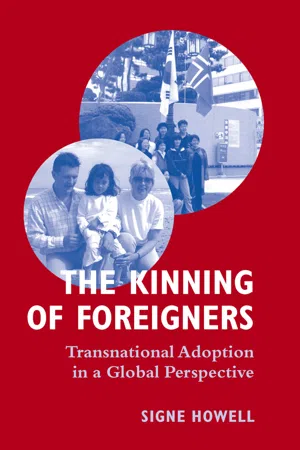
Since the late nineteen sixties, transnational adoption has emerged as a global phenomenon. Due to a sharp decline in infants being made available for adoption locally, involuntarily childless couples in Western Europe and North America who wish to create a family, have to look to look to countries in the poor South and Eastern Europe. The purpose of this book is to locate transnational adoption within a broad context of contemporary Western life, especially values concerning family, children and meaningful relatedness, and to explore the many ambiguities and paradoxes that the practice entails. Based on empirical research from Norway, the author identifies three main themes for analysis: Firstly, by focusing on the perceived relationship between biology and sociality, she examines how notions of child, childhood and significant relatedness vary across time and space. She argues that through a process of kinning, persons are made into kin. In the case of adoption, kinning overcomes a dominant cultural emphasis placed upon biological connectedness. Secondly, it is a study of the rise of expert knowledge in the understanding of 'the best interest of the child', and how the part played by the 'psycho.technocrats' effects national and international policy and practice of transnational adoption. Thirdly, it shows how transnational adoption both depends upon and helps to foster the globalisation of Western rationality and morality. The book is an original contribution to the anthropological study of kinship and globalisation.
- 273 pages
- English
- PDF
- Available on iOS & Android
eBook - PDF
About this book
Information
Table of contents
- The Kinning of Foreigners
- CONTENTS
- PREFACE
- ACKNOWLEDGEMENTS
- PART I. Adoption – Biology or Sociality?
- Chapter 1. DESIRE AND RIGHTS: TRANSNATIONAL MOVEMENT OF SUBSTANCES AND CONCEPTS
- Chapter 2. A CHANGING WORLD OF FAMILIES: AN OVERVIEW
- Chapter 3. KINSHIP WITH STRANGERS: VALUES AND PRACTICES OF ADOPTION
- Chapter 4. KINNING AND TRANSUBSTANTIATION: NORWEGIANISATION OF ADOPTEES
- Chapter 5. EXPERT KNOWLEDGE: THE ROLE OF PSYCHOLOGY IN ADOPTION DISCOURSES
- Chapter 6. WHO AM I, THEN? ADOPTEES’ PERSPECTIVESON IDENTITY AND ETHNICITY
- PART II. Governmentality and the Role of Psycho-technocrats
- Chapter 7. BENEVOLENT CONTROL: ADOPTION LEGISLATION IN THE USA AND NORWAY
- Chapter 8. BENEVOLENT CONTROL: INTERNATIONAL TREATIES ON ADOPTION
- Chapter 9. EXPERT KNOWLEDGE: GLOBAL AND LOCAL ADOPTION DISCOURSES IN INDIA, ETHIOPIA, CHINA AND ROMANIA
- Chapter 10. IN CONCLUSION: TO KIN A FOREIGN CHILD
- POSTSCRIPT: A NOTE ON METHODS
- BIBLIOGRAPHY
- INDEX
Trusted by 375,005 students
Access to over 1.5 million titles for a fair monthly price.
Study more efficiently using our study tools.
Frequently asked questions
Yes, you can cancel anytime from the Subscription tab in your account settings on the Perlego website. Your subscription will stay active until the end of your current billing period. Learn how to cancel your subscription
No, books cannot be downloaded as external files, such as PDFs, for use outside of Perlego. However, you can download books within the Perlego app for offline reading on mobile or tablet. Learn how to download books offline
Perlego offers two plans: Essential and Complete
- Essential is ideal for learners and professionals who enjoy exploring a wide range of subjects. Access the Essential Library with 800,000+ trusted titles and best-sellers across business, personal growth, and the humanities. Includes unlimited reading time and Standard Read Aloud voice.
- Complete: Perfect for advanced learners and researchers needing full, unrestricted access. Unlock 1.5M+ books across hundreds of subjects, including academic and specialized titles. The Complete Plan also includes advanced features like Premium Read Aloud and Research Assistant.
We are an online textbook subscription service, where you can get access to an entire online library for less than the price of a single book per month. With over 1.5 million books across 990+ topics, we’ve got you covered! Learn about our mission
Look out for the read-aloud symbol on your next book to see if you can listen to it. The read-aloud tool reads text aloud for you, highlighting the text as it is being read. You can pause it, speed it up and slow it down. Learn more about Read Aloud
Yes! You can use the Perlego app on both iOS and Android devices to read anytime, anywhere — even offline. Perfect for commutes or when you’re on the go.
Please note we cannot support devices running on iOS 13 and Android 7 or earlier. Learn more about using the app
Please note we cannot support devices running on iOS 13 and Android 7 or earlier. Learn more about using the app
Yes, you can access The Kinning of Foreigners by Signe Howell in PDF and/or ePUB format, as well as other popular books in Social Sciences & Education General. We have over 1.5 million books available in our catalogue for you to explore.