This volume offers a comprehensive guide to methods used in the sociocultural, linguistic and historical research of food use. This volume is unique in offering food-related research methods from multiple academic disciplines, and includes methods that bridge disciplines to provide a thorough review of best practices. In each chapter, a case study from the author's own work is to illustrate why the methods were adopted in that particular case along with abundant additional resources to further develop and explore the methods.
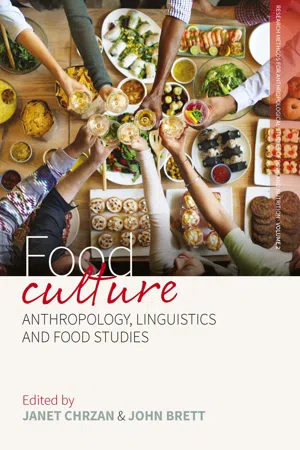
eBook - PDF
Food Culture
Anthropology, Linguistics and Food Studies
- 282 pages
- English
- PDF
- Available on iOS & Android
eBook - PDF
Food Culture
Anthropology, Linguistics and Food Studies
About this book
Information


CHAPTER
1
The
Anthropology
of
Food
and
Food
Anthropology
A
Sociocultural
Perspective
Geraldine
Moreno-Black
Method
is
about
choice.
—H.
Russell
Bernard,
Handbook
of
Methods
in
Cultural
Anthropology
Another
nice
thing
about
methods
is
that
disciplines
cannot
own
them.
—H.
Russell
Bernard,
Handbook
of
Methods
in
Cultural
Anthropology
Introduction
Food
as
a
topic
of
study
has
deep
roots
and
a
long
history
in
anthropology;
some
suggest
it
is
probably
as
old
as
the
discipline
itself
(Mintz
and
Dubois
2002;
Murcott
1998;
Ulijaszek
and
Strickland
1993).
Food
represents
an
integral
part
of
human
culture,
livelihood,
and
biology,
so
the
study
of
food
has
relevance
for
all
subfields
of
anthropology—sociocultural
anthropology,
biological
anthropology,
archaeol-
ogy,
and
linguistics.
During
past
decades,
the
development
of
food-
and
nutrition-
focused
scholarship
in
anthropology
has
raised
fundamental
challenges
to
the
way
many
anthropologists
formulate
hypotheses,
collect
and
analyze
data,
and
develop
theories.
In
this
chapter,
I
present
an
overview
of
sociocultural
anthro-
pology
methods
as
a
way
to
introduce
more
specific
sections
on
what
methods
cultural
anthropologists
employ
to
understand
food
use
and
how
they
“work”
within
a
food
and
nutrition
framework.
Table of contents
- FOOD CULTURE
- Contents
- Introduction to the Three-Volume Set
- Introduction to Food Culture: Anthropology, Linguistics, and Food Studies
- Research Ethics in Food Studies
- SECTION IV. Socio-Cultural Approaches
- CHAPTER 1. The Anthropology of Food and Food Anthropology
- CHAPTER 2. Interviewing Epistemologies
- CHAPTER 3. Studying Body Image and Food Consumption Practices
- CHAPTER 4. Visual Anthropology Methods
- CHAPTER 5. On the Lookout
- CHAPTER 6. Participant-Observation and Interviewing Techniques
- Chapter 7. Focus Groups in Qualitative or Mixed-Methods Research
- CHAPTER 8. Studying Food and Culture
- SECTION V. Linguistics and Food Talk
- CHAPTER 9. Introduction to Linguistic Anthropology Food Research Methods
- CHAPTER 10. Food Talk
- CHAPTER 11. An Introduction to Cultural Domain Analysis in Food Research
- CHAPTER 12. Food and Text(ual) Analysis
- CHAPTER 13. Analysis of Historic Primary Sources
- SECTION VI. Food Studies
- CHAPTER 14. Introduction to Food Studies Methods
- CHAPTER 15. Meaning-Centered Research in Food Studies
- CHAPTER 16. Food and Place
- CHAPTER 17. Sensory Ethnography
- CHAPTER 18. Methods for Examining Food Value Chains in Conventional and Alternative Trade
- CHAPTER 19. The Single Food Approach
- Index
Trusted by 375,005 students
Access to over 1.5 million titles for a fair monthly price.
Study more efficiently using our study tools.
Frequently asked questions
Yes, you can cancel anytime from the Subscription tab in your account settings on the Perlego website. Your subscription will stay active until the end of your current billing period. Learn how to cancel your subscription
No, books cannot be downloaded as external files, such as PDFs, for use outside of Perlego. However, you can download books within the Perlego app for offline reading on mobile or tablet. Learn how to download books offline
We are an online textbook subscription service, where you can get access to an entire online library for less than the price of a single book per month. With over 1.5 million books across 990+ topics, we’ve got you covered! Learn about our mission
Look out for the read-aloud symbol on your next book to see if you can listen to it. The read-aloud tool reads text aloud for you, highlighting the text as it is being read. You can pause it, speed it up and slow it down. Learn more about Read Aloud
Yes! You can use the Perlego app on both iOS and Android devices to read anytime, anywhere — even offline. Perfect for commutes or when you’re on the go.
Please note we cannot support devices running on iOS 13 and Android 7 or earlier. Learn more about using the app
Please note we cannot support devices running on iOS 13 and Android 7 or earlier. Learn more about using the app
Yes, you can access Food Culture by Janet Chrzan,John Brett, Janet Chrzan, John Brett in PDF and/or ePUB format, as well as other popular books in Social Sciences & Agricultural Public Policy. We have over 1.5 million books available in our catalogue for you to explore.