- 92 pages
- English
- ePUB (mobile friendly)
- Available on iOS & Android
eBook - ePub
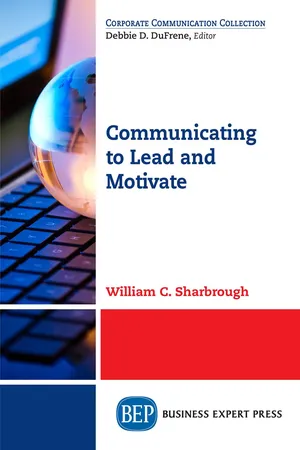
Communicating to Lead and Motivate
About this book
Effective leaders lead by communicating. It is through communication that leadership is enacted as leaders influence followers to behave in ways that achieve the leader's and the organization's goals. This book applies leadership theory and research to communication in ways that are easily understood and can be applied to any situation where individuals find themselves in a leadership position in an organization whether as a front-line or top-level leader. The book begins with a basic explanation of the leadership process and how leaders express their vision. It then looks at how leaders can create positive relationships with followers that pay off in effective performance. Next, the book investigates how leaders motivate their followers by creating follower self-efficacy, trust, and valued rewards. Then, the focus changes to the specific types of messages a leader can use to motivate followers. Leading is about change, so the book next looks at ways effective leaders communicate in leading change in organizations and at how the changing workforce is effecting how effective leaders communicate with the new workforce.
Information
CHAPTER 1
Leaders Communicate a Vision
Effective leaders lead by communicating. As noted by Conger more than 20 years ago, “The era of managing [leading] by dictate is ending and is being replaced by an era of managing [leading] by inspiration.” He further states that the most important skill needed by leaders is the ability to create messages that are “motivational.”1 In 2003, a researcher said, “Of all leadership behaviors, the ability to communicate may be the most important. Communication lays the foundation for leading others.”2
In the decade since, communication has become even more critical to effective leadership. Changing expectations, increased levels of employee empowerment, and the expanding use of teams have all contributed to changes in the ways that effective leaders lead. As leaders influence followers to behave in ways that achieve the organization’s and leader’s goals, leadership occurs. This book applies both communication theory and research and leadership theory and research to leaders and the process of leadership in ways that are easily understood and applied to any situation or organizational level where you may find yourself.
Research consistently shows that when leaders communicate effectively with their followers, performance and job satisfaction increase. Other positive outcomes are decreased absenteeism and turnover. In today’s hectic and rapidly evolving environment, effective leader communication also leads to increased follower self-efficacy, organizational commitment, and innovation.3 All of these positive outcomes occur with few, if any, negative side effects and are critical to organizational effectiveness.
Leadership Is…
Leadership, as noted by James MacGregor Burns, “is one of the most observed and least understood phenomena on earth.”4 The various definitions of leadership and related research can be categorized according to four themes: leader traits, leader influence (use of power), leader behaviors, and leader–follower interactions. Typical definitions of leadership may be summarized as “getting people to do something they wouldn’t do by themselves.” While physical traits such as fitness, attractiveness, etc., seem to have little impact on leader effectiveness, psychological traits such as extroversion, willingness to communicate, emotional intelligence, etc., have been associated with effective leadership.5
Leader behaviors focus on either an emphasis on the followers’ needs or accomplishing the task. The role of power and influence are the subject of much research, while the nature of the leader–follower interactions is a relatively new branch of research in leadership. Communication is implicit in most of the research and definitions of leadership. However, it is only in the past 25 years or so that scholars have begun to investigate the specific role of communication in leadership.
This book focuses on how leaders use communication in their efforts to influence followers. Leaders not only have to give directions but also have to explain and convince followers of the reason for those directions. While leaders may communicate with their followers through written messages (paper, e-mails, texts, etc.), the majority and preferred method of leader communication is oral (face-to-face, telephone, videoconferencing, etc.). The emphasis of the book is on oral communication unless otherwise noted. However, all guidance provided applies equally to written as well as spoken messages by leaders.
As noted, leadership is one of the most studied concepts in the literature of organizations, though there is little agreement on its definition or what constitutes effectiveness. Bennis and Nanus stated in 1985 that “decades of academic analysis have given us more than 340 definitions of leadership.6
However, there are some common themes among the many definitions: (1) leader traits, (2) the exercise of influence or power, (3) leader behaviors/the importance of followers, and (4) leader–follower collaboration. All four themes implicitly involve communication. This leads to a communication-based definition of leadership as
As the authors note, “Leadership shares all the features of human communication. . . . First, leaders use symbols to create reality . . . through language, stories, and rituals. . . . Second, leaders communicate about the past, present, and future, to create a desirable vision. . . . Third, leaders make conscious use of symbols to reach their goals.”7 Further, effective leaders are good listeners who apply listening skills in their relationships with their followers.
Thus, leaders lead by communicating with followers and creating messages directed at those followers which influence their behavior in the leader’s desired direction. Leaders must communicate the mission of the organization to followers, framing it in terms that followers can easily understand. Then, they must communicate the vision or end state that the followers have to work toward to achieve both the leader’s and organization’s goals.
In fact, the higher the level of responsibility, the more the leader’s time and effort is spent in communicating and the higher is the demand for communication competence. Leaders who are perceived as competent communicators by their followers share and respond to information in a timely manner, actively listen to others’ points of view, communicate clearly and succinctly to all levels of the organization, and use differing communication channels.8 Leader communication competence can include clarity of expression, situation-appropriate language usage, and job-specific communication skills (skills related to customer service, sales, human resources, etc.). Research has indicated that communication competence is a good predictor of overall leader performance.9
While early research on physical leader traits has had little support, more recent approaches have focused on behavioral traits. Traits such as extroversion, willingness to communicate, impression management, emotional intelligence, are associated with effective leadership and reflect aspects of communication.
The Role of Vision
Much of the current focus of leadership theory and practice focuses on “vision.” Leaders must have a vision of the state or place they want their followers to move to or attain. Whether this vision is as complex as one of societal change or as simple as increasing productivity by two percent, effective leaders must be able to communicate this vision to their followers in a clear and convincing way that followers can both understand and work to achieve. While “vision” implies looking into the distant future at the top of organizations, vision can be as simple as knowing and expressing what needs to be done to accomplish small tasks on the front lines of the organization. A Harvard Business Review article noted that effective vision routinely has an “almost mundane quality” based on current ideas.10 Regardless of its complexity, the leader must express that vision to followers in a clear and compelling way. Leaders must also choose symbolic words and language that give emotional power to their message, creating a clear sense of direction for the organization and its members.
To frame the vision or leadership message effectively, leaders should organize their thoughts and choose words that clearly and vividly lay out what is to be accomplished, creating a “map for action”11 and generating “energized behavior”12 in the followers. The leader may also tell stories about the organization, its founders, and its past, or other organizations and people to lay out the vision and make it concrete for followers. These stories and rituals may also describe the values and traditions of the organization and its culture, which form the basis for the organization’s mission and the leader’s vision.
These stories, and the organizational rituals that sometimes accompany them, also help the leader create the emotional power needed to motivate followers. One example would be the ritualistic way that Steve Jobs and Apple introduced new products. Even after his death, Apple follows the same format/ritual to introduce their new products, continuing the tone and culture of leadership at Apple Corporation.
Effective leaders choose metaphors and analogies to give their messages emotional strength. Clearly, many business leaders see their task as a battle, a war to be won, “a hill to be taken,” etc. and encourage the widespread use of military-related language in business. Likewise, others see their organizations as competitors and use sports analogies such as “in overtime,” “major league,” etc. to accomplish the same purpose. In today’s rapidly changing, highly technological business environment, we are hearing more stories, analogies, and metaphors from the world of computers and cyberspace (“multitasking,” “in the cloud,” etc.). Such language choice can help leaders define the vision and culture for their organizations.
Other traditional speech techniques may also be used to help build the emotional power that leaders need.13 Repetition, rhythm, and alliteration (all in the toolboxes of religious and political leaders) can also aid a leader in building followers’ emotional commitment to the vision. While beyond the scope of this book, you may want to investigate and practice using these techniques as well.
To sum up, leaders influence others to follow by communicating clear directions toward a compelling vision of a more positive situation or objective. The effective communication of this vision or message motivates followers so they exert energy toward achieving this objective. A leader who cannot successfully communicate, may have a vision, but that vision is just a hallucination. Followers will not follow and the leader cannot lead.
A Preview
After a brief introduction to the concept of leadership as communication and the role of vision in this chapter, the following chapters focus on followers, for leading requires followers. Chapter 2 looks at the relationships between leaders and followers and at how leaders can create positive relationships that pay off in effective performance.
Chapter 3 continues to explore these relationships through effective listening. Listening to followers helps leaders make better decisions and develop more positive relationships.
Chapter 4 explores what leader actions and behaviors motivate followers. Creating follower self-efficacy and trust and offering valued rewards are keys to successful leadership. This chapter gives specific advice to leaders concerning how to create positive expectations.
Leaders use a variety of messages to motivate followers to perform effectively, as examined in Chapter 5. Message types include giving directions, creating meaning, and expressing empathy. The chapter introduces the concept of motivating language (ML) and presents a brief review of the research that indicates the positive impact of using ML on a variety of performance-related variables. The bulk of the chapter explains the kinds of messages that leaders use to motivate followers.
While not all leaders have to lead changes in their organizations, when they do, the changes may be the most difficult task they face. On a smaller scale, all leadership is about change. Chapter 6 looks at ways effective leaders communicate in leading change in their organizations. Specifically, the chapter discusses the reasons that followers may resist changes and the steps required to lead a successful change.
Chapter 7 focuses on concepts and strategies related to leading a group of culturally diverse followers. It begins by discussing today’s diverse workforce and how it has changed over the past several years. It then looks at different aspects of diversity and how they may impact a leader’s communication efforts. The chapter concludes with techniques for capitalizing on the diversity of your work group to be a more effective leader.
The final chapter reviews the different ways that leaders communicate and gives guidance for practicing effective leader communication. Several appendices provide resource materials and activities that leaders can use to strengthen communication with their followers.
CHAPTER 2
Leadership Is About Relationships
Being a leader implies that there is at least one person who acts as a follower and there may be many. A leader’s followers could range from one or two individuals who report directly to the leader to all the members of a Fortune 500–sized organization below the CEO level. However, leadership is very personal, and a good way to view being a leader is at the one-on-one or leader–follower level, and the relationship between the leader and follower. Pete Anderson, director of Operations, Advanced Airplane Programs at Gulfstream Inc., in a recent talk to a group of college seniors, began by saying that “leadership is about relationships.” Two of the most important factors in leader–follower relationships are trust and consideration.

Earning Trust
Leaders must be able to trust their followers, just as followers must be able to trust their leaders. However, trust must be developed or earned as relationships grow between a leader and a follower. A leader’s clear, open, and fair communication with followers is a good starting place for developing trust.
Clear. While clear communication may seem as simple as “saying what you mean/meaning what you say,” it also involves choosing the right words and messages to ensure that followers understand what the leader wants them to do. By learning about the background and experience of each follower, the leader can make more effective choices in framing messages that are clear and understandable to the follower.
An effective leader will use a different level of specificity in giving directions to a new, fresh-out-of-college employee than when giving directions ...
Table of contents
- Cover
- Half-title Page
- Title Page
- Copyright
- Abstract
- Contents
- Acknowledgments
- Chapter 1 Leaders Communicate a Vision
- Chapter 2 Leadership Is About Relationships
- Chapter 3 Leaders Listen
- Chapter 4 Leaders Build Positive Expectations
- Chapter 5 Communicating to Motivate
- Chapter 6 Leading and Communicating Change
- Chapter 7 Leading Culturally Diverse Groups
- Chapter 8 Leading Is Communicating: Putting It All Together
- Appendix 1: Motivating Language Questionnaire for Leaders (MLQL)
- Appendix 2: Motivating Language Questionnaire (MLQ)
- Appendix 3: Motivating Language Exercises
- Notes
- Bibliography
- Index
- Backcover
Trusted by 375,005 students
Access to over 1.5 million titles for a fair monthly price.
Study more efficiently using our study tools.
Frequently asked questions
Yes, you can cancel anytime from the Subscription tab in your account settings on the Perlego website. Your subscription will stay active until the end of your current billing period. Learn how to cancel your subscription
No, books cannot be downloaded as external files, such as PDFs, for use outside of Perlego. However, you can download books within the Perlego app for offline reading on mobile or tablet. Learn how to download books offline
Perlego offers two plans: Essential and Complete
- Essential is ideal for learners and professionals who enjoy exploring a wide range of subjects. Access the Essential Library with 800,000+ trusted titles and best-sellers across business, personal growth, and the humanities. Includes unlimited reading time and Standard Read Aloud voice.
- Complete: Perfect for advanced learners and researchers needing full, unrestricted access. Unlock 1.5M+ books across hundreds of subjects, including academic and specialized titles. The Complete Plan also includes advanced features like Premium Read Aloud and Research Assistant.
We are an online textbook subscription service, where you can get access to an entire online library for less than the price of a single book per month. With over 1.5 million books across 990+ topics, we’ve got you covered! Learn about our mission
Look out for the read-aloud symbol on your next book to see if you can listen to it. The read-aloud tool reads text aloud for you, highlighting the text as it is being read. You can pause it, speed it up and slow it down. Learn more about Read Aloud
Yes! You can use the Perlego app on both iOS and Android devices to read anytime, anywhere — even offline. Perfect for commutes or when you’re on the go.
Please note we cannot support devices running on iOS 13 and Android 7 or earlier. Learn more about using the app
Please note we cannot support devices running on iOS 13 and Android 7 or earlier. Learn more about using the app
Yes, you can access Communicating to Lead and Motivate by William C. Sharbrough in PDF and/or ePUB format, as well as other popular books in Business & Leadership. We have over 1.5 million books available in our catalogue for you to explore.