Structured to meet employers' needs for low-wage farm workers, the well-known Bracero Program recruited thousands of Mexicans to perform physical labor in the United States between 1942 and 1964 in exchange for remittances sent back to Mexico. As partners and family members were dispersed across national borders, interpersonal relationships were transformed. The prolonged absences of Mexican workers, mostly men, forced women and children at home to inhabit new roles, create new identities, and cope with long-distance communication from fathers, brothers, and sons.
Drawing on an extraordinary range of sources, Ana Elizabeth Rosas uncovers a previously hidden history of transnational family life. Intimate and personal experiences are revealed to show how Mexican immigrants and their families were not passive victims but instead found ways to embrace the spirit (abrazando el espíritu) of making and implementing difficult decisions concerning their family situations—creating new forms of affection, gender roles, and economic survival strategies with long-term consequences.
eBook - PDF
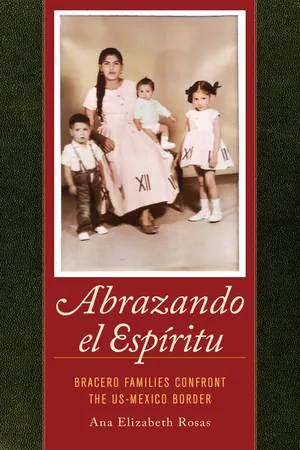
Abrazando el Espiritu
Bracero Families Confront the US-Mexico Border
- 276 pages
- English
- PDF
- Available on iOS & Android
eBook - PDF
About this book
Information
Publisher
University of California PressYear
2014Print ISBN
9780520282674
Edition
1eBook ISBN
9780520958654
Table of contents
- Cover
- Contents
- List of Illustrations
- Acknowledgments
- Introduction
- PART ONE: EMERGENCIES
- PART TWO: LOVE AND LONGING
- PART THREE: DECISIVE MEASURES
- Epilogue: The Generative Potential of Thinking and Acting Historically
- Notes
- Bibliography
- Index
Trusted by 375,005 students
Access to over 1.5 million titles for a fair monthly price.
Study more efficiently using our study tools.
Frequently asked questions
Yes, you can cancel anytime from the Subscription tab in your account settings on the Perlego website. Your subscription will stay active until the end of your current billing period. Learn how to cancel your subscription
No, books cannot be downloaded as external files, such as PDFs, for use outside of Perlego. However, you can download books within the Perlego app for offline reading on mobile or tablet. Learn how to download books offline
Perlego offers two plans: Essential and Complete
- Essential is ideal for learners and professionals who enjoy exploring a wide range of subjects. Access the Essential Library with 800,000+ trusted titles and best-sellers across business, personal growth, and the humanities. Includes unlimited reading time and Standard Read Aloud voice.
- Complete: Perfect for advanced learners and researchers needing full, unrestricted access. Unlock 1.5M+ books across hundreds of subjects, including academic and specialized titles. The Complete Plan also includes advanced features like Premium Read Aloud and Research Assistant.
We are an online textbook subscription service, where you can get access to an entire online library for less than the price of a single book per month. With over 1.5 million books across 990+ topics, we’ve got you covered! Learn about our mission
Look out for the read-aloud symbol on your next book to see if you can listen to it. The read-aloud tool reads text aloud for you, highlighting the text as it is being read. You can pause it, speed it up and slow it down. Learn more about Read Aloud
Yes! You can use the Perlego app on both iOS and Android devices to read anytime, anywhere — even offline. Perfect for commutes or when you’re on the go.
Please note we cannot support devices running on iOS 13 and Android 7 or earlier. Learn more about using the app
Please note we cannot support devices running on iOS 13 and Android 7 or earlier. Learn more about using the app
Yes, you can access Abrazando el Espiritu by Dr. Ana Elizabeth Rosas in PDF and/or ePUB format, as well as other popular books in History & Mexican History. We have over 1.5 million books available in our catalogue for you to explore.