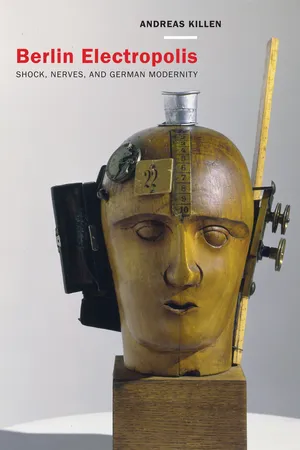
Berlin Electropolis ties the German discourse on nervousness in the late nineteenth and early twentieth centuries to Berlin's transformation into a capital of the second industrial revolution. Focusing on three key groups—railway personnel, soldiers, and telephone operators—Andreas Killen traces the emergence in the 1880s and then later decline of the belief that modernity caused nervous illness. During this period, Killen explains, Berlin became arguably the most advanced metropolis in Europe. A host of changes, many associated with breakthroughs in technologies of transportation, communication, and leisure, combined to radically alter the shape and tempo of everyday life in Berlin. The resulting consciousness of accelerated social change and the shocks and afflictions that accompanied it found their consummate expression in the discourse about nervousness.
Wonderfully researched and clearly written, this book offers a wealth of new insights into the nature of the modern metropolis, the psychological aftermath of World War I, and the operations of the German welfare state. Killen also explores cultural attitudes toward electricity, the evolution of psychiatric thought and practice, and the status of women workers in Germany's rapidly industrializing economy. Ultimately, he argues that the backlash against the welfare state that occurred during the late Weimar Republic brought about the final decoupling of modernity and nervous illness.
- 307 pages
- English
- PDF
- Available on iOS & Android
eBook - PDF
About this book
Information
Publisher
University of California PressYear
2006Print ISBN
9780520243620
Edition
1eBook ISBN
9780520931633
Table of contents
- Contents
- Acknowledgments
- Introduction
- 1. Berlin Electropolis
- 2. Electrotherapy and the Nervous Self in Nineteenth-Century Germany
- 3. Railway Accidents, Social Insurance, and the Pathogenesis of Mass Nervousness, 1889–1914
- 4. Electrotherapy and the Nervous Self during Wartime
- 5. Psychiatrists, Telephone Operators, and Traumatic Neurosis, 1900–1926
- Conclusion
- Notes
- Selected Bibliography
- Index
Trusted by 375,005 students
Access to over 1.5 million titles for a fair monthly price.
Study more efficiently using our study tools.
Frequently asked questions
Yes, you can cancel anytime from the Subscription tab in your account settings on the Perlego website. Your subscription will stay active until the end of your current billing period. Learn how to cancel your subscription
No, books cannot be downloaded as external files, such as PDFs, for use outside of Perlego. However, you can download books within the Perlego app for offline reading on mobile or tablet. Learn how to download books offline
Perlego offers two plans: Essential and Complete
- Essential is ideal for learners and professionals who enjoy exploring a wide range of subjects. Access the Essential Library with 800,000+ trusted titles and best-sellers across business, personal growth, and the humanities. Includes unlimited reading time and Standard Read Aloud voice.
- Complete: Perfect for advanced learners and researchers needing full, unrestricted access. Unlock 1.5M+ books across hundreds of subjects, including academic and specialized titles. The Complete Plan also includes advanced features like Premium Read Aloud and Research Assistant.
We are an online textbook subscription service, where you can get access to an entire online library for less than the price of a single book per month. With over 1.5 million books across 990+ topics, we’ve got you covered! Learn about our mission
Look out for the read-aloud symbol on your next book to see if you can listen to it. The read-aloud tool reads text aloud for you, highlighting the text as it is being read. You can pause it, speed it up and slow it down. Learn more about Read Aloud
Yes! You can use the Perlego app on both iOS and Android devices to read anytime, anywhere — even offline. Perfect for commutes or when you’re on the go.
Please note we cannot support devices running on iOS 13 and Android 7 or earlier. Learn more about using the app
Please note we cannot support devices running on iOS 13 and Android 7 or earlier. Learn more about using the app
Yes, you can access Berlin Electropolis by Andreas Killen in PDF and/or ePUB format, as well as other popular books in History & European History. We have over 1.5 million books available in our catalogue for you to explore.