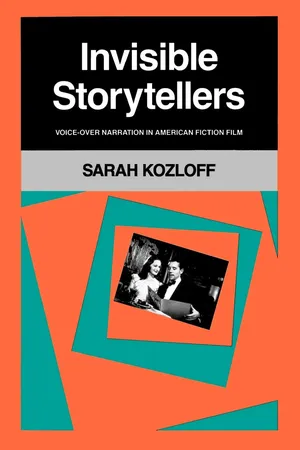
"Let me tell you a story," each film seems to offer silently as its opening frames hit the screen. But sometimes the film finds a voice—an off-screen narrator—for all or part of the story. From Wuthering Heights and Double Indemnity to Annie Hall and Platoon, voice-over narration has been an integral part of American movies.
Through examples from films such as How Green Was My Valley, All About Eve, The Naked City, and Barry Lyndon, Sarah Kozloff examines and analyzes voice-over narration. She refutes the assumptions that words should only play a minimal role in film, that "showing" is superior to "telling," or that the technique is inescapably authoritarian (the "voice of god"). She questions the common conception that voice-over is a literary technique by tracing its origins in the silent era and by highlighting the influence of radio, documentaries, and television. She explores how first-person or third-person narration really affects a film, in terms of genre conventions, viewer identification, time and nostalgia, subjectivity, and reliability. In conclusion she argues that voice-over increases film's potential for intimacy and sophisticated irony.
- 178 pages
- English
- PDF
- Available on iOS & Android
eBook - PDF
About this book
Information
The
Prejudices
against
Voice-Over
Narration
21
How
Green
Was
My
Valley.
Huw
[voice-over):
After
dinner
when
dishes
had
been
washed,
the
box
was
brought
to
the
table
for
the
spending
money
to
be
handed
out.
money.
This
overlapping
relates
to
the
cherishing
of
these
moments
by
the
older,
nostalgic
narrator—we
linger
over
these
moments
contentedly,
sharing
the
double
perspective
of
the
reflecting
narrating-I
and
the
participating
child.
This
lingering
forces
the
spectator
to
view
such
simple
familial
details
as
em-
blematic
of
all
that
is
lost;
as
Guido
Fink
remarks,
"Things
must
be
twice-told
in
order
to
be
safely
redeemed
from
time
and
decay."
28
Far
from
being
an
egregious
fault,
this
overlap
is
a
modest
plum.
"The
Last
Resort
of
the
Incompetent"
Is
it
[voice-over
narration]
a
meaningful
conven-
tion
.
.
.
Or
is
it
an
emergency
cord
the
filmmaker
pulls
when
he
or
she
cannot
think
of
another
way
to
begin
a
movie
or
deliver
some
important
piece
of
information?
Bernard
Dick,
Anatomy
of
Film
According
to
another
common
view,
since
real
filmmakers
know
that
film
is
essentially
a
visual
medium,
it
is
the
unimaginative
and
incompetent
who
Table of contents
- Cover
- Contents
- Acknowledgments
- Introduction
- 1 The Prejudices against Voice-Over Narration
- 2 Ancestors, Influences, and Development
- 3 First-Person Narrators
- 4 Third-Person Narrators
- 5 Irony in Voice-Over Films
- Conclusion
- Notes
- Filmography
- Bibliography of Works Cited
- Index
Trusted by 375,005 students
Access to over 1.5 million titles for a fair monthly price.
Study more efficiently using our study tools.
Frequently asked questions
Yes, you can cancel anytime from the Subscription tab in your account settings on the Perlego website. Your subscription will stay active until the end of your current billing period. Learn how to cancel your subscription
No, books cannot be downloaded as external files, such as PDFs, for use outside of Perlego. However, you can download books within the Perlego app for offline reading on mobile or tablet. Learn how to download books offline
Perlego offers two plans: Essential and Complete
- Essential is ideal for learners and professionals who enjoy exploring a wide range of subjects. Access the Essential Library with 800,000+ trusted titles and best-sellers across business, personal growth, and the humanities. Includes unlimited reading time and Standard Read Aloud voice.
- Complete: Perfect for advanced learners and researchers needing full, unrestricted access. Unlock 1.5M+ books across hundreds of subjects, including academic and specialized titles. The Complete Plan also includes advanced features like Premium Read Aloud and Research Assistant.
We are an online textbook subscription service, where you can get access to an entire online library for less than the price of a single book per month. With over 1.5 million books across 990+ topics, we’ve got you covered! Learn about our mission
Look out for the read-aloud symbol on your next book to see if you can listen to it. The read-aloud tool reads text aloud for you, highlighting the text as it is being read. You can pause it, speed it up and slow it down. Learn more about Read Aloud
Yes! You can use the Perlego app on both iOS and Android devices to read anytime, anywhere — even offline. Perfect for commutes or when you’re on the go.
Please note we cannot support devices running on iOS 13 and Android 7 or earlier. Learn more about using the app
Please note we cannot support devices running on iOS 13 and Android 7 or earlier. Learn more about using the app
Yes, you can access Invisible Storytellers by Sarah Kozloff in PDF and/or ePUB format, as well as other popular books in Media & Performing Arts & Film & Video. We have over 1.5 million books available in our catalogue for you to explore.